
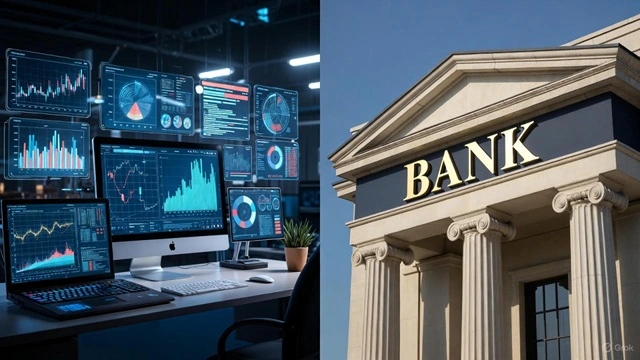
Digital Banks vs Traditional Banks: Who Wins in 2026?
1. Introduction: The Evolving Landscape of Banking
If you’re anything like me, you’ve probably noticed a massive shift in how we handle our money. Gone are the days when a trip to a physical bank branch was a weekly ritual. Today, it feels like our entire finance world fits neatly into our pockets, right on our smartphones.
1.1. The Digital Revolution in Finance
This isn’t just a hunch; the numbers back it up. We’re in the midst of a rapid digital revolution, and consumers are increasingly opting for digital banking channels. In fact, a statistic from Suisse Bank tells us that a staggering 77% of Americans prefer using mobile apps and computers for their banking needs over traditional branch visits. It makes you wonder, doesn’t it? Will digital banks truly overtake traditional institutions by 2026?
1.2. Defining the Contenders
Before we dive deeper, let’s quickly define our players in this exciting financial showdown. On one side, we have **Traditional Banks**, which we all recognize by their physical branches, often relying on legacy systems, and boasting a long, established history. On the other, we have **Digital Banks** (often called Neobanks or Challenger Banks). These are the agile newcomers, built primarily online or as mobile-first entities, leveraging modern, cloud-based architectures to offer a new way to manage your money.
2. The Digital Imperative: Why Customers Are Choosing Digital
So, how did we get here? What’s driving this mass migration to digital platforms? It boils down to a few compelling factors that truly highlight the advantages of online banking.
2.1. Unparalleled Convenience and Accessibility
For me, the biggest draw is the sheer convenience. Digital banks offer 24/7 access to services from literally anywhere. Whether I’m checking my savings account balance on a Sunday morning or transferring funds late at night, the seamless mobile and online experiences make it effortless. Plus, we’re talking faster transaction processing and instant alerts – no more waiting days for a payment to clear or wondering if a deposit went through.
2.2. Cost-Efficiency and Competitive Offerings
Another huge factor is cost-efficiency. Digital-first banks often have lower fees and can offer higher interest rates on deposits because they don’t have the massive overhead of maintaining physical branches. This allows them to pass those savings on to us, the customers. They also have the agility to offer specialized products tailored specifically to digital-native customers, which can be a real game-changer when you’re looking for tailored financial planning or specific investment options.
2.3. Agility and Innovation
Let’s face it, traditional banks can sometimes feel a bit… slow. Digital-only banks, on the other hand, are built on modern infrastructure. As Forrester points out, they are less restricted by legacy systems, which means faster product development and deployment cycles. This agility allows them to innovate quickly, rolling out new features and services at a pace traditional banks often struggle to match.
3. The Technological Battleground: Key Innovations Shaping 2026
The future of banking isn’t just about convenience; it’s a technological arms race. By 2026, we’re going to see some incredible innovations become mainstream.
3.1. Artificial Intelligence (AI) and Machine Learning
3.1.1. Agentic AI for Automation and Efficiency
Forget basic chatbots. We’re transitioning to autonomous AI agents that can actually *do* things. Companies like Grasshopper Bank and insights from The Financial Brand highlight how Agentic AI will handle automated reconciliation, real-time fraud detection, and even loan pre-underwriting. Imagine JPMorgan Chase’s internal LLM Suite already assisting tens of thousands of employees with coding, content, and knowledge queries – that’s just a glimpse of what’s to come.
3.1.2. Hyper-Personalization and Proactive Service
AI isn’t just for the back office. It’s revolutionizing customer experience through hyper-personalization. We’ll see AI-driven insights offering tailored financial advice and product recommendations. For businesses, this means predictive cash flow intelligence and AI-powered CFO copilots, as highlighted by Grasshopper Bank, which will transform how companies manage their emergency fund and overall financial plan.
3.2. Real-Time Payments (RTP) Infrastructure
The mainstream adoption of Real-Time Payments (RTP) infrastructure will mean immediate settlement for most transactions, as both Grasshopper and The Financial Brand anticipate. This is critical for consumer expectations, B2B cash flow, and even instant payroll, enhancing overall financial freedom. U.S. Bank, for example, has expanded its embedded payments suite to enable real-time payments, setting a new standard.
3.3. Data Modernization and Analytics
Robust data modernization means consolidated data platforms for predictive modeling, fraud detection, and deeper customer insights (The Financial Brand). It’s about empowering employees and customers alike with data-driven tools to make smarter decisions, as Grasshopper notes, which helps you save better and manage your savings account more effectively.
3.4. Cloud Migration and Decoupled Architectures
Traditional banks are not sitting still. Many are shifting to cloud-native or hybrid-core systems to gain flexibility and agility, a trend highlighted by Forrester and The Financial Brand. This reduces maintenance burdens and accelerates new product delivery.
3.5. API-First Banking and Embedded Finance
Designing services as modular, programmatic endpoints for seamless integration – that’s the core of API-first banking (The Financial Brand). This paves the way for embedded finance, where banking services are integrated directly into third-party platforms, as we see with Citi’s API-first strategy via its Developer Hub for corporate clients and fintechs.
3.6. Cybersecurity and Digital Identity
In this increasingly digital world, cybersecurity is non-negotiable for all institutions (The Financial Brand). Advanced fraud detection, biometrics, and adaptive authentication will ensure secure access and protect our personal and financial data. These are crucial tips for anyone involved in digital banking.
4. Strategic Evolution: How Traditional Banks Are Adapting
Traditional banks aren’t just giving up; they’re fighting back with smart strategies and significant investments to compete in this dynamic Market.
4.1. Modernizing Legacy Systems and Digital Transformation
Many traditional banks are pouring resources into modernizing their legacy systems, undergoing massive digital transformations. They’re investing in robust RegTech, AI governance, and automated oversight, as Grasshopper highlights. By leveraging the efficiency gains from AI and automation, they aim to streamline operations and offer competitive services.
4.2. Embracing Fintech Partnerships
The smartest move for many traditional banks is to embrace partnerships. Banks can provide chartered licenses and regulatory oversight, while fintechs bring agile technology and innovative solutions (Grasshopper). We’re seeing a shift towards more direct partnerships for better compliance management, focusing innovation on embedded lending based on proprietary data rather than generic offerings. This is a crucial B2B strategy for growth.
4.3. The “Hybrid” Model Advantage
Perhaps the most promising strategy is the “hybrid” model. This approach combines the safety and trust of a regulated charter (what traditional banks excel at) with the connectivity and innovation of fintechs (Grasshopper). This allows them to build loyalty through integrated services that offer true utility, rather than just competing on interest rates alone.
5. Shifting Customer Expectations and New Product Paradigms
Our expectations as customers are constantly evolving, pushing banks to innovate new products and services.
5.1. Demand for Seamless Operational Integration
Today’s customers, especially businesses, expect banking features to be embedded directly into their core business software, like QuickBooks, Stripe, or ERPs (Grasshopper). This eliminates manual reconciliation and provides a single, real-time view of financial health, a game-changer for effective retirement plan calculator integration.
5.2. Focus on Efficiency and Automated Yield
The expectation is now “Treasury-as-a-Service,” with automatic sweeps to high-yielding accounts without manual intervention (Grasshopper). Natural language interfaces for querying financial data will also become the norm, making personal financial guide access as easy as asking a question.
5.3. Speed, Flexibility, and Global Capabilities
Instant onboarding, immediate access to funds, and fast capital access are no longer luxuries but expectations (Grasshopper). For global operations, support for local currency payments to avoid hefty FX fees will be critical for businesses looking to expand their ecommerce strategy.
5.4. Emergence of Micro-Lending and Flexible Capital
We’re also seeing a shift towards smaller, purpose-driven financing ($10K–$50K) for specific needs (Grasshopper). This micro-lending relies on real-time operational data for faster lending decisions, making it easier to sell my business or manage daily cash flow.
6. Macroeconomic Influences and the Competitive Landscape
Beyond technology and customer demand, broader economic forces will continue to shape the banking landscape in 2026.
6.1. Economic Uncertainty and Lending Shifts
Economic uncertainty will likely drive a demand for “efficiency capital” over “growth capital” (Grasshopper). Borrowers will prioritize conservative strategies and partners who truly understand unit economics. Finding the top advisors will be key for navigating this.
6.2. Evolving Deposit Competition
As interest rates stabilize, deposit competition will shift from simply offering the highest rates to providing utility (Grasshopper). The “hybrid” model, connecting directly to a client’s software, will win deposits by becoming indispensable to daily operations.
6.3. Digital Banks Impacting PE/VC Banking
Digital banks are disrupting the slow processes of traditional Private Equity (PE) and Venture Capital (VC) banking by using data for faster fund underwriting and capital call lines (Grasshopper). They’re now directly competing for General Partner (GP) relationships with automated lines of credit and high-yield accounts, providing a new avenue for investing in this space.
7. Conclusion: Who Wins in 2026?
7.1. The Adaptive Hybrid Emerges Victorious
So, who ultimately wins in 2026? My take is that neither traditional nor purely digital banks will “win” outright. Instead, success will hinge on adaptation, deep integration, and a relentlessly customer-centric approach. The true winners will be those who can activate their data effectively, embed intelligence into every interaction, and treat compliance, security, and trust not as burdens, but as core product features, as Grasshopper aptly puts it.
7.2. Key Differentiators for Future Success
To really thrive, banks will need to master Agentic AI and data activation. Seamless integration and strong fintech partnerships will be critical. And, of course, an unwavering focus on compliance, security, and trust will always be foundational. Ultimately, delivering real utility and proactive, personalized experiences will be what truly differentiates the banking leaders of tomorrow. If you’re looking for the best emergency account or simply trying to navigate your personal finance, these are the hallmarks of a truly great banking partner.
Disclosure
This blog post is intended for informational purposes only and does not constitute financial advice. The content provided is based on current trends, expert opinions, and referenced sources, but financial markets and regulations are subject to change. Readers should consult with a certified financial planner or other qualified professionals before making any financial decisions. We do not endorse any specific financial product or service mentioned herein as suitable for all individuals.
References
- Suisse Bank. (n.d.). Digital Banking Trends in 2026 and the Future of Financial Services. Medium. Retrieved from https://medium.com/@suisse.bank/digital-banking-trends-in-2026-and-the-future-of-financial-services-ea614e3d5139
- Forrester. (n.d.). Architecting Agility: De-Coupled Banking Systems Will Be the Key to Success in 2026. Retrieved from https://www.forrester.com/blogs/architecting-agility-de-coupled-banking-systems-will-be-the-key-to-success-in-2026/
- Grasshopper Bank. (2025, December 15). 2026 Banking Trends: How Data, Security, and Trust Will Define the Next Era. Retrieved from https://www.grasshopper.bank/who-we-are/blog/2026-banking-trends-how-data-security-and-trust-will-define-the-next-era/
- The Financial Brand. (2025, December 17). How to Filter Out the Hype for Your 2026 Bank Tech Planning. Retrieved from https://thefinancialbrand.com/news/banking-technology/bank-technology-ranking-194452
- YouTube. (n.d.). Traditional Bank vs. Digital Bank: Which is Better?. Retrieved from https://www.youtube.com/watch?v=4idhju6gxII
Image Credit
aceembelifhttps://cdn.pixabay.com/user/2020/12/04/12-05-57-349_250x250.jpg