
Marketing

Quirkyjournals.com — Marketing insights, brand growth essentials & simplified digital strategy. Not marketing advice.

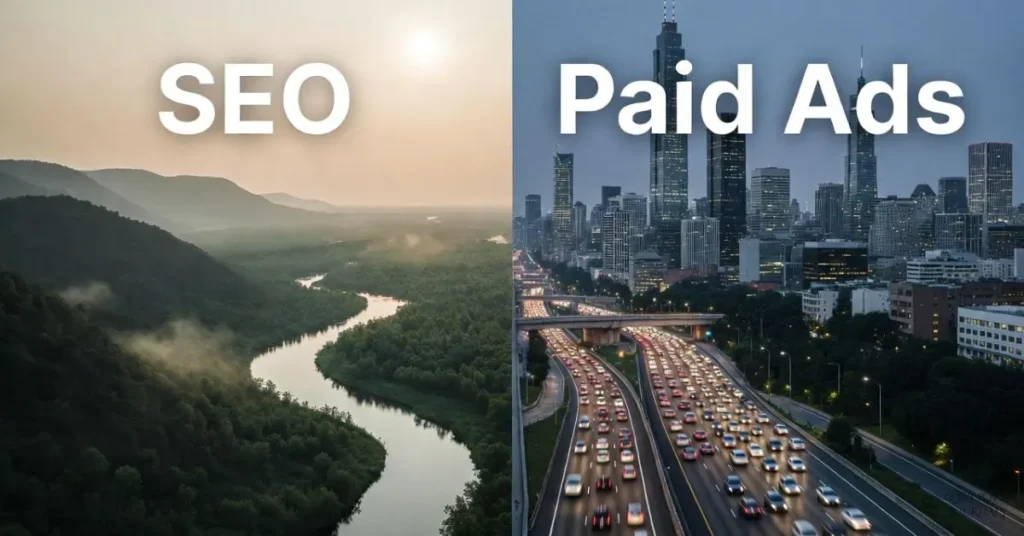
SEO vs Paid Ads: At What Scale Does SEO Actually Win?

At What Scale Does SEO Outperform Paid Ads?

Paid ads give instant traffic you rent per click; SEO builds owned rankings that compound free visits over time. This analysis reveals ROI crossover points where SEO becomes cheaper—typically after 6–18 months of consistent effort—plus scale thresholds, keyword competition factors and why top marketers run both until organic takes over.

At What Scale Does SEO Outperform Paid Ads? Read More »

Why High Traffic Didn't Convert A Funnel Autopsy

Funnel Autopsy: Diagnosing High Traffic and Near‑Zero Conversions

Seeing traffic climb while demo requests and sales stay flat isn’t a “more eyeballs” problem—it’s a funnel problem. High traffic with low conversions usually signals one of three deeper issues: you’re attracting the wrong visitors, your messaging and offers don’t match their intent, or you’re losing qualified prospects at key friction points like landing pages and forms. This guide walks through a full funnel autopsy: segmenting traffic by source and intent, mapping every step from first click to purchase, and using data at each stage to pinpoint leaks so you can fix structure instead of just throwing more budget at traffic.

Funnel Autopsy: Diagnosing High Traffic and Near‑Zero Conversions Read More »

Why Startups Fail After Product-Market Fit (Case Study & Framework)

Why Startups Fail After Product-Market Fit (Case Study & Framework)

Hitting product‑market fit doesn’t mean you’re safe—McKinsey data shows 78% of companies that get there still fail to scale. The real killer isn’t product quality but a broken revenue system: premature hiring before GTM fit, CAC higher than LTV, unit economics that never work at 100 customers (let alone 10,000), and burn rates that assume the next round will arrive on schedule. This case study breaks down eight post‑PMF failure patterns (Homejoy’s unit economics death spiral, Beepi’s $7M/month burn, Doppler Labs’ chasm‑crossing failure, Artifact’s loss of focus) and gives you a three‑phase checklist: rigorously validate real PMF, prove GTM fit and ICP with working CAC/LTV, then scale slowly with tight runway discipline and operational excellence.

Why Startups Fail After Product-Market Fit (Case Study & Framework) Read More »

A modern, editorial-style illustration of a smartphone showing a social media feed with a popular influencer post, while warning symbols, fake verification badges, and suspicious direct messages appear around the screen. In the foreground, a hand hesitates before clicking a “limited time investment” link, and subtle visual cues like a hacked account icon, a fake giveaway box, and a crypto wallet warning add tension. Bright social-media-inspired colors with sharp red caution accents, clean composition, 16:9 aspect ratio, suitable as a blog header for an article about influencer scams and online money protection.

9 Influencer Scams to Avoid: How to Protect Your Money Online

Influencer scams thrive on trust, urgency, and the illusion of insider access, which makes them dangerously effective across social media platforms. This guide breaks down 9 common influencer scams, shows you the red flags behind each one, and explains how to protect your money, your identity, and your online reputation before a bad deal turns into a costly mistake.

9 Influencer Scams to Avoid: How to Protect Your Money Online Read More »

A bold, modern marketing scene showing a Gen Z audience scrolling on smartphones while a series of stale, overly polished ads fade into the background. In the foreground, one ad “wins attention” with fast-cut visuals, bold typography, meme-style energy, and authentic creator-style presentation. Include social app UI elements, a short-form video frame, and a subtle analytics dashboard showing higher engagement. Bright, high-contrast colors with neon accents, 16:9 aspect ratio, suitable as a blog header for an article about Gen Z ads and modern marketing.

Attracting Gen Z Clicks: What Works in Advertising to Gen Z Clients

Most brands are still advertising to Gen Z like it is 2015, and that is why the ads are getting ignored. This guide breaks down what actually works with Gen Z today—short hooks, authentic creative, platform-native content, and trust-first messaging—so you can stop being skipped and start getting attention that converts.

Attracting Gen Z Clicks: What Works in Advertising to Gen Z Clients Read More »

A sleek, editorial‑style composition showing a Samsung Galaxy S25 Ultra and an iPhone side by side on a minimalist desk, both connected visually by glowing lines to surrounding devices: smartwatch, earbuds, tablet, laptop, and a smart TV in the background, symbolizing ecosystem lock‑in. Subtle icons for AI (neural network, spark lines) float between the devices to suggest intelligent features and cross‑device continuity. Clean, modern lighting with cool whites and soft gradients, slightly premium “Apple‑ad” aesthetic but with Samsung branding visible on the Galaxy device, 16:9 aspect ratio, suitable for a tech strategy article about Samsung’s Apple‑style pivot.

Can Samsung Win by Becoming More Like Apple?

For years, Samsung played the role of Android’s hardware maverick, racing ahead with curved screens, folding phones, and spec-heavy flagships. By 2026, that story has flipped: the Galaxy S25 line sold more by changing less, leaning on iterative refinements, Galaxy AI features, and a tightly woven device ecosystem instead of headline‑grabbing hardware upgrades. This article unpacks how Samsung’s Apple‑style pivot toward premium pricing, ecosystem lock‑in, and polished software is reshaping its rivalry with Apple—and what that shift means for the next phase of the smartphone industry.

Can Samsung Win by Becoming More Like Apple? Read More »

A 16:9 semi-realistic illustration of a marketer in a modern office standing in front of a large digital dashboard wall. The screen shows multiple ad channels feeding into a central funnel graphic: icons for search ads, social ads, affiliates, and influencers at the top, narrowing down to clear action icons at the bottom (a shopping bag for purchases, a form icon for leads, a download arrow for app installs), all without text or numbers. On a nearby desk, an open laptop mirrors a simplified version of the funnel, reinforcing the idea of tracking and optimisation. The colour palette uses cool blues and teals with a few bright accent colours on the action icons to convey precision, data, and results-focused marketing, with no logos anywhere.

Performance Marketing 101: A Beginner’s Guide to Results-Driven Ads

Performance marketing flips traditional advertising on its head. Instead of paying upfront for impressions or airtime and hoping something works, you set a clear goal—like a lead, sale, app install, or email signup—and only pay when that action happens. By combining precise tracking (UTMs, pixels, unique landing pages) with real-time optimisation across channels like search, paid social, affiliates, and influencers, it turns marketing into a repeatable, data-driven engine rather than a branding gamble. This guide walks through how performance marketing works, the main channels and pricing models, how it differs from classic brand campaigns, and the practical steps to build and improve your own performance strategy.

Performance Marketing 101: A Beginner’s Guide to Results-Driven Ads Read More »

Brand Trust Collapse After One PR Crisis Case Studies, Hard Data, and a Survival Playbook

PR Crisis Playbook: Survive Trust Collapse

Trust takes years to build but hours to destroy in the social media era. A Harvard Business Review study ties trust breaches to 15% average stock declines, while 71% of consumers ditch untrusted brands forever per Edelman. This guide breaks down the shock-scrutiny-scepticism arc of trust crashes, dissects real case studies, and delivers a playbook to prevent, respond, and recover from reputational disasters that hit the bottom line hard.

PR Crisis Playbook: Survive Trust Collapse Read More »

Influencer Marketing That Backfired: When Vanity Metrics Meet Reality

Influencer Marketing Failures: When Follower Counts Don’t Equal Sales

Influencer marketing looks unstoppable on paper: a $24 billion industry, giant follower counts, huge reach, and impressive engagement numbers on every campaign report. Yet an estimated 73% of influencer campaigns fail to produce meaningful business results, and only a tiny share of consumers say they’re likely to buy what influencers promote. This article unpacks why—how brands get trapped by follower counts, misread engagement rates, ignore audience relevance and authenticity, and end up with beautiful metrics and zero ROI—and lays out a practical framework for selecting creators, structuring campaigns, and tracking outcomes based on leads, customers, and revenue, not likes.

Influencer Marketing Failures: When Follower Counts Don’t Equal Sales Read More »