
SEO vs Paid Ads: At What Scale Does SEO Actually Win?
A data-driven breakdown of ROI timelines, cost crossover points, and the exact conditions under which organic search beats paid advertising — for good.
The Question Every Growth Marketer Eventually Asks
Every business reaches an inflexion point. You have been running paid ads. Traffic is consistent. Conversions are decent. Then the bills arrive, and someone in the room asks the question that changes everything: ‘At what point does SEO actually become cheaper than just paying for clicks?’
It is a deceptively complex question. Both SEO and paid advertising (PPC) are traffic acquisition strategies. However, they operate on fundamentally different economic models — and the point at which one outperforms the other depends on your industry, your budget, your timeline, and the competitive landscape around your keywords.
This guide answers that question with precision. Rather than offering generic advice to ‘use both,’ it examines the data on ROI crossover points, compounding content value, cost-per-click inflation, and the specific scale thresholds at which SEO transitions from a supporting role to the dominant growth engine. Along the way, it covers the strategic logic behind each channel, the scenarios where paid ads remain the smarter choice, and the hybrid model that top-performing marketers use to get the best of both worlds.
Whether you are a founder allocating a limited budget, a marketing director building a three-year channel strategy, or an agency professional advising clients, this analysis gives you the framework to make that decision with confidence.
Understanding the Fundamental Economic Difference
Before comparing ROI timelines, you need to understand why SEO and paid ads scale so differently. The distinction is not about quality or complexity — it is about the nature of the asset you are building.
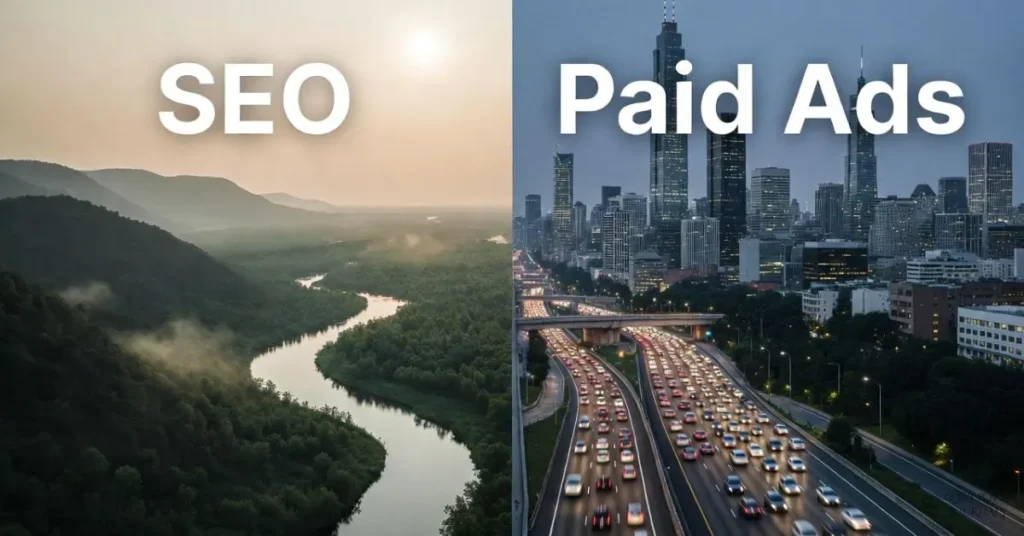
Paid advertising operates on a rental model. You pay for every visitor. The moment you stop paying, visibility disappears instantly. There is no residual value, no compounding benefit, and no equity that accumulates over time. As Kreative Hive summarises precisely: ‘Ads are like renting space. You get traffic fast, but you pay for every visitor. And when you stop paying, you lose visibility.’
SEO, by contrast, operates on an ownership model. You invest time and resources to build organic visibility — through content, technical optimisation, and backlinks. That visibility then generates traffic without a per-click fee. Furthermore, once rankings are established, they tend to persist even if investment slows. As the IJRPR study on SEO vs paid advertising notes: ‘SEO is a long-term investment that, when done correctly, can drive consistent and sustainable traffic’ — and it continues to attract free traffic even with minimal updates.
This ownership-vs-rental dynamic is why the two channels have such different economic profiles over time. Paid ads deliver predictable, immediate returns — but those returns require continuous investment to maintain. SEO delivers delayed, uncertain initial returns — but those returns compound and become progressively cheaper per visitor as time passes.
Understanding this distinction reframes the entire question. You are not choosing between two advertising channels. You are choosing between renting traffic and owning it. The right answer depends entirely on how long your time horizon is.
Month 1: Why Paid Ads Win Early and Win Clearly
In the first 30 days of any digital marketing programme, the ROI narrative belongs entirely to paid advertising. This is not a close contest. According to Purge Digital’s ROI timeline comparison, in the first month, the returns from PPC are immediate and measurable, while SEO typically generates zero organic traffic from new content.
The logic is simple. A paid campaign can be live within hours. Ads appear at the top of search results immediately, targeting exactly the keywords and audience segments you specify. Conversion tracking is set up from day one. You know precisely what each click costs, what converts, and what the return on ad spend (ROAS) looks like in real time.
SEO, meanwhile, is doing invisible work in month one. Google needs time to crawl new content, assess its quality relative to existing results, and determine where it should rank. Even with a well-executed content and technical strategy, most pages take three to six months to rank meaningfully. Competitive keywords may take considerably longer.
This early-stage reality has important implications for startups and early-stage businesses. If you need traffic and leads within weeks — for a product launch, a fundraising round, or simply to prove initial demand — paid ads are the only viable option. SEO cannot fulfil that timeline, and pretending otherwise leads to miscalibrated expectations and wasted early resources.
Consequently, most sophisticated digital marketers recommend a sequenced approach: use paid ads to generate immediate data and revenue while the SEO foundation is being built. The paid ads pay for the current quarter. The SEO investment pays for the next three years.
Month 1 Performance Snapshot: SEO vs Paid Ads
| Metric | SEO (Month 1) | Paid Ads (Month 1) |
| Traffic Volume | Near zero (new site) or minimal lift | Immediate, volume scales with budget |
| Cost Per Click | $0 (no clicks yet) | Varies by industry: $1–$50+ |
| Conversion Data | Not yet available | Available from day one |
| Brand Visibility | Minimal | Top-of-page ad placement |
| ROI | Negative (investment only) | Can be positive immediately |
| Campaign Flexibility | Low (content takes time) | Very high (pause, adjust instantly) |
The 6-Month Crossover: When the Tide Begins to Turn
Around the six-month mark, something important starts to happen. Early SEO investments begin delivering returns. Content published in months one and two starts ranking. Some pages reach page one for lower-competition keywords. Organic traffic begins to trickle, then flow.
At the same time, paid ad costs have often risen. Competition in your category bids up CPC rates. Ad fatigue reduces click-through rates on audiences you have retargeted repeatedly. Your customer acquisition cost through paid channels, which looked attractive in month one, has crept upward as the lowest-hanging fruit of your audience has been converted.
The result is that the ROI gap between the two channels begins to narrow. As Purge Digital’s analysis documents, the crossover point — where SEO ROI begins to exceed PPC ROI — typically falls between six and twelve months. The exact timing depends on the competitiveness of your keywords, the quality of your content programme, and the technical health of your website.
Furthermore, SEO traffic at the six-month mark has a qualitative advantage that the numbers alone do not capture. Organic visitors — people who found you through a genuine search query — typically exhibit higher engagement, lower bounce rates, and stronger purchase intent than paid visitors. They were looking for exactly what you offer. That alignment between searcher intent and your content is what makes organic traffic so valuable at scale.
Meanwhile, the content assets you have built for SEO are generating compound value. A blog post that ranks on page one generates traffic not just this month, but next month and the month after — without additional spend. That compounding dynamic does not exist in paid advertising. Every month of PPC budget buys exactly one month of traffic. Every month of SEO investment builds equity that pays forward indefinitely.
Month 12 and Beyond: SEO’s Compounding Advantage Becomes Dominant
At the twelve-month mark, the ROI comparison shifts decisively. For businesses that have invested consistently in SEO, organic traffic is now a significant and growing channel. The cost per organic visitor has fallen dramatically as the fixed investment in content and technical work is spread across a growing traffic base. The incremental cost of an additional organic visitor approaches zero.
Paid advertising’s economics, by contrast, have not improved. The cost of each click remains tied to market auction dynamics. If your category has grown more competitive over the past year — which is common in expanding markets — your CPCs may actually be higher than they were twelve months ago. You are paying more for the same outcome.
The data from Purge Digital consistently shows that SEO’s average long-term ROI is substantially higher than PPC, with some studies reporting 500% to 1,300% over a multi-year period. This is not because SEO is magic — it is because the traffic it generates is genuinely free once rankings are established, and the value of that traffic compounds as more pages rank and more keywords are covered.
For businesses in industries with high CPCs — legal services, finance, insurance, healthcare, real estate — the ROI advantage of SEO at twelve months is especially dramatic. Categories where a single click costs $30 to $100 or more make the economics of organic traffic almost incomparably attractive once rankings are achieved. The investment required to rank for a high-CPC keyword may represent a tiny fraction of what you would spend buying equivalent traffic through paid ads over the same period.
Additionally, the trust dimension matters enormously at this stage. Research consistently shows that organic search results receive significantly higher click-through rates than paid ads for informational and research-phase queries. Users have become increasingly ad-aware, and for many categories, being found signals authority and credibility in a way that paid placements cannot replicate.
ROI Comparison: SEO vs Paid Ads Over 12 Months
| Timeframe | SEO ROI Status | Paid Ads ROI Status | Recommended Primary Channel |
| Month 1 | Negative (investment phase) | Positive (if campaign is optimised) | Paid Ads |
| Month 3 | Break-even to slightly positive | Positive but rising costs | Paid Ads (with SEO building) |
| Month 6 | Positive, growing | Positive but flattening | Hybrid — roughly equal |
| Month 9 | Strongly positive | Positive with cost pressure | SEO gaining edge |
| Month 12 | Significantly high positive | Positive but higher CPA | SEO dominant |
| Year 2+ | Compounding — 500–1,300% ROI reported | Requires ongoing spend to maintain | SEO clear winner |
The Scale Question: When Does SEO Definitively Win?
The headline question of this article deserves a direct answer. SEO definitively wins — meaning its ROI unambiguously exceeds paid advertising’s — when the following conditions are simultaneously met.
Condition 1 — Time threshold crossed: Your SEO programme has been running consistently for at least 9 to 12 months with quality content, technical optimisation, and active link building. Before this point, SEO is still in its investment phase and cannot compete with paid ads on pure ROI terms.
Condition 2 — Traffic volume threshold reached: Your organic traffic has reached a level where the cost-per-visit, when calculated against total SEO investment, falls below your average CPC in paid channels. For most businesses, this crossover occurs when monthly organic traffic exceeds roughly 2,000 to 5,000 visits, though the exact figure depends heavily on your CPC environment.
Condition 3 — High-CPC category: The higher your industry’s average cost-per-click, the faster and more dramatic SEO wins. In low-CPC categories (under $2 per click), the ROI advantage of SEO takes longer to become dominant. In high-CPC categories ($10 to $100+ per click), SEO’s advantage becomes decisive relatively quickly after rankings are established.
Condition 4 — Informational intent keywords: SEO performs best on informational and research-phase queries — the kind of content that educates, answers questions, and builds trust over multiple interactions. If your product is typically purchased after extended research (B2B software, financial services, healthcare services, legal services), SEO aligns perfectly with the buyer journey. Transactional impulse purchases with highly specific intent may still favour paid ads even at scale.
Condition 5 — Long-term business horizon: SEO is worth the investment if your business will be operating for years, not months. The compounding value of organic rankings accrues over time. Businesses with short time horizons — seasonal campaigns, event marketing, short product cycles — will rarely live long enough to see SEO’s full ROI advantage materialise.
Industries Where SEO Wins Fastest — and Where It Struggles
Not all industries experience the SEO vs paid ads ROI crossover at the same speed. The competitive landscape, average CPC rates, and the nature of buyer intent in each category determine how quickly organic search becomes the dominant channel.
Legal services represent perhaps the most extreme case. The average CPC for terms like ‘personal injury lawyer’ or ‘divorce attorney’ can exceed $100 in competitive US markets. A single page ranking on page one for a term like this can deliver traffic worth tens of thousands of dollars per month in paid ad equivalent value. Firms that have built strong local and topical SEO authority in legal services enjoy an almost insurmountable cost advantage over competitors relying purely on paid ads.
Finance and insurance are similarly extreme. Terms like ‘best mortgage rates’ or ‘life insurance quotes’ command CPCs in the $20 to $80 range. Ahrefs’ keyword difficulty data consistently shows these categories among the most competitive — but precisely because the CPC is so high, ranking for even a handful of relevant terms delivers extraordinary organic ROI.
SaaS and technology businesses benefit from SEO’s strength at the consideration and evaluation stage. B2B buyers extensively research software solutions before purchasing. According to Gartner’s B2B buying research, the average B2B purchase involves 6 to 10 decision-makers and multiple rounds of independent research. Content that appears organically during this research phase builds trust and influences purchasing decisions in a way that display ads simply cannot replicate.
E-commerce is more nuanced. Product-specific searches with immediate transactional intent often perform better with paid shopping ads, particularly for higher-priced items where conversion is time-sensitive. However, informational content — buying guides, comparison articles, how-to content — represents a powerful SEO opportunity even in e-commerce, driving top-of-funnel awareness that converts via retargeting or repeat organic visits.
Local businesses — plumbers, dentists, restaurants, contractors — benefit enormously from local SEO. Google Business Profile optimisation, local citation building, and location-specific content can drive high-intent local traffic at zero cost per click — making local SEO one of the highest-ROI marketing investments available to small businesses.
SEO vs Paid Ads ROI by Industry Category
| Industry | Avg CPC Range | SEO Win Timeline | SEO Advantage Level |
| Legal Services | $20–$100+ | 6–12 months | Extreme — very high CPC justifies early SEO investment |
| Finance & Insurance | $15–$80 | 9–18 months | Very High — informational content dominates the buyer journey |
| B2B SaaS | $5–$30 | 9–18 months | High — research-heavy buying cycle favours content |
| Healthcare | $5–$40 | 9–18 months | High — trust content crucial, high CPC |
| E-commerce (general) | $0.50–$5 | 12–24 months | Moderate — product pages compete, content wins top-funnel |
| Local Services | $2–$20 | 6–12 months | High — local SEO delivers free high-intent leads |
| News / Media | $0.10–$1 | 12–24 months | Moderate — volume required, low CPC reduces urgency |
| Event / Short Campaigns | N/A | SEO rarely reaches crossover | Low — time horizon too short |
The Cost Stack: What SEO Actually Costs and How It Compares
A common misconception is that SEO is ‘free.’ It is not. SEO requires investment — in content creation, technical expertise, link building, and ongoing strategy. What makes SEO economically attractive is not that it costs nothing, but that the cost is fixed or slowly growing while the traffic it generates can scale dramatically.
A realistic monthly SEO investment for a small to medium business might look like this: content creation ($1,000 to $5,000), technical SEO and site maintenance ($500 to $2,000), link building outreach ($1,000 to $3,000), and tools like Ahrefs or Semrush ($100 to $500 per month). Total monthly investment: roughly $2,600 to $10,500.
Compare this to a paid ads budget generating equivalent traffic. If your average CPC is $5 and you need 5,000 monthly visitors, you are spending $25,000 per month. At a $15 average CPC for 5,000 visitors, the equivalent paid spend is $75,000 per month. The SEO programme that achieves those same 5,000 organic visits costs a fraction of those figures — and does not reset to zero if you reduce spending.
This cost comparison illustrates why the scale question matters so much. At 500 monthly organic visits, the financial case for SEO is not yet compelling. At 5,000 monthly visits, it is very strong. At 50,000 monthly organic visits, an SEO programme represents an asset worth millions of dollars in annual traffic value — traffic that would cost an extraordinary amount to replicate through paid channels.
The key insight from Delphin Digital Academy’s 2026 analysis is that ‘SEO is a long-term strategy that, after getting rankings, can bring consistent traffic and leads without any ongoing cost for each click.’ That phrase — ‘without any ongoing cost for each click’ — is the core of SEO’s economic case. Once you own those rankings, the marginal cost of each visitor approaches zero.
Where Paid Ads Remain the Superior Choice
Acknowledging SEO’s long-term advantage does not mean paid advertising is obsolete. There are specific, well-defined scenarios where paid ads remain the superior choice — and sophisticated marketers know exactly when to deploy them.
New product launches: When you introduce a new product or service, organic search rankings do not yet exist for the relevant keywords. Paid ads provide instant visibility to a targeted audience, enabling rapid demand testing and initial customer acquisition while SEO authority is being built.
Time-sensitive promotions: Sales events, seasonal campaigns, and limited-time offers require traffic now, not in six months. Paid ads are the only mechanism that can reliably deliver immediate, targeted traffic on demand. SEO cannot serve this function.
Hyper-competitive keywords: Some keyword categories are so dominated by established brands with years of SEO authority that ranking organically is extremely difficult and slow. In these situations, paid ads may offer a faster path to visibility — even if the cost is high.
Bottom-funnel transactional queries: Users searching for ‘buy [product name] now’ or ‘[service] near me tonight’ are in immediate purchase mode. Google Ads andMicrosoft Advertising allow you to intercept these high-intent moments with compelling offers and targeted landing pages. Paid ads are highly effective for this use case.
Testing and data gathering: Paid ads deliver conversion data at a speed and volume that organic search simply cannot match in the early stages. Running paid campaigns to test which headlines, offers, and landing page elements convert best is a legitimate and valuable use of paid budget — even for businesses that are primarily SEO-focused.
Remarketing and retention: Paid remarketing — showing ads to visitors who have already interacted with your site — is one of the highest-ROI applications of paid advertising. This audience is already warm. The cost of converting them is low relative to cold traffic. Remarketing works alongside SEO, not in competition with it.
The Hybrid Strategy: What the Best Marketers Actually Do
The most effective digital marketers do not choose between SEO and paid ads. They use both, sequentially and simultaneously, in ways that maximise the return on each channel while leveraging the strengths of both.
The standard hybrid model works like this. In the first three to six months, allocate the majority of the budget to paid ads to generate immediate traffic, test messaging, and build conversion data. Simultaneously, invest in the SEO foundation: content production, technical site health, and initial link building. The paid ads are funding current operations while the SEO investment builds a future asset.
From months six to twelve, begin shifting budget from paid to organic as rankings start to materialise and organic traffic grows. Reduce spending on keywords where you are now ranking organically, but maintain paid presence on highly competitive terms and for bottom-funnel transactional queries. Use the conversion data from paid campaigns to refine your organic content strategy.
Beyond twelve months, organic search becomes the primary traffic driver, with paid advertising fulfilling three specific roles: new product launches, seasonal promotions, and remarketing to organic visitors who have not yet converted. This allocation maximises the long-term ROI of the combined channel mix while maintaining the agility that paid ads provide.
As Kreative Hive explains, combining both channels creates a synergy that neither can achieve alone: ‘use SEO for awareness and trust-building, and ads for lead capture or time-sensitive promotions.’ The result is a marketing system where each channel reinforces the other.
Furthermore, paid search data is one of the best inputs available for SEO strategy. You can run paid campaigns on keywords you want to rank for organically, measure conversion rates precisely, and prioritise SEO investment on the keywords that actually generate revenue — not just traffic. This data feedback loop between paid and organic is one of the most underutilised advantages in digital marketing.
Recommended Budget Allocation by Business Stage
| Business Stage | Paid Ads Allocation | SEO Allocation | Primary Goals |
| Pre-revenue (0–3 months) | 70–80% | 20–30% | Test demand, acquire first customers, build a foundation |
| Early growth (3–9 months) | 60–70% | 30–40% | Scale acquisition, build content assets, gather data |
| Growth stage (9–18 months) | 40–50% | 50–60% | Organic begins contributing, reducing CPA dependency |
| Maturity (18–36 months) | 25–35% | 65–75% | SEO dominant, paid for launches and retargeting |
| Scale (36+ months) | 15–25% | 75–85% | Organic drives growth, paid is tactical and supplemental |
Technical SEO: The Foundation That Paid Ads Cannot Replace
One aspect of SEO that deserves dedicated attention is technical SEO — the infrastructure layer that determines whether search engines can effectively crawl, index, and rank your content. Technical issues can silently undermine even the most well-executed content strategy, making the entire SEO investment less productive.
Core technical factors include site speed, mobile-friendliness, crawlability, indexation, structured data, and Core Web Vitals. Google’s Core Web Vitals framework — measuring Largest Contentful Paint, First Input Delay, and Cumulative Layout Shift — directly influences rankings and is a mandatory consideration for any serious SEO programme.
Tools likeGoogle Search Console provide invaluable diagnostic data on crawl errors, indexation issues, and manual penalties. Screaming Frog enables comprehensive technical audits that surface issues invisible to the naked eye.PageSpeed Insights delivers specific recommendations for improving load performance.
Technical SEO is a fixed cost that pays compounding dividends. Unlike paid advertising, a well-optimised site structure does not degrade when you stop spending. Moreover, it makes every dollar of content investment more productive — because content on a technically sound site ranks faster and higher than equivalent content on a poorly structured one.
Consequently, technical SEO should be among the first investments made when building an organic channel. It is the foundation upon which content and link-building ROI multiply.
Content Quality and E-E-A-T: Why Cheap Content Fails
One of the most common mistakes businesses make with SEO is underinvesting in content quality. The logic is tempting: produce lots of content cheaply, cover lots of keywords, rank for lots of terms. In practice, this approach produces poor results and can actively harm your domain authority.
Google’s quality guidelines now centre on a framework called E-E-A-T: Experience, Expertise, Authoritativeness, and Trustworthiness. Content that demonstrates these qualities ranks better and holds its rankings more durably. Content that lacks them — generic, AI-spun, thin, or poorly sourced — is increasingly filtered from prominent search positions.
High-quality SEO content requires domain expertise. For healthcare content, that means medically reviewed articles written or edited by qualified practitioners. For legal content, it means attorney-reviewed guidance. For financial content, it means analysis grounded in verifiable data from credible sources likethe Federal Reserve, the IMF, or peer-reviewed academic research.
This quality requirement raises the cost of SEO content production — but it also raises the quality ceiling of what is achievable. Businesses that invest in genuinely expertise-driven content build durable competitive moats in search. Competitors cannot easily replicate content that reflects years of genuine expertise. This durability is another dimension of SEO’s compounding advantage that paid advertising simply cannot offer.
Link Building: The Accelerator of SEO ROI
Content and technical SEO build the foundation. Link building is the accelerator. Backlinks — external sites linking to your content — remain one of the strongest signals in Google’s ranking algorithm. The quantity and quality of backlinks pointing to your site determine how quickly your content rises in rankings relative to competitors.
Effective link-building strategies include digital PR — creating data-driven, newsworthy content that earns coverage and links from authoritative publications. Guest posting on relevant industry publications builds both links and brand awareness simultaneously. Broken link building, resource page outreach, and HARO (Help A Reporter Out) are additional tactics used by experienced SEO teams.
Tools like Ahrefs and Semrush allow you to analyse competitor backlink profiles, identifying the specific sites and strategies driving their organic authority. This intelligence dramatically improves the efficiency of link-building investment by focusing efforts on proven, high-impact opportunities.
The ROI on link building is difficult to measure in isolation, but its impact on overall SEO performance is substantial. A high-quality backlink from a Domain Rating 80+ publication can lift an entire site’s authority meaningfully — accelerating the ranking of not just one page, but every page on the domain. This systemic benefit is unique to SEO and has no equivalent in paid advertising.
Importantly, link building is also the most time-intensive component of SEO, which is why it is often the most underfunded. Businesses that invest appropriately in link acquisition consistently outperform those that focus solely on content production, particularly in competitive keyword categories.
Measuring SEO Success: The Metrics That Actually Matter
SEO success is frequently mismeasured, which leads to premature programme cancellations and misallocated budgets. Rankings are the most commonly tracked metric — but they are also the least informative about business impact. A page ranking number one for a keyword nobody searches is worthless.
The metrics that actually matter are organic traffic, organic-sourced leads and conversions, organic revenue, and traffic value — the estimated cost to acquire equivalent traffic through paid advertising. Google Analytics 4 tracks the first three. Ahrefs and Semrush estimate traffic value, giving you a dollar figure that makes the ROI case concrete.
Additionally, track keyword coverage — the number of keywords for which your site appears in the top ten positions. This is a leading indicator of future traffic growth. A site with 500 top-ten keywords today will, all else being equal, have substantially higher organic traffic six months from now than a site with 50 top-ten keywords.
Furthermore, monitor domain authority metrics like Domain Rating (DR) on Ahrefs or Domain Authority (DA) on Moz. These composite scores reflect the overall strength of your backlink profile and correlate strongly with your ability to rank for competitive keywords. Growing DR over time confirms that your link-building investment is translating into a durable competitive advantage.
Finally, track branded search volume over time. As your content reaches more people and builds awareness, the number of people searching directly for your brand name increases. This branded demand is a consequence of SEO authority and represents a compounding return that extends beyond organic search into overall business equity.
Key SEO Metrics and What They Reveal
| Metric | What It Measures | Tool | Why It Matters |
| Organic Traffic | Monthly sessions from the unpaid search | Google Analytics 4 | Core volume metric — basis for ROI calculation |
| Organic Conversions | Leads/sales from organic traffic | GA4 + CRM | Revenue attribution for SEO investment |
| Traffic Value | Estimated cost to buy equivalent traffic via PPC | Ahrefs / Semrush | Makes an ROI case in dollar terms |
| Domain Rating / Authority | Overall backlink profile strength | Ahrefs / Moz | Predicts ranking ability for competitive terms |
| Keyword Coverage | # of keywords ranking in the top 10 | Ahrefs / Semrush / Search Console | Leading indicator of future traffic growth |
| Core Web Vitals | Site speed and UX performance | Google Search Console / PageSpeed | Ranking factor — low scores suppress rankings |
| Branded Search Volume | Monthly searches for your brand name | Google Search Console | Measures brand awareness compounding from SEO |
Common SEO Mistakes That Delay the ROI Crossover
Many businesses invest in SEO but never reach the crossover point where it wins — not because SEO does not work, but because critical execution mistakes slow or stall the compounding process. Recognising these mistakes is half the battle.
Targeting keywords that are too competitive too early: Attempting to rank for high-volume, high-competition keywords before building domain authority is like trying to lift 200 kg on your first day at the gym. Start with lower-competition, longer-tail keywords where rankings are achievable within three to six months. Early wins build authority that eventually enables you to compete for harder terms.
Inconsistent content production: SEO compounds over time — but only if investment continues. Businesses that produce 20 articles and then stop see their traffic growth plateau quickly. A consistent, sustained content production schedule — even at modest volume — outperforms sporadic bursts of activity.
Ignoring technical SEO: Poor site speed, crawl errors, duplicate content, and unoptimised site structure cap the ceiling of what content and links can achieve. Address technical issues before scaling content production.
Neglecting search intent: Ranking on page one for a keyword only matters if your content matches what the searcher actually wants. A transactional keyword requires a product or service page. An informational keyword requires a detailed guide. Misaligning content type with search intent produces rankings that do not convert.
Underinvesting in link building: Content without links is like a great product nobody knows about. In competitive categories, link acquisition is non-negotiable. Businesses that budget for content but not for link building consistently underperform their potential.
Avoiding these mistakes does not guarantee overnight SEO success. However, avoiding them consistently compresses the timeline to the ROI crossover point and maximises the ultimate return on the SEO investment.
Voice Search, AI Overviews, and How They Change the SEO Equation
The SEO landscape is not static. Two developments in particular are reshaping the organic search channel in ways that both challenge and create opportunity: the growth of voice search and the emergence of AI-generated search overviews.
Voice search — queries made throughGoogle Assistant, Amazon Alexa, andApple Siri — typically use longer, more conversational queries than typed search. Optimising for voice means targeting question-based keywords (who, what, how, why) and providing clear, concise answers that voice assistants can read aloud. Featured snippets — the answer boxes that appear above organic results — are particularly valuable in a voice search context.
More significant is the rise of AI-generated search overviews. Google’s AI Overviews (formerly Search Generative Experience) generate summarised answers at the top of search results pages, sometimes reducing the click-through rate to organic listings below. This is a real challenge for SEO practitioners — but it is also a significant challenge for paid advertisers, as AI Overviews often appear above paid ads.
The businesses best positioned for this new landscape are those producing genuinely authoritative, expert content. AI Overviews preferentially cite well-established, trustworthy sources. Being cited in an AI Overview — even if users do not click through — builds brand visibility and reinforces authority. This dynamic rewards exactly the kind of high-quality, E-E-A-T-compliant content that has always been the foundation of durable SEO performance.
Consequently, the strategic response to AI search evolution is not to reduce SEO investment but to raise content quality standards. The destinations that AI systems cite most frequently are those that will maintain visibility as search behaviour evolves.
Calculating Your SEO Break-Even Point: A Practical Framework
Rather than relying on general timelines, you can calculate the specific break-even point for your SEO investment using a straightforward framework. This exercise grounds the strategic conversation in numbers specific to your business.
Step 1 — Calculate your current average CPC: Look at your paid search campaigns and calculate the average cost per click across your target keywords. If you do not run paid search, use Google’s Keyword Planner or Ahrefs’ keyword data to estimate average CPCs for your target terms.
Step 2 — Project your SEO traffic target: Define the monthly organic traffic volume that would represent a meaningful business contribution. For most SMBs, a target of 2,000 to 10,000 monthly organic sessions is a realistic twelve-month goal with consistent investment.
Step 3 — Calculate the monthly traffic value: Multiply your target traffic volume by your average CPC. If you are targeting 5,000 monthly organic visits and your average CPC is $8, the monthly traffic value is $40,000. This is what you would need to spend on paid ads to acquire equivalent traffic.
Step 4 — Estimate SEO investment: Calculate your monthly SEO programme cost (content, technical, links, tools). For this example, assume $5,000 per month.
Step 5 — Calculate cumulative break-even: Add up the cumulative SEO investment over your projected timeline. At $5,000 per month, your twelve-month investment totals $60,000. When your organic traffic delivers $40,000 per month in traffic value, you will recoup your entire investment in roughly two months — after which every month represents pure ROI.
This framework makes the business case for SEO concrete and defensible. It translates a strategic argument into financial projections that resonate with business owners and CFOs alike.
Putting It All Together: Making the Right Choice for Your Business
No single answer fits every business. As Delphin Digital Academy summarises, ‘there is no definitive victor in the debate between SEO and paid advertising. Each strategy has a specific purpose and value to offer businesses at different stages of maturity.’
However, the data and framework laid out in this article make the decision conditions clear. SEO definitely wins when you have a time horizon of twelve months or more, operate in a high-CPC category, can sustain consistent investment in quality content and link building, and are targeting informational or research-phase buyer journeys. Under these conditions, SEO’s compounding returns and zero marginal cost per visitor make it the highest-ROI channel available.
Paid advertising wins when you need immediate traffic, are launching something new, are running time-sensitive promotions, or need bottom-funnel transactional visibility in categories where organic competition is prohibitive. These are real and legitimate use cases — and the businesses that recognise them allocate their paid budget more efficiently as a result.
The hybrid model, used by the most sophisticated growth marketers, deploys both channels strategically: paid ads for velocity and data, SEO for sustainable long-term growth. Each channel informs and supports the other. Paid data improves SEO targeting. SEO authority reduces dependence on ever-rising paid CPCs. Together, they build a marketing system that is more durable, more cost-efficient, and more defensible than either channel could be alone.
The scale question, ultimately, is not just about traffic numbers. It is about what kind of business you want to build: one that rents its audience indefinitely, or one that owns it. For most businesses with a multi-year horizon, the answer is obvious.
Spend some time for your future.
To deepen your understanding of today’s evolving financial landscape, we recommend exploring the following articles:
Low-Limit Credit Cards: The Hidden Credit Score Trap
Is China Really a Key Player in International Finance? A case study
Fractional Investing Explained: From Tokens to Skyscrapers
Top 10 Businesses with the Highest Failure Rates Exposed
Explore these articles to get a grasp on the new changes in the financial world.
Legal Disclaimer
The information in this article is for general educational purposes only. ROI figures and timelines are based on industry data and vary significantly depending on industry, competitive landscape, budget, and execution quality. Nothing in this article constitutes financial, marketing, or professional business advice. Consult qualified marketing professionals before making strategic investment decisions.
References
[1] Delphin Digital Academy, ‘SEO vs Paid Ads: The Smartest Marketing Investment in 2026’, 2026. [Online]. Available: https://delphindigital.academy/blog/seo-vs-paid-ads-in-2026/
[2] IJRPR,‘ Study on Search Engine Optimisation (SEO) vs. Paid Advertising,’ Vol. 6, Issue 4. [Online]. Available: https://ijrpr.com/uploads/V6ISSUE4/IJRPR41950.pdf
[3] Kreative Hive, ‘Paid Ads Service vs SEO: Which Is Better for Your Budget?’ [Online]. Available: https://kreativehive.ca/seo-services-vs-paid-ads-whats-better-for-your-budget/
[4] Purge Digital,‘ SEO vs. Paid Advertising ROI: 1, 6 and 12 Month Comparison’. [Online]. Available: https://purgedigital.com.au/seo-vs-paid-advertising-roi-1-6-and-12-month-comparison/
[5] CI Web Group,‘ Average ROI from SEO vs Paid Ads in the Trades — What the 2025 Data Shows’. [Online]. Available: https://www.ciwebgroup.com/blog/average-roi-from-seo-vs-paid-ads-in-the-trades-what-the-2025-data-shows
[6] Moz,‘ Beginner’s Guide to SEO’. [Online]. Available: https://moz.com/beginners-guide-to-seo
[7] Google,‘ Creating Helpful, Reliable, People-First Content (E-E-A-T)’. [Online]. Available: https://developers.google.com/search/docs/fundamentals/creating-helpful-content
[8] Google,‘ Core Web Vitals’. [Online]. Available: https://web.dev/vitals/
[9] Gartner,‘ The B2B Buying Journey’. [Online]. Available: https://www.gartner.com/en/sales/insights/b2b-buying-journey
[10] BrightLocal,‘ Local SEO Industry Survey’. [Online]. Available: https://www.brightlocal.com/research/local-seo-industry-survey/