
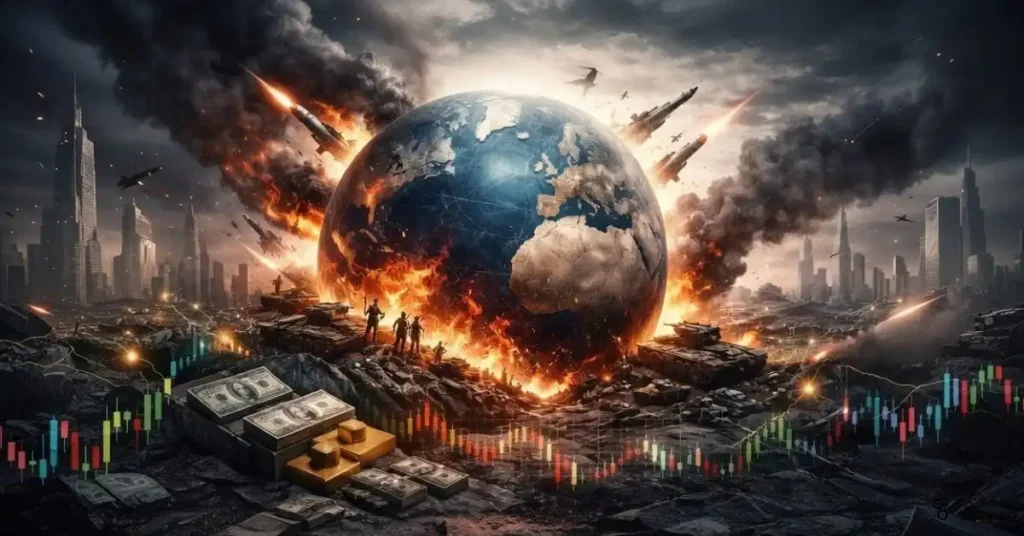
War Economy Chapter 8: Geopolitics for Investors – Reading Tensions Without Speculating
In February 2026, investors faced an unprecedented geopolitical landscape. The World Economic Forum identifies geoeconomic confrontation as the number one global risk, with defence budgets reaching record highs and military spending exceeding $2.7 trillion globally. Meanwhile, NATO members have committed to spending 5% of GDP on defence by 2035, representing the most dramatic peacetime military expansion in decades. For investors, the question isn’t whether geopolitics matters – it’s how to navigate these tensions without falling into the speculation trap that destroys portfolios.
This chapter explores the critical but often misunderstood intersection of war economies, geopolitical tensions, and investment strategy. Unlike typical market analysis that treats geopolitics as temporary noise, we’ll examine the structural economic realities that determine how conflicts truly impact markets. More importantly, we’ll dissect the dangerous gap between political ideology and economic reality – a gap where trillions in investor capital have been lost throughout history.
The central thesis is counterintuitive: most investors lose money on geopolitics not because they fail to predict conflicts, but because they misunderstand how war economies actually function. They speculate on who will win battles instead of analysing who absorbs costs. They chase defence stocks during tensions without understanding the sunk cost fallacy that governs military spending. Most critically, they fail to recognise that citizens – including investors themselves – ultimately pay for every geopolitical gamble through mechanisms far more subtle than direct taxation.
Throughout this analysis, we’ll examine why delayed corrections in war economies create systematic mispricing, how ideology consistently trumps economic rationality in military decisions, and practical frameworks for reading geopolitical tensions without speculating on outcomes. Whether you’re managing a global portfolio or simply trying to protect retirement savings, understanding these dynamics has never been more essential.
Understanding War Economies: When Ideology Overrides Economic Reality
Traditional economic analysis assumes rational actors making decisions based on cost-benefit calculations. War economies operate under fundamentally different rules where ideological imperatives, political survival, and national pride systematically override economic rationality. This isn’t a bug in the system – it’s the defining feature that creates both massive investment risks and occasional opportunities for those who understand the pattern.
The Ideology-Economics Disconnect
Consider the fundamental difference between peacetime and wartime resource allocation. In normal economic conditions, governments face political pressure to justify every dollar of spending. Healthcare, education, and infrastructure compete for budget share, with opposition parties ready to pounce on wasteful expenditures. Economic efficiency matters because voters care about getting value for their taxes.
War changes everything. Once a conflict becomes framed as existential – whether it actually is or not – economic constraints evaporate. Political discourse shifts from ‘Can we afford this?’ to ‘How can we not afford this?’ This transformation happens remarkably quickly and persists remarkably long, even when the original rationale becomes questionable.
The current Russia-Ukraine conflict provides a clear example. European nations that spent decades refusing to meet NATO’s 2% GDP target – citing budget constraints and domestic priorities – suddenly found resources for dramatic increases. Germany announced a 100 billion euro special fund for defence. Poland plans to reach 4% of GDP on military spending. The money didn’t appear from nowhere; it came from other uses or increased borrowing. Yet the political resistance that blocked such spending for decades vanished almost overnight.
Why Economic Feedback Loops Break Down
In normal markets, bad economic decisions create rapid feedback. A company that overpays for acquisitions sees its stock price punish management. A government that wastes money on ineffective programs faces voter backlash at the next election. These feedback mechanisms, while imperfect, create some discipline around resource allocation.
Military spending in war economies breaks these feedback loops through several mechanisms. First, time delays between spending and outcomes can span years or decades. The costs appear immediately on budgets, but whether the spending achieved its strategic objectives often remains unclear for years. Did that weapons system actually deter the adversary, or would the adversary have backed down anyway? There’s no control group, no way to run the experiment twice.
Second, classification and national security concerns prevent the transparency that markets require for efficient pricing. When defence projects run over budget or fail to deliver promised capabilities, this information often remains classified. According to a U.S. Government Accountability Office report, 98 major defence acquisition programs were collectively $402 billion over budget in 2010. Similar patterns persist today, but the complexity and classification of programs make accountability nearly impossible.
Third, the political incentives completely flip during conflicts. Politicians who question military spending get accused of being unpatriotic or weak on defence. The safe political move is always to support more spending, not less. This creates a ratchet effect where spending easily increases during crises but seldom decreases proportionally when tensions ease.
The Guns vs. Butter Trade-off That Investors Must Understand
Economics students learn about the guns versus butter curve – a classic illustration of opportunity cost. Every dollar spent on military capabilities is a dollar not spent on consumer goods, infrastructure, or productive investment. In theory, societies choose an optimal balance that maximises welfare given security threats.
In practice, war economies systematically choose points far from any economic optimum. The political dynamics discussed above mean that military spending continues well beyond the point where marginal costs exceed marginal benefits. This isn’t just wasteful – it represents a massive wealth transfer from productive economic activity to consumption of resources that produce no lasting value.
For investors, this matters enormously. Increased military spending doesn’t just redirect government budgets – it crowds out private investment, distorts capital allocation, and often leads to inflation as governments monetise deficits to fund wars. The economic costs compound over time, but they’re obscured by the complexity of modern economies and the time lag between cause and effect.
The Sunk Cost Fallacy in Military Spending: Why Projects Never Die
Perhaps no concept better explains the dysfunction of war economies than the sunk cost fallacy. In standard economic theory, sunk costs – money already spent that cannot be recovered – should be irrelevant to future decisions. The only rational approach is to evaluate whether continuing a project delivers value greater than its remaining costs, regardless of how much has already been invested.
Humans consistently violate this principle, and nowhere is this more pronounced than in military procurement. The psychological imperative to not ‘waste’ past investments leads to throwing good money after bad, often on a staggering scale. For investors, understanding this pattern is crucial because it explains why defence budgets become so rigid and why certain types of spending persist long after any rational justification has disappeared.
How Sunk Costs Escalate in Defence Projects
Major weapons systems typically take 10-20 years from initial concept to operational deployment. Throughout this journey, costs invariably exceed initial estimates – sometimes by factors of two, three, or more. Performance often falls short of promises. Delivery schedules slip by years. Yet cancellation remains extraordinarily rare.
The pattern is predictable. Early in development, a program promises revolutionary capabilities at a reasonable cost. Political support builds as military services advocate for the system and defence contractors lobby politicians. Initial funding passes with optimistic projections. Then reality intervenes. Technical challenges prove harder than anticipated. Integration with existing systems creates unforeseen complications. Testing reveals performance shortfalls requiring design changes.
At this point, rational analysis would suggest re-evaluating whether to continue. However, billions have been invested. Thousands of jobs depend on the program. Military services have built their modernisation plans around the system. Politicians in districts with defence contractors face pressure to keep funding flowing. The sunk cost fallacy takes over: ‘We’ve come too far to turn back now.’
Research from King’s College London on the AUKUS submarine program demonstrates this dynamic perfectly. The project spans multiple generations, with costs measured in hundreds of billions. The time horizon makes any meaningful cost-benefit analysis almost impossible, yet the very magnitude of investment creates enormous political pressure to continue regardless of changing strategic circumstances or cost overruns.
The Institutional Forces That Perpetuate Sunk Cost Thinking
The sunk cost fallacy in military spending isn’t just psychological – it’s institutionalised through several mechanisms that make course correction extremely difficult even when problems become obvious.
First, the revolving door between government and defence contractors creates perverse incentives. Military officers and government officials who manage programs often take jobs with the contractors they previously oversaw. This creates subtle pressure to protect programs from cancellation, as doing so maintains relationships valuable for future employment. While not illegal, this dynamic tilts decisions away from taxpayer interests.
Second, defence contractors deliberately spread production across multiple congressional districts, creating political constituencies for programs. A weapons system might have suppliers in 40 states, making cancellation politically toxic for senators and representatives who would face job losses in their districts. This strategy, known as political engineering, proves remarkably effective at preventing program cancellations regardless of performance or cost issues.
Third, the classification system prevents public accountability. When programs encounter problems, much of the information remains classified for national security reasons. Taxpayers can’t fully evaluate whether their money is being spent wisely, and political debate happens without complete information. This opacity makes it easier to justify continued spending on struggling programs.
Fourth, military services have organisational incentives to protect major programs. Cancelling a troubled fighter aircraft program, for instance, doesn’t redirect that money to other Air Force priorities – it often means the entire budget allocation goes to other services or government departments. This creates internal military pressure to fix problems rather than cancel programs, even when fixing costs more than starting over.
Investment Implications of Systematic Sunk Cost Behaviour
For investors, the defence sector’s vulnerability to sunk cost fallacy creates both risks and opportunities. On the risk side, governments routinely overpay for capabilities because they can’t rationally assess when to cut losses. This means defence contractor stocks often trade based on political momentum rather than economic fundamentals.
However, this same dynamic creates predictability. Once a major program receives multi-year funding authorisation, cancellation becomes extremely unlikely regardless of performance. Defence contractors with strong political engineering – spreading work across many districts – enjoy quasi-monopolistic positions with remarkable pricing power. Their revenues become less volatile than typical government contracts because the sunk cost fallacy protects them from rational re-evaluation.
The key insight is that military spending becomes ‘sticky’ in ways civilian spending does not. Education budgets can be cut when governments face fiscal pressure. Infrastructure projects get delayed or cancelled. But major defence programs, once established, persist almost indefinitely. This creates long-term revenue visibility for contractors but also means taxpayers (including investors) bear the costs of this inefficiency through higher taxes, increased debt, or inflation.
Who Really Pays: Understanding Delayed Corrections and Hidden Costs
The most critical question for investors in war economies is also the most overlooked: who ultimately pays for geopolitical decisions? The answer determines everything from currency values to bond yields to equity returns, yet most analysis focuses on immediate budgetary impacts while ignoring the complex mechanisms through which costs get distributed across society.
The Immediate Illusion: Why Direct Costs Mislead
When governments announce military spending increases, financial media typically report the immediate budget impact. NATO countries committing to 5% of GDP on defence generates headlines about hundreds of billions in new spending. Investors might assume this means straightforward analysis: higher government debt, potential tax increases, perhaps some crowding out of private investment.
This analysis, while not wrong, captures only a fraction of the economic impact. The real costs manifest through multiple channels over extended periods, creating delayed corrections that can devastate investors who don’t see them coming. These delayed effects often dwarf the immediate budgetary numbers while being far less visible to casual observers.
Consider a simple example: a country increases defence spending by 2% of GDP during a geopolitical crisis. The immediate effect is increased government borrowing or reallocation from other programs. But what happens next? The increased demand for military goods and services often occurs in specialised sectors with limited capacity. This creates bottlenecks, driving up prices not just for military equipment but throughout the economy as skilled labour and materials get bid away from civilian uses.
Manufacturing capacity that could have produced consumer goods or capital equipment instead produces weapons. Research and development resources flow toward military applications rather than productivity-enhancing technologies. Talented engineers work on fighter jets instead of improving manufacturing processes. None of these opportunity costs appear in government budgets, yet they represent real economic losses that compound over time.
The Inflation Channel: How War Economies Monetise Costs
Perhaps the most insidious way citizens pay for military spending is through inflation. While governments can theoretically fund wars through current taxation or borrowing with the intent to repay, historical experience shows they almost always resort to monetary expansion – creating money to finance spending rather than raising taxes sufficiently to cover costs.
This pattern isn’t accidental. Raising taxes to fund military spending creates immediate political pain. Voters see reduced take-home pay and can directly connect it to government decisions. Borrowing delays the pain but eventually requires higher taxes or spending cuts to service debt. Inflation, by contrast, acts as a hidden tax that voters struggle to attribute to specific policies.
When central banks accommodate government deficit spending by expanding the monetary base – either through direct purchases of government debt or by keeping interest rates artificially low – they create inflation. This inflation erodes the real value of everyone’s savings and fixed income. Retirees on pensions see their purchasing power decline. Workers find their wages buy less. Bondholders receive repayment in depreciated currency.
According to research from SIPRI, the lack of transparency in military spending makes it particularly easy for governments to finance conflicts through monetary expansion rather than honest taxation. Citizens can’t effectively oppose spending they can’t fully measure, and the distributed nature of inflation makes it hard to organise political resistance compared to direct tax increases.
The Debt Burden: Future Generations as Silent Payers
Even when governments avoid excessive monetary expansion, war financing typically creates substantial debt burdens. This represents a deliberate choice to make future taxpayers pay for current geopolitical decisions. The economic impact unfolds over decades as debt service consumes portions of future budgets that could otherwise fund productive investments or social programs.
The burden is particularly severe because military debt typically finances consumption rather than investment. Unlike infrastructure spending that creates productive assets, or education spending that enhances human capital, military expenditure mostly produces weapons that depreciate and eventually become obsolete. The debt remains, but the spending creates no lasting productive capacity to help repay it.
This dynamic creates what economists call ‘intergenerational inequity.’ Current voters and politicians decide to pursue military options, but future citizens who had no voice in these decisions pay a significant portion of the costs through reduced government services, higher taxes, or both. The longer the time horizon of military commitments – and modern nuclear submarines or fighter aircraft programs often span 30-50 years – the more pronounced this effect becomes.
For investors, this means that apparent prosperity during military buildups can mask underlying deterioration in government finances that will eventually require correction. Bond yields may stay low for years as central banks suppress rates, then spike suddenly when markets lose confidence in debt sustainability. Equity markets may rally on defence contractor earnings while ignoring the broader economic costs that will eventually matter.
Why Delayed Corrections Create Investment Traps
The extended time lag between geopolitical decisions and their full economic impact creates systematic opportunities for investor error. Markets are reasonably efficient at pricing immediate, obvious effects. They struggle with costs that accumulate slowly over years or decades through multiple transmission channels.
Consider an investor who sees military spending increase and buys defence contractor stocks. This might work well for several years as earnings grow and stock prices rise. However, the broader economic costs – reduced private investment, misallocation of capital, eventual inflation or debt crisis – build in the background. When these finally manifest, they can create market dislocations that wipe out gains from sector bets.
The investor who profited from defence stocks might lose more in currency depreciation if the country monetises its deficits. Or in a sovereign debt crisis, if borrowing became unsustainable. Or in an economic slowdown, as military spending crowded out productive investment. The sector bet looked right in isolation, but missed the system-wide effects that ultimately mattered more.
This is why understanding ‘who pays’ requires looking beyond immediate budget impacts to the complex web of effects that ripple through economies over time. Citizens always pay eventually – the question is through which combination of taxes, inflation, reduced government services, slower economic growth, and financial crises. Smart investors position for these delayed corrections rather than just chasing the obvious beneficiaries of increased spending.
Reading Geopolitical Tensions Without Speculation: A Framework for Investors
The challenge for investors isn’t predicting which country wins which conflict – that’s speculation, not analysis. The challenge is developing frameworks to assess how geopolitical tensions will impact economic fundamentals regardless of political outcomes. This section provides practical approaches to reading geopolitical situations without falling into the prediction trap that destroys capital.
The Non-Speculative Baseline: What Almost Always Happens
Investment strategist Ken Fisher observes that geopolitical events rarely cause bear markets unless they escalate into world wars that severely disrupt global trade. This historical pattern provides a crucial baseline for investors: most geopolitical tensions create volatility and headlines, but don’t fundamentally alter market trajectories.
The reason relates to something we discussed earlier – economic incentives usually trump ideology, at least at the margins. Even during conflicts, trade continues in most goods. Capital still flows to the highest risk-adjusted returns. Companies adapt supply chains but don’t stop doing business. The economic machine keeps running, albeit with some friction.
This doesn’t mean geopolitics doesn’t matter. Rather, it means investors should focus on the economic mechanisms of impact rather than speculating on political outcomes. Will this conflict disrupt global supply chains for critical commodities? Does it force reallocation of capital from productive uses to military spending? Will it create inflation through monetary financing? These questions have analyzable answers that don’t require predicting who wins.
Supply Chain Analysis: Following the Economic Logic
One area where geopolitics creates clear investment implications is supply chain disruption. When tensions affect regions that control significant portions of global production for key materials or components, the economic impacts are both predictable and quantifiable without speculating on conflict outcomes.
Consider rare earth elements, where China controls over 80% of global refining capacity. Regardless of specific U.S.-China tensions, this concentration creates vulnerability. Companies dependent on these materials face supply risk, encouraging diversification into alternative suppliers or substitutes. This creates investment opportunities in rare earth production outside China, recycling technologies, and companies developing alternatives.
Similarly, Taiwan Semiconductor Manufacturing Company produces over 90% of the world’s most advanced chips. Tensions in the Taiwan Strait don’t require predicting invasion to matter for investors. The mere risk encourages chip buyers to diversify suppliers, governments to subsidise domestic production, and TSMC to build fabs outside Taiwan. These trends create analyzable investment opportunities regardless of whether conflict actually occurs.
The key is focusing on structural changes that happen because of risk, not because of specific outcomes. Companies diversifying supply chains create demand for alternative suppliers. Governments subsidising strategic industries create opportunities in those sectors. These effects occur even if the feared geopolitical event never materialises.
Currency and Bond Market Signals: What Markets Already Know
Markets continuously price geopolitical risks through currency values and bond yields. Investors who learn to read these signals can identify when risks are increasing or decreasing without needing to predict political outcomes.
Safe-haven currency flows – into U.S. dollars, Swiss francs, or Japanese yen during crises – reflect global investor assessment of relative stability. When tensions rise, capital flees risky assets and countries for perceived safety. These flows happen quickly and at scale, providing real-time information about how seriously markets take specific threats.
Similarly, sovereign bond yields reflect the market assessment of both default risk and currency depreciation risk. When a country faces serious geopolitical pressures, bond yields typically rise as investors demand higher compensation for increased risk. These movements often precede crises, becoming obvious to casual observers.
For investors, watching these markets provides useful information without requiring independent geopolitical analysis. You don’t need to know whether Russia will escalate in Ukraine – you can observe whether Russian bond yields and currency values reflect market concern about that possibility. This doesn’t eliminate judgment, but it anchors decisions in market-determined probabilities rather than amateur political forecasting.
The Diversification Imperative: Building Resilience Without Prediction
Perhaps the most important principle for investing amid geopolitical uncertainty is that you don’t need to predict specific outcomes if you build sufficient diversification. This isn’t about simple geographic or asset class diversification – it’s about ensuring your portfolio can survive multiple scenarios.
Consider different types of geopolitical risks and their impacts. A major conflict disrupting global trade would benefit commodities and hurt growth stocks. Increased military spending benefits defence contractors but potentially hurts government bond values. Currency crises harm foreign investments but might benefit domestic exporters. No single position protects against all scenarios, but a balanced portfolio can weather various outcomes.
Research from the CFA Institute emphasises that sophisticated investors focus on building resilient portfolios rather than making concentrated bets on geopolitical outcomes. This means maintaining exposure across regions, currencies, and asset types while using hedging strategies to protect against tail risks.
Practical Investment Strategies for Geopolitical Uncertainty
Understanding how war economies function, recognising sunk cost fallacies, and knowing who ultimately pays for geopolitical decisions provides essential context. But investors need practical frameworks for translating this knowledge into portfolio decisions. This section outlines specific approaches that work in geopolitically uncertain environments.
Sector Positioning: Beyond Simple Defence Stocks
The naive approach to geopolitical investing is buying defence contractors when tensions rise. While this sometimes works, it oversimplifies in ways that often lead to losses. Defence stocks typically rally well before conflicts begin, as professional investors position ahead of obvious catalysts. By the time retail investors pile in, much of the move has occurred.
Moreover, defence contractors face the same sunk cost dynamics we discussed earlier. Their revenues are sticky and predictable, which limits both downside and upside. They’re effectively bond-like equities – stable but not explosive. The real investment opportunity often lies in secondary effects: cybersecurity firms that benefit from increased security spending, satellite communications companies that support military operations, or materials producers that sell to defence contractors.
Similarly, investors should consider sectors that become strategic during conflicts. Energy independence becomes a priority, benefiting domestic oil and gas producers even if global prices don’t spike. Semiconductor manufacturing becomes a national security issue, driving government subsidies for domestic production. These second-order effects often provide better risk-reward than direct defence exposure.
| Investment Approach | Advantages | Risks |
| Direct Defense Contractors | Sticky revenues, government backing, sunk cost protection | Limited upside, political risk, often pre-priced |
| Strategic Materials | Supply constraints, pricing power, and essential demand | Commodity volatility, substitution risk |
| Cybersecurity | Growing budgets, private sector demand, recurring revenue | Competitive, technology risk, high valuations |
| Safe-Haven Assets | Capital preservation, crisis protection, liquidity | Opportunity cost, no yield, timing difficulty |
| Diversified Global Equity | Resilience, no prediction needed, broad exposure | Correlation in crises, no tactical advantage |
Geographic Allocation in a Fragmenting World
The era of seamless globalisation is ending, replaced by what analysts call ‘friend-shoring’ or ‘de-risking.’ Companies are reorganising supply chains not for maximum efficiency but to reduce exposure to geopolitically risky regions. This creates investment implications across geographies.
Countries like Vietnam, India, and Mexico benefit as companies diversify away from concentrated China exposure. These aren’t predictions about conflict – they’re responses to structural incentives created by geopolitical risk. Governments offer subsidies for domestic production. Companies pay premium prices for supply chain resilience. This drives capital expenditure in alternative manufacturing locations regardless of whether U.S.-China tensions escalate further.
For investors, this suggests overweighting countries positioned to benefit from supply chain reshoring while being cautious about regions where concentration creates vulnerability. This isn’t about picking winners in geopolitical conflicts – it’s about following capital flows that are already happening in response to risk.
Conclusion: Investing with Eyes Open in an Uncertain World
Geopolitics in 2026 presents investors with unprecedented challenges and opportunities. With geoeconomic confrontation topping global risk assessments, military spending at historic highs, and major power competition intensifying, the temptation to speculate on political outcomes has never been stronger. Resist that temptation.
The key insights from this analysis apply regardless of which specific tensions escalate or resolve. War economies systematically misallocate resources because ideology overrides economics. The sunk cost fallacy ensures military spending persists long after rational justification disappears. Citizens always pay eventually – through inflation, debt, reduced services, or slower growth – even though the costs are hidden and delayed.
Smart investors don’t try to predict geopolitical outcomes. Instead, they analyse economic mechanisms, build resilient portfolios, and position for structural changes that occur because of risk rather than requiring specific conflict outcomes. They understand that markets climb walls of worry, that most geopolitical events create volatility without altering long-term trajectories, and that diversification matters more than ever when uncertainty is high.
As you navigate investment decisions in this environment, remember that the goal isn’t avoiding all exposure to geopolitical risk – that’s impossible in a globalised world. The goal is understanding how those risks translate into economic impacts, ensuring your portfolio can survive multiple scenarios, and avoiding the speculation trap that has destroyed countless portfolios throughout history.
The investors who thrive in geopolitically uncertain times are those who maintain discipline, focus on fundamentals, and recognise that successful investing has always been about managing risk rather than predicting the future. That principle holds regardless of whether tensions escalate or ease in the months and years ahead.
Spend some time for your future.
To deepen your understanding of today’s evolving financial landscape, we recommend exploring the following articles:
War Economy Chapter 7: How Modern Wars Start Without Declarations
Side Hustles vs. Your Career: The Harsh Math of Modern Gig Income
Advanced Credit Score Engineering: The 15/3 Payment Method and Limit Hacks
Why Replacing Developers with AI Is Going Horribly Wrong: The Hidden Crisis in Modern Software Development
Stop “Investing” in Diamonds: How Lab Stones Broke the Scarcity Myth
Credit Card Interest Rates Explained: Smart Money Cards and Strategies to Avoid Debt
Explore these articles to get a grasp on the new changes in the financial world.
Legal Disclaimer
This article provides educational information about geopolitical investing and economic analysis. It should not be construed as investment advice, financial guidance, or recommendations to buy or sell specific securities. Geopolitical events are inherently unpredictable, and past patterns do not guarantee future results.
Investing in geopolitically sensitive assets and regions carries substantial risks, including political instability, currency fluctuations, regulatory changes, and potential loss of capital. Economic theories and frameworks discussed in this article represent one perspective among many, and reasonable investors may reach different conclusions based on their own analysis.
Before making investment decisions, readers should conduct thorough independent research, consider their individual financial circumstances and risk tolerance, and consult with qualified financial advisors. The author and publisher disclaim any liability for financial decisions made based on information in this article. Market conditions, geopolitical situations, and government policies can change rapidly and unpredictably.
References
[1] CFA Institute, “Geo-Economics: The Interplay between Geopolitics, Economics, and Investments,” 2020. Available: https://www.cfainstitute.org/research/foundation/2020/geo-economics
[2] NATO, “Defence Expenditure of NATO Countries,” 2024. Available: https://www.nato.int/nato_static_fl2014/assets/pdf/2024/6/pdf/240617-def-exp-2024-en.pdf
[3] Fisher Investments, “What Investors Need to Know About Geopolitical Turmoil,” Available: https://www.fisherinvestments.com/en-us/insights/videos/what-investors-need-to-know-about-geopolitical-turmoil [Accessed: Feb. 3, 2026].
[4] Noda, T., “Understanding Irreversibility Through the Sunk Cost Fallacy,” King’s College London, 2021. Available: https://kclpure.kcl.ac.uk/portal/en/publications/aukus-and-the-digger-wasp
[5] U.S. Government Accountability Office, Defence Acquisitions: Assessments of Selected Weapon Programs,” GAO-23-106059, 2023.
[6] SIPRI, “Transparency and Accountability in Military Spending,” 2016. Available: https://www.sipri.org/commentary/topical-backgrounder/2016/transparency-and-accountability-military-spending
[7] Cambridge University Press, “Economic Warfare and the Economy of War,” Available: https://www.cambridge.org/core/books/ethics-of-insurgency/economic-warfare-and-the-economy-of-war/49A429AD250021BF2A983B3EB04E3E8C [Accessed: Feb. 3, 2026].
[8] New York Life Investments, “Geopolitics and Politics: Investing in a Shifting World Order,” Available: https://www.newyorklifeinvestments.com/global-markets/geopolitics [Accessed: Feb. 3, 2026].
[9] PwC, “Geopolitical Investing,” Available: https://www.pwc.com/us/en/services/consulting/cybersecurity-risk-regulatory/geopolitical-investing.html [Accessed: Feb. 3, 2026].
[10] Investopedia, “How Military Spending Affects Economic Growth,” Available: https://www.investopedia.com/articles/investing/072115/how-military-spending-affects-economy.asp [Accessed: Feb. 3, 2026].
[11] U.S. Geological Survey, “Rare Earths Statistics and Information,” Available: https://www.usgs.gov/centers/national-minerals-information-center/rare-earths-statistics-and-information [Accessed: Feb. 3, 2026].
[12] Leadership IQ, “The Sunk Cost Fallacy,” Available: https://www.leadershipiq.com/blogs/leadershipiq/the-sunk-cost-fallacy [Accessed: Feb. 3, 2026].
[13] Klement, J., “Geo-Economics: The Interplay between Geopolitics, Economics, and Investments,” CFA Institute Research Foundation, 2020.
[14] Pinnacle Digest, “The Hidden Driver: Why Every Investor Must Watch Geopolitical Risk,” Available: https://pinnacledigest.com/blog/the-hidden-driver-why-every-investor-must-watch-geopolitical-risk [Accessed: Feb. 3, 2026].
[15] World Economic Forum, “Global Risks Report 2026,” Available: https://www.weforum.org/publications/global-risks-report-2026/ [Accessed: Feb. 3, 2026].