
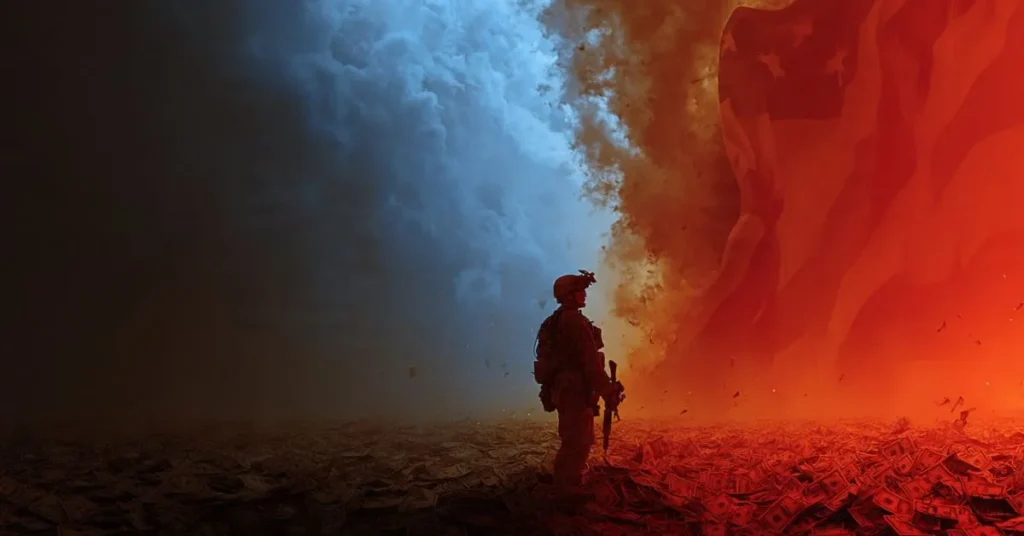
The Cost of Political Ego: When Decisions Override Economics in War
Throughout history, wars have been initiated, prolonged, and escalated not by rational economic calculation, but by the unbending pride of leaders who couldn’t admit error. The phenomenon transcends culture, ideology, and era. From World War I’s trench warfare stalemate to the decades-long War on Terror, political egos have consistently overridden economic reality — transforming what should be calculated risk assessments into catastrophic wealth destruction on scales that beggar imagination.
The economic consequences of ego-driven warfare extend far beyond battlefield costs. They encompass lost human capital, environmental devastation that spans generations, technological development diverted from productive civilian uses, and institutional inertia that prevents peace dividends from ever materialising. Moreover, in our interconnected global economy, a single leader’s pride can trigger inflation cascades affecting populations thousands of miles from any combat zone.
This analysis dissects the true economic costs of political ego in warfare. We’ll examine the sunk cost fallacy that keeps conflicts grinding forward long after victory becomes impossible, the overconfidence bias that makes leaders grotesquely underestimate war duration and costs, and the brain drain that creates economic collapse persisting decades after peace treaties are signed. Understanding these dynamics matters because they continue operating today — and the next major conflict driven by political ego may already be in its planning stages.
The Sunk Cost Fallacy: ‘Too Much Sacrificed to Quit Now’
Perhaps no cognitive bias has proven more deadly in military history than the sunk cost fallacy. The logic appears deceptively compelling: ‘We’ve already sacrificed so much — 7,000 soldiers dead, $2 trillion spent. How can we quit now and let those deaths mean nothing?’ This argument surfaces reliably whenever withdrawal from failing conflicts is proposed. It sounds honourable. It sounds patriotic. It’s also completely irrational from any economic perspective.
The economic principle is straightforward: sunk costs are expenditures that cannot be recovered once made. Therefore, rational decision-making should ignore them entirely and focus only on future costs versus future benefits. If continuing a war will cost another $500 billion with minimal probability of achieving stated objectives, the $2 trillion already spent is irrelevant to whether continuation makes sense. Past costs cannot be changed. Only future costs can be avoided.
Yet political leaders repeatedly reject this logic. As military analyst Carl Forsling observes, ‘The military, more than any other institution, lives by sunk costs. Once a man is lost, seizing a piece of ground, it becomes hallowed. How can we give this up after all we’ve sacrificed?’ This emotional attachment transforms military decisions into monuments to past sacrifice rather than rational assessments of future options.
World War I: The Prototype of Sunk Cost Madness
The Great War provides perhaps the clearest historical example. After initial mobilisation failed to produce a quick victory, European powers faced a choice: negotiate a settlement recognising that territorial gains wouldn’t justify the mounting casualties, or continue feeding men into the meat grinder, hoping for a breakthrough. Leaders consistently chose the latter. Historical analysis suggests that by 1916, military and political leadership on all sides understood the stalemate’s fundamental nature — yet couldn’t conceive of stopping because ‘we’ve sacrificed too much.’
The economic irrationality becomes staggering when examining the numbers. By 1917, Britain was spending over 50% of its GDP on the war effort. France faced similar burdens. Germany’s economy collapsed under the strain. These weren’t investments with expected returns — they were wealth destruction on an industrial scale, continued primarily because admitting that 1914-1916 deaths were meaningless proved psychologically impossible for leaders whose egos were invested in vindication.
Moreover, each additional month of warfare didn’t just waste resources — it compounded future costs through destroyed infrastructure, killed productive workers, and accumulated debt requiring decades of repayment. The sunk cost fallacy prevented recognition that cutting losses in 1916 would have left all combatants immensely better off than continuing to 1918. Political ego demanded vindication. Economics was irrelevant.
The War on Terror and Modern Sunk Cost Thinking
Fast-forward a century. The post-9/11 wars in Afghanistan and Iraq cost the United States over $6 trillion and 7,000 military deaths. By 2010, most honest assessments concluded that stated objectives were unachievable. Yet withdrawal faced fierce resistance rooted explicitly in sunk cost logic: ‘Do you want their deaths to mean nothing?!’ This question, emotionally powerful, is economically nonsensical. Those deaths already occurred. The only relevant question is whether future expenditures will achieve objectives worth their cost.
The consequences of sunk cost thinking in Afghanistan proved devastating. Each additional year costs roughly $50 billion while accomplishing virtually nothing toward sustainable governance or counter-terrorism objectives. That $50 billion represented opportunity costs — schools not built, infrastructure not repaired, research not funded, poverty not alleviated. The sunk cost fallacy didn’t just waste money already spent; it prevented recognition that continued spending was wasting money that could still be saved or redirected.
The ‘Home by Christmas’ Delusion: Overconfidence Bias in War Planning
Every major conflict of the past century began with leaders assuring their populations that victory would come quickly. World War I soldiers were told they’d be ‘home by Christmas.’ Nazi Germany expected to conquer the Soviet Union in three months. The United States entered Vietnam expecting to stabilise the situation within a few years. These weren’t lies, necessarily — they were manifestations of overconfidence bias, the systematic tendency of decision-makers to overestimate their own capabilities while underestimating obstacles and adversary determination.
The economic implications are catastrophic. When leaders dramatically underestimate war duration, initial budget allocations bear no relationship to actual costs. Governments commit to conflicts based on financial projections that prove laughably wrong — not by small margins, but by factors of ten or more. This isn’t a mere forecasting error. It’s a psychological blind spot whereby political egos cannot conceive of outcomes other than swift victory.
The Planning Fallacy in Military Budgeting
Consider the U.S. invasion of Iraq in 2003. Initial cost estimates ranged from $50-60 billion. Actual costs exceeded $2 trillion. This isn’t a 20% miscalculation — it’s 97% error. Such massive forecasting failures stem from overconfidence bias operating at multiple levels. Military planners overestimate their own competence. Political leaders overestimate the duration of public support. Both underestimate adversary resilience and the complexity of post-conflict governance.
Moreover, this bias creates a ratchet effect. Once a conflict exceeds initial projections, admitting the scale of miscalculation becomes politically untenable. Leaders double down, insisting that ‘just a bit more’ will achieve victory. Each escalation carries its own optimistic timeline that proves equally wrong. The economic burden compounds as treasuries empty and debts accumulate, yet political egos prevent honest reassessment because that would require acknowledging fundamental errors in judgment.
Institutional Incentives for Optimistic Forecasting
The bias gets reinforced by institutional dynamics. Military leadership gains promotions and budget increases by projecting confidence and capability. Political figures win elections by promising decisive action with minimal costs. Sceptical voices face accusations of defeatism or lack of patriotism. Consequently, the planning process systematically filters out realistic assessments in favour of optimistic projections that serve short-term political needs while guaranteeing long-term economic disaster.
| Conflict | Initial Duration Estimate | Actual Duration | Initial Cost Estimate | Actual Cost |
| World War I | ~6 months (‘Home by Christmas’) | 4+ years | ~£1B (UK) | ~£35B+ (UK alone) |
| Vietnam War | 2-3 years stabilization | 20 years of active involvement | $10-15B estimated | $168B+ (nominal) |
| Afghanistan | Swift Taliban removal | 20 years of occupation | ~$20-30B initial | $2.3 trillion total |
| Iraq War | Quick regime change | 8 years of combat, ongoing effects | $50-60B projected | $2+ trillion total |
Sources: Various historical analyses. Cost figures are inflation-adjusted where applicable.
The Innovation Versus Destruction Paradox
Defenders of military spending frequently invoke technological spillovers: ‘Yes, war is costly, but it gives us the Internet, GPS, jet engines, and countless other innovations!’ This argument appears throughout policy debates, seemingly offering economic justification for otherwise irrational expenditures. The reality proves far more complex and far less favourable than these examples suggest.
The Broken Window Fallacy Applied to R&D
The broken window fallacy, articulated by economist Frédéric Bastiat in 1850, remains relevant. Breaking a window doesn’t create economic value by generating work for glaziers — it destroys the value that the window represented and diverts resources from other productive uses. Similarly, any innovation from military spending must be weighed against what would have been invented if those same billions funded civilian research and development.
Consider the ARPANET project that eventually became the Internet. This consumed billions in defence spending over decades. The question isn’t whether ARPANET succeeded, but whether comparable investment in civilian networking research would have produced similar or better results sooner. Given that commercial incentives for communication networks were already enormous, there’s a strong reason to believe civilian development would have progressed rapidly without military funding.
Moreover, military R&D priorities often distort technological development away from applications with the greatest civilian benefit. Resources flow toward weapons systems rather than medical research, battlefield communications rather than education technology, armoured vehicles rather than sustainable energy. The opportunity cost isn’t merely delayed innovation — it’s fundamental misdirection of scientific talent and capital toward less socially beneficial applications.
What We Lost: The Innovation Not Pursued
Every dollar spent on military research represents an investment not made elsewhere. The post-WWII period saw massive defence R&D spending that produced jet engines and nuclear technology. But what diseases would have been cured if medical research received equivalent funding? What energy breakthroughs would have emerged from comparable investment in physics and chemistry? These counterfactuals can’t be proven, but the logic remains inescapable: scientific resources are finite, and their allocation determines technological trajectories.
Furthermore, the human capital destruction of warfare eliminates potential researchers who might have made revolutionary discoveries. World War II killed tens of millions, including countless individuals who would have contributed to postwar innovation had they survived. The opportunity cost of war-related innovation includes not just diverted resources but lost human capital that can never be recovered.
Brain Drain: The Silent Economic Collapse
When conflict erupts, the most economically valuable citizens often leave first. Doctors, engineers, software developers, entrepreneurs — those with internationally marketable skills and resources to relocate — exit rapidly. This brain drain creates a secondary economic collapse that persists decades after fighting ends, because the engine of economic growth has physically relocated to other countries.
The Flight of Human Capital
Syria provides a stark contemporary example. Before 2011, Syria had an educated middle class, including doctors, engineers, and academics. By 2016, over 5 million Syrians had fled as refugees. This wasn’t a representative cross-section of the population — it disproportionately included the most educated and skilled workers who possessed resources to escape and credentials recognised internationally.
The economic consequences compound across generations. Syrian doctors now practice in Germany, Turkey, and Sweden — contributing to those economies rather than rebuilding their homeland. Syrian engineers work for tech companies in Dubai and North America. Their children will be educated abroad, integrate into foreign societies, and likely never return. Syria didn’t just lose current production capacity; it lost the future scientists, entrepreneurs, and leaders who would have driven postwar recovery.
Moreover, this pattern repeats across conflicts. UNHCR data shows that refugee flows consistently include disproportionate numbers of educated professionals. This isn’t surprising — education and wealth enable migration. But it means war-torn countries lose precisely the human capital most essential for economic recovery. The resulting vicious cycle sees brain drain → economic stagnation → continued instability → further brain drain.
Remittances Versus Domestic Investment
Some argue that diaspora remittances offset brain drain by channelling money back to origin countries. While remittances do provide important household income, they cannot substitute for domestic human capital. Remittances fund consumption, not productive investment. They don’t build companies, conduct research, or train the next generation of professionals. A doctor in Germany sending money home to family does not equate to replacing the medical services and training capacity that the doctor would have provided domestically.
Furthermore, remittances create dependency rather than development. Economies become structurally reliant on expatriate transfers instead of developing productive capacity. This dependency makes them vulnerable to external shocks affecting diaspora communities and prevents the institutional development that comes from having educated professionals engaged in domestic governance and economic management.
War-Induced Inflation: The Regressive Tax Nobody Voted For
Warfare creates powerful inflationary pressures through multiple channels. Governments print money to finance military spending. Supply chains get disrupted. Labour shortages emerge. Commodity prices spike. The resulting inflation functions as a regressive tax, hitting hardest those with fixed incomes and savings while enriching those holding real assets. Political egos that initiate wars impose this tax without democratic consent or compensation for those who suffer its effects.
The Money-Printing Path to Inflation
Major wars historically get financed through three mechanisms: taxes, borrowing, and money creation. The first two prove politically difficult to sustain at the massive scales required. Consequently, governments turn to the printing press — expanding the money supply to pay military salaries, purchase equipment, and fund logistics. As economic historians document, this pattern appears repeatedly from the U.S. Civil War through both World Wars to modern conflicts.
The consequences fall disproportionately on middle-class savers. Those with wealth in stocks, real estate, or commodities see asset prices inflate alongside currency. Those with cash savings or fixed-income investments watch purchasing power evaporate. The American Civil War provides a stark example: Confederate money-printing rendered savings worthless for millions while war profiteers accumulated real assets at bargain prices. The distributional effects of war-induced inflation represent wealth transfer from ordinary citizens to those positioned to benefit from currency debasement.
Supply-Side Shocks and Stagflation
Beyond monetary expansion, war disrupts production capacity directly. Factories convert to military production. Agricultural land becomes battlefields. Trade routes close. Workers join armies. The combination of reduced supply and increased monetary demand creates a perfect inflationary storm. Historical examples abound: World War II saw significant inflation despite price controls and rationing. The Gulf War spiked oil prices globally. Russia’s invasion of Ukraine triggered food and energy inflation, affecting populations worldwide.
These supply shocks hit necessities hardest — food, energy, and housing. Consequently, lower-income households allocating larger budget shares to essentials experience disproportionate welfare losses. A 20% increase in food prices imposes a manageable burden on wealthy households but devastates those already near subsistence. War-induced inflation thus operates as a profoundly regressive tax, compounding other economic harms of conflict.
Hyperinflation: When Printing Presses Run Wild
In extreme cases, war financing through money creation produces hyperinflation — inflation rates exceeding 50% monthly. The most dramatic examples occurred in war-devastated economies: Hungary in 1946 experienced the highest recorded hyperinflation following World War II destruction. Austria faced similar conditions. These cases weren’t gradual inflation but complete monetary collapse, where currency became literally worthless.
Hyperinflation destroys economies comprehensively. Savings evaporate overnight. Contracts become meaningless. Investment ceases. Barter replaces monetary exchange. The social fabric tears as economic activity grinds to a halt. Recovery requires not just monetary reform but rebuilding trust in financial institutions — a process requiring years or decades. The political egos that initiate wars rarely suffer these consequences directly, as leadership typically insulates itself through foreign assets and special privileges.
Environmental Debt: The Invoice Future Generations Will Pay
Modern warfare’s environmental costs dwarf historical comparisons. Military operations consume petroleum at staggering rates. Explosives contaminate soil and water. Infrastructure destruction requires energy-intensive reconstruction. Yet these costs rarely appear in war budgets, instead manifesting as long-term environmental degradation and cleanup expenses paid decades later by populations who never consented to the conflict.
The Carbon Footprint of Military Operations
The U.S. military alone ranks as one of the world’s largest petroleum consumers. Aircraft carriers, tanks, transport aircraft, and logistics chains burn fuel at rates exceeding many nations’ total consumption. Each bomb dropped, each building destroyed, each convoy dispatched contributes to carbon emissions that will drive climate change for centuries. These emissions don’t appear in military accounting as costs, yet their economic impact through climate disruption will eventually exceed direct military expenditures.
Moreover, reconstruction’s carbon footprint compounds initial damage. Rebuilding destroyed cities requires producing cement, steel, glass, and other materials — all energy-intensive manufacturing processes. The total carbon cost of a conflict, therefore, includes not just military operations but decades of reconstruction emissions. This environmental debt represents the transfer of costs from current generations making war decisions to future generations inheriting a degraded climate.
Land Contamination and Cleanup Costs
Beyond carbon emissions, warfare leaves physical contamination requiring massive cleanup expenditures. Unexploded ordnance renders land unusable for agriculture. Chemical weapons contaminate water supplies. Destroyed infrastructure leaks pollutants. Vietnam still suffers from Agent Orange contamination 50 years after the war ended. Laos has faced unexploded bomb problems for generations.
The cleanup costs frequently exceed the original weapons’ costs by orders of magnitude. A bomb costing $50,000 might require $2 million in removal expenses plus indefinite monitoring. Multiply across millions of munitions, and total cleanup bills reach hundreds of billions — expenses typically not included in initial war budgets. Political leaders who initiate conflicts rarely remain in office long enough to fund cleanup, instead passing this environmental debt to successors who face impossible choices between cleanup funding and other social needs.
Weaponising Global Interdependence: Supply Chain Contagion
Modern economic integration means that warfare between any two nations triggers cascading effects globally. Supply chains depend on components sourced worldwide. Financial systems interconnect across borders. Commodity markets respond instantly to disruption anywhere. Consequently, a single leader’s ego-driven decision to initiate conflict can spike bread prices 5,000 miles from any battlefield, creating economic harm and moral responsibility extending far beyond immediate combatants.
The Sanctions Paradox
Economic sanctions represent warfare by other means — attempts to coerce adversaries through economic pain rather than military force. Yet sanctions rarely remain contained to the target countries. When the West sanctioned Russia following Ukraine’s invasion, energy prices spiked globally. European households faced heating cost increases. African nations dependent on Russian and Ukrainian grain exports faced food shortages. The sanctions achieved their political purpose, but imposed enormous costs on populations having no connection to the conflict.
This raises profound moral questions about who bears responsibility for economic damage from sanctions. When German industry contracts due to energy sanctions, should Russians pay compensation? When Sub-Saharan Africa faces famine from disrupted grain exports, who owes relief? Political leaders initiating conflicts or sanctions rarely consider these collateral costs, yet they represent real economic harm to innocent third parties. The interconnected global economy ensures that no conflict remains truly bilateral.
Critical Supply Chain Concentration
Globalisation created efficiency through specialization but also created vulnerabilities through concentration. Taiwan produces the majority of advanced semiconductors. Ukraine and Russia combined supply 30% of global wheat exports. A handful of shipping chokepoints carry enormous trade flows. Conflict affecting any of these critical nodes triggers global economic disruption disproportionate to the physical damage in the conflict zone.
Political egos that initiate wars rarely account for these systemic vulnerabilities. The decision to invade Ukraine was made without apparent consideration for global food security implications. Taiwan conflict scenarios seldom incorporate semiconductor disruption costs to the global economy. Leaders focus narrowly on bilateral military advantages while ignoring how modern supply chains ensure that regional conflicts become everyone’s economic problem.
| Conflict/Sanction | Direct Geographic Scope | Global Economic Impact | Duration of Impact |
| Ukraine War (2022-) | Ukraine, Russia, Belarus | Global energy and food inflation | Multi-year ongoing |
| Gulf War (1990-91) | Iraq, Kuwait, Saudi Arabia | Oil price spike to $46/barrel | ~6 months acute |
| Suez Crisis (1956) | Egypt, Suez Canal | Oil supply disruption, rationing | Several months |
| Taiwan Scenario | Taiwan, China (hypothetical) | Semiconductor shortage, global recession | Years to decade+ |
Historical events and hypothetical scenario analysis
The Peace Dividend That Never Arrives
When wars end, populations reasonably expect a ‘peace dividend’ — the redirection of military spending toward civilian priorities. Infrastructure investment, education funding, and healthcare expansion — all the social goods deferred during conflict should finally receive resources once fighting stops. In practice, this dividend rarely materialises. Instead, institutional inertia and the military-industrial complex ensure that spending floors established during wartime become new peacetime baselines.
The Ratchet Effect in Military Spending
Examine U.S. defence spending across the 20th century. Each major conflict — World War II, Korea, Vietnam, Cold War buildup — increased military budgets dramatically. Following each conflict, spending declined somewhat but never returned to pre-war levels. Instead, a new, higher baseline emerged. The pattern resembles a ratchet: easy to turn one direction, nearly impossible to reverse.
This ratchet operates through multiple mechanisms. Defence contractors establish permanent relationships with procurement offices. Military bases become economic anchors for local communities whose political representatives fight closure. Weapons systems take decades to develop, creating long-term funding commitments. Veterans’ benefits accumulate. Each war adds permanent obligations that prevent spending reductions even during peace.
The Military-Industrial Complex as Economic Parasite
President Eisenhower warned in 1961 about the military-industrial complex — the interlocking relationships between defence contractors, military leadership, and political figures that perpetuate military spending regardless of actual security needs. This complex operates as an economic parasite, extracting resources from productive sectors while contributing minimally to genuine security.
The dynamics are self-reinforcing. Defence contractors fund political campaigns. Politicians vote for weapons systems manufactured in their districts. Military officers retire into lucrative defence industry positions. Pentagon budgets increase regardless of threats. Meanwhile, social spending faces constant austerity pressure despite military spending consuming 3-4% of GDP even during peacetime. The opportunity cost represents schools not built, infrastructure not repaired, research not funded — all sacrificed to maintain unnecessary military capacity.
Veterans’ Costs: The Long Tail of War Spending
Even when active conflict ends, costs continue accumulating for decades through veterans’ benefits, medical care, and disability payments. World War II veterans received benefits into the 21st century — over 70 years after the war ended. Vietnam veterans continue receiving care. Iraq and Afghanistan veterans will require support for 50+ years.
These obligations represent entirely appropriate moral commitments to those who served. However, they also illustrate how war costs extend vastly beyond immediate military spending. A politician committing forces to combat in 2025 is committing taxpayers to funding consequences until 2075 or beyond. Yet budget projections rarely incorporate these long-term costs honestly. The true fiscal burden of war-initiation decisions gets hidden through accounting conventions that treat veterans’ spending as separate from ‘defence’ spending.
Psychological Barriers to Rational War Termination
Understanding why wars continue despite their economic irrationality requires examining psychological factors operating at individual and institutional levels. Political leaders face cognitive biases that prevent rational cost-benefit analysis. Institutions develop self-perpetuating incentives. Publics experience nationalism that overrides economic self-interest. These psychological barriers ensure that economic logic alone cannot prevent or terminate conflicts.
Loss Aversion and the Pain of Admitting Error
Loss aversion — the tendency to weigh losses more heavily than equivalent gains — operates powerfully in military contexts. Admitting that war was a mistake means acknowledging that deaths were meaningless, treasure was wasted, and suffering was unnecessary. Political egos cannot bear this admission. Consequently, leaders double down, insisting that continued sacrifice will eventually vindicate initial decisions.
This pattern appears across conflicts regardless of ideology or political system. Democratic leaders face electoral incentives to project strength and avoid admissions of failure. Authoritarian leaders face even stronger incentives, as admitting error might trigger regime instability. The result is the continuation of wars long after any rational analysis would recommend termination. Economic costs become irrelevant compared to political survival imperatives.
Commitment Bias and Reputation Concerns
Leaders who publicly commit to military objectives face pressure to follow through regardless of changing circumstances. Backing down appears as weakness. Admitting miscalculation invites domestic political attacks. Therefore, initial commitments become psychological traps where leaders feel compelled to escalate rather than withdraw, even when escalation makes situations worse.
International reputation concerns compound this dynamic. Leaders fear that withdrawal signals weakness to adversaries, potentially inviting future challenges. This logic drove American escalation in Vietnam — policymakers repeatedly argued that withdrawal would undermine credibility globally. In retrospect, this appears obviously wrong; continued involvement caused far more reputational damage than earlier withdrawal would have. Yet at the time, commitment bias prevented rational reassessment.
Breaking the Cycle: Economic Accountability in Military Decision-Making
If political egos consistently override economic rationality in warfare, how can societies establish accountability mechanisms that prevent or limit damage? Several potential reforms deserve consideration, though implementing any faces formidable political obstacles.
Mandatory Economic Impact Assessments
Requiring comprehensive economic impact assessments before military action might inject reality into decision-making. Such assessments would include direct costs, opportunity costs, long-term obligations like veterans’ care, environmental cleanup expenses, and potential global supply chain disruptions. Publishing these assessments would enable public debate about whether military objectives justify economic burdens.
However, this faces obvious problems. Governments have strong incentives to underestimate costs, as demonstrated repeatedly in pre-war planning. Independent assessment institutions might prove more honest, but face access problems to classified information. Moreover, even accurate assessments might not prevent wars driven primarily by political ego rather than rational calculation. Still, mandatory economic accounting would at least make leaders explicitly acknowledge costs they currently ignore.
Sunset Provisions for Military Authorisations
Many democracies require periodic renewal of military authorisations. The United States Constitution grants Congress war declaration powers, yet post-9/11 authorisations remain in effect decades later with no expiration. Requiring military actions to receive renewed legislative approval every 2-3 years would force periodic reassessment of whether continued commitment makes economic and strategic sense.
Sunset provisions wouldn’t prevent initial conflicts but might limit their duration. Political leaders would need to regularly justify continuation, making it harder to sustain wars purely through inertia. Economic costs would become more politically salient when presented for reconsideration rather than buried in continuing appropriations. This mechanism addresses the sunk cost fallacy by structurally requiring evaluation of future costs independent of past expenditures.
Personal Financial Liability for Leaders
More radically, some theorists propose making political leaders personally financially liable for war costs. If presidents or prime ministers initiating conflicts faced personal wealth consequences proportional to the costs incurred, their incentives might align better with societal welfare. This would internalise costs currently externalised onto taxpayers.
This faces enormous practical and ethical problems. Determining appropriate liability is nearly impossible. Leaders might simply become more secretive about decision-making. The mechanism could be manipulated by wealthy individuals comfortable accepting personal costs. Nevertheless, the thought experiment highlights the fundamental problem: current institutional arrangements allow leaders to impose massive costs on others while bearing minimal personal consequences for errors in judgment.
Legal Disclaimer
This article presents an analysis of historical events and economic phenomena for educational purposes. It does not constitute political advice, investment guidance, or policy recommendations. Views expressed represent the author’s interpretation of historical and economic evidence. Readers should consult qualified professionals before making decisions based on information contained herein. The author and publisher assume no liability for actions taken based on this analysis.
Conclusion: The Unbearable Cost of Ego Unchecked by Economics
The historical record offers a damning verdict: when political ego encounters economic rationality in military contexts, ego wins consistently. Leaders continue wars long past the point where costs exceed any conceivable benefit. They initiate conflicts based on wildly optimistic projections and refuse to acknowledge error when reality proves them wrong. They impose environmental damage, trigger inflation, cause brain drain, and prevent peace dividends from materialising — all while insisting that ‘national honour’ justifies unlimited sacrifice.
The economic costs of this dynamic are almost beyond comprehension. World War I cost combatants over $200 billion (1918 dollars) — perhaps $4 trillion in modern terms. World War II cost even more. The post-9/11 wars consumed $6 trillion. These figures don’t include opportunity costs — the medical research not funded, the infrastructure not built, the education not provided. They don’t include long-term veteran care, environmental cleanup, or compound economic effects of destroyed human capital.
Moreover, the pattern continues operating today. Every major power maintains military spending levels far exceeding rational security needs. Sunk cost thinking drives force structure decisions. Overconfidence bias pervades contingency planning. The military-industrial complex extracts resources while contributing minimally to actual security. Brain drain from current conflicts will create economic problems for decades. War-induced inflation erodes purchasing power globally.
Breaking this cycle requires confronting uncomfortable truths about human psychology and political institutions. We must acknowledge that leaders are not rational actors conducting cost-benefit analyses. They are ego-driven individuals subject to cognitive biases that routinely produce catastrophic decisions. We must recognise that economic logic alone cannot constrain warfare, because wars are fundamentally about politics and psychology rather than economics.
Yet acknowledging these realities need not lead to fatalism. Institutional reforms can create structural constraints on political ego. Transparency requirements force honest accounting of costs. Sunset provisions enable periodic reassessment. Democratic accountability allows populations to impose consequences on leaders whose decisions prove disastrous. The goal isn’t eliminating all warfare — sometimes military action may be genuinely necessary — but ensuring that economic costs receive appropriate weight in decisions currently dominated by political ego.
Until societies establish such mechanisms, the pattern will continue. Political leaders will initiate conflicts based on optimistic fantasies. They will continue wars long past rational stopping points. They will impose enormous economic costs on populations who never consented to the decisions. And they will rarely face personal consequences for the devastation their egos wrought. The cost of political ego in warfare is measured not just in wasted treasure but in destroyed lives, stolen futures, and opportunities forever lost.
Spend some time for your future.
To deepen your understanding of today’s evolving financial landscape, we recommend exploring the following articles:
Global EVs After the Boom: What’s Really Driving Demand Now
Sleep-Test Investing: Building a Portfolio You Can Hold Through Any Market
Influencer Marketing Failures: When Follower Counts Don’t Equal Sales
Saving a Dying Business: No-Capital Turnaround Strategies That Actually Work
War Economy Chapter 9: Sanctions, Trade Wars, and Economic Weapons Explained
Explore these articles to get a grasp on the new changes in the financial world.
References
[1] A. R. Hall Blanco, ‘The Sunk Cost Fallacy in the War on Terror,’ American Institute for Economic Research, 2021. [Online]. Available: https://thedailyeconomy.org/article/the-sunk-cost-fallacy-in-the-war-on-terror/
[2] A. Davies, ‘Don’t look back: the fallacy of sunk costs,’ The Strategist, Australian Strategic Policy Institute, 2020. [Online]. Available: https://www.aspistrategist.org.au/dont-look-back-the-fallacy-of-sunk-costs/
[3] C. Forsling, ‘Understanding the sacrifice and sunk cost of the war in Afghanistan,’ Task & Purpose, Mar. 2020. [Online]. Available: https://taskandpurpose.com/news/afghanistan-sunk-costs-withdrawal/
[4] The Decision Lab, ‘The Sunk Cost Fallacy,’ The Decision Lab, 2023. [Online]. Available: https://thedecisionlab.com/biases/the-sunk-cost-fallacy
[5] Economics Help, ‘Economic impact of war,’ Economics Help, 2022. [Online]. Available: https://www.economicshelp.org/blog/2180/economics/economic-impact-of-war/
[6] Sveriges Riksbank, ‘Monetary policy and inflation in times of war,’ Economic Review, 2022. [Online]. Available: https://www.riksbank.se/globalassets/media/rapporter/pov/artiklar/engelska/2022/221216/2022_2-monetary-policy-and-inflation-in-times-of-war.pdf
[7] ScienceDirect, ‘What is it good for? On the inflationary effects of military conflict,’ Economic Modelling, 2024. [Online]. Available: https://www.sciencedirect.com/science/article/abs/pii/S2110701724000581
[8] European Parliament, ‘The direct and indirect impacts of the war on inflation,’ Economic Governance and EMU Scrutiny Unit, 2023. [Online]. Available: https://www.europarl.europa.eu/RegData/etudes/IDAN/2023/741487/IPOL_IDA(2023)741487_EN.pdf
[9] RSM US LLP, ‘Life during wartime: Inflation, price controls and economic conflict,’ RSM Insights, 2022. [Online]. Available: https://rsmus.com/insights/economics/life-during-wartime.html
[10] Reddit AskHistory, ‘How much did the sunk cost fallacy play into continuing WW1?’ Reddit discussion, Jan. 2025. [Online]. Available: https://www.reddit.com/r/AskHistory/comments/1hrb2wg/how_much_did_the_sunk_cost_fallacy_play_into/