
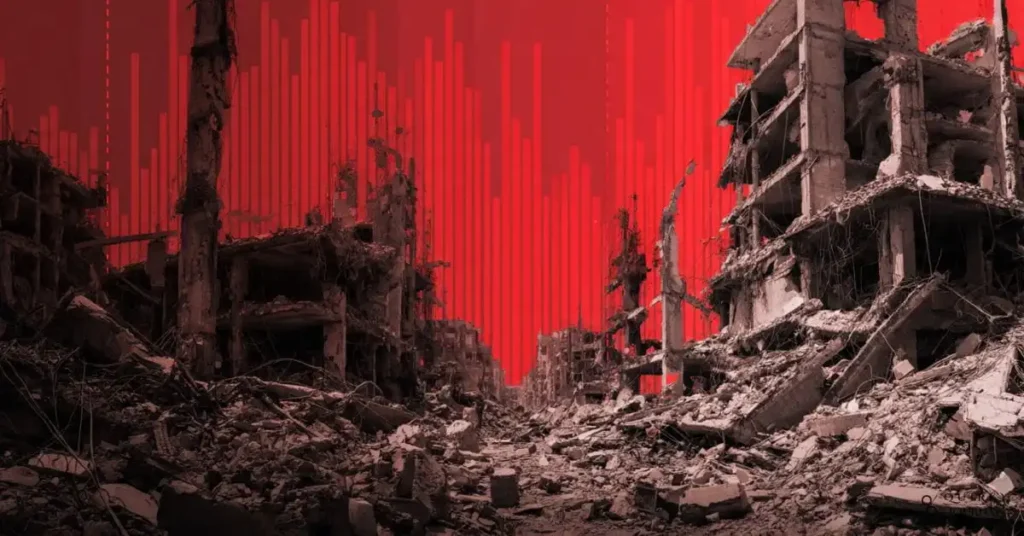
War Economy: Which Sectors Collapse First During Conflict
War does not destroy economies evenly. Instead, it tears through specific sectors in a predictable sequence, leaving communities vulnerable long before peace arrives. Understanding which sectors collapse first during conflict is not just an academic exercise. It is a vital guide for policymakers, investors, humanitarian workers, and ordinary citizens who want to prepare for the economic shockwaves of armed conflict.
History offers a grim but instructive record. From the ruins of post-invasion Iraq to the fractured economies of South Sudan and Sudan, certain industries always buckle first. Financial systems freeze. Supply chains shatter. Healthcare systems collapse under impossible pressure. Then, gradually, everything else follows.
This post examines the war economy in detail. Furthermore, it explores the cascade of sector failures that follows the outbreak of conflict. Whether you are studying macroeconomic impacts of war, tracking conflict-driven market disruptions, or simply trying to understand what happens to ordinary people when bullets start flying, this guide covers the full picture.
How War Reshapes an Economy: The Big Picture
Before diving into specific sectors, it helps to understand the broader economic mechanics at play. War is, at its core, a massive misallocation of resources. Governments redirect spending away from schools, hospitals, and roads toward weapons, soldiers, and fortifications.
According to research by Benmelech and Monteiro (2025), covering 115 conflicts across 145 countries over 75 years, real GDP falls by roughly 12% over ten years on average. Moreover, the damage does not stop when the guns go silent. Investment collapses by around 13%, and domestic credit drops by 20%, a figure larger than the output loss itself.
Additionally, exports fall by 12% and imports by 7%, severing countries from global trade networks they may have spent decades building. These are not temporary disruptions. Rather, they are long-term structural wounds that reshape entire generations.
Consequently, the question shifts from whether a war economy will collapse to which parts of it will fall first. The answer follows a clear, repeatable pattern across conflicts ranging from World War II to the Ukraine-Russia war of the 2020s.
Sector 1: Financial Systems and Banking
The financial sector is almost always the first casualty of war. Banks depend on confidence. Conflict destroys confidence almost instantly. As soon as fighting begins, depositors rush to withdraw cash. Businesses halt lending. Foreign investors flee to safer markets.
Consider what happened in Ukraine in 2022. Within days of the Russian invasion, the hryvnia fell sharply, ATM queues stretched around city blocks, and the central bank had to impose strict capital controls to prevent total financial collapse. Similarly, the Lebanese banking crisis, though not purely war-driven, illustrated how quickly a banking system can freeze when geopolitical instability intersects with weak institutions.
Furthermore, the collapse of domestic credit has devastating knock-on effects. Small businesses cannot access loans. Construction projects stall. Even surviving businesses struggle to pay wages. Thus, the financial sector collapse acts as the trigger that initiates failures elsewhere in the economy.
Why Credit Markets Freeze During Conflict
Credit markets freeze for several interconnected reasons. First, lenders cannot assess risk accurately when the future is uncertain. Second, collateral values plummet as property markets crash. Third, capital flight depletes the pool of lendable funds. Interest rates do not fall to stimulate lending, as one might expect. Instead, they either spike or become irrelevant as lenders simply refuse to extend credit regardless of the rate.
Therefore, businesses that relied on rolling credit lines to fund daily operations quickly find themselves unable to function. Payroll cannot be met. Suppliers stop extending trade credit. Then, piece by piece, the commercial sector begins to seize up.
| Conflict | Financial Impact | Currency Change | Credit Contraction |
| Ukraine (2022) | Banking freeze, capital controls | Hryvnia fell ~30% | Severe domestic credit decline |
| Syria (2011-present) | Banking system near total collapse | The pound lost 98%+ of its value | Formal credit is almost non-existent |
| Lebanon (2019-2022) | Bank deposits frozen | The pound lost 90%+ of its value | Lending effectively halted |
| Iraq (2003) | Banking infrastructure destroyed | Dinar is volatile, with a hyperinflation risk | Credit markets non-functional |
| Yugoslavia (1991-1995) | Hyperinflation, currency collapse | The Yugoslav dinar collapsed | Inter-republic credit severed |
Sector 2: Energy and Fuel Supply
Energy infrastructure is a primary military target in virtually every modern conflict. Power grids, pipelines, fuel depots, and refineries are strategically vital, which makes them strategically vulnerable. Consequently, the energy sector collapses early, and its failure cascades through every other part of the economy.
In Yemen’s ongoing civil war, deliberate attacks on fuel infrastructure have repeatedly crippled the entire economy. Without fuel, water pumping stations fail. Hospitals cannot run generators. Food transport grinds to a halt. Essentially, destroying energy infrastructure is a force multiplier for economic damage.
Similarly, Russia’s systematic targeting of Ukrainian energy infrastructure throughout 2022 and 2023 demonstrated how effectively this strategy weakens civilian resilience. Rolling blackouts lasting up to 12 hours per day disrupted factories, hospitals, schools, and homes simultaneously.
The Ripple Effects of Energy Sector Failure
When energy infrastructure collapses, the ripple effects are immediate and severe. Manufacturing plants dependent on stable electricity stop production. Cold chains for food and medicine break down, leading to spoilage and shortages. Telecommunications networks falter as backup generators run out of fuel. Moreover, water treatment plants stop functioning, creating public health emergencies that compound the suffering caused directly by conflict.
According to the International Energy Agency, energy security is the foundation upon which every other aspect of economic activity rests. Consequently, when this foundation cracks, recovery becomes exponentially harder. The rebuilding of energy infrastructure after conflict typically costs billions and takes years, as post-conflict reconstruction data from Iraq makes painfully clear.
Sector 3: Trade, Supply Chains, and Agriculture
Trade collapses rapidly during conflict. Export routes become dangerous or impossible to use. Import channels dry up as foreign suppliers refuse to deal with unstable partners. Ports may be blockaded or destroyed. Roads become battlegrounds. The result is a rapid deterioration in the availability of both raw materials and finished goods.
Agriculture suffers especially badly. Farmers abandon fields. Livestock are killed or stolen. Irrigation systems are damaged. Seasonal planting cycles are missed, with effects that last for years. According to the Food and Agriculture Organisation of the United Nations, armed conflict is now the leading driver of food insecurity globally, responsible for the majority of people facing acute hunger.
Furthermore, the relationship between food insecurity and conflict is circular. Food shortages fuel grievances. Grievances extend conflicts. Extended conflicts destroy more agricultural capacity. Breaking this cycle requires deliberate intervention, yet during active fighting, such intervention is nearly impossible.
Global Supply Chain Vulnerability
Modern economies depend on just-in-time supply chains that have very little slack. War introduces enormous uncertainty into these systems. Shipping insurance costs skyrocket for conflict zones. Vessels reroute around danger areas, increasing transit times and costs. Even conflicts that seem geographically distant can disrupt global supply chains, as the Red Sea shipping disruptions of 2023 and 2024 demonstrated clearly.
Therefore, even countries not directly involved in a conflict can experience serious economic consequences. Prices rise. Shortages develop. Business confidence falls. The global economy is so deeply interconnected that war in one region sends shockwaves across the entire system.
Sector 4: Healthcare and Public Health
Healthcare systems collapse under the dual pressure of dramatically increased demand and severely disrupted supply. Hospitals struggle to treat both battle casualties and the normal population, who now cannot access routine care. Medical supply chains break down. Healthcare workers flee conflict zones. Many facilities are deliberately targeted or repurposed for military use.
In Sudan, according to research from the Lieber Institute at West Point, an estimated 70 to 80% of hospitals in conflict-affected states have been rendered non-functional. This is not a marginal reduction in healthcare capacity. It is a near-total collapse that leaves millions without any access to medical care.
Preventable diseases spread rapidly when healthcare collapses. Cholera, measles, malaria, and dengue fever all surge. Vaccination programmes stop. Prenatal care disappears. Mental health services, already stretched thin before the conflict, become essentially non-existent. The health consequences extend far beyond the injuries directly caused by fighting.
Long-Term Health Consequences of Conflict
Perhaps most troubling is the long-term nature of health sector damage. Even after a ceasefire, the damage persists. Medical professionals who fled rarely return quickly. Equipment that was destroyed takes years to replace. Chronic diseases go unmanaged for so long that they become far harder to treat. Trauma and post-traumatic stress disorder affect large portions of the population, reducing economic productivity for decades.
Additionally, child health outcomes in conflict zones are catastrophic. Malnutrition rates soar. Infant mortality rises sharply. Childhood diseases that were previously under control make a devastating comeback. The World Health Organisation consistently identifies conflict as one of the most destructive forces for public health outcomes globally.
| Conflict Zone | Hospital Functionality | Disease Outbreaks | Key Health Impact |
| Sudan (2023-present) | 20-30% functional | Cholera, measles, malaria | 70-80% of hospitals are non-functional |
| Yemen (2015-present) | Severely degraded | Cholera epidemic | Worst humanitarian crisis globally |
| Syria (2011-present) | Partial function only | Typhoid, hepatitis | Half of the pre-war capacity was destroyed |
| DRC (ongoing) | Highly variable by region | Ebola, cholera, measles | Remote areas are completely unserved |
| Ukraine (2022-present) | Disrupted by attacks | Limited but monitored | Energy attacks hit the hospital’s power |
Sector 5: Education
Education may seem like a softer target compared to banks or power grids, but its collapse carries enormous long-term economic consequences. Schools close when they are damaged, destroyed, or repurposed for military use. Teachers flee conflict zones. Families prioritise immediate survival over education. Children who miss years of schooling face permanently reduced earning potential.
According to the Lieber Institute’s research on systemic impacts of war in protracted conflicts, over 18 million children in Sudan are currently out of school. That is not just a humanitarian tragedy. It represents an enormous destruction of human capital that will suppress economic output for generations.
Furthermore, the collapse of education fuels the continuation of the conflict. Young people with no schooling and no economic prospects become easier targets for recruitment by armed groups. Thus, the destruction of education contributes directly to the perpetuation of the very conflict that caused it in the first place.
Education Recovery Takes Decades
Rebuilding an education system after conflict is painfully slow. Teachers must be retrained or recruited. Curricula must be updated to remove conflict-era propaganda. School buildings must be repaired or rebuilt. Most importantly, families must be convinced that peace is stable enough to send children back to school. Research from UNICEF’s education in emergencies programme shows that education recovery in post-conflict societies routinely takes 10 to 20 years.
Sector 6: Housing and Real Estate
Real estate markets collapse almost instantly when conflict breaks out. Property values in conflict zones can fall to near zero as buyers disappear and owners flee. Physical destruction is often catastrophic. In Mariupol, Ukraine, satellite imagery showed that over 90% of residential buildings sustained damage or destruction during the 2022 siege. Similar patterns have been documented in Mosul, Iraq and Aleppo, Syria.
Beyond physical destruction, the housing market collapses because the legal and financial infrastructure underpinning it disintegrates. Land registries may be destroyed or looted. Mortgages cannot be serviced. Disputes over property ownership multiply rapidly, especially when large numbers of people are displaced and then attempt to return.
Consequently, reconstruction costs become enormous. The World Bank’s damage assessment for Ukraine estimated reconstruction needs in the hundreds of billions of dollars within the first two years of conflict alone. Comparable assessments for Syria suggest reconstruction costs exceeding $400 billion, a figure that dwarfs the pre-war GDP of the country.
Sector 7: Manufacturing and Industry
Manufacturing collapses for multiple simultaneous reasons during conflict. Physical plants are damaged or destroyed. Supply chains for raw materials are severed. Workers flee. Export markets disappear. Even factories that survive physically often cannot operate because they lack electricity, fuel, or raw material inputs.
The industrial sector is particularly vulnerable because it requires so many complementary inputs to function. A car factory needs steel, which requires iron ore, which requires mining equipment, which requires fuel and electricity, which require functioning energy infrastructure. War disrupts all of these chains at once, making industrial recovery far harder than in peacetime recessions.
According to economic research on conflict and investment, real investment falls by around 13% during conflicts. However, this average masks much larger declines in manufacturing-heavy economies. In some cases, industrial output falls by 50% or more within the first year of major conflict.
Small and Medium Enterprises Face Existential Threats
Large corporations may have the resources to relocate operations, shift to safer markets, or lobby for government support. Small and medium enterprises generally have none of these options. They are tied to specific locations, specific customers, and specific supply chains. Therefore, when conflict hits, they are often the first businesses to close permanently.
The loss of small businesses is particularly devastating because they typically account for the majority of employment in developing economies. When they close, unemployment rises sharply, household incomes collapse, and the informal safety nets that communities rely on disappear simultaneously.
Sector 8: Government Services and Public Administration
Government institutions are both targets and casualties of conflict. Administrative buildings are destroyed. Civil servants flee or are killed. Government revenue collapses as the tax base evaporates. Public services ranging from rubbish collection to courts of law stop functioning. The result is a governance vacuum that typically makes everything else worse.
The collapse of governance structures during conflict creates space for armed groups, criminal networks, and warlords to step in as alternative providers of order. In the DRC, Mwenga territory’s experience illustrates how local militias exploit governance gaps, entrenching themselves in ways that make post-conflict reconstruction far more difficult.
Furthermore, the fragmentation of governance makes it very hard to deliver any kind of coordinated response to the economic crisis. Different parts of the country may be under different authorities. Aid organisations may struggle to operate across these fragmented lines. Consequently, recovery efforts remain patchy and ineffective long after the immediate fighting ends.
Rebuilding Institutions After Conflict
Rebuilding government institutions after conflict is among the most difficult tasks in development economics. Physical buildings can be rebuilt relatively quickly. Institutional trust, professional bureaucracies, and functioning legal systems take far longer to restore. According to research from the World Bank on fragile states, it takes an average of more than a generation to rebuild effective state institutions after severe conflict.
The Domino Effect: How Sector Collapses Interact
Understanding which sectors collapse first is useful. However, understanding how those collapses interact with each other is even more important. War economies do not experience sector failures in isolation. Instead, each collapse triggers others in a cascading sequence that accelerates the overall deterioration.
The financial sector collapses, cutting off credit to businesses. Without credit, businesses cut staff and reduce output. Manufacturing slows. Tax revenues fall. The government cannot pay civil servants. Public services deteriorate. Confidence falls further. More capital flees. The currency weakens. Import costs rise. Inflation accelerates. The healthcare system, already under pressure from conflict casualties, struggles to buy imported medicines. Preventable diseases spread. Worker productivity collapses. And so the cycle continues.
This cascade is sometimes described in the academic literature as the concept of reverberating effects, a framework that acknowledges how indirect economic harms can long outlast the direct destruction caused by military strikes. Even a limited conflict can trigger cascading economic damage far beyond its immediate geographic scope.
Historical Examples of the Cascade
The collapse of Yugoslavia between 1991 and 1995 demonstrates this cascade perfectly. Economic weakness undermined political legitimacy. Political failure ignited ethnic conflict. Conflict destroyed trade networks. The loss of trade collapsed manufacturing. Industrial unemployment fuelled further political extremism. Each stage fed into the next, transforming what might have been a manageable economic transition into one of Europe’s worst post-World War II catastrophes.
Similarly, the five stages of collapse theory, as described by economic analysts identifies financial collapse as Stage 1, followed by commercial collapse, political collapse, social collapse, and finally cultural collapse. Although not every conflict follows this exact sequence, the general pattern of cascading failures is remarkably consistent across different historical contexts.
| Stage of Collapse | Primary Sector Affected | Secondary Effects | Recovery Timeline |
| Stage 1: Financial | Banking, credit, currency | Business closures, unemployment | 3-7 years (partial) |
| Stage 2: Commercial | Trade, supply chains, retail | Shortages, inflation, and poverty | 5-10 years |
| Stage 3: Political | Government, public services, law | Governance gaps, crime, and militias | 10-25 years |
| Stage 4: Social | Healthcare, education, housing | Disease, illiteracy, displacement | 15-30 years |
| Stage 5: Full Economic | All sectors simultaneously | GDP collapse, mass migration | 20-40+ years |
Which Economies Are Most Vulnerable to Conflict-Driven Collapse?
Not all economies are equally vulnerable to war-driven sector collapse. Several structural factors determine how quickly and how severely an economy deteriorates when conflict breaks out. Understanding these factors helps explain why some wars cause catastrophic economic collapse while others produce more limited damage.
Commodity-dependent economies are particularly fragile. When a country relies heavily on oil, minerals, or agricultural exports, conflict that disrupts extraction or transport can instantly collapse government revenues. Resource curse dynamics often mean that these economies already have weak institutional structures, making governance collapse faster when fighting begins.
Conversely, economies with diversified industrial bases, strong institutions, and substantial foreign exchange reserves tend to be more resilient. Nevertheless, even these advantages can only delay rather than prevent economic deterioration if conflict is prolonged. The economic impact of the Korean War and the sustained damage to South Korean economic output in the early 1950s illustrate that even relatively capable economies suffer severely in major conflicts.
The Role of External Support
External financial and material support can significantly change the trajectory of a war economy. Western economic and military support for Ukraine has clearly prevented a total economic collapse that the country might otherwise have experienced. International Monetary Fund emergency lending, bilateral budget support from allied governments, and continued access to international financial markets have all helped maintain a degree of economic functionality under extremely difficult circumstances.
However, external support also creates dependencies and distortions. An economy that depends heavily on foreign aid to function may struggle to transition back to self-sufficiency after conflict ends. Therefore, the manner in which external support is structured matters enormously for long-term recovery prospects.
The Human Cost Behind the Economic Data
Economic statistics about collapsing sectors can feel abstract. Behind every percentage point of GDP decline are real people losing livelihoods, savings, and futures. Behind every hospital that goes non-functional are patients who die from treatable conditions. Behind every school that closes is a child whose life prospects narrow dramatically.
The UNHCR refugee statistics paint the human picture behind the economic data. In recent years, conflict and violence have driven more than 100 million people from their homes. Many of these displaced people were economically productive members of their communities before conflict struck. Doctors, teachers, engineers, farmers, and entrepreneurs all become refugees, stripping their home countries of the very human capital needed for recovery.
Furthermore, the psychological damage of conflict is immense. Post-traumatic stress disorder affects large proportions of conflict-affected populations. Depression and anxiety are widespread. Trust, both in institutions and between individuals, is eroded. All of these psychological consequences reduce economic productivity and social cohesion for years after formal conflict ends.
Women and Children Bear Disproportionate Costs
Research consistently shows that women and children bear disproportionate costs during economic collapse in conflict zones. Women often lose formal employment first as economies contract. Child labour increases as families desperate for income send children to work rather than school. Gender-based violence increases sharply during and after conflict, with enormous long-term social and economic consequences.
According to UN Women research on conflict economics, women’s economic participation typically takes far longer to recover than aggregate GDP figures suggest. Even when national economies begin to grow again after conflict, women’s labour market participation often lags for a decade or more.
Post-Conflict Economic Recovery: What the Evidence Shows
Despite the grim picture painted so far, some post-conflict economies do recover. Understanding what drives recovery and what hinders it is crucial for policymakers and international organisations working in conflict-affected settings.
The speed and quality of recovery depend on several factors. Peace agreements that are durable and broadly accepted accelerate recovery. Institutional continuity, meaning the survival of at least some functioning government structures, helps enormously. Access to international financial support matters. So does the physical extent of war damage, with wars fought primarily in rural areas generally causing less long-term damage than those fought in cities.
Nevertheless, according to CEPR research on lasting economic scars of war, GDP does not fully recover even after ten years in most conflict-affected countries. Real investment remains depressed. Credit markets recover slowly. Human capital losses accumulate rather than reverse. Therefore, the honest conclusion is that war leaves permanent scars on economies that outlast the conflict by decades.
Successful Recovery Cases
Some countries have achieved remarkable post-conflict recoveries. Rwanda’s economic transformation after the 1994 genocide is frequently cited as an example of how determined leadership, institutional rebuilding, and sustained international support can produce impressive growth even after catastrophic conflict. Similarly, post-war Germany and Japan achieved economic miracles, though it is worth noting that both benefited from extraordinary external support through the Marshall Plan and similar programmes.
Botswana, which maintained peace through the post-colonial period, offers an interesting contrast. It demonstrates that avoiding conflict in the first place is enormously more economically efficient than recovering from it. Prevention, as development economists consistently argue, is far cheaper than a cure.
Preparing for Economic Shock: Lessons for Investors and Policymakers
For investors, the pattern of conflict-driven sector collapse offers some practical guidance. Financial assets in conflict-prone regions carry enormous downside risk that standard models often underestimate. Diversification across geographies is not merely a financial best practice. In an era of increasing geopolitical tension, it is essential for risk management.
Furthermore, certain sectors tend to be more resilient than others during conflict. Basic commodities, particularly food staples and energy, often maintain or increase their value even as other markets collapse. Gold and other traditional safe-haven assets typically attract capital during periods of geopolitical uncertainty. Conversely, banking stocks, real estate assets, and manufacturing companies in conflict-prone regions face severe downside risk.
For policymakers, the evidence suggests several priority areas. Strengthening institutional resilience before conflict begins is the most cost-effective approach. Building strategic reserves of food, fuel, and foreign exchange provides a buffer against the initial shock. Maintaining strong social safety nets reduces the human suffering caused by economic disruption and helps prevent conflict from escalating further.
The Role of International Institutions
International institutions such as the International Monetary Fund, the World Bank, and regional development banks play a crucial role in preventing complete economic collapse in conflict-affected countries. Emergency financing, technical assistance, and debt relief can all help preserve minimum levels of economic functionality during and after conflict.
However, these institutions can only do so much. Political will from donor governments, coordination among international actors, and the cooperation of belligerent parties are all required for effective intervention. When these conditions are absent, as they frequently are in the most severe conflicts, even well-resourced international responses struggle to prevent catastrophic economic collapse.
Summary: Sequence of Sector Collapse in War Economies
| Collapse Order | Sector | Speed of Collapse | Key Driver | Recovery Difficulty |
| 1st | Financial/Banking | Days to weeks | Loss of confidence, capital flight | High |
| 2nd | Energy/Fuel | Weeks | Infrastructure targeting | Very High |
| 3rd | Trade/Supply Chains | Weeks to months | Route disruption, insurance collapse | High |
| 4th | Manufacturing | Months | Input shortage, worker flight | High |
| 5th | Healthcare | Months | Facility attacks, staff flight | Extremely High |
| 6th | Government Services | Months to years | Revenue collapse, staff loss | Extremely High |
| 7th | Education | Months to years | School closures, teacher exodus | Extremely High |
| 8th | Housing/Real Estate | Ongoing | Physical destruction, displacement | Extremely High |
Conclusion: The Predictable Tragedy of War Economies
War economies follow a predictable and devastating sequence. Financial systems seize up first, cutting off the oxygen of credit that modern economies depend on. Energy infrastructure collapses under deliberate targeting, cascading disruption across every other sector. Trade routes are severed, isolating conflict-affected economies from the global system. Manufacturing stops. Healthcare collapses. Education disintegrates. Government services break down. Housing is destroyed.
Moreover, these collapses do not occur independently. Each failure accelerates the others, creating a cascading downward spiral that can take decades to fully reverse. The economic scars of war are long, deep, and profoundly resistant to healing. Real GDP falls on average by 12% over ten years. Investment collapses. Credit markets freeze. Human capital is lost to death, displacement, and missed education.
Nevertheless, recovery is possible. History shows that with the right combination of durable peace, institutional reconstruction, international support, and determined leadership, even severely war-damaged economies can regain their footing. The stories of Rwanda, post-war Germany, and Japan all offer reasons for cautious optimism.
Above all, however, the evidence makes one point with brutal clarity: prevention is infinitely preferable to recovery. Avoiding conflict costs a fraction of rebuilding from it. The most powerful economic policy any government can pursue is therefore the one that makes war less likely in the first place, through strong institutions, inclusive economic growth, effective diplomacy, and the resolution of the grievances that, if left unaddressed, ignite the conflicts that ultimately destroy so much of what societies have built.
For those seeking to understand the economics of conflict further, resources from the World Bank Fragility and Conflict team, the CEPR economic research portal, and the Lieber Institute for Law and Warfare all provide rigorous, evidence-based analyses that go deeper than any single blog post can cover.
Spend some time for your future.
To deepen your understanding of today’s evolving financial landscape, we recommend exploring the following articles:
PR Crisis Playbook: Survive Trust Collapse
How to Choose the Right Retirement Account (401k, IRA, TFSA, RRSP)
India in International Finance: How the World’s Fastest-Growing Major Economy Is Reshaping Global Capital Markets
Launching a Business in 2026: No-Nonsense Playbook
War Economy Chapter 11: What Actually Happens to Stock Markets When War Begins
Explore these articles to get a grasp on the new changes in the financial world.
Disclaimer
This article is for informational and educational purposes only. Nothing in this post constitutes financial, investment, legal, or professional advice. The economic data and historical examples cited are based on publicly available research and may not reflect the most current figures. Readers should consult qualified professionals before making any financial or policy decisions. The author and publisher accept no liability for actions taken based on the information contained herein.
References
[1] E. Benmelech and N. Monteiro, “The Lasting Economic Scars of War,” CEPR VoxEU, 2025. [Online]. Available: https://cepr.org/voxeu/columns/lasting-economic-scars-war
[2] Lieber Institute, West Point, “Systemic Impacts of War in Protracted Conflicts,” 2024. [Online]. Available: https://lieber.westpoint.edu/systemic-impacts-war-protracted-conflicts/
[3] International Monetary Fund, “The Economic Effects of War and Violence,” IMF Working Paper, 2022. [Online]. Available: https://www.imf.org/en/Publications/WP/Issues/2022/03/15/The-Economic-Effects-of-War-and-Violence-513712
[4] World Bank, “Fragility, Conflict, and Violence Overview,” World Bank Group. [Online]. Available: https://www.worldbank.org/en/topic/fragilityconflictviolence/overview
[5] World Bank, “Ukraine Rapid Damage and Needs Assessment,” 2022. [Online]. Available: https://www.worldbank.org/en/country/ukraine/publication/ukraine-rapid-damage-needs-assessment
[6] Food and Agriculture Organisation of the United Nations, “Conflict and Food Crises,” FAO. [Online]. Available: https://www.fao.org/conflict/en/
[7] World Health Organisation, “Post-Traumatic Stress Disorder,” WHO Fact Sheet. [Online]. Available: https://www.who.int/news-room/fact-sheets/detail/post-traumatic-stress-disorder
[8] UNICEF, “Education in Emergencies,” UNICEF. [Online]. Available: https://www.unicef.org/education/emergencies
[9] UNHCR, “Global Trends: Forced Displacement,” UNHCR. [Online]. Available: https://www.unhcr.org/global-trends
[10] International Energy Agency, “Energy Security,” IEA. [Online]. Available: https://www.iea.org/topics/energy-security
[11] UNCTAD, “Review of Maritime Transport 2023,” United Nations Conference on Trade and Development. [Online]. Available: https://unctad.org/publication/review-maritime-transport-2023
[12] D. Orlov, “The Five Stages of Collapse,” Resilience.org, 2008. [Online]. Available: https://www.resilience.org/stories/2008-11-11/five-stages-collapse-2/
[13] World Bank, “Rwanda Overview,” World Bank Group. [Online]. Available: https://www.worldbank.org/en/country/rwanda/overview
[14] IMF, “Lebanon: Finding a Path Out of a Most Deliberate Depression,” IMF, 2022. [Online]. Available: https://www.imf.org/en/News/Articles/2022/07/28/cf-lebanon-finding-path-out-of-a-most-deliberate-depression
[15] UN Women, “Humanitarian Action,” UN Women. [Online]. Available: https://www.unwomen.org/en/what-we-do/humanitarian-action
[16] World Gold Council, “Gold as a Strategic Asset,” Gold.org. [Online]. Available: https://www.gold.org/goldhub/research/gold-as-a-strategic-asset