
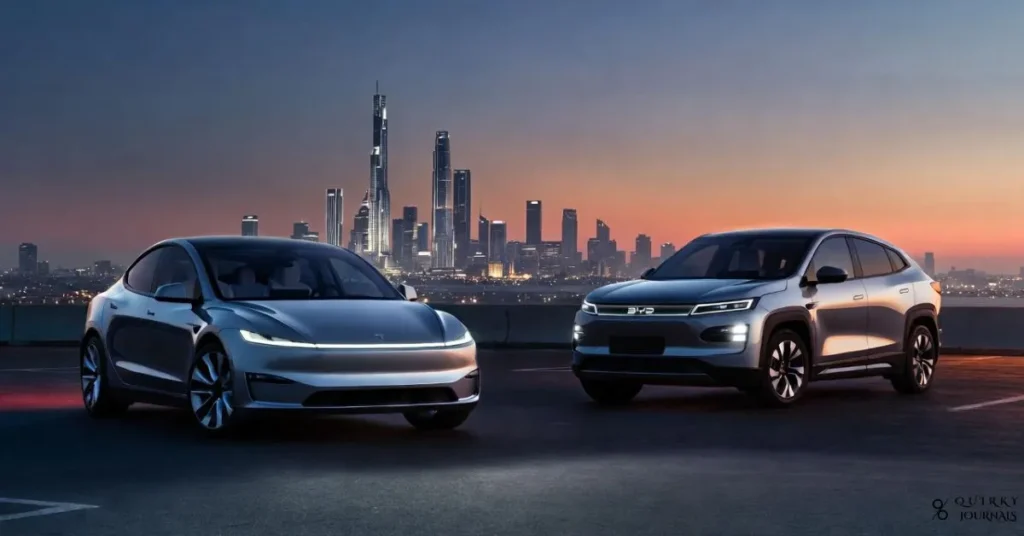
The “Tesla Killer”? How BYD’s “Cheap” Strategy Built a Trillion-Dollar EV Empire
In 2011, Elon Musk was asked about Chinese competitor BYD. He laughed openly. The video clip went viral as Musk dismissed BYD’s products as inferior. “Have you seen their cars?” he asked incredulously.
Fast forward to 2026. BYD is now the world’s number one electric vehicle seller. They sold 2.26 million battery electric vehicles in 2025, crushing Tesla’s 1.64 million units. Even Tesla now buys BYD’s “Blade Batteries” for some models.
The mockery turned into reality. How did a battery company that started with a $300,000 loan defeat a Silicon Valley giant backed by billions? The answer reveals uncomfortable truths about innovation, efficiency, and what actually wins in business.
The Man Nobody Took Seriously
Wang Chuanfu founded BYD in 1995. He was 29 years old with a battery engineering degree and almost no money. His cousin Lu Xiangyang provided the $300,000 startup capital.
The company name BYD originally meant nothing. Wang later gave it two backronyms: “Build Your Dreams” and “Bring Your Dollars.” Both proved prophetic in different ways.
Wang’s strategy from day one was brutally simple. Copy successful products exactly. Then make them cheaper than anyone thought possible. This approach offended purists who valued original innovation. But it worked spectacularly in practice.
The Battery Foundation
BYD initially targeted cellphone batteries. Companies like Motorola, Nokia, and Sony dominated this market with Japanese manufacturing. Their batteries were excellent but expensive due to labour costs and automation expenses.
Wang saw an opportunity in labour arbitrage. Instead of expensive robotic clean rooms, he used simple sealed boxes he called “Clean Boxes.” Instead of automation, he hired thousands of workers on short-term contracts. This kept wages low and flexibility high.
The approach was genius in its simplicity. By 2002, BYD dominated the rechargeable battery market globally. Major brands, including Samsung, Motorola, and Nokia, all bought BYD batteries. Wang had made his first billion.
The Automotive Gamble
In 2003, Wang made a move that puzzled everyone. He bought the failing state carmaker Tsinchuan Automobile and renamed it BYD Auto. Industry experts predicted disaster. What did a battery maker know about cars?
Everything, it turned out. Wang understood that electric vehicles were fundamentally battery products with wheels attached. His battery expertise gave him a structural advantage that traditional automakers lacked.
BYD launched the F3 sedan in 2005. It looked remarkably similar to the Toyota Corolla. But it costs a fraction of the Toyota’s price. Chinese consumers did not care about the resemblance. They cared about value. The F3 topped sales charts by decade’s end.
The Warren Buffett Seal of Approval
In 2008, Berkshire Hathaway invested $232 million in BYD. This Warren Buffett endorsement changed everything. It validated Wang’s vision globally and attracted serious investor attention.
BYD’s market value jumped to $5.1 billion almost overnight. Wang topped Forbes China’s rich list for the first time in 2009. The battery maker that nobody took seriously was now a billion-dollar automotive company.
The Clean Box Innovation Nobody Talks About
Wang’s greatest innovation might be his refusal to over-innovate. While competitors built multi-million dollar robotic assembly lines, Wang stuck with human labour and simple environmental controls. This decision saved enormous capital while maintaining quality.
Traditional battery manufacturing requires pristine clean rooms. Dust particles ruin batteries by creating short circuits. Companies like Sony and Panasonic invested heavily in robotic systems operating in hermetically sealed environments. These facilities cost tens of millions to build.
Wang invented a cheaper solution. His “Clean Boxes” were simple sealed enclosures where workers assembled batteries manually. These boxes cost a tiny fraction of full clean rooms. They worked almost as well for lithium batteries that tolerate slightly more contamination than some alternatives.
Labour Over Robots: The Cost Advantage
| Approach | Initial Investment | Labor Cost | Flexibility | Quality Control |
| Japanese Robotic Clean Room | $50 to $100 million | Low (few technicians) | Low (retooling expensive) | Very high (consistent) |
| BYD Clean Box Method | $2 to $5 million | Higher (thousands of workers) | Very great (rapid changes) | High (with proper training) |
The table reveals BYD’s genius. By accepting slightly higher ongoing labour costs, they slashed capital requirements by 90% or more. This freed massive resources for research, expansion, and price competition. Moreover, human workers proved more adaptable than robots when products changed frequently.
Vertical Integration: The Secret Weapon
BYD’s defining strategic advantage is vertical integration. Unlike Tesla, which relies on hundreds of suppliers, BYD makes almost everything itself. They control their supply chain from lithium mines to finished vehicles.
This integration spans the entire production process. BYD owns stakes in lithium mines in Chile and Brazil through partnerships with companies like SQM. They refine raw lithium into battery-grade chemicals. They manufacture battery cells, power electronics, electric motors, and semiconductors all in-house.
According to the New York Times analysis, this vertical integration saves BYD 15% to 30% on every vehicle. That cost advantage lets them price cars aggressively while maintaining healthy margins. It also protects them from supply chain disruptions that cripple competitors.
The Chip Advantage
BYD established BYD Semiconductor in 2004. This proved prescient when global chip shortages paralysed automakers in 2021-2022. While Ford, GM, and even Tesla cut production due to missing semiconductors, BYD’s factories kept running.
BYD Semiconductor produces chips for battery management systems, motor controllers, and infotainment. They attracted investment from Sequoia Capital and CICC Capital in 2021 to expand capacity. This internal chip supply creates enormous strategic flexibility.
When competitors must beg chip manufacturers for allocation, BYD simply allocates chips internally. When automotive chips get scarce, BYD can shift production from consumer electronics to cars. This flexibility proved invaluable during the semiconductor crisis.
The Blade Battery Revolution
In March 2020, BYD unveiled the Blade Battery. This innovation transformed the electric vehicle industry by solving three problems simultaneously: safety, cost, and range.
Traditional EV batteries use cylindrical or pouch cells arranged in modules. These modules then get packed into battery enclosures. This module architecture wastes significant space and adds weight. It also creates fire risks when individual cells overheat.
The Blade Battery eliminates modules. Long, thin cells get inserted directly into the pack in a cell-to-pack (CTP) design. This approach increases space utilisation by 50% while dramatically improving safety.
The Nail Penetration Test
BYD famously demonstrated Blade Battery safety through the nail penetration test. This brutal examination involves driving a steel nail through a fully charged battery. Most lithium batteries burst into flames or explode. The Blade Battery barely warmed up.
At CES 2026, BYD showed live demonstrations. Standard high-nickel cells erupted in smoke and fire during puncture. The Blade Battery surface temperature only reached 30 to 60 degrees Celsius with zero smoke. This fire resistance addresses consumers’ biggest EV safety fear.
The secret lies in lithium iron phosphate (LFP) chemistry combined with the blade structure. LFP is inherently more stable than nickel-cobalt alternatives. The blade shape also acts as a structural beam, spreading forces and heat across the entire pack rather than concentrating them.
Blade Battery 2.0: The 2026 Leap
| Specification | Blade Battery 1.0 (2020) | Blade Battery 2.0 (2026) | Improvement |
| Energy Density | 140 to 160 Wh/kg | 190 to 210 Wh/kg | 30% to 40% increase |
| Charging Speed | 1C to 2C (30-60 min) | 8C (10 min for 10% to 80%) | 6X to 8X faster |
| Maximum Range | 600 km (CLTC) | 1,000 km (CLTC) | 66% increase |
| Lifespan | 1,500 cycles (300K km) | 3,000 cycles (1.2 million km) | Triple the lifespan |
| Cost per kWh | $80 to $100 | $50 to $60 | 40% to 50% reduction |
The Blade Battery 2.0 represents a quantum leap. It achieves energy densities rivalling expensive nickel-cobalt batteries while maintaining LFP’s cost and safety advantages. The 8C charging capability means you can add 300 kilometres of range in ten minutes. The 1.2 million-kilometre lifespan exceeds most vehicles’ useful life.
The Hybrid Bridge Strategy
While Tesla pushed pure electric vehicles exclusively, BYD pursued a dual approach. They offered both pure EVs and plug-in hybrid electric vehicles (PHEVs). This strategy proved brilliant for mass market adoption.
Many consumers fear range anxiety—the worry about running out of battery far from charging stations. PHEVs eliminate this concern by including small gasoline engines as backup. You can drive electric for daily commutes while having a gasoline range for road trips.
BYD’s DM-i hybrid system delivers exceptional efficiency. The latest 5.0 version achieves over 2,000 kilometres of combined range. It uses electricity for most driving but can run on gasoline when needed. This flexibility appealed to cautious buyers.
The Numbers Tell the Story
In 2024, BYD sold approximately 1.8 million plug-in hybrids alongside 2.26 million pure EVs. This combined total of 4+ million electrified vehicles dwarfs any competitor. Tesla, focusing only on pure EVs, sold just 1.64 million vehicles total.
The hybrid strategy lets BYD capture customers not ready for full electric. As charging infrastructure improves and battery technology advances, these PHEV customers naturally transition to pure EVs. BYD positioned itself to serve both markets simultaneously.
The COVID Pivot: Manufacturing Masks
When COVID-19 struck in early 2020, most companies panicked. BYD pivoted. Within weeks, they became the world’s largest face mask manufacturer. This move demonstrated the adaptability that vertical integration enables.
BYD could retool quickly because it controlled its facilities completely. They did not need supplier approval or complex negotiations. Wang simply redirected resources from automotive to medical manufacturing. By February 2020, BYD was producing 5 million masks daily.
This “cockroach mentality”—the ability to survive any crisis through rapid adaptation—defines BYD’s culture. While the mask business was temporary, it kept factories running and workers employed. It also generated positive publicity at a critical moment.
The Price War: $7,800 EVs
In 2024, BYD launched the Seagull subcompact. The base price: $9,700 in China. By early 2026, promotional pricing had dropped below $7,800 in some markets. This price point shocked the industry and terrified competitors.
How can BYD profitably sell electric vehicles for under $8,000? The answer combines every advantage discussed: vertical integration, reducing costs, Blade Battery manufacturing expertise, labour cost management, and massive production scale, enabling efficiency.
According to Bloomberg teardown analysis, the Seagull costs BYD approximately $6,500 to manufacture. This leaves healthy margins even at $7,800 retail. For comparison, most Western automakers cannot profitably build EVs under $35,000.
The Global Price Comparison
| Model | Manufacturer | Starting Price | Range (EPA/WLTP) | Target Market |
| BYD Seagull | BYD | $7,800 (China) | 305 km | Urban budget buyers |
| BYD Dolphin | BYD | $14,500 (China); $23,990 (Europe) | 427 km | Compact segment |
| BYD Atto 3 | BYD | $19,900 (China); $36,000 (Europe) | 420 km | Crossover SUV buyers |
| BYD Seal | BYD | $25,000 (China); $46,990 (Europe) | 570 km | Tesla Model 3 alternative |
| Tesla Model 3 | Tesla | $38,990 (US) | 438 km | Premium compact |
| Chevrolet Bolt EV | GM | $26,500 (US, discontinued) | 417 km | Budget EV (ended production) |
The price differential is staggering. BYD’s entry models cost less than half what Western competitors charge for comparable range. Even accounting for higher European pricing due to tariffs and shipping, BYD undercuts established brands significantly.
Global Expansion: Building the Empire
BYD’s dominance in China is impressive but not surprising given home market advantages. Their global expansion proves the model works internationally. They are building factories across multiple continents simultaneously.
In July 2024, BYD opened a wholly-owned factory in Rayong, Thailand, with 150,000 units annual capacity. This facility employs 10,000 workers and serves Southeast Asian markets. Additional plants are under construction in Hungary, Brazil, and Turkey—each with 150,000 unit capacity.
This localisation strategy avoids tariffs while creating local jobs that reduce political resistance. European and South American governments welcome BYD investment that brings employment. The factories also shorten supply chains and reduce shipping costs.
The Multi-Brand Approach
BYD uses different brands for different market segments. The main BYD brand targets value-conscious buyers. Denza serves premium customers. Yangwang focuses on ultra-luxury and performance. This multi-brand strategy lets BYD cover every price point.
The approach mirrors successful automotive strategies from companies like Volkswagen Group (VW, Audi, Porsche) and General Motors (Chevrolet, Cadillac). By creating distinct brands, BYD avoids the “cheap car company” perception while still serving budget buyers.
In Europe, the Seal sedan competes directly against the Tesla Model 3 and BMW 3 Series. It offers comparable performance and features at lower prices. European automotive journalists have praised its build quality and technology integration. BYD is shedding the “cheap Chinese car” stereotype through quality products.
Tesla’s Response: Buying BYD Batteries
Perhaps the ultimate validation of BYD’s battery expertise came when Tesla began purchasing Blade Batteries for certain models. The company Elon Musk once mocked now supplies critical components to Tesla vehicles.
Tesla uses Blade Batteries in some standard-range Model Y and Model 3 variants sold in China. This makes business sense—the Blade Battery offers excellent range at a lower cost than Tesla’s own cells. But it represents a symbolic shift in the competitive dynamic.
The student has become the teacher. BYD’s battery technology now leads the industry in the cost-to-performance ratio. Tesla, facing pressure to reduce prices, pragmatically sources the best available technology regardless of the supplier.
The Investment Perspective
From an investment standpoint, BYD represents a fundamentally different opportunity than Tesla. Tesla trades as a growth stock with a forward price-to-earnings ratio often exceeding 50. Investors pay premiums for future autonomous vehicle potential and AI capabilities.
BYD trades more like a traditional automaker. Its P/E ratio typically ranges from 15 to 25. This reflects market perception of BYD as a manufacturing company rather than a technology platform. Yet BYD’s actual technology—particularly in batteries and power electronics—arguably leads the industry.
Tesla vs BYD: Investment Comparison
| Metric | Tesla | BYD | Advantage |
| 2025 BEV Sales | 1.64 million | 2.26 million | BYD +38% |
| Total Electrified Sales | 1.64 million (BEV only) | 4+ million (BEV + PHEV) | BYD +144% |
| Average Vehicle Price | $45,000 to $50,000 | $18,000 to $25,000 | Tesla (premium) |
| Gross Margin | 18% to 20% | 20% to 22% | BYD slightly higher |
| Vertical Integration | Moderate (batteries, some chips) | Extreme (batteries, chips, motors, mining) | BYD significantly |
| Autonomous Driving | Leading (FSD) | Developing (ADAS standard) | Tesla significantly |
| Brand Premium | High (tech/luxury perception) | Low (value perception) | Tesla significantly |
| P/E Ratio (typical) | 40 to 60 | 15 to 25 | Depends on strategy |
The table reveals complementary strengths. Tesla dominates brand perception and autonomous technology. BYD leads in manufacturing efficiency, cost structure, and total vehicle volume. Tesla is a growth bet on the autonomous future. BYD is a value play on EV mass adoption.
The Weaknesses Nobody Mentions
BYD’s vertical integration strategy carries significant risks that balanced analysis must acknowledge. The fortress that protects also constrains.
First, massive capital requirements strain finances. Building and maintaining factories for batteries, chips, motors, and vehicles demands constant heavy investment. This pressure forces BYD to maintain high production volumes to achieve economies of scale. They cannot easily scale down during downturns.
Second, the closed ecosystem might breed technological stagnation. When you are your own primary supplier, you face less external competitive pressure. Suppliers competing for business drive innovation. BYD must cultivate an internal innovation culture to avoid complacency.
Third, geographic concentration creates vulnerability. Most BYD production remains in China. Trade tensions, tariffs, or political conflicts could severely impact operations. The new overseas factories reduce but do not eliminate this risk.
The Quality Perception Gap
BYD faces persistent brand perception challenges in Western markets. Despite improving quality, many consumers still view Chinese cars as inferior. This perception forces BYD to price vehicles below comparable Western alternatives to attract buyers.
Additionally, BYD lacks Tesla’s software sophistication and autonomous driving capabilities. Tesla’s Full Self-Driving (FSD) system, despite its controversies, represents genuine technological leadership. BYD offers advanced driver assistance systems but lags in autonomous capability.
Service network limitations also constrain growth. Tesla built extensive proprietary charging and service infrastructure. BYD must rely more on third-party networks and dealers. This creates inconsistent customer experiences that can damage brand reputation.
The Real Battle: Manufacturing vs Software
The Tesla-BYD competition represents a fundamental clash of philosophies. Tesla prioritises software, autonomy, and brand premium. BYD focuses on manufacturing efficiency, cost leadership, and production scale.
Elon Musk envisions Tesla as a robotics and AI company that happens to make cars. The vehicles exist primarily as platforms for autonomous systems and energy products. Future revenue theoretically comes from software subscriptions and robotaxi networks.
Wang Chuanfu sees BYD as a manufacturing company that uses technology as a competitive advantage. The goal is to make the most efficient, affordable electric vehicles possible. Software enhances the product, but manufacturing excellence drives profitability.
Which Strategy Wins?
Perhaps both win in different ways. Tesla might dominate premium segments and autonomous technology. BYD could own mass-market segments through unbeatable costs. The automotive market is large enough for multiple successful strategies.
However, history provides cautionary tales. Apple’s premium strategy succeeded spectacularly in smartphones while Android captured 70%+ market share through affordability. Both Apple and Android ecosystem leaders profited enormously. But volume eventually translates to ecosystem advantages.
If BYD captures mass market share through aggressive pricing, they control the platform that matters most—what most people actually drive. Network effects, charging infrastructure, parts availability, and service expertise might shift toward the volume leader regardless of technology sophistication.
Lessons for Investors and Entrepreneurs
BYD’s rise offers valuable lessons beyond automotive industry specifics. These principles apply across sectors and markets.
Lesson One: Technology leadership differs from product leadership. BYD does not have the most advanced autonomous systems or flashiest features. But they mastered the fundamental technology—batteries—that makes EVs economically viable. Sometimes boring technology executed extremely well beats exciting technology executed adequately.
Lesson Two: Cost structure creates sustainable competitive advantage. BYD’s vertical integration and manufacturing efficiency cannot be quickly replicated. Building battery factories, chip fabs, and motor plants takes years and billions. This creates defensive moats that pricing alone cannot overcome.
Lesson Three: Market leaders get mocked before they get respected. Elon Musk laughing at BYD in 2011 perfectly illustrates how established players dismiss upstart competitors. By the time the threat becomes obvious, the competitor has often become unbeatable. Humility matters even for geniuses.
Lesson Four: Hybrid approaches sometimes beat pure strategies. BYD’s decision to offer both pure EVs and plug-in hybrids seemed like hedging. In reality, it captured customers across the adoption curve. Purity has aesthetic appeal, but flexibility often wins commercially.
The 2026 Outlook and Beyond
BYD enters 2026 with extraordinary momentum but is facing significant challenges. China’s economy shows concerning weakness. Real estate crisis and stock market declines make Chinese consumers more cautious. Domestic EV price wars slash margins across the industry.
However, BYD’s low manufacturing costs position them better than competitors to survive any sustained slowdown. While rivals bleed cash selling vehicles below cost, BYD maintains profitability even during aggressive price competition. This endurance could lead to massive market share gains as weaker players exit.
International expansion provides growth when domestic markets mature. The Thailand, Hungary, Brazil, and Turkey factories coming online in 2026 create substantial new capacity targeting markets with less saturation. BYD can sustain growth even if China’s market stagnates.
Battery technology evolution continues to favour BYD. The Blade Battery 2.0 closes the performance gap with premium alternatives while maintaining cost advantages. Solid-state battery development promises further improvements. BYD’s battery-first DNA gives them edges in each technological generation.
Conclusion: The Boring Company That Won
BYD lacks Tesla’s charisma. Wang Chuanfu gives no bombastic press conferences. BYD vehicles do not accelerate to 60 mph in under two seconds. The company does not promise colonising Mars or solving traffic with underground tunnels.
Instead, BYD focuses on unglamorous fundamentals. They make batteries cheaper and safer than competitors. They control supply chains from minerals to motors. They manufacture vehicles at costs rivals cannot match. They price aggressively to capture market share.
This boring strategy built a trillion-dollar empire that now leads the global electric vehicle industry in unit sales. It transformed a $300,000 battery startup into a company selling more EVs than Tesla. It proved that in business, consistent execution of sound strategy beats brilliance every time.
The real lesson is not about electric vehicles specifically. It is about value creation fundamentals that transcend industries. Control your costs relentlessly. Master core technologies enabling your products. Build competitive moats through vertical integration and scale. Price to capture markets rather than maximise margins initially.
Elon Musk was right to laugh at BYD’s early vehicles. They were crude and derivative. But Wang Chuanfu built a foundation—battery manufacturing expertise, cost discipline, supply chain control—that could not be defeated through brilliance alone. He played a long game that valued manufacturing excellence over marketing flash.
Today, Tesla buys BYD batteries. BYD sells more electric vehicles than any company on Earth. The mockery turned to respect and eventually to market dominance. The “cheap” strategy built an empire that rivals funded with billions could not match.
For investors, this case study reinforces timeless lessons. Value investing works not just in stock selection but in business strategy. The company solving fundamental problems at the lowest sustainable cost often wins regardless of competitors’ technological sophistication. Boring businesses that execute extremely well frequently beat exciting businesses that execute adequately.
The Tesla-BYD competition will define the 2020s automotive industry. But the ultimate lesson transcends cars and batteries. In business as in nature, survival belongs not to the strongest or most intelligent but to those most adaptable to change. BYD’s cockroach mentality—willing to make masks during pandemics, build affordable cars when others chase premium segments, and relentlessly optimise costs while others pursue vision—might be the most valuable competitive advantage of all.
The boring battery company built a castle from bricks that people threw at them. That castle now dominates the global electric vehicle landscape. And the story is just beginning.
Spend some time for your future.
To deepen your understanding of today’s evolving financial landscape, we recommend exploring the following articles:
How Power Laws Predict Bitcoin’s Price Floor
Salary Negotiation Scripts That Actually Work: Data-Backed Strategies for Remote Roles
Value Proposition Design for Tech Startups: From Unmet Need to Scalable Revenue
War Economy Chapter 10: The Cost of Political Ego: When Decisions Override Economics
Explore these articles to get a grasp on the new changes in the financial world.
Legal Disclaimer
This article provides general information and industry analysis for educational purposes only and does not constitute investment advice, financial guidance, or recommendations to buy or sell securities. Company valuations, competitive positions, and market dynamics change rapidly. Information reflects conditions at publication time and may quickly become outdated. Readers should conduct independent research and consult qualified investment professionals before making financial decisions based on individual circumstances, goals, and risk tolerance.
References
[1] “How China Built BYD, Its Tesla Killer,” The New York Times, Feb. 12, 2024. [Online]. Available: https://www.nytimes.com/2024/02/12/business/byd-china-electric-vehicle.html. [Accessed: Jan. 31, 2026].
[2] “BYD Is Quietly Building a Global EV Empire,” Yahoo Finance. [Online]. Available: https://finance.yahoo.com/news/byd-quietly-building-global-ev-091400753.html. [Accessed: Jan. 31, 2026].
[3] “How BYD’s Wang Chuanfu Beat Elon Musk’s Tesla in the EV Race,” Business Insider. [Online]. Available: https://www.businessinsider.com/byd-founder-wang-chuanfu-biggest-chinese-global-ev-automaker-2024-1. [Accessed: Jan. 31, 2026].
[4] “BYD vs. Tesla: Inside the Blade 2.0 Battery CES 2026 Reveal,” Editorial GE. [Online]. Available: https://editorialge.com/byd-vs-tesla-inside-the-blade/. [Accessed: Jan. 31, 2026].
[5] “How China’s BYD surpassed Tesla with production and battery tech,” Automotive Manufacturing Solutions, Jul. 7, 2025. [Online]. Available: https://www.automotivemanufacturingsolutions.com/electrification/how-chinas-byd-surpassed-tesla-with-production-and-battery-tech. [Accessed: Jan. 31, 2026].
[6] “The blueprint of an EV empire: how BYD built global dominance through vertical integration,” EVBoosters, Apr. 23, 2025. [Online]. Available: https://evboosters.com/ev-charging-news/the-blueprint-of-an-ev-empire. [Accessed: Jan. 31, 2026].
[7] “BYD’s Secret Weapon: The Vertical Integration Advantage Explained,” EV Parts 4×4, Oct. 30, 2025. [Online]. Available: https://evparts4x4.com/blogs/news/byd-the-vertical-integration-advantage-explained. [Accessed: Jan. 31, 2026].
[8] “Case Study Addendum: Why BYD Leads in EV Battery Manufacturing,” Energy Central, Apr. 17, 2025. [Online]. Available: https://www.energycentral.com/energy-biz/post/case-study-addendum-why-byd-leads-ev-battery-manufacturing. [Accessed: Jan. 31, 2026].