
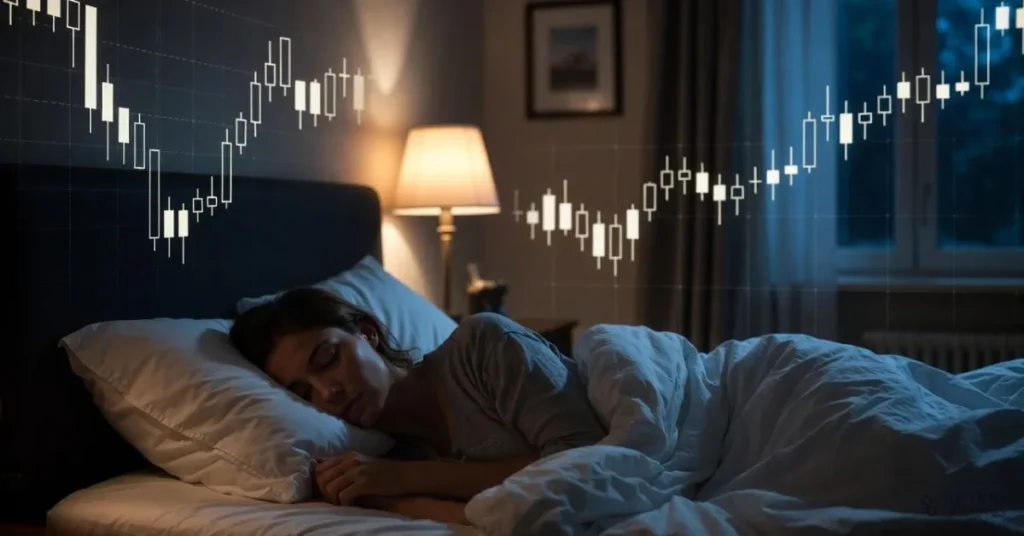
The Sleep Test: Why Your Portfolio Should Only Include Stocks You’re Comfortable Holding
Picture this: it’s 2 a.m., and you’re refreshing a stock ticker for the fourth time since midnight. Your stomach is in knots. You’ve watched a position slide 18% in three weeks, and every headline about inflation, geopolitical tension, or interest rates feels like a personal attack on your retirement account. Sound familiar? If that scenario resonates even slightly, your portfolio may be failing what experienced investors call the Sleep Test — and failing it quietly, before a real crisis ever hits.
The Sleep Test is deceptively simple. Before you buy a stock — or hold one you already own — ask yourself honestly: if this position fell 30% tomorrow, could I still sleep through the night? Most people answer that question during calm bull markets and wildly overestimate their own tolerance. Then volatility arrives, panic floods in, and the damage from panic selling follows immediately. The consequences often take years to undo.
This guide digs into the psychology behind panic selling, explains why comfort and conviction are genuine investing advantages, and gives you a practical framework for building a portfolio that you can hold with confidence — whether markets are surging or crashing. Along the way, we’ll draw on real research, historical data, and strategic insights that go well beyond the usual ‘just stay calm’ advice you’ve probably already heard.
What Exactly Is the Sleep Test?
The Sleep Test isn’t a formal financial metric. No brokerage publishes it as a ratio on your dashboard. Instead, it’s a behavioural checkpoint — a gut-level verification that the risk you’ve taken on paper matches the risk you can actually tolerate as a human being. The gap between these two things is where most investing mistakes are born.
Theoretically, investors are supposed to quantify risk tolerance before building a portfolio. In practice, many people fill out a short questionnaire, choose an ‘aggressive growth’ allocation because it sounds appealing, and then discover during a market drop that their real tolerance is far more conservative. Morgan Stanley’s analysis of investor behaviour found that panic-selling during downturns is among the most financially destructive mistakes retail investors make — not because markets don’t recover, but because most people who sell in panic never fully reinvest at the right time.
The Sleep Test cuts through that theoretical gap. It connects abstract percentage figures to a visceral, lived experience. If imagining a 25% drop triggers genuine anxiety or the urge to sell, that’s important data. It means your current allocation exceeds your real risk threshold, regardless of what a quiz said. Conversely, if you can genuinely shrug off volatility because you understand the underlying business and trust the long-term thesis, that’s a portfolio built on conviction. This kind actually survives downturns intact.
Behavioural finance researchers call the opposite phenomenon myopic loss aversion — the tendency to weigh short-term losses far more heavily than equivalent gains. Psychologist Shlomo Benartzi has shown that investors who check their portfolios daily experience this aversion most acutely, because they feel the sting of losses frequently and in real time. Those who review quarterly or annually feel the same mathematical losses far less intensely. Changing how often you look is, remarkably, as powerful as changing what you hold.
The Neuroscience of Panic: Why Your Brain Wants You to Sell
Understanding why panic selling feels so compulsive requires a quick detour into how the brain processes financial threat. Markets trigger the same neural architecture that evolved to handle physical danger. When a stock drops sharply, the amygdala fires a stress response before the prefrontal cortex — the rational, planning part of your brain — has time to weigh the situation. Your body is flooded with cortisol and adrenaline. Your instinct screams: do something, stop the bleeding, get safe.
That response served our ancestors well. In the savanna, a threat that triggered inaction could be fatal. In a market downturn, however, that same instinct almost always destroys value. Selling into a decline locks in losses, destroys your participation in the eventual recovery, and typically triggers a second error: staying in cash too long because returning to the market feels just as frightening as leaving it did.
Research published by Benartzi and colleagues suggests a clear diagnostic. Investors who are hypersensitive to short-term losses share identifiable traits: they check performance daily or weekly, they shift goals when the situation becomes uncomfortable, and they struggle to separate the emotional discomfort of a decline from its actual financial significance. Recognising these patterns in yourself isn’t a character flaw — it’s data you can act on strategically.
Moreover, technology has made the problem worse. Decades ago, you’d call a broker, fill out a form, and wait. Today, a single thumb-swipe can liquidate an entire position. Commission-free trading apps make reacting to fear frictionless. The very convenience that democratised investing has simultaneously made it easier to make one of investing’s costliest mistakes.
The True Cost of Panic Selling — By the Numbers
Abstract warnings about panic selling are easy to dismiss. Hard numbers are harder to ignore. Consider the following illustration drawn from Morgan Stanley’s research: an investor who sold after a 30% market drop and held cash for several years ended up with roughly $524,000 after 45 years (including ongoing contributions). An investor who stayed fully invested through the same drop accumulated dramatically more, even if the initial recovery took several years. The difference isn’t small — it represents a significant portion of a retirement nest egg.
That gap compounds through time in several ways. First, the immediate loss crystallises when you sell — you’re no longer holding an unrealised paper loss, but an actual permanent one. Second, the rebound, which history shows almost always materialises, happens without you. Third, you face the psychological burden of deciding when to re-enter, a decision that paralysis often indefinitely delays. As NerdWallet summarises, winning long-term returns comes from the ability to ride out unpleasantness and remain invested for the eventual recovery.
Furthermore, repeated panic selling compounds behavioural damage beyond the financial. Each experience makes investors increasingly risk-averse — not more sophisticated, just more cautious. They adopt overly conservative allocations that fail to generate returns adequate for their actual goals. As the WNY Asset Management team explains, rebuilding a portfolio after a reactive sale takes time — and if heightened risk-aversion follows, the investor may never return to a strategy capable of achieving original financial objectives.
| Scenario | Initial Crash Response | Portfolio After 45 Years* |
| Long-term holder | Stayed invested through 30% drop | $1,200,000+ (est.) |
| Panic seller, re-entered after 1 yr | Sold, waited, bought back | $820,000 (est.) |
| Panic seller, stayed in cash | Sold and never reinvested fully | $524,000 (est.) |
| Panic seller, became ultra-conservative | Moved to bonds/cash long-term | $390,000 (est.) |
*Illustrative figures based on Morgan Stanley’s hypothetical modelling. Past performance does not guarantee future results.
Stop Investing in Stocks You’re Not Ready to Hold Through a Crash
This is the actionable centre of the Sleep Test. The principle sounds obvious, but its implications are surprisingly radical: if a stock in your portfolio would prompt you to sell in a real crisis, you shouldn’t own it in the first place. That includes positions that look great on paper, stocks with fantastic momentum, and companies you find intellectually fascinating. Excitement is not conviction. Admiration is not a thesis.
The question isn’t whether a stock is good. The question is whether you understand it well enough, trust its fundamentals deeply enough, and have a time horizon long enough to hold it through a 40% or 50% drawdown without flinching. As U.S. Bank’s buy-and-hold research makes clear, passive long-term investors who hold through downturns consistently outperform those who try to time the market. The keyword is hold — and holding requires prior conviction, not emergency courage summoned under pressure.
Before buying any position, honestly answer these three questions. Could I explain this company’s business model to a ten-year-old? Do I understand the main risks that could permanently impair the business, not just temporarily depress the stock? And finally, does this fit within a broader allocation I’d be comfortable maintaining for five years minimum? If any answer is unclear or uncomfortable, that’s a signal worth respecting. Discomfort now is far less expensive than a panic sale later.
Assessing Your Real Risk Tolerance — Honestly
The phrase ‘risk tolerance’ gets used loosely. In practice, it refers to two different things that often get conflated. The first is risk capacity — how much financial loss you could technically absorb without permanently derailing your plans. The second is risk appetite — how much volatility you can emotionally withstand without reacting destructively. Both matter. Neglecting either leads to trouble.
Your risk capacity is roughly determined by factors outside your psychology: your time horizon, your income stability, your emergency savings, and whether you’re in the accumulation or distribution phase of your financial life. A 28-year-old with stable employment and 35 years until retirement has a high capacity, even if their appetite is moderate. A retiree drawing down a fixed portfolio has low capacity, even if they’re psychologically unrattled by volatility.
Risk appetite is murkier because it’s emotional, not mathematical. The clearest way to gauge it is through memory rather than imagination. Think back to the steepest market drop you personally lived through as an investor — 2008, 2020, the 2022 rate-hike selloff. What did you actually do? Not what did you want to do, not what you planned — what did you do? If the honest answer involves selling, reducing exposure, or spending considerable mental energy agonising over positions, your real appetite is more conservative than your stated one. Design your portfolio accordingly.
Behavioural finance researcher Benartzi recommends a short self-assessment. How often do you check your portfolio: daily, monthly, or quarterly? Do you frequently abandon financial goals when the journey gets uncomfortable? Do short-term losses affect your mood, sleep, or daily functioning? Higher frequency checking, frequent goal-switching, and emotional spillover all point toward elevated loss sensitivity. Acknowledging this is not defeatist — it’s the starting point of building a portfolio you’ll actually stick with.
The Long-Term Strategy Framework: Building a Portfolio That Doesn’t Keep You Awake
Once you understand your real risk tolerance, the next step is translating that understanding into a concrete portfolio structure. This isn’t as complicated as the financial industry sometimes implies. In fact, WNY Asset Management’s research suggests that a well-constructed long-term investment plan with regular contributions does more to prevent panic selling than almost any other single factor. Anchoring decisions to long-term objectives makes short-term volatility feel less threatening — because it is less threatening within that context.
The foundation for most individual investors is a simple diversified core: broad exposure to equities across geographies, some fixed-income ballast to dampen volatility, and a cash reserve large enough to cover genuine emergencies without forcing investment liquidations at bad prices. Beyond that core, any individual positions should only be added when you can genuinely pass the Sleep Test for each one.
Dollar-Cost Averaging as Discipline
One of the most underrated panic-prevention strategies is automating regular contributions through dollar-cost averaging (DCA). By committing to investing a fixed sum at regular intervals regardless of market conditions, you accomplish several things simultaneously. You remove emotion from the timing decision. You buy more shares when prices are low and fewer when prices are high. You build a habit of continued investing through downturns, which counteracts the instinct to stop. As several experienced Bogleheads community members note, automating the entire process removes the decision — and the decision is where panic most often intrudes.
Asset Allocation as a Buffer
Proper asset allocation reduces the severity of drawdowns that trigger panic in the first place. A portfolio with 80% equities and 20% bonds or cash will fall less sharply during a stock market crash than a 100% equity portfolio. That difference in severity matters enormously to emotional decision-making. A 25% drawdown feels survivable to many investors. A 45% drawdown feels catastrophic to many of those same people — even if the mathematical recovery path is similar. Keeping drawdowns within your emotional tolerance range is itself a strategy.
Practical Tools for Reducing Panic Risk
Alongside strategy, several specific tools and techniques can meaningfully reduce the likelihood of a panic-driven mistake. They range from the structural to the psychological, and the best portfolios combine both categories.
Stop-Loss Orders — Use Them Carefully
A stop-loss order automatically sells a position if it falls to a pre-set price — for example, 10% below your purchase price. On the surface, this sounds like an ideal panic-prevention device: it limits losses without requiring emotional discipline in the moment. However, stop losses have a significant limitation. In a sharp, fast correction that recovers quickly, your position might trigger at the bottom and lock in a loss right before the rebound. Used thoughtfully in high-volatility, speculative positions, they can provide useful guardrails. Used indiscriminately in a long-term portfolio of quality businesses, they can crystallise exactly the kind of losses they’re designed to avoid.
Tax-Advantaged Accounts as a Psychological Barrier
Holding investments inside a Roth IRA or 401(k) adds a natural friction to panic selling. Early withdrawals trigger tax penalties. That friction isn’t just financial — it’s psychological. The additional step of facing a real monetary consequence for breaking discipline often slows down reactive decisions long enough for better judgment to kick in. For this reason, keeping long-term equity investments inside tax-advantaged accounts is useful not only for tax efficiency but for behavioural stability.
The Digital Detox During Turbulence
Benartzi’s research makes a blunt suggestion for investors who identify as hypersensitive to short-term losses: delete financial apps from your phone during periods of market stress. It sounds extreme. It works because it removes the frictionless access that makes panic-selling so easy. Behaviour is partly a function of environment. Making the reactive behaviour harder to execute is a legitimate and effective strategy. Replace the apps with a scheduled monthly review that happens on a specific date, regardless of market conditions.
Investing During a Crisis — What History Actually Shows
Every major market crisis — 1987’s Black Monday, the dot-com collapse, 2008’s financial crisis, the 2020 pandemic crash — produced the same prediction from many commentators: this time is different. This time, the damage is permanent. Each time, markets recovered. Not necessarily quickly. Not always to a linear trajectory. But recovered, and then grew beyond previous highs.
NerdWallet’s historical analysis is blunt: ‘For long-term investors, a market downturn can simply mean stocks and other investments are on sale.’ Historical market crash data shows that investors who maintained contributions through downturns bought into recoveries at the best prices they’d see for years. The challenge is that this strategy requires a portfolio you genuinely believe in — not just one you’re holding because selling feels complicated.
Fulton Bank’s guidance on investing during crises reinforces a key nuance: the decision to continue investing through a downturn should depend on your financial position, your time horizon, and your risk tolerance — not on what markets are doing. If those three fundamentals support continued investment, a crash is an opportunity to acquire quality assets at reduced prices. If those fundamentals don’t support it, stopping temporarily is a legitimate choice — provided it’s a rational decision, not a fear-driven one.
Meanwhile, Benartzi’s 1-2-3 approach offers a particularly useful reframe for investors approaching retirement who fear a market crash has damaged their plans. Retiring one year later than planned, saving one percentage point more per year for two years, and reducing planned retirement spending by just 3% can fully compensate for a significant market downturn — even without a recovery. That kind of quantified perspective dissolves vague dread into manageable, actionable numbers.
Protecting Investments Without Abandoning Them
There’s an important distinction between protecting a portfolio and abandoning it. Protection strategies keep you invested while managing downside risk. Abandonment — panic selling into cash — eliminates downside risk by eliminating upside participation. The goal should almost always be the former.
Diversification as the Primary Protective Layer
Proper diversification across asset classes, sectors, and geographies doesn’t eliminate losses in a crash, but it reliably reduces their severity. As AJ Bell’s investment research notes, how much you invest in shares versus bonds and other assets really depends on how much risk you want to take. A portfolio spread across domestic equities, international equities, bonds, and perhaps real assets will fall less dramatically in most scenarios than a concentrated position in any single sector.
Regular Rebalancing as a Built-In Discipline
Balancing strategy — where you periodically sell assets that have grown beyond their target allocation and buy those that have fallen below — enforces a buy-low, sell-high discipline without requiring any market timing or emotional judgement. After a significant market drop, rebalancing typically means buying more equities because their share of the portfolio has fallen. This is mechanically sensible and psychologically counterintuitive — exactly the kind of discipline that generates long-term outperformance.
Maintaining an Emergency Fund Separate from Investments
One of the most underappreciated panic triggers is a genuine cash need that forces investment liquidation at the worst time. Maintaining a liquid emergency fund — typically three to six months of expenses, held in cash or a high-yield savings account — means that a job loss, medical expense, or major repair doesn’t require touching the investment portfolio. Removing that possible forced-sale trigger dramatically reduces the likelihood of a panic-driven liquidation.
Conviction Versus Speculation: Knowing What You Actually Own
A central problem with portfolios built during bull markets is that they often contain a mix of conviction positions and speculative momentum bets — and the investor can’t always tell the difference. Conviction positions are held because you understand the underlying business, believe in its long-term competitive position, and are comfortable owning it through turbulence. Speculative positions are held because the price is going up.
The practical test: read the company’s most recent annual report. If you cannot follow the narrative of how the business makes money, what its main risks are, and what management’s long-term plan involves, you own a speculative position. That isn’t necessarily wrong — speculation has a legitimate place in some portfolios — but it should be sized accordingly and held without illusions. Allocating 40% of a retirement portfolio to stocks you can’t explain is a setup for panic.
Furthermore, Fulton Bank’s crisis investing guidance specifically recommends avoiding cyclical, speculative, and high-risk investments during downturns — including unproven startups, highly leveraged companies, and luxury manufacturers with volatile demand. These aren’t just theoretically risky. They’re likely to move against you most severely at exactly the moment when your emotional resilience is lowest.
Sleep Test Checklist: Stock-by-Stock Evaluation
Apply this framework to every existing and potential holding before your next portfolio review.
| Sleep Test Question | Green Light | Red Flag |
| Can I explain this business simply? | Yes, clearly and confidently | Vague, jargon-heavy, or unsure |
| Do I understand the key business risks? | Specific risks identified and weighed | Only aware of upside; risks feel abstract |
| Would a 30-50% drop change my view? | No — fundamentals would need to change | Yes — I’d likely want to sell |
| What is my intended holding period? | 5+ years minimum | Until ‘it recovers’ or price targets are hit |
| Does position size match conviction? | Sized for genuine long-term weight | Sized by recent momentum or tips |
| Could a cash need force this sale? | No — emergency fund is separate | Yes — this is also liquid savings |
The Role of a Financial Adviser in Panic Prevention
Much of the sleep-test philosophy can be implemented independently. However, several research sources point to an underappreciated role for professional guidance — not primarily as a source of market predictions, but as a behavioural guardrail. As Morgan Stanley’s analysis puts it: ‘Don’t go it alone. A Financial Advisor can help you navigate the market, based on your time horizon and risk tolerance.’
A good financial adviser serves several functions during a market crash that are difficult to replicate alone. They provide historical context that counteracts the brain’s tendency to read a current crisis as unprecedented. They enforce pre-agreed plans, preventing emotional decisions that violate a strategy the client chose during calmer conditions. They also ask the questions that self-directed investors don’t always ask themselves — including, essentially, versions of the Sleep Test.
Benartzi frames advisers as ‘app doctors’ — professionals who can help clients build a digital environment that encourages longer-term decision-making. That might mean removing access to certain account features during downturns, setting up accountability structures, or simply ensuring regular check-ins happen at scheduled intervals rather than in response to market events. Structure replaces reactive willpower, which is a more reliable system.
Index Funds and ETFs: The Default Sleep-Test Pass
For investors who struggle to identify individual stocks that pass the Sleep Test, broad-market index funds and exchange-traded funds (ETFs) offer a straightforward solution. Owning a fund that tracks the S&P 500 — such as Vanguard’s VOO, BlackRock’s IVV, or similar vehicles — is definitively holding a diversified slice of the entire US large-cap equity market. It’s hard to argue that a diversified economy will permanently fail, which makes the conviction thesis easier to maintain.
The Bogleheads community discussion on stopping panic selling highlights several specific approaches. Investing in VOO or IVV for US equity exposure, adding a total international equity fund for global diversification, and including a bond fund for ballast creates a three-fund portfolio that captures the vast majority of long-term market returns while naturally limiting exposure to any single company’s collapse.
Low expense ratios compound the advantage significantly over time. Community members advise targeting funds with expense ratios below 0.25% and ideally below 0.10%. The arithmetic is simple: every basis point you save in fees is a basis point that compounds in your favour over decades. Funds like VOO and IVV typically carry expense ratios well below that threshold, making them structurally sound as well as behaviourally manageable.
Applying the Sleep Test to Your Existing Portfolio Right Now
Most people reading this already have an investment portfolio of some kind. The productive question isn’t whether you’ve made mistakes in the past — virtually every investor has — but whether your current holdings would hold up under real stress. Here’s a practical approach to conducting that audit without turning it into a paralysing exercise.
Start by listing every holding along with its current percentage of your portfolio. Next to each, write down — honestly and without consulting any source — one or two sentences explaining why you own it. If you can’t do that from memory for a position that represents more than 5% of your portfolio, that’s a meaningful signal. Then, for each position, imagine it has dropped 35% since last month. Would your answer to the ‘why I own it’ question change? If yes, the holding may be speculative rather than conviction-based.
Positions that fail the Sleep Test don’t necessarily need to be sold immediately or in a panic. Instead, consider gradually trimming them toward a size that feels genuinely comfortable — a size where their continued decline wouldn’t keep you awake. Meanwhile, the proceeds can move into positions that pass the test. This approach avoids the opposite mistake of acting too reactively during a portfolio review.
Additionally, review your overall allocation against your real risk tolerance profile — not the one you filled out five years ago. Has your situation changed? Is retirement closer than it was? Has your income stability shifted? AJ Bell’s guidance notes that not everyone will have the stomach for being fully invested in the stock market, and that plenty of investment options provide market exposure while managing risk. Finding your right balance is not a personal failing — it’s honest financial engineering.
Target-Date Funds and Robo-Advisers: Automated Sleep Tests
For investors who want to remove portfolio management decisions from their own hands entirely, target-date funds and robo-advisers represent compelling alternatives. Both approaches embed the Sleep Test into the structure itself.
Target-date funds — widely offered inside 401(k) plans — gradually shift allocation from aggressive equities toward more conservative bonds and cash as the target retirement year approaches. As Bankrate’s long-term investing research explains, these funds adjust your allocation so the portfolio is safer as you approach retirement. The investor never has to decide how to rebalance — the fund handles it. For investors who know their own tendency to interfere destructively with their portfolios during downturns, removing that ability is an enormous advantage.
Robo-advisers operate similarly for taxable accounts. They collect information about your goals and risk tolerance, build a diversified portfolio aligned to those inputs, rebalance automatically, and often harvest tax losses on your behalf. The result is a professionally designed allocation that requires no active management. Furthermore, most robo-advisers include some form of guardrails against large unilateral changes — adding friction to panic-driven decisions before they’re executed.
Building the Habit: Sleep-Test Thinking as Ongoing Practice
The Sleep Test isn’t a one-time exercise. It’s a recurring practice that should accompany every significant investment decision and every portfolio review. Over time, applying it consistently builds a qualitatively different kind of portfolio — one that reflects genuine understanding and conviction rather than accumulated impulse purchases made at various market peaks.
The habit also changes how you research potential investments. Instead of beginning with price charts and recent momentum — the usual starting points for retail investors — you start with the business. What does this company actually do? Who are its customers? What would have to go wrong for the thesis to fail permanently? This shift toward fundamental analysis as the primary lens naturally filters out speculative positions that would fail the Sleep Test anyway.
Meanwhile, consider keeping a brief investment journal. Write down your thesis for each purchase, the risks you’ve identified, and the conditions under which you’d reconsider the position. Reviewing those notes during a downturn is genuinely useful. Rather than reacting to a declining price, you can ask: has anything changed about the underlying business or my original thesis? If not, the rational action is typically to hold — or, if conviction remains strong and allocation allows, to add.
The broader point is this: long-term investing success is less about picking the right stocks than about developing the temperament to hold good positions through inevitable volatility. The Sleep Test is a tool for building that temperament proactively — before a crisis forces the issue. It shifts the most important decisions to calm, reflective moments rather than leaving them to the mercy of 2 a.m. anxiety and a panic-sell button.
What Market History Tells Us About Staying the Course
One of the most powerful antidotes to panic is historical perspective. The S&P 500 has experienced many significant corrections across its history, yet its long-term annualised return has remained consistently positive over multi-decade periods. That fact is easy to cite and very difficult to feel during a sharp drawdown. Internalising it — genuinely, not just intellectually — is part of what the Sleep Test is trying to accomplish.
Consider the 2020 pandemic crash. Between February and March of that year, the S&P 500 fell roughly 34% in five weeks. Markets were accompanied by unprecedented global uncertainty. Investors who sold at the low missed one of the fastest recoveries on record. As Bankrate’s long-term investing guide notes, downturns can represent some of the best entry points for long-term investors — provided you have the structure and conviction to act rationally rather than reactively.
The 2008 crisis is equally instructive. Markets fell roughly 57% peak to trough. Recovery took until 2013. Yet investors who held through the full cycle — particularly those contributing regularly through dollar-cost averaging into diversified index funds — arrived at 2015 with substantially larger portfolios than they’d held in 2007. They bought shares cheaply throughout the downturn without realising it. The lesson is durable: investors who remain in the market long enough allow history to work in their favour.
Quick Reference: Sleep Test Strategies at a Glance
| Strategy | What It Does | Best For |
| Dollar-cost averaging | Removes timing emotion; buys more when prices are low | All investors, especially beginners |
| Asset allocation review | Aligns portfolio risk with real, not assumed, tolerance | Anyone who hasn’t reviewed in 2+ years |
| Three-fund portfolio | Simple, diversified, low-cost, easy to hold through crashes | Investors who want minimal decisions |
| Tax-advantaged accounts | Adds friction to panic selling via tax penalty | Long-term savers in the accumulation phase |
| Emergency fund maintenance | Prevents forced investment liquidation at bad prices | Anyone without 3-6 months of liquid cash |
| Financial adviser engagement | Provides behavioural guardrail and contextual perspective | Investors prone to emotional decisions |
| Portfolio audit (Sleep Test) | Identifies positions held without conviction or understanding | Any investor, at least annually |
| Investment journal | Creates a rational reference point to consult during downturns | Self-directed investors in all stages |
Final Thoughts: A Good Night’s Sleep Is a Financial Strategy
The Sleep Test reframes a question most investors never think to ask explicitly. Not ‘is this a good stock?’ but ‘is this a stock I’m genuinely prepared to hold through the worst?’ That distinction is subtle in a rising market and massive during a crash. The investors who navigate volatility best are rarely the most sophisticated analysts. They are, more often, the people who built portfolios they genuinely understand and genuinely believe in — and who, therefore, feel far less urgency to react when prices fall.
Getting there requires honest self-assessment, simple structural decisions, and the courage to own fewer things with more conviction rather than more things with less. It requires accepting that some of the most exciting opportunities — the high-momentum names generating social media buzz — may simply not belong in your portfolio if they’d trigger panic under stress. That’s not a failure of ambition. It’s the foundation of a strategy that actually survives contact with reality.
Ultimately, the best investment portfolio isn’t the one with the highest theoretical return. It’s the one you’ll hold intact through the next crash — whenever it comes, whatever causes it, however long it lasts. Apply the Sleep Test before you buy, repeat it during your annual review, and your future self will have a great deal more to thank you for than your portfolio balance alone.
Spend some time for your future.
To deepen your understanding of today’s evolving financial landscape, we recommend exploring the following articles:
The Ultimate Guide to Stock Market Websites for Real-Time Analysis
Influencer Marketing Failures: When Follower Counts Don’t Equal Sales
Saving a Dying Business: No-Capital Turnaround Strategies That Actually Work
Startup Market Research: How to Calculate TAM, SAM, and SOM
Explore these articles to get a grasp on the new changes in the financial world.
Legal Disclaimer
This article is provided for informational and educational purposes only. It does not constitute financial, investment, tax, or legal advice. All investing involves risk, including the possible loss of principal. Past market performance does not guarantee future results. Individual circumstances vary; readers should consult a qualified financial adviser before making investment decisions. The author and publisher accept no liability for decisions made based on information contained herein.
References
[1] WNY Asset Management, ‘How Panic Selling Damages Your Portfolio — And What to Do Instead,’ WNY Asset Management, 2024. [Online]. Available: https://www.wnyasset.com/how-panic-selling-damages-your-portfolio-and-what-to-do-instead/
[2] Reddit r/Bogleheads, ‘How Do You Stop Yourself From Panic Selling?’ Reddit, 2022. [Online]. Available: https://www.reddit.com/r/Bogleheads/comments/sss8iz/how_do_you_stop_yourself_from_panic_selling/
[3] D. Hunt, ‘Top 5 Mistakes Investors Make in Volatile Markets,’ Morgan Stanley, 2024. [Online]. Available: https://www.morganstanley.com/articles/top-5-investor-mistakes
[4] S. Benartzi, ‘Here’s Why Some Investors Panic. And Here’s How to Make Sure You Don’t,’ ShlomoBenanrtzi.com, 2022. [Online]. Available: http://www.shlomobenartzi.com/columns/heres-why-some-investors-panic-and-heres-how-to-make-sure-you-dont
[5] NerdWallet, ‘What To Do When the Stock Market Crashes,’ NerdWallet, 2024. [Online]. Available: https://www.nerdwallet.com/investing/learn/what-to-do-when-stock-market-is-crashing
[6] U.S. Bank, ‘Why Buy-and-Hold Stocks for Long-Term Investing,’ U.S. Bank, 2024. [Online]. Available: https://www.usbank.com/investing/financial-perspectives/investing-insights/buy-and-hold-long-term-investment-strategies.html
[7] Fulton Bank, ‘Is Investing During a Crisis or Recession a Good Idea?’ Fulton Bank Education Centre, 2024. [Online]. Available: https://www.fultonbank.com/Education-Center/Investing/Investing-during-a-crisis
[8] AJ Bell, ‘Three Ways to Protect Your Investments from a Stock Market Crash,’ AJ Bell, 2024. [Online]. Available: https://www.ajbell.co.uk/news/three-ways-protect-your-investments-stock-market-crash
[9] Bankrate, ’10 Best Long-Term Investments In 2026,’ Bankrate, 2026. [Online]. Available: https://www.bankrate.com/investing/best-long-term-investments/