
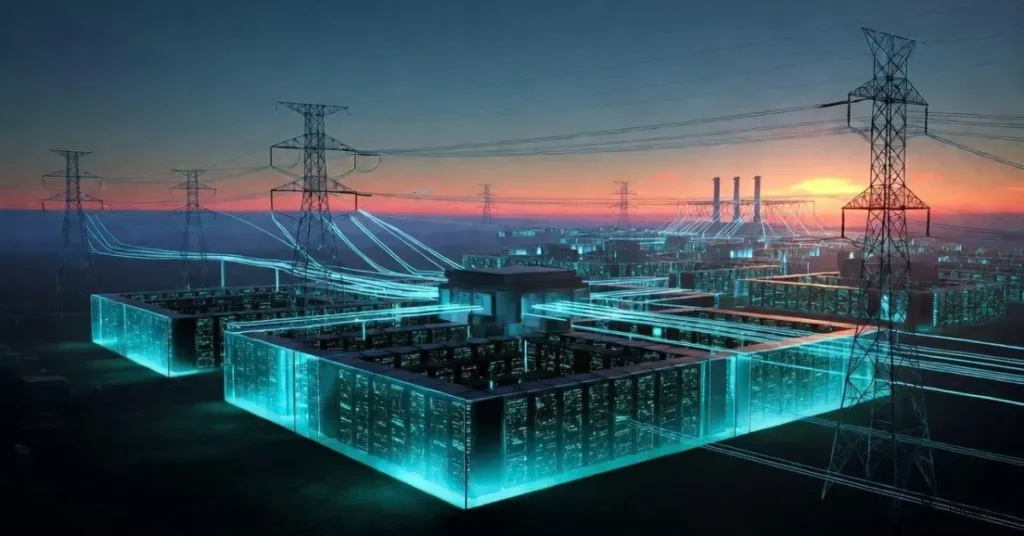
When AI Hits the Grid: Powering the Next Boom
The AI revolution is changing gears. For years, the spotlight shone on software—on large language models, neural networks, and intelligent algorithms racing to outperform one another. Today, though, the real bottleneck is not code. It is power. The market is waking up to a structural truth: AI needs enormous amounts of energy, and the world is not fully ready to supply it.
This shift is more than a technical footnote. It represents a profound reallocation of capital, attention, and strategic planning across the global economy. Investors, governments, and technology companies are scrambling to understand what Physical AI infrastructure actually means for portfolios, policy, and the planet.
So what exactly is driving this transition? Why does it matter so urgently right now? And, crucially, who stands to benefit most from the coming energy infrastructure build-out? This guide explores all of that and more, with data-backed insights to help you navigate one of the most consequential investment themes of the decade.
What Is Physical AI Infrastructure?
Before diving into the investment thesis, it helps to understand the terminology. The phrase “Physical AI” has two related meanings, and both matter here.
In its first sense, Physical AI refers to AI systems that operate in and interact with the real world. Think autonomous robots, self-driving vehicles, smart sensors, and AI-powered drones. These systems need to perceive, process, and respond to physical environments in real time. Companies like Booz Allen Hamilton describe this as AI moving “out of the cloud, into reality.”
In its second and equally important sense, Physical AI infrastructure refers to the tangible, real-world assets required to run AI at scale. This includes data centres, high-voltage power lines, cooling towers, substations, fibre cables, and water supply systems. Unlike software, these assets cannot be virtualised. You cannot abstract away a power plant.
As theRCR Technologies AI Infrastructure Market Pulse Report puts it bluntly: “Compute can be virtualised, and workloads abstracted, but power, water, land, and materials cannot.” This single insight is the foundation of the entire energy-meets-AI thesis.
Understanding this distinction changes how investors should think about the sector. Software companies compete on brains; physical infrastructure companies compete on land, permits, and megawatts. The rules are fundamentally different, and so are the moats.
The Software AI Era: A Rapid Recap
To appreciate where we are now, it is worth pausing to reflect on where we came from. Between 2017 and 2024, the AI story was overwhelmingly a software story. The emergence of transformer-based architectures, followed by the launch of models like GPT -4 and Google Gemini, created extraordinary investor enthusiasm for AI-native software companies.
The so-called Magnificent 7 tech stocks dominated the narrative. Returns from that group jumped 75% in 2023, moderated to around 50% in 2024, and have since slowed to less than 25% in 2025, according toGoldman Sachs research. That deceleration is not a sign of AI losing relevance. Rather, it signals a natural maturation and a capital rotation toward the picks-and-shovels layer beneath the software.
During the early software boom, questions of energy efficiency and physical infrastructure were treated as secondary. Algorithms were the prize. However, as models grew larger and inference demands increased, the physical costs became impossible to ignore. Training a single frontier model can now consume as much electricity as thousands of homes use in a year.
Consequently, investors are sharpening their focus. The question is no longer only “who has the best model?” It is also “who controls the power and the infrastructure to run it?” That reframing is reshaping capital markets in real time.
Why Energy Has Become the New Bottleneck
The numbers are startling. Morgan Stanley analysts warn that data centre operators face significant power shortages, particularly over the next two years, as their energy demand exceeds available supply. This is not a hypothetical risk. It is already causing project delays and forcing companies to rethink their geographic strategies.
Consider what goes into running a modern AI cluster. Graphics processing units (GPUs) are extraordinarily power-hungry. A single Nvidia H100 GPU draws up to 700 watts. A data centre housing tens of thousands of these chips can consume several hundred megawatts continuously. For comparison, that is roughly the output of a mid-sized power plant dedicated to a single facility.
AI Power Consumption: Comparative Scale
| Activity / Facility | Approximate Power Draw | Annual Energy Equivalent |
| Training GPT-4 (estimated) | ~50 GWh total | 5,000+ US homes (annual) |
| Small AI data centre | 20-50 MW continuous | 15,000-40,000 US homes |
| Hyperscale AI campus (1 GW) | 1,000 MW continuous | 750,000+ US homes |
| Global data centre sector (2025 est.) | ~500 TWh/year | ~5% of global electricity use |
| Projected global data centre demand (2030) | ~1,000+ TWh/year | ~8-10% of global electricity |
Sources: IEA, Goldman Sachs, and Morgan Stanley estimates.
Furthermore, the physical build-out is not simply about raw megawatts. It also involves transmission infrastructure to get power from generators to data centres, often located in areas with cheap land but limited grid access. This creates cascading investment needs across generation, transmission, and distribution segments of the energy industry.
The International Energy Agency has flagged data centres as one of the fastest-growing sources of electricity demand worldwide. Consequently, what was once a niche real estate sub-sector is fast becoming a primary driver of national energy policy in the US, Europe, and Asia.
Data Centres: The Hungry Heart of AI
Data centres are the physical embodiment of digital intelligence. They house the servers, storage systems, networking hardware, and cooling equipment that enable AI. Yet their appetites are growing faster than the grid can accommodate.
Hyperscalers, including Amazon Web Services, Microsoft Azure, and Google Cloud, are investing hundreds of billions of dollars in new capacity. Microsoft alone has announced plans to invest $80 billion in data centre infrastructure in fiscal 2025. Amazon and Google have made similarly eye-watering commitments.
The physical profile of these facilities is changing as well. AI-optimised data centres require higher power densities per rack than traditional cloud facilities. Where a standard server rack might draw 5 to 10 kilowatts, an AI compute rack can demand 30 to 100 kilowatts or more. This necessitates entirely new cooling architectures, more robust power distribution systems, and land parcels near available grid capacity.
Importantly, Morgan Stanley analysts note that these are not short-cycle projects. Building a gigawatt-scale data centre campus can take three to five years from planning to operation. Grid interconnection queues, permitting timelines, and equipment lead times all create significant delays. For this reason, established operators with existing grid connections and permitted sites hold a substantial competitive advantage.
Smaller players simply cannot absorb the capital requirements. As one Morgan Stanley analyst observed, this “is not a sector where a smaller company can easily just say, ‘I’m going to get into the 1 GW data centre business.'” The moats are real, physical, and very expensive to replicate.
The Power Grid Cannot Keep Up.
Perhaps no single constraint is more pressing than grid infrastructure. Electricity grids in the United States, Europe, and parts of Asia were largely designed in the mid-20th century. They were built for a world of relatively predictable, dispersed demand. The sudden concentration of massive power loads in specific locations is creating serious stress.
In the United States, the North American Electric Reliability Corporation (NERC) has repeatedly warned about grid reliability risks as demand growth accelerates. Interconnection queues for new generators, which must connect to the transmission network before they can sell power, now extend for many years in most regions.
Transmission investment has also lagged. Building new high-voltage transmission lines in the US typically requires siting approvals from multiple states, environmental reviews, and negotiations with dozens of local jurisdictions. The process can take a decade. Meanwhile, data centre developers need power now.
This mismatch between fast-growing demand and slow supply response is, paradoxically, good news for investors in grid infrastructure. Companies that build and operate transformers, switchgear, substations, and high-voltage cable are facing order backlogs stretching years into the future. Lead times for large power transformers, for example, have grown to two to four years in some cases.
Consequently, infrastructure-focused companies in the electrical equipment space are benefiting enormously. The S&P 500 Utilities sector and adjacent industrial equipment makers have attracted renewed investor attention after years of being overlooked following the Global Financial Crisis.
Cooling: The Overlooked Crisis in AI Infrastructure
Heat is the enemy of computing. Every watt of electricity that flows into a data centre eventually becomes heat that must be removed. As power densities climb, conventional air-cooling methods are reaching their limits.
Traditional data centres rely on computer room air conditioning (CRAC) units and raised-floor architectures to circulate cool air. However, at the rack power densities demanded by AI workloads, air simply cannot carry heat away fast enough. The industry is therefore pivoting rapidly toward liquid cooling, where water or specialised fluids are brought into direct contact with chip surfaces.
Companies like LiquidStack and various divisions of established cooling giants are rolling out immersion cooling and direct liquid cooling (DLC) systems. These technologies can handle power densities of 100 kilowatts per rack or more. However, they require significant water infrastructure and introduce new operational complexities.
Water consumption is a growing concern. A typical hyperscale data centre can use millions of gallons of water per day for cooling. As facilities cluster in areas with cheaper land and power, such as the US Southwest, water scarcity becomes a direct constraint on expansion. According to the RCR Technologies report, energy efficiency, cooling innovation, and sustainability are now “core enablers of scale”—not optional features.
From an investment angle, the cooling technology sector is ripe with opportunity. Companies solving the thermal management problem for AI are positioned at a critical chokepoint. Furthermore, improvements in cooling efficiency directly reduce operating costs, creating strong alignment between financial returns and technical innovation.
Renewable Energy and AI: An Uneasy Marriage
One of the most striking tensions in the AI energy story is the conflict between stated sustainability goals and actual power demand. Many of the world’s largest technology companies have made ambitious commitments to run on 100% renewable energy. Yet the scale and consistency of power AI demands are straining those pledges.
Renewable energy sources, particularly solar and wind, are inherently variable. They produce power when the sun shines and the wind blows, not necessarily when AI clusters need peak compute. Balancing variable renewable output with near-constant AI power demand requires either massive battery storage, complementary firm power sources, or both.
This has sparked a renewed interest in long-duration energy storage technologies. Companies developing grid-scale batteries, pumped-hydro systems, and emerging solutions such as iron-air batteries are receiving significant attention. TheDepartment of Energy’s grid storage initiatives reflect this urgency at the policy level.
Additionally, the intermittency problem is prompting some hyperscalers to adopt more nuanced energy procurement strategies. Instead of simply buying renewable energy certificates, leading operators are investing in power purchase agreements (PPAs) that require actual delivery of renewable electrons to their facilities on an hourly basis. This “24/7 carbon-free energy” standard, championed byGoogle, is raising the bar for what clean power actually means.
Nevertheless, for most operators, natural gas remains a critical bridging fuel. Gas turbines can respond quickly to sudden demand spikes, providing the reliability that renewables alone cannot guarantee today. This means the natural gas sector also benefits from the AI energy build-out, even as the long-term trajectory points toward decarbonization.
Investment Landscape: Who Wins the Physical AI Race?
The shift toward physical AI infrastructure creates investment opportunities across multiple layers of the economy. Rather than picking a single winner, sophisticated investors are building exposure across the supply chain.
Key Investment Categories in Physical AI Infrastructure
| Category | Key Players | Investment Theme | Risk Level |
| Data Centre REITs | Equinix, Digital Realty | Land, power rights, colocation revenue | Medium |
| Utilities / Grid Operators | NextEra, Duke Energy | Long-term contracted capacity growth | Low-Medium |
| Electrical Equipment | Eaton, Schneider, ABB | Transformer, switchgear backlogs | Medium |
| Cooling Technology | Vertiv, Stulz, LiquidStack | Liquid cooling systems demand | Medium-High |
| Nuclear Energy | Constellation, Cameco | Firm power supply for data centres | Medium |
| Renewables + Storage | NextEra, Fluence, BYD | Clean firm power solutions | Medium-High |
| Hyperscalers (Capex) | Microsoft, Amazon, Google | Vertical integration of infrastructure | Medium |
| Private Credit / Infra Funds | Brookfield, Blackstone | Project financing, long-duration returns | Low-Medium |
Note: This table is for informational purposes only. Not investment advice.
Among these categories, the electrical equipment sector deserves special attention. Companies like Eaton Corporation and Schneider Electric supply the power distribution and management hardware that sits between the grid and the servers. Their order books have surged, and their pricing power has strengthened materially as backlogs extend.
Meanwhile, Goldman Sachs notes that traditional value sectors, including utilities, have been “starved of capital spending since the Global Financial Crisis.” Their return profiles are now improving as AI-driven demand justifies the infrastructure investment that regulators and capital markets had previously resisted.
Private credit markets are also playing an expanding role. As Morgan Stanley’s Lisa Shalett points out, the scale of infrastructure finance required means strong credit profiles matter enormously. Private credit funds with infrastructure mandates are therefore well-positioned to participate in project financing for both data centre development and associated grid build-outs.
Geopolitical Dimensions of AI Energy Infrastructure
Energy infrastructure is never purely economic. It is also strategic and political. The race to build AI data centres and power them reliably is playing out against a backdrop of intensifying geopolitical competition, particularly between the United States and China.
Both nations understand that AI supremacy requires energy supremacy. A country that cannot reliably power its AI compute clusters at scale will fall behind in both commercial and national security applications. Consequently, governments are increasingly treating AI infrastructure as critical national infrastructure, warranting the same level of protection as water systems or nuclear facilities.
In the United States, the CHIPS and Science Act and related executive actions have signalled a commitment to domestic AI infrastructure. Tax incentives for semiconductor manufacturing and data centre construction are already reshaping where capacity gets built.
Europe faces a different challenge. The EU’s ambitious climate targets conflict with the imperative to rapidly build reliable, high-output power sources. Permitting reform is underway in several member states, but the regulatory landscape remains complex. Meanwhile, energy prices in Europe, still elevated following geopolitical disruptions, are prompting some hyperscalers to favour US or Asian locations for new capacity.
For investors, this geopolitical dimension adds another layer of analysis. Companies with diversified geographic exposure, strong relationships with regulators, and assets in politically stable jurisdictions with reliable power grids will likely command premium valuations over time.
The Rise of Nuclear Power in the AI Age
Nuclear energy is experiencing a remarkable renaissance, driven largely by AI’s demand for firm, carbon-free power. Several hyperscalers have already signed significant agreements with nuclear operators, marking a notable shift in corporate energy procurement.
Microsoft signed a deal to restart a unit at theThree Mile Island nuclear plant in Pennsylvania, powered byConstellation Energy. Google announced an agreement to purchase power from multiple small modular reactors (SMRs) developed byKairos Power. Amazon has also invested in nuclear energy ventures through its AWS Clean Energy Portfolio.
The appeal of nuclear for AI operators is straightforward. Nuclear plants produce power around the clock, regardless of the weather. Their capacity factors often exceed 90%, far above wind or solar. Moreover, nuclear power generates virtually no carbon emissions during operation, helping companies meet their sustainability commitments without sacrificing reliability.
Small modular reactors (SMRs) are particularly interesting because they can be sited closer to demand centres and built with shorter lead times than traditional large nuclear plants. Companies like NuScale Power and TerraPower are at the forefront of this technology shift. Furthermore, uranium mining companies like Cameco are seeing renewed demand as the nuclear supply chain reactivates.
Admittedly, nuclear power still faces challenges. Construction costs have historically overrun budgets significantly, and public acceptance varies by region. However, the AI energy crisis is accelerating regulatory streamlining and public reassessment of nuclear’s role in a clean power future.
Physical AI in Energy Operations: A Two-Way Street
There is a fascinating feedback loop at work here. AI needs energy, but it is also transforming how energy is produced, managed, and distributed. Siemens Energy provides one of the most compelling examples of this dynamic.
According toPower Magazine, Siemens Energy now deploys drones and robots to inspect energy facilities without sending personnel into the field. Cameras, thermal imaging, and 3D laser scanning, combined with AI analytics, automatically flag anomalies and prioritise maintenance. The result is safer, more efficient operations and reduced unplanned downtime.
Siemens engineers have even developed an AI “brain” that allows robots to navigate and operate autonomously inside power plants. This is Physical AI in the purest sense: intelligent machines acting independently in complex physical environments. The implications for operational cost reduction and safety improvement are significant.
Beyond robotics, AI is also improving how energy markets operate. Predictive algorithms can forecast electricity prices, model wind and solar output hours ahead, and optimise the dispatch of generation assets in real time. This creates measurable cost savings for utilities and opens new trading opportunities for sophisticated participants.
Additionally, AI-powered demand response systems are helping grid operators balance supply and demand more effectively. By predicting when and where demand will spike, these systems can proactively adjust loads and storage dispatch to prevent blackouts. The US Department of Energy has funded several major initiatives in this space.
AI Applications Across the Energy Value Chain
| Application Area | AI Capability Used | Benefit |
| Grid management | Predictive analytics, real-time optimisation | Reduced outages, lower balancing costs |
| Renewable forecasting | Machine learning, weather modelling | Better dispatch planning, less curtailment |
| Asset inspection | Computer vision, drones, thermal imaging | Safer workforce, earlier fault detection |
| Demand response | Load forecasting, optimisation algorithms | Reduced peak demand, lower consumer bills |
| Maintenance scheduling | Predictive failure models | Lower unplanned downtime, extended asset life |
| Energy trading | Algorithmic decision-making | Better pricing, arbitrage opportunities |
| Carbon accounting | Data integration, emissions modeling | Regulatory compliance, ESG reporting accuracy |
Source: Compiled from industry reports.
This bidirectional relationship is important for investors. The energy sector is not merely a passive provider of fuel for AI growth. It is being actively transformed by AI, creating compounding value over time. Well-positioned energy companies are, therefore, both infrastructure and technology players.
Key Risks Every Investor Must Consider
No investment thesis is complete without a thorough risk assessment. The physical AI infrastructure story carries real risks that deserve serious attention.
First, demand forecasts may prove too optimistic. AI adoption curves are notoriously hard to predict. If model efficiency improves faster than expected, thanks to techniques like model distillation, quantisation, or novel architectures, then the energy intensity per unit of AI output could fall significantly. That scenario would reduce the urgency of new infrastructure investment.
Second, regulatory and permitting risks are substantial. Grid interconnection queues, environmental reviews, and local opposition to data centre projects can delay or derail planned investments. Changes in environmental policy or water use regulations could also affect project economics.
Third, geopolitical risks could disrupt supply chains. The supply chains for key infrastructure components, including power transformers, advanced semiconductors, and cooling equipment, depend on global manufacturing networks that could be disrupted by trade tensions or conflict.
Fourth, capital allocation risk is real. Several hyperscalers are investing at a pace that raises questions about returns on invested capital. If AI revenue growth does not materialise at the pace implied by current spending, project write-downs could follow. The Goldman Sachs analysis notes that investors are already beginning to question whether AI capital spending will translate into commensurate profit gains.
Fifth, interest rate sensitivity matters. Infrastructure assets, including utilities and data centre REITs, tend to carry significant debt. Higher-for-longer interest rate environments increase financing costs and can compress equity valuations for capital-intensive businesses.
What Should Investors Do Now?
Given all of the above, how should an investor position themselves for the Physical AI infrastructure super-cycle? Several practical frameworks are worth considering.
To begin with, think in layers. The AI energy build-out is not a single trade. It is a multi-decade capital deployment across generation, transmission, distribution, cooling, and data centre real estate. Building diversified exposure across these layers reduces idiosyncratic risk while capturing the macro theme.
Moreover, prioritise quality. In infrastructure investing, the difference between a well-sited, permitted, and grid-connected asset and a speculative project is enormous. Established operators with existing relationships, contracted revenue streams, and strong balance sheets should receive a premium relative to early-stage players.
Additionally, keep an eye on efficiency disruptors. Companies developing better cooling technology, more efficient power delivery systems, or next-generation chip packaging that reduces energy consumption could significantly affect the economics of AI infrastructure. Being aware of these technology risks helps avoid being caught on the wrong side of an efficiency breakthrough.
Furthermore, watch policy developments closely. Regulatory changes in grid permitting, nuclear licensing, renewable energy incentives, and data centre taxation will all have material effects on project economics. The Federal Energy Regulatory Commission (FERC) in the US, for instance, has recently accelerated interconnection reform, which benefits new generation developers.
Finally, consider the private markets angle. Much of the infrastructure investment driving this theme is flowing through private channels, including private equity, infrastructure funds, and private credit. Investors with access to these markets may find attractive risk-adjusted returns in project financing for data centres, substations, and renewable generation tied to AI demand.
As Morgan Stanley’s Spitzley observes, “We’re simply not going to get all of this capacity built without strong credits.” That reality underpins the case for infrastructure-focused private credit as a complement to public market equity exposure.
The Long Arc: AI, Energy, and the Next Industrial Revolution
Stepping back, the transition from Software AI to Physical AI infrastructure looks increasingly like the next great industrial transformation. Much like electrification in the early 20th century or the build-out of the internet in the late 20th century, it involves enormous upfront capital investment with payoffs that compound over decades.
Electrification required not just power plants but wires, transformers, switches, meters, and an entirely new workforce. The internet required not just software but fibre, servers, routers, and global undersea cable networks. Physical AI requires not just algorithms but megawatts, cooling systems, land, water, and a reinvented grid.
Each of these transformations created generational investment opportunities. Early infrastructure investors in electrification and the internet earned exceptional returns over long holding periods, despite near-term volatility. The parallels are not perfect, of course, but the structural logic is strikingly similar.
What makes the current moment particularly compelling is the convergence of multiple drivers. AI is creating new demand. Climate policy is reshaping supply. Ageing grid infrastructure must be replaced anyway. Urbanisation is concentrating energy load. All of these forces are pointing in the same direction: massive, sustained infrastructure investment for years to come.
Accordingly, investors who understand this convergence early and who build well-diversified exposure to its key components are positioning themselves ahead of what could be one of the most significant capital flows of the 21st century.
Key Takeaways at a Glance
• AI infrastructure has shifted from a software story to a physical, energy-centric story.
• Data centres now represent one of the fastest-growing electricity demand categories globally.
• Grid infrastructure, cooling technology, and firm power supply are critical bottlenecks.
• Investment opportunities exist across utilities, electrical equipment, nuclear, renewables, data centre REITs, and private credit.
• Risks include demand forecast uncertainty, regulatory delays, geopolitical disruption, and interest rate sensitivity.
• AI is also transforming energy operations, creating a productive feedback loop between the two sectors.
• This may represent a generational infrastructure investment opportunity similar to electrification and the internet build-out.
Spend some time for your future.
To deepen your understanding of today’s evolving financial landscape, we recommend exploring the following articles:
The Rise of Spatial Finance: Mapping Risk in 3D
Stop Worrying About Money: 9 Stress‑Cutting Tips
Achieving Product-Market Fit for Startups: Key Signals and Retention Metrics
Best Highly Liquid Investments for Fast Cash Access
Explore these articles to get a grasp on the new changes in the financial world.
DISCLAIMER
This article is provided for informational and educational purposes only. It does not constitute financial, investment, legal, or tax advice. Nothing in this post should be construed as a recommendation to buy, sell, or hold any security or financial instrument. All investments carry risk, including the possible loss of principal. Past performance is not indicative of future results. Readers should consult a qualified financial adviser before making any investment decisions. The author and publisher are not responsible for actions taken based on information contained herein.
References
[1] RCR Technologies, “The AI Infrastructure Platform Shift Is Here,” RCR Technologies AI Infrastructure Market Pulse Report, 2025. [Online]. Available: https://8928696.fs1.hubspotusercontent-na1.net/hubfs/8928696/RCRTech%20AI%20Infrastructure%20Market%20Pulse%20Report.pdf
[2] Morgan Stanley, “Energy Markets Race to Solve the AI Power Bottleneck,” Morgan Stanley Insights, 2026. [Online]. Available: https://www.morganstanley.com/insights/articles/powering-ai-energy-market-outlook-2026
[3] Goldman Sachs, “Could Value Stocks Benefit from the AI Rout?” Goldman Sachs Insights, 2025. [Online]. Available: https://www.goldmansachs.com/insights/articles/could-value-stocks-benefit-from-the-ai-rout
[4] Power Magazine, “No Boots on Deck? How AI Enables Autonomous Energy Operations,” Power Magazine, 2025. [Online]. Available: https://www.powermag.com/no-boots-on-deck-how-ai-enables-autonomous-energy-operations/
[5] Booz Allen Hamilton, “Physical AI,” Booz Allen, 2025. [Online]. Available: https://www.boozallen.com/expertise/artificial-intelligence/ai-solutions/physical-ai.html
[6] International Energy Agency, “Data Centres and Data Transmission Networks,” IEA, 2025. [Online]. Available: https://www.iea.org/topics/data-centres-and-data-transmission-networks
[7] U.S. Department of Energy, “Grid Energy Storage,” DOE Office of Electricity, 2025. [Online]. Available: https://www.energy.gov/oe/grid-energy-storage
[8] Google, “24/7 Carbon-Free Energy,” Google Sustainability, 2025. [Online]. Available: https://sustainability.google/progress/energy/
[9] Microsoft, “Microsoft and Constellation Announce Landmark Nuclear Energy Agreement,” Microsoft Cloud Blog, Sep. 2023. [Online]. Available: https://www.microsoft.com/en-us/microsoft-cloud/blog/2023/09/26/microsoft-and-constellation-announce-landmark-nuclear-energy-agreement/
[10] Federal Energy Regulatory Commission, “Interconnection Reform,” FERC, 2025. [Online]. Available: https://www.ferc.gov
[11] U.S. Department of Commerce, “CHIPS and Science Act,” Commerce.gov, 2024. [Online]. Available: https://www.commerce.gov/tags/chips-and-science-act
[12] North American Electric Reliability Corporation, “Grid Reliability Reports,” NERC, 2025. [Online]. Available: https://www.nerc.com