
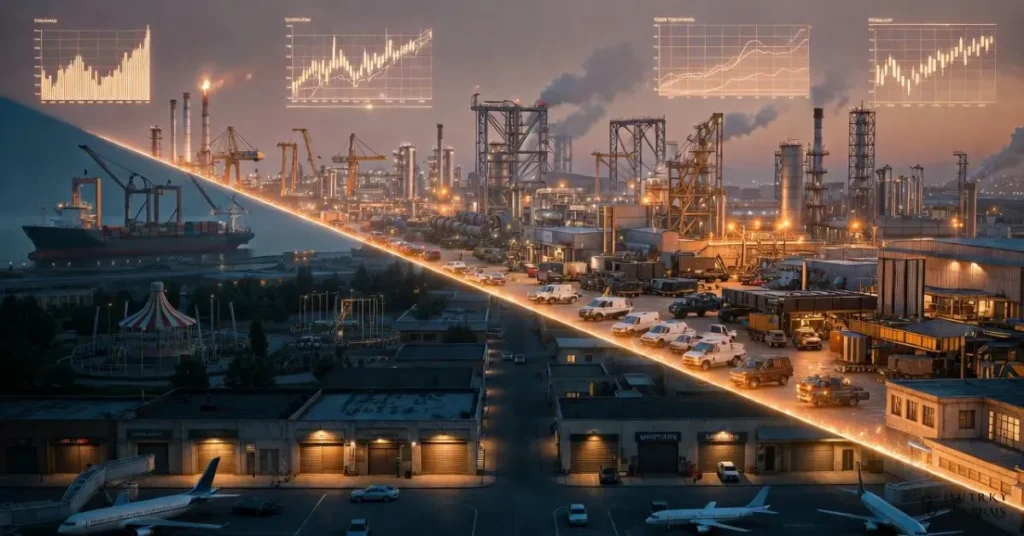
War Economy Chapter 13: Which Industries Historically Grow During War
Few forces reshape an economy as rapidly as war. When conflict breaks out, governments shift enormous sums of money away from peacetime priorities and into the war machine. This reallocation creates both winners and losers across financial markets and industries. Understanding these historical patterns can help investors, policymakers, and business owners make smarter decisions in uncertain times.
Throughout history, the economic consequences of war have been profound and far-reaching. From the industrial mobilisation of World War II to the post-9/11 defence boom, certain sectors have repeatedly outperformed during periods of armed conflict. Moreover, some industries that appear safe at first glance can suffer significant setbacks when war disrupts global trade and consumer confidence.
This post examines each major sector in depth. We will examine what history tells us, why certain industries grow and which tend to shrink, and what today’s investors and business operators should know. Keep in mind that every conflict is unique. Nevertheless, clear patterns emerge when studying the data across multiple wars and centuries.
Why War Transforms an Economy
To understand which industries grow during war, we first need to understand how conflict changes the basic flow of money. In peacetime, capital flows toward consumer preferences. People spend on entertainment, travel, luxury goods, and discretionary items. Governments focus budgets on social programs, infrastructure, and public services.
War reverses these priorities almost instantly. Suddenly, national security becomes the dominant concern. Governments begin spending at a scale that dwarfs normal peacetime budgets. The result is a dramatic shift in the allocation of capital across the entire economy.
As research from EBSCO’s historical business analysis shows, certain materials and industries see explosive demand increases during conflict. Steel, copper, chemicals, and textiles all surged in price and production during major wars, as manufacturers scrambled to supply the military machine. These patterns repeat across virtually every major armed conflict.
There is also the inflation effect to consider. War spending is inherently inflationary. Governments print money or issue bonds to fund the conflict. This increases the money supply and drives up prices for raw materials, energy, and manufactured goods. For businesses already operating in these sectors, rising prices typically mean rising revenues and profits.
The Defence and Aerospace Sector: The Most Consistent Wartime Winner
Defence and aerospace stand out as the single most reliable wartime beneficiary across all of recorded financial history. The logic is simple: wars require weapons. Governments must buy missiles, aircraft, warships, armoured vehicles, radar systems, and communications technology. All of that spending flows directly to defence contractors.
According to Middleton Private Capital’s capital allocation analysis, companies like BAE Systems, Lockheed Martin, Rolls-Royce, and Babcock are typically embedded in domestic defence ecosystems before a conflict begins. When war starts, these firms are first in line for expanded government contracts. Multi-year backlogs build up quickly, providing revenue visibility that few other sectors can match.
The post-9/11 period is especially instructive. Over the decade following the September 11 attacks, the defence sector returned an estimated 250 to 300 per cent while the broader S&P 500 was essentially flat. Similarly, during the 2022-2026 Ukraine era, major defence companies gained 50 to 70 per cent or more. This is not a coincidence. It reflects a structural reality: defence budgets rise during conflict, and they rarely fall back to pre-war levels once the fighting ends.
Key Defence Companies and ETFs
Several publicly traded companies have historically benefited most from wartime spending. These include:
Lockheed Martin (LMT), the world’s largest defence contractor, builds advanced fighter jets, missiles, and space systems. Similarly, RTX Corporation (RTX), formerly Raytheon, produces missile defence systems and advanced electronics. Northrop Grumman (NOC) specialises in stealth technology and autonomous systems, while General Dynamics (GD) builds submarines, combat vehicles, and IT systems for the military.
For investors who prefer diversification, the iShares U.S. Aerospace & Defence ETF (ITA) provides broad exposure to the sector. This fund holds positions across multiple defence primes and suppliers, reducing concentration risk while still capturing the sector’s wartime upside.
| Company | Ticker | Primary Products | Historical War Performance |
| Lockheed Martin | LMT | Fighter jets, missiles, space | Strongly positive |
| RTX Corporation | RTX | Missile defense, avionics | Strongly positive |
| Northrop Grumman | NOC | Stealth aircraft, autonomous systems | Strongly positive |
| General Dynamics | GD | Submarines, combat vehicles | Strongly positive |
| L3Harris | LHX | Communications, intelligence | Positive |
| Palantir Technologies | PLTR | Military AI, data analytics | Positive (modern conflicts) |
Energy Sector: Oil, Gas, and the Geography of War
Energy is the second great wartime beneficiary, though with an important caveat: performance depends heavily on where the conflict occurs. Wars fought in or near major oil-producing regions trigger immediate supply disruptions. Prices spike. Energy companies benefit. Wars in non-energy regions still tend to boost energy demand, but with a less dramatic effect on prices.
The 1973 Arab-Israeli War triggered an OPEC oil embargo that sent energy prices soaring by over 300 per cent. The Gulf War of 1990 temporarily pushed crude oil prices from around $17 to over $46 per barrel. The 2022 Russian invasion of Ukraine sent European natural gas prices to historic highs, benefiting energy producers across the board.
Beyond the direct price effect, wars also drive governments to invest in energy security and domestic production. Countries that feel exposed to foreign energy suppliers rush to diversify supply chains, build LNG terminals, invest in pipelines, and incentivise domestic drilling. All of this spending is a tailwind for energy companies and their suppliers.
Oil Majors and the Energy ETF
Major integrated oil companies like ExxonMobil (XOM), Chevron (CVX), and Shell (SHEL) have all historically performed well during wartime energy price spikes. Additionally, pipeline companies and LNG exporters benefit from increased demand for energy infrastructure. The Energy Select Sector SPDR ETF (XLE) offers diversified energy exposure.
However, not every energy company benefits equally. Refiners, for example, can face margin compression if crude oil prices rise faster than refined product prices. Upstream producers, by contrast, typically see the largest gains when oil prices climb. Therefore, sector-level analysis requires understanding which part of the energy value chain you are investing in.
| War / Conflict | Energy Price Impact | Primary Driver |
| Arab-Israeli War 1973 | Oil +300%+ (embargo) | OPEC embargo/supply shock |
| Gulf War 1990 | Oil rose from $17 to $46/bbl | Iraq’s invasion of Kuwait |
| Iraq War 2003 | Moderate oil price rise | Geopolitical uncertainty |
| Ukraine War 2022-present | Nat gas to historic highs in the EU | Russia sanctions/supply cut |
Industrial Manufacturing: Turning Factories Into War Machines
Throughout history, industrial manufacturing has been one of the defining sectors of wartime economies. Wars consume enormous quantities of physical goods. Ammunition, uniforms, food rations, trucks, boots, helmets, radios, medical supplies, and countless other items must be produced at scale. This surge in demand transforms the industrial sector.
The most dramatic example remains World War II American industrial mobilisation. In 1941, the U.S. produced over three million cars. During the entire war period, only 139 more were made. Instead, those same factories produced fighter jets, tanks, artillery pieces, and military trucks. Between 1938 and 1944, American industrial production essentially doubled in size. The country produced 297,000 aircraft, 193,000 artillery pieces, and 86,000 tanks during that period alone.
Companies like General Motors, Ford, Chrysler, and Boeing became central pillars of the Allied war effort. As Ken Burns’ PBS War Production documentary series documents, even small manufacturers pivoted: one Connecticut firm switched from making upholstery nails to producing three million cartridge clips per week. This kind of industrial flexibility drove enormous revenue growth for firms that could adapt quickly.
Modern Industrial Wartime Winners
Today, the picture is somewhat different but follows similar principles. Modern militaries still require enormous quantities of manufactured goods. Moreover, the complexity of modern warfare means that supply chains are both longer and more specialised than in previous centuries.
Companies like Caterpillar (CAT) benefit from wartime infrastructure reconstruction contracts. 3M (MMM) produces a wide range of materials used in military equipment. Oshkosh Defence builds tactical wheeled vehicles for the U.S. military. Furthermore, logistics companies that support military supply chains see significant contract volumes during sustained conflicts.
The Industrial Select Sector SPDR ETF (XLI) provides broad industrial exposure. However, selective stock picking in defence-adjacent manufacturing can deliver stronger wartime returns than a broad industrial index.
Cybersecurity and Military Technology: The Modern Battlefield
One of the most significant changes in wartime economics over the past two decades is the rise of cybersecurity and advanced military technology as major growth sectors. Modern conflicts are no longer fought only on physical battlefields. They extend into cyberspace, satellite networks, AI-driven intelligence systems, and drone warfare.
As Middleton Private Capital notes in their wartime allocation research, governments now invest heavily in cybersecurity infrastructure, surveillance upgrades, and logistics readiness. This creates a powerful tailwind for technology companies operating in the defence space.
Specifically, companies providing military AI and data analytics solutions have emerged as major beneficiaries of modern conflicts. Palantir Technologies, for example, has secured major contracts with the U.S. Department of Defence and allied military organisations. Its analytics platforms help military commanders process battlefield data faster and more effectively than traditional intelligence methods allow.
Cybersecurity Companies in Wartime
Several publicly listed cybersecurity firms benefit directly from elevated wartime threat environments. When nations go to war, cyberattacks against critical infrastructure escalate dramatically. Banks, power grids, water systems, and communications networks all face increased threat levels. Governments and corporations respond by dramatically increasing cybersecurity budgets.
Companies like CrowdStrike (CRWD), Palo Alto Networks (PANW), and Fortinet (FTNT) have all seen contract growth during periods of elevated geopolitical tension. Furthermore, Booz Allen Hamilton (BAH), which provides consulting and cybersecurity services directly to defence agencies, is another notable wartime beneficiary.
The drone industry is equally noteworthy. Companies producing unmanned aerial vehicles for both surveillance and offensive roles have seen explosive demand growth in recent conflicts. The Ukraine war accelerated drone warfare adoption far beyond what most defence analysts predicted as recently as 2020.
| Technology Sector | Key Companies | Wartime Demand Driver |
| Military AI / Analytics | Palantir (PLTR) | Battlefield data processing, intelligence |
| Cybersecurity | CrowdStrike, Palo Alto Networks | Nation-state cyberattack defense |
| Satellite / Space | L3Harris, Northrop Grumman | Surveillance, GPS, communications |
| Drones / UAV | AeroVironment, Shield AI | Reconnaissance, precision strikes |
| Defense IT | Booz Allen Hamilton (BAH) | Government tech consulting |
Commodities and Raw Materials: War Drives Demand for Physical Inputs
Wars are extraordinarily resource-intensive. Building a single modern fighter jet requires aluminium, titanium, copper, rare earth metals, composite materials, and hundreds of specialised components. Multiply that across thousands of aircraft, ships, vehicles, and weapons systems, and you get an enormous surge in commodity demand.
According to EBSCO’s economic research on war’s business impact, steel, copper, aluminium, and rubber all saw dramatic price increases during major 20th-century conflicts. During World War II, the American Brass Company alone produced over two billion pounds of brass rods, sheets, and tubes for the military. Prices for these materials surged as demand outpaced peacetime supply capacities.
Today, rare earth metals have become especially strategic. Modern weapons systems depend heavily on rare earth elements for motors, guidance systems, and electronics. China controls approximately 60 per cent of global rare earth production, making supply security a major concern during geopolitical conflicts. This creates investment opportunities in rare earth mining companies outside of China.
Gold and Safe-Haven Commodities
Beyond industrial commodities, gold has historically performed well during wartime. When investors feel uncertain about the economic outlook, they often move money into safe-haven assets like gold and government bonds. Gold prices surged during the Gulf War, the post-9/11 period, and the 2022 Ukraine conflict.
Silver, which has both monetary and industrial applications, often follows a similar pattern. Platinum and palladium, used heavily in automotive and industrial applications, can be affected in either direction depending on whether war disrupts supply chains or stimulates industrial production.
For commodity exposure, investors can consider the SPDR Gold Shares ETF (GLD) for gold, or the iShares MSCI Global Metals & Mining ETF (PICK) for broader commodity producers. Both have historically seen inflows during periods of elevated geopolitical risk.
Healthcare and Pharmaceuticals: Conflict Creates Urgent Medical Demand
Wars generate a devastating amount of human suffering, and that suffering creates urgent, non-discretionary demand for medical products and services. Battlefield injuries require surgical instruments, blood products, antibiotics, pain management medications, and advanced wound care. Military medical programs are substantially funded during active conflicts.
The historical record is clear on this point. Every major 20th-century conflict drove significant investment in military medicine and the pharmaceutical supply chain. During World War II, the mass production of penicillin was dramatically accelerated due to military demand, laying the groundwork for the modern pharmaceutical industry.
Beyond immediate battlefield care, mental health treatment demand also surges during and after conflicts. Post-traumatic stress disorder affects a significant percentage of combat veterans. This creates long-term demand for mental health services, pharmaceuticals, and rehabilitation programs. As a result, healthcare companies with military contracts and those specialising in trauma care see elevated revenues during sustained conflicts.
Medical Device and Pharma Companies
Companies providing battlefield medical equipment benefit most directly.DRS Technologies and similar defence medical contractors supply field hospitals and combat medic equipment. Larger pharmaceutical companies likeJohnson & Johnson (JNJ), Pfizer (PFE), andAbbott Laboratories (ABT) all supply medical products used extensively in military healthcare systems.
Rehabilitation technology is another growth area. Companies developing prosthetics, neural interfaces, and physical therapy technologies see increased demand as conflicts produce more veterans requiring long-term care. The healthcare sector ETF (XLV) provides broad sector exposure, though more targeted plays in defence medicine tend to outperform during active conflicts.
Agriculture and Food Supply: Feeding Armies and Civilians
Historically, feeding armies was one of the most significant logistical challenges of warfare. Napoleon famously observed that an army marches on its stomach. This reality made agriculture and food supply chains critically important wartime industries. That principle still holds true today, though the methods have changed dramatically.
During both World Wars, agricultural prices surged as European farming was disrupted. American farmers, positioned as suppliers to both domestic and Allied forces, saw significant price increases for grains, livestock, and agricultural commodities. The U.S. Department of Agriculture documented extensive government intervention in food markets during wartime to manage supply and pricing.
Today, wars that disrupt major agricultural regions drive global food price inflation. The 2022 Ukraine conflict is a prime example. Ukraine and Russia together account for roughly 30 per cent of global wheat exports. Russia’s invasion caused wheat prices to surge by over 50 per cent in early 2022, benefiting agricultural commodity producers and food processing companies in unaffected regions.
Modern Agricultural Wartime Beneficiaries
Companies like Archer-Daniels-Midland (ADM), Bunge Limited (BG), and Corteva Agriscience (CTVA) operate across agricultural supply chains that benefit from both elevated commodity prices and increased food security spending. Additionally, fertiliser producers like Nutrien (NTR) and Mosaic Company (MOS) benefit because war disrupts fertiliser supply chains, pushing prices higher.
Investors should also consider the Invesco DB Agriculture ETF (DBA), which tracks a basket of agricultural commodity futures. During wartime commodity spikes, this fund has historically captured meaningful upside from food price inflation.
Sectors That Typically Decline During War
Understanding which industries grow is only half the picture. Equally important is knowing which sectors typically underperform during wartime. This knowledge helps investors rebalance portfolios and helps business operators anticipate challenging periods.
Consumer discretionary is usually the hardest hit. When geopolitical uncertainty rises, consumers cut back on non-essential spending. Travel, luxury goods, restaurants, retail fashion, and entertainment all tend to contract during wartime. Airlines are particularly vulnerable: fuel costs rise, passenger confidence drops, and route disruptions can devastate revenues.
Real estate can also struggle, particularly in or near conflict zones. But even in unaffected countries, rising interest rates driven by wartime inflation can cool property markets. The construction and real estate sectors historically underperform during inflationary wartime periods.
| Sector | Typical War Performance | Primary Reason |
| Defense & Aerospace | Strongly Positive | Direct government military spending |
| Energy (oil/gas) | Positive (near conflict zones) | Supply disruption, price spikes |
| Industrial Manufacturing | Positive | Military production contracts |
| Cybersecurity / Tech | Positive | Elevated threat environment |
| Commodities / Metals | Positive | Surge in raw material demand |
| Healthcare | Moderately Positive | Military medical demand |
| Agriculture | Positive (if near food region) | Supply disruption, price spikes |
| Consumer Discretionary | Negative | Consumer confidence drops |
| Airlines / Travel | Negative | Fuel costs, route disruption |
| Luxury Goods | Negative | Reduced consumer spending |
| Real Estate | Mixed to Negative | Interest rate pressure, inflation |
| Auto Manufacturing (civilian) | Negative | Production diverted to the military |
The Military-Industrial Complex: A Historical Perspective
One of the most consequential long-term outcomes of wartime economic mobilisation is the creation of a permanent defence industrial base. President Dwight D. Eisenhower famously warned about this in his 1961 farewell address, coining the phrase ” military-industrial complex to describe the alliance between government defence agencies and private defence contractors.
As EBSCO’s historical business research explains, companies in aviation, weapons production, and high-tech security systems that grew exponentially during wartime found a continuing market for their products after conflicts ended. These firms developed close working relationships with senior defence officials, ensuring that orders continued flowing even during peacetime.
This dynamic has profound investment implications. Defence companies do not simply spike during active wars and then collapse when peace returns. They typically maintain elevated revenues because defence budgets rarely return to pre-war levels. Eisenhower himself acknowledged that this relationship, while potentially concerning for democracy, was perhaps an inevitable feature of a world in which the U.S. maintained a global military presence.
Defence Spending Trends Today
Global defence spending has been on a rising trajectory for much of the past two decades. According to SIPRI’s global military expenditure data, world military spending reached approximately $2.2 trillion in 2023, the highest level ever recorded. European NATO members in particular began dramatically increasing defence budgets following Russia’s 2022 Ukraine invasion.
Germany is committed to spending 2 per cent of its GDP on defence. Poland accelerated its military buildup to become one of NATO’s largest per-capita spenders. Several Scandinavian countries joined NATO for the first time. Each of these decisions translates directly into contracts for defence companies, both domestic and allied. This structural shift suggests that the defence sector tailwind extends well beyond any single conflict’s timeline.
For investors monitoring defence sector trends, the NATO Defence Expenditure reports provide regular updates on member spending commitments. These documents are valuable primary sources for estimating future contract flows to major defence companies.
Government Bonds and War Finance: What History Shows
Wars are extraordinarily expensive. To finance them, governments typically issue large quantities of bonds. This creates opportunities for investors in fixed-income markets, though the risk profile varies considerably depending on the country and the nature of the conflict.
As EBSCO’s economic research highlights, governments issued bonds during major conflicts to generate capital for military expenditure. These securities historically offered good interest rates with relatively minimal risk, at least for the winning side. Investors who bought U.S. war bonds during both World Wars received their principal back with interest when peace returned.
However, the bond market picture is more nuanced today. Wartime spending drives inflation, which erodes the real value of fixed-income payments. The U.S. Federal Reserve’s response to wartime inflation has historically been complex: sometimes holding rates low to help finance the government, and sometimes raising them to control inflation. This uncertainty makes plain vanilla bonds a less reliable war play than in previous centuries.
Inflation-Protected Securities in Wartime
One modern solution for fixed-income investors is to favour Treasury Inflation-Protected Securities (TIPS). These bonds adjust their principal value with inflation, protecting against the inflationary effects of wartime spending. Similarly, Series I Savings Bonds have seen elevated demand during periods of high wartime inflation.
International investors should also consider which country’s bonds they are buying. The bonds of a large, stable economy fighting a distant war are very different in risk profile from the bonds of a country directly engaged in fighting on its own territory. Credit risk, currency risk, and sovereign default risk all escalate dramatically for countries experiencing significant battlefield losses or economic disruption.
How World War II Reshaped American Industry Forever
World War II deserves special attention as the most dramatic example of wartime industrial transformation in modern history. The scale of American industrial mobilisation was unprecedented and has never been matched since.
As Ken Burns’ PBS War Production documentary records, American industry provided nearly two-thirds of all Allied military equipment produced during the conflict. That included 297,000 aircraft, 193,000 artillery pieces, 86,000 tanks, and two million army trucks. In four years, American industrial production doubled in size despite the country already being close to full employment.
The transformation was staggering in its scope. As noted by Dissent Magazine’s economic review of the wartime economy, unemployment fell by approximately 10 million between 1938 and 1944. Private employment rose by 10 million, and military employment rose by another 10 million, with roughly 10 million new workers entering the labour force, primarily women.
Lessons for Modern Economies
The WWII experience holds several lessons for modern economies facing war. First, rapid industrial retooling is possible if the government coordinates it correctly. Second, war can temporarily solve unemployment and underutilization problems through the massive demand shock it creates. Third, the transition back to peacetime can be equally challenging, as industries built for war suddenly face shrinking demand.
As Middleton Private Capital’s analysis emphasises, the WWII experience showed that despite initial panic in markets, equities eventually surged as the economic benefits of mobilisation became clear. This suggests that investors who stay disciplined during the early, uncertain phase of a conflict often capture significant gains as wartime production ramps up.
Modern economies face some structural differences, however. Today’s wars are fought with highly specialised, technology-intensive weapons systems rather than mass-produced conventional weapons. This shifts the industrial benefit toward advanced technology firms and away from basic manufacturers. The ratio of software to steel has changed substantially since 1945.
Emerging Markets and War: A Different Risk Profile
For investors in emerging markets, wartime economics present a significantly different risk profile. Developing economies that are directly involved in conflict face potential currency collapse, hyperinflation, capital flight, and complete disruption of normal business activity. These are not investment opportunities; they are risk zones to avoid.
However, emerging markets that are geographically distant from the conflict but benefit from commodity price increases can present interesting opportunities. Brazil, for example, is a major agricultural exporter that has historically benefited from global food price spikes caused by wars disrupting other producing regions. Similarly, Middle Eastern producers outside the direct conflict zone can benefit from oil price increases caused by regional instability.
The International Monetary Fund’s research on war and economic growth demonstrates that the economic ripple effects of major conflicts extend well beyond the immediate war zone. Countries with strong commodity exports and stable governance often see economic tailwinds during wars fought elsewhere.
Small Business and War: Adapting to Shifting Demand
Much of the discussion about wartime economics focuses on large publicly traded companies. But small businesses also face significant choices when conflicts reshape the economic landscape. History shows that small manufacturers who could pivot to military supply contracts often thrived, while those dependent on consumer spending or import-export trade frequently struggled.
The World War II example is again instructive. As PBS War Production documents, the Mattatuck Manufacturing Company switched from making upholstery nails to producing three million cartridge clips per week. This kind of rapid adaptation required flexibility, machinery that could be repurposed, and a willingness to engage with government contracting processes.
Today, small businesses can access U.S. Small Business Administration defence contracting programs, which set aside a percentage of government contracts specifically for small businesses. Firms with capabilities in manufacturing, technology, logistics, or specialised services can often find wartime opportunities through these programs even without the scale of a major defence prime.
Supply Chain Adaptation for Small Businesses
Beyond direct government contracts, small businesses should think carefully about supply chain resilience during wartime. Import-dependent businesses face significant risk if their supply chains run through conflict zones or through countries subject to sanctions. Conversely, domestic suppliers who can replace disrupted imports often see sudden demand increases.
For entrepreneurs and small business owners, the key lesson is agility. The businesses that thrived historically were not necessarily the largest or the most established. Rather, they were the ones who identified the new demand patterns quickly and adapted their operations to meet them. This remains true in modern conflicts, where supply chain disruptions create opportunities for nimble domestic producers.
Investment Strategy: How to Position a Portfolio for Wartime
Understanding which industries grow during war is academically interesting. However, turning that knowledge into actionable investment decisions requires a clear-eyed look at risk, timing, and diversification. Several principles have historically guided successful wartime portfolio positioning.
First, diversification within winning sectors remains essential. Within defence, for example, not every contractor performs equally. Some focus on ground systems; others on aerospace or naval. Spreading exposure across subsectors reduces the risk of a single contract cancellation or budget shift wiping out gains. The ITA defence ETF is one way to achieve this diversification automatically.
Second, timing matters enormously. The clearest wartime returns often come in the first weeks and months after a conflict begins, when markets are pricing in the new defence spending reality. Late entries into wartime positions tend to deliver lower returns as the premium is already priced in. Consequently, investors who maintain permanent modest allocations to defence and energy typically outperform those who try to trade in and out around conflict news.
Risk Management in Wartime Portfolios
Wartime investing carries real risks that must be managed. Conflicts can end unexpectedly, triggering sharp reversals in defence stocks. Additionally, war can trigger broader market downturns that temporarily affect even the winning sectors. During the early days of World War II, the U.S. stock market actually fell before the industrial mobilisation benefits became clear.
Therefore, position sizing is critical. Overweighting any single wartime theme creates a dangerous concentration risk. Combining defence exposure with other wartime beneficiaries, like energy and commodities, while maintaining some allocation to defensive sectors like utilities and consumer staples, creates a more balanced wartime portfolio.
Investors should also monitor the VIX volatility index as a proxy for market fear during wartime. High volatility environments often create short-term opportunities to buy quality companies at discounts, even within the wartime-winning sectors. Patience and discipline tend to be rewarded more consistently than rapid trading during these periods.
| Portfolio Strategy | Key Instruments | Risk Level |
| Core Defence Allocation | ITA ETF, LMT, NOC, RTX | Moderate |
| Energy Exposure | XLE ETF, XOM, CVX | Moderate-High |
| Commodity Hedge | GLD, PICK ETF, agricultural futures | High |
| Inflation Protection | TIPS, I-Bonds | Low-Moderate |
| Cybersecurity Theme | CRWD, PANW, FTNT | Moderate-High |
| Broad Industrial | XLI ETF, Caterpillar, Oshkosh | Moderate |
The Post-War Economy: What Happens When Fighting Stops
Understanding the wartime economy also requires understanding what happens when the war ends. History shows that the transition to peacetime can be as disruptive as the transition to war, and that some wartime winners become peacetime losers.
After World War II, for example, many defence companies had to dramatically downsize as military contracts evaporated. As EBSCO’s historical business analysis notes, industries relying on skilled workers such as computer technicians, legal professionals, and medical personnel were hit by labour shortages after demobilisation. Workers who had been in uniform returned to the labour market, and the sudden surge in labour supply compressed wages in some sectors.
However, many wartime industries managed the transition successfully. Defence companies diversified into commercial aviation, electronics, and other civilian applications of their wartime technology. The defence research investments of World War II and the Cold War gave birth to the internet, GPS technology, and dozens of other civilian technologies that generated enormous peacetime value.
Long-Term Technology Spinoffs from War
One of the most underappreciated aspects of wartime economics is the long-term civilian value created by military research. DARPA, the U.S. Defence Advanced Research Projects Agency, has funded research that produced the internet, drone technology, GPS navigation, voice recognition, and materials science breakthroughs. These investments paid dividends for civilian technology companies for decades after the original military need had passed.
Similarly, the World War II investment in radar technology eventually led to microwave ovens, air traffic control systems, and weather forecasting. The nuclear research of the Manhattan Project, while primarily destructive in its immediate application, eventually generated the civilian nuclear power industry. In this sense, wars sometimes create technology platforms that support decades of peacetime economic growth.
Global Supply Chains and War: Modern Vulnerabilities
Modern economies are more interconnected than at any previous point in history. This interconnectedness creates both risks and opportunities when war disrupts global supply chains. The impact of a conflict in one region can cascade rapidly through supply chains that span multiple continents.
The semiconductor industry offers a compelling modern example. Taiwan produces approximately 60 per cent of the world’s semiconductors and over 90 per cent of the most advanced chips. A conflict involving Taiwan would be catastrophic for global electronics supply chains. This risk has already prompted massive government investment in domestic semiconductor manufacturing through the CHIPS Act and equivalent European initiatives.
For investors, supply chain vulnerability analysis is therefore an essential component of wartime portfolio management. Companies with diversified supply chains and strong domestic manufacturing capabilities are typically more resilient during wartime disruptions than those dependent on single-source foreign suppliers. As recent experience with COVID-19 supply chain disruptions demonstrated, even modest disruptions can have outsized effects on just-in-time manufacturing systems.
Shipping, Logistics, and Transportation During War
Military logistics is a vast and often overlooked component of wartime economic activity. Moving troops, equipment, ammunition, fuel, food, and medical supplies across vast distances requires an enormous logistical infrastructure. This creates significant demand for shipping, trucking, rail freight, and air cargo services.
During both World Wars, shipping companies saw revenues surge as the military demanded massive quantities of transport capacity. The construction of Liberty ships during World War II represents one of the greatest industrial achievements in history, with American shipyards producing over 2,700 vessels in just four years. Shipbuilding companies and operators benefited enormously from this demand.
Today, defence logistics is typically provided either by military transport commands or by large logistics contractors like DHL Defence, Leidos Holdings (LDOS), and SAIC (SAIC). These companies hold significant government contracts for logistics support and tend to see elevated revenues during active conflicts.
Psychological Impact on Consumer Markets
Beyond the direct economic effects, war also reshapes consumer psychology in ways that affect business across virtually every sector. Fear, uncertainty, and patriotism all influence buying decisions during wartime in ways that can be difficult to predict but important to understand.
Generally, consumers shift toward essentials during wartime. Spending on food, medicine, household necessities, and home improvement tends to hold up better than discretionary spending. Companies like Walmart (WMT), Costco (COST), and other essential retailers historically outperform discretionary peers during periods of elevated fear and uncertainty.
Conversely, consumers sharply reduce spending on international travel, luxury goods, high-end restaurants, and entertainment during wartime. The psychological impact of conflict, even when it is occurring far from a consumer’s home, significantly reduces willingness to make large or non-essential purchases. This is why consumer confidence indices are closely watched by both economists and investors during geopolitical crises.
Lessons from the Ukraine War: A Modern Case Study
The 2022 Russian invasion of Ukraine provides the most recent and directly relevant case study for understanding modern wartime economics. The conflict has generated clear economic winners and losers that closely mirror the historical patterns identified throughout this article.
European defence companies saw immediate stock price surges. BAE Systems, Rheinmetall, Leonardo, and KNDS all saw dramatically increased orders as NATO countries scrambled to replenish weapons stocks donated to Ukraine and to rebuild their own depleted inventories. Rheinmetall’s stock rose by over 300 per cent in the years following the invasion, reflecting the extraordinary demand surge for artillery shells, armoured vehicles, and air defence systems.
Energy markets were equally dramatic. European natural gas prices surged to record highs as Russia restricted supply. LNG exporters, particularly U.S. producers, saw massive revenue increases as Europe scrambled to replace Russian gas with alternative suppliers. Meanwhile, European renewable energy investment accelerated sharply as governments sought to reduce dependence on fossil fuels that could be weaponised by hostile powers.
Agricultural Impact of the Ukraine War
The agricultural impact of the Ukraine war has also been severe. Ukraine is one of the world’s largest exporters of wheat, corn, and sunflower oil. Russia’s invasion disrupted planting cycles, damaged agricultural infrastructure, and blocked Black Sea export routes, at least temporarily. As a result, global food prices surged in 2022, benefiting agricultural commodity producers and exporters in unaffected countries while creating serious food security challenges for import-dependent nations.
The UN Food and Agriculture Organisation’s food price index hit its highest level ever recorded in March 2022, shortly after the invasion began. This translated directly into higher revenues for agricultural commodity companies and food producers in countries like Brazil, Australia, Canada, and the United States. It also accelerated investment in agricultural productivity technologies as food security concerns intensified globally.
How to Research Wartime Investment Opportunities
For investors and analysts who want to apply these historical lessons, several research resources are particularly valuable. Understanding where to find reliable data on defence spending, commodity markets, and geopolitical risks is essential for making well-informed decisions.
The Stockholm International Peace Research Institute (SIPRI) publishes comprehensive annual data on global military expenditure. This is perhaps the most authoritative source for tracking defence budget trends across all major countries. SIPRI data is free to access and is frequently cited by defence analysts and investment researchers.
For energy market intelligence, the International Energy Agency (IEA) publishes detailed reports on supply, demand, and price dynamics across all major energy markets. Similarly, the U.S. Energy Information Administration (EIA) provides granular data on domestic production, inventory levels, and import/export dynamics. Both are essential reading for anyone investing in energy during wartime.
Defence Contract Tracking Resources
For tracking actual defence contracts, the U.S. Department of Defence publishes daily contract announcements at defense.gov/News/Contracts. Each announcement includes the contractor, contract value, scope of work, and delivery timeline. Following this data stream closely allows analysts to spot emerging contract trends before they appear in company earnings reports.
Additionally, many defence companies publish quarterly earnings presentations that include backlog data. A rising backlog typically signals sustained future revenue growth even if current-quarter results are modest. Comparing backlog growth across competing defence primes is a useful way to identify relative winners within the sector. Investor relations pages for Lockheed Martin, RTX Corporation, and other majors all provide this data regularly.
Spend some time for your future.
To deepen your understanding of today’s evolving financial landscape, we recommend exploring the following articles:
From Software to Watts: Why the Next AI Boom Is an Energy Story
The Rise of Spatial Finance: Mapping Risk in 3D
Stop Worrying About Money: 9 Stress‑Cutting Tips
Achieving Product-Market Fit for Startups: Key Signals and Retention Metrics
War Economy Chapter 12: Which Sectors Collapse First During Conflict
Explore these articles to get a grasp on the new changes in the financial world.
Disclaimer
Important: This article is provided for informational and educational purposes only. Nothing in this post constitutes financial, investment, legal, or tax advice. Past performance of any sector, company, or index is not a guarantee of future results. All investments carry risk, including the possible loss of principal. Geopolitical situations are inherently unpredictable, and wartime economic patterns may not repeat in future conflicts. Please consult a qualified financial advisor before making any investment decisions. The author and publisher accept no liability for any losses incurred as a result of information presented in this article.
References
[1] MoneySense AI, “Which Stock Sectors Win and Which Lose During Military Conflicts,” 2026. [Online]. Available: https://moneysense.ai/blog/financial-news/war-economy-sectors-winners-losers-2026
[2] EBSCO Research Starters, “Historical Impact of War on Business,” EBSCO Publishing. [Online]. Available: https://www.ebsco.com/research-starters/economics/historical-impact-war-business
[3] Middleton Private Capital, “Where to Allocate Capital During War,” Middleton Private Capital. [Online]. Available: https://www.middletonprivatecapital.co.uk/where-to-allocate-capital-during-war/
[4] K. Burns, “War Production,” PBS/Ken Burns, The War Documentary Series. [Online]. Available: https://www.pbs.org/kenburns/the-war/war-production
[5] M. Wilson, “The Economy During Wartime,” Dissent Magazine. [Online]. Available: https://dissentmagazine.org/article/second-world-war-economy-mark-wilson-destructive-creation-review/
[6] Stockholm International Peace Research Institute (SIPRI), “World Military Expenditure Data,” SIPRI. [Online]. Available: https://www.sipri.org/research/armament-and-disarmament/arms-and-military-expenditure
[7] International Energy Agency, “Global Energy Crisis,” IEA. [Online]. Available: https://www.iea.org/topics/global-energy-crisis
[8] Food and Agriculture Organisation of the United Nations, “Food Price Index,” FAO. [Online]. Available: https://www.fao.org/worldfoodsituation/foodpricesindex/en/
[9] U.S. Energy Information Administration, “Energy Security,” EIA. [Online]. Available: https://www.eia.gov/energyexplained/energy-and-the-environment/energy-security.php
[10] U.S. Department of Defence, “Defence Contracts,” DoD. [Online]. Available: https://www.defense.gov/News/Contracts/