
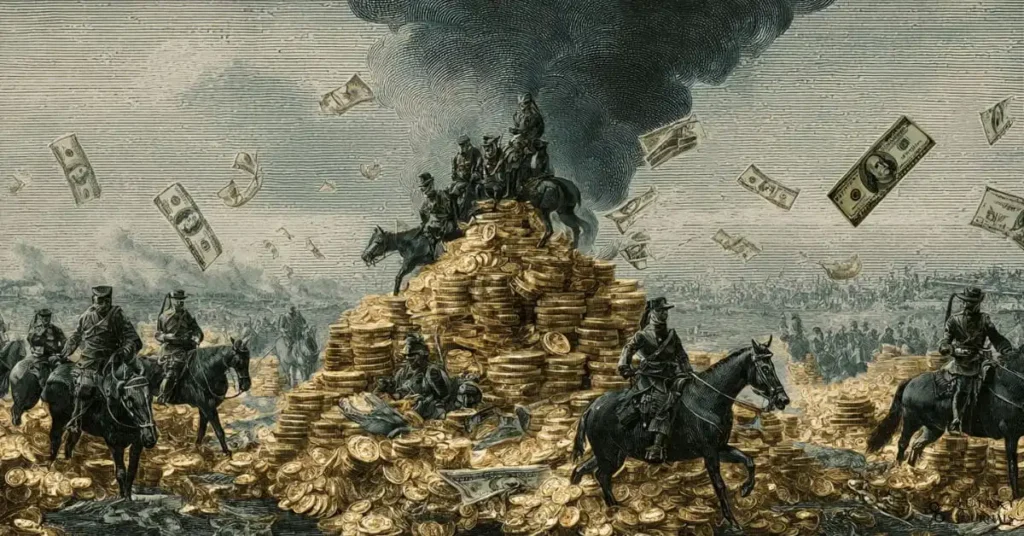
War Economy Chapter 15: Liquidity Crises – When Cash Becomes King
In the long sweep of economic history, few forces destabilise financial systems as completely as armed conflict. Wars do not simply destroy physical infrastructure. They also shatter the invisible architecture of trust, credit, and liquidity that underpins every modern economy. When that architecture cracks, a liquidity crisis typically follows, and cash transforms from a routine medium of exchange into the planet’s most precious commodity.
Understanding wartime liquidity crises is not merely an academic exercise. For investors, business owners, policymakers, and ordinary citizens, these episodes carry enormous practical consequences. Credit markets freeze. Banks refuse to lend. Businesses cannot meet payroll. Governments struggle to fund their own operations. The entire economic organism, normally so fluid and adaptive, suddenly seizes up.
This article examines the mechanics of wartime liquidity crises in depth. We explore how wars trigger cash shortages, how governments attempt to manage them, what historical conflicts tell us about the patterns that emerge, and what investors and businesses can do to protect themselves when the next crisis arrives. Along the way, we draw on research from economists, central banks, and financial historians who have studied these phenomena with exceptional rigour.
From the monetary chaos of World War I to the inflationary financing of World War II, from the liquidity squeeze of the Gulf War to the extraordinary interventions of recent conflicts, the story of cash becoming king in wartime is one of the most consequential recurring narratives in all of financial history. Equally, it is one of the most practically relevant for anyone navigating today’s increasingly volatile geopolitical landscape.
What Is a Liquidity Crisis and Why Does War Cause One?
A liquidity crisis occurs when economic actors cannot convert assets into cash quickly enough to meet their obligations. This is distinct from solvency: a solvent institution has sufficient assets to cover its liabilities but cannot access them fast enough when needed. During a liquidity crisis, creditworthy borrowers cannot get loans, solvent banks cannot fund their operations, and otherwise viable businesses cannot pay their suppliers or employees.
War creates the conditions for liquidity crises through multiple simultaneous channels. First, it destroys physical and financial infrastructure, making normal economic transactions impossible or extremely costly. Second, it generates massive and sudden government spending demands that compete directly with private sector credit needs. Third, it triggers flight-to-safety behaviour among investors and households, which concentrates cash hoarding and depletes the circulating supply of liquidity.
Research published by the Centre for Economic Policy Research (CEPR) documents a striking phenomenon called the ‘flight to liquidity’ effect during wartime. Even as sharp inflation erodes the value of cash, households continue to hold it because alternatives are limited and uncertainty is extreme. This behaviour, rational at the individual level, is deeply destabilising at the macro level because it withdraws liquidity from the banking system precisely when it is most needed.
Additionally, as the CEPR research shows, governments at war shift dramatically toward short-term borrowing. The share of long-term government debt falls by approximately 2.2 percentage points, equivalent to about 1.2 per cent of GDP, as governments pivot to short-term instruments to manage heightened risk and constrained market access. This structural shift in the composition of government debt increases rollover risk and makes already fragile economies significantly more vulnerable to further financial disruption.
The combination of individual cash hoarding, banking system stress, government borrowing pressure, and collapsing private sector confidence creates a liquidity trap from which wartime economies struggle to escape without extraordinary intervention. Understanding these interlocking dynamics is essential for anyone seeking to anticipate, prepare for, or respond to the financial crises that accompany armed conflict.
The Inflation Paradox: Why Cash Becomes King Even as It Loses Value
One of the most counterintuitive aspects of wartime financial behaviour is the simultaneous hoarding of cash even as inflation rapidly erodes its purchasing power. This apparent contradiction resolves once you understand the specific nature of wartime uncertainty. When all familiar stores of value become unreliable, cash at least provides immediate, unconditional purchasing power for essential goods and survival necessities.
CEPR research documents that in the decade following the onset of conflict, consumer price levels rise by approximately 62 per cent. Nominal money supply increases by roughly 67 per cent over the same period, yet real money balances remain essentially unchanged. This pattern is consistent with what economists call inflationary financing of government deficits, rather than genuine cash hoarding in real terms.
The Riksbank, Sweden’s central bank, published detailed research on monetary policy and inflation in wartime. This research identifies the critical role of war financing methods in determining inflationary outcomes. When governments finance war through taxation or reduced spending elsewhere, inflationary pressure is limited. When they instead print money or borrow heavily from the central bank, inflation becomes severe and sustained.
War triggers what economists describe as a fiscal dominance regime: deficits, monetisation, and inflation feed into each other in a self-reinforcing cycle. Governments need funds for military operations. Central banks provide those funds by expanding the money supply. The resulting inflation erodes real wages and savings. Citizens and businesses respond by demanding more nominal cash to maintain their real purchasing power. Governments then expand the money supply further to meet this demand, driving inflation still higher.
This cycle is exactly what the CEPR research identifies in wartime economies. Inflation acts as what researchers call a ‘silent tax’ on households and businesses, transferring real resources from the private sector to the government through the erosion of monetary purchasing power. It is silent because it does not require legislative approval, it falls on all holders of nominal assets simultaneously, and it operates through the invisible mechanism of price changes rather than explicit tax collection.
How Governments Finance Wars and What It Does to Liquidity
War finance is among the most consequential and least publicly understood aspects of conflict economics. Governments engaged in major conflicts face financing demands that dwarf ordinary peacetime budgets. Meeting these demands requires choices that have profound and lasting effects on monetary systems, credit markets, and the distribution of economic resources across society.
The Wikipedia article on war finance identifies the primary mechanisms governments use to fund military operations: taxation, bond issuance, borrowing from financial institutions, and direct money creation by the central bank. Each of these mechanisms carries different implications for liquidity, inflation, and the burden distribution across different groups within the economy.
War bonds represent one of the most historically significant liquidity management tools. During World War I, the U.S. government spent over $300 million, equivalent to over $4 billion in today’s money, on bonds that were sold directly to the public through intensive advertising campaigns using radio, cinema, and newspapers. These bonds served a dual purpose: they raised funds for the war effort and simultaneously absorbed excess money supply that might otherwise have driven inflation higher.
The Riksbank research explains the critical distinction between different financing methods clearly. Tax-financed wars reduce private purchasing power directly, counteracting the inflationary effect of increased government military expenditure. Debt-financed wars defer the fiscal burden into the future but can crowd out private investment if government borrowing absorbs too large a share of available credit. Money-financed wars, where the central bank effectively prints currency to fund government spending, are the most inflationary and most damaging to long-term monetary stability.
The Institute for Economics and Peace research on the economic consequences of war on the U.S. economy documents how the financing of the Iraq and Afghanistan wars contributed to broader macroeconomic distortions. The large budget deficits created by war spending limited policymakers’ fiscal options during the subsequent Global Financial Crisis of 2008. This constrained fiscal space forced the Federal Reserve to compensate through extraordinary monetary policy, including flood liquidity operations and historically low interest rates.
Table 1: War Financing Methods and Their Liquidity Impact
| Method | Inflation Risk | Liquidity Effect | Debt Burden | Historical Example |
| Taxation | Low | Neutral to negative | None | UK in WWI (partial) |
| War bonds (public) | Low-medium | Absorbs excess money | Deferred | The US in WWI and WWII |
| Bank borrowing | Medium | Crowding out private credit | High | Germany in WWI |
| Central bank monetisation | Very High | Expands the money supply | Inflationary | Weimar Germany (1923) |
| Asset sales/reserves | Low | Reduces future buffers | None initially | UK selling US assets (WWII) |
Source: Compiled from Wikipedia, War Finance, Riksbank Monetary Policy Research, and IEP Economic Consequences of War.
The Banking System Under Wartime Stress: Credit Freezes and Bank Runs
Banks are the plumbing of any modern economy. They channel savings into productive investments, provide the payment infrastructure for commercial transactions, and create credit that allows businesses and households to function between income and expenditure cycles. When wartime stress damages this plumbing, the consequences spread rapidly throughout every sector of the economy.
The most acute banking system threat during wartime is the bank run: a self-fulfilling panic where depositors rush to withdraw funds simultaneously because each fears being last in the queue when limited reserves run out. Bank runs do not require banks to actually be insolvent. They require only a sufficient number of depositors to believe that other depositors might panic, creating the very panic they feared. This reflexive dynamic is particularly virulent during wartime when uncertainty is extreme, and trust in institutions is fragile.
Historical evidence shows that wartime bank runs often trigger bank consolidation and the suspension of normal banking operations. During World War I, the Bank of England suspended convertibility of pounds sterling into gold on August 1, 1914, just days after the outbreak of hostilities. This decision, effectively ending the classical gold standard in Britain, was a direct response to a liquidity crisis as foreign creditors demanded gold settlement of their claims simultaneously.
The interbank lending market, through which banks with excess reserves lend to those with shortfalls, is particularly vulnerable to wartime stress. When banks become uncertain about the creditworthiness of their counterparties, they stop lending to each other. The interbank market freezes. Banks with temporary shortfalls cannot access short-term funding. What begins as a liquidity problem rapidly becomes an insolvency crisis as illiquid banks face forced asset sales at distressed prices.
Government guarantees and central bank interventions are the primary tools used to prevent or arrest banking system crises during wartime. Deposit guarantee schemes reassure ordinary depositors that their savings are protected, reducing the incentive to join a bank run. Central bank lending of last resort provides emergency liquidity to solvent but illiquid institutions. Together, these backstops are designed to prevent individually rational behaviour from creating collectively irrational outcomes.
Central Bank Responses to Wartime Liquidity Crises
Central banks occupy the critical pivot point in wartime financial management. They control the money supply, set short-term interest rates, serve as lender of last resort to the banking system, and, in modern conflicts, often directly finance government deficits. The choices they make during wartime liquidity crises have consequences that echo through economies for decades after peace is restored.
The fundamental tension facing wartime central banks is stark. Expanding the money supply and cutting interest rates provides immediate liquidity relief but risks fuelling the inflation that CEPR research documents as a lasting scar of conflict. Maintaining tight money to contain inflation may be appropriate in normal times, but it risks triggering unnecessary economic collapse during an existential national emergency. Most central banks have historically resolved this tension in favour of liquidity provision, accepting inflation as the price of avoiding financial system breakdown.
The Riksbank research documents how different financing choices during World War II led to dramatically different inflationary outcomes across countries. Nations that relied heavily on central bank monetisation experienced severe inflation during and after the conflict. Those that combined taxation, genuine public bond issuance, and price controls more successfully contained inflation, though often at the cost of significant economic distortion and reduced consumer welfare during the conflict years.
Modern central banks have substantially more sophisticated tools than their wartime predecessors. Quantitative easing, targeted lending facilities, and foreign exchange swap lines between central banks all represent advances in liquidity provision that reduce the need for crude money printing. The Federal Reserve’s deployment of these tools during the COVID-19 pandemic demonstrated their potential utility in wartime liquidity crises as well, though the subsequent inflation surge also demonstrated their limitations.
Perhaps most significantly, the Institute for Economics and Peace research on the Iraq and Afghanistan conflicts shows how wartime monetary decisions create long-lasting structural legacies. The Federal Reserve’s extended period of low interest rates and liquidity provision, necessitated partly by the fiscal constraints created by war spending, contributed to the credit conditions that fuelled the housing bubble and subsequent financial crisis of 2008. Wartime monetary choices thus cascaded into peacetime financial catastrophe years later.
Flight to Safety: How Investors Behave During Wartime Liquidity Crunches
When liquidity crises strike during wartime, investor behaviour shifts dramatically and predictably. The diversity of investment strategies that characterise normal market conditions collapses into a uniform rush for safety, liquidity, and capital preservation. Understanding these behavioural patterns allows investors and financial institutions to anticipate market movements and position themselves more effectively before crises fully unfold.
Cash and near-cash instruments are the first beneficiaries of flight-to-safety behaviour. Treasury bills, money market funds, and bank deposits all see surging demand as investors prioritise liquidity above all other considerations. Even negative real returns, where inflation exceeds the nominal yield on cash instruments, do not deter investors during acute crises. The certainty of a small loss is preferred overwhelmingly to the uncertainty of a potentially larger one.
Government bonds, particularly those of nations perceived as stable and creditworthy, also benefit from safe-haven flows. The U.S. Treasury market, the world’s deepest and most liquid bond market, typically sees yield compression during global crises as foreign investors pile into American government debt. This dynamic can occur even when the United States is directly involved in the conflict, reflecting the extraordinary depth and credibility of U.S. financial institutions relative to all alternatives.
Gold consistently fulfils its historical role as the ultimate store of value during wartime uncertainty. Unlike currencies, gold cannot be inflated away by government decree. Unlike bonds, it carries no counterparty credit risk. Unlike equities, it does not depend on corporate profitability or economic growth. Gold prices have surged during virtually every major conflict of the modern era, reflecting their unique status as a monetary asset that exists entirely outside the governmental and banking systems that wartime stress most severely damages.
Conversely, assets that depend on continued economic activity, creditworthiness, or political stability suffer. Corporate bonds, particularly high-yield instruments from sectors with war-related exposure, experience sharp spread widening as default risk perceptions jump. Equities in sectors dependent on global trade, consumer spending, or stable supply chains fall sharply. Currencies of nations directly involved in conflict weaken as capital flees to safer jurisdictions and as inflationary war finance erodes monetary credibility.
Table 2: Asset Class Performance During Wartime Liquidity Crises
| Asset Class | Typical Direction | Primary Driver | Liquidity Profile | Notable Example |
| Physical cash | Demand surges | Precautionary hoarding | Highest | All major conflicts |
| US Treasury bills | Prices rise / yields fall | Safe-haven demand | Very high | Gulf War 1990-91 |
| Gold | Strong appreciation | Store of value/hedge | High | Russia-Ukraine 2022 |
| Corporate bonds (HY) | Prices fall sharply | Default risk spike | Low to illiquid | Iraq War 2003 |
| Conflict-nation currency | Sharp depreciation | Capital flight/inflation | Can freeze | Rouble Feb 2022 |
| Defence equities | Rise | Spending surge anticipation | High | Post-9/11 period |
| Trade-dependent equities | Fall | Supply chain disruption | Medium | Ukraine invasion 2022 |
Source: Compiled from CEPR, Institute for Economics and Peace, Riksbank, and market data records.
Case Study: World War I and the Collapse of the Gold Standard
The financial crisis triggered by the outbreak of World War I in August 1914 stands as one of the most instructive examples of wartime liquidity disruption in modern history. Within days of the assassination of Archduke Franz Ferdinand and the subsequent declarations of war, global financial markets experienced a complete liquidity seizure that required extraordinary government intervention to resolve.
The classical gold standard, which had provided monetary stability and facilitated international trade for decades, became the mechanism of contagion rather than stabilisation. As nations moved toward war, creditors demanded gold settlement of their outstanding claims. Gold began flowing toward the likely belligerents, depleting the reserves of neutral nations and creating severe liquidity stress across the global monetary system.
The London Stock Exchange, then the world’s most important financial marketplace, closed on July 31, 1914, the first closure in its 113-year history. It remained closed for five months. The New York Stock Exchange followed, closing on July 31 and not reopening for regular trading until December 12, 1914. These closures, extraordinary by any historical standard, reflect the complete breakdown of normal market liquidity that war had triggered.
Britain’s decision to suspend gold convertibility and issue emergency paper currency to meet immediate liquidity needs illustrates the impossible choices that wartime liquidity crises force upon policymakers. The immediate relief was substantial: bank runs subsided, panic eased, and the financial system stabilised enough to function in wartime conditions. The long-term consequence was the permanent weakening of the gold standard and the eventual transition to the fiat monetary system that governs global finance today.
War bonds became central to Britain’s liquidity management strategy during World War I. The British government issued multiple tranches of war loan bonds, ultimately raising enormous sums from domestic investors. The combination of patriotic appeal and relatively attractive yields drew substantial private savings into government bonds, simultaneously funding the war effort and absorbing the excess money supply that might otherwise have driven inflation to levels incompatible with continued war financing.
Case Study: World War II and the Architecture of Wartime Finance
World War II produced the most sophisticated and comprehensive wartime financial management system in history. Having learned painful lessons from the monetary chaos of WWI and the subsequent hyperinflation in Germany, the major belligerents of WWII deployed elaborate combinations of price controls, rationing, bond drives, taxation, and central bank coordination to manage liquidity and inflation simultaneously.
The United States, drawing on the institutional memory of WWI, launched massive war bond campaigns. As the Wikipedia war finance article notes, Americans purchased bonds through multiple channels, including payroll deductions, school savings programmes, and famous celebrity-endorsed drives. These efforts raised hundreds of billions of dollars, simultaneously funding the war and absorbing the excess private sector liquidity that full wartime employment and high wages were generating.
The Riksbank research confirms that the U.S. economy approached full capacity utilisation during WWII, which economists argue finally ended the Great Depression. This industrial surge created intense inflationary pressure that price controls temporarily suppressed. The inflation that was administratively contained during the war years erupted in the immediate post-war period when controls were lifted, demonstrating that liquidity and inflation management during wartime often defers rather than eliminates the underlying monetary tensions.
Britain’s wartime financial position was considerably more precarious. By the early years of the conflict, the UK was depleting its gold and dollar reserves at an alarming rate to pay for American-produced war materials. The Lend-Lease programme, which allowed Britain to receive war materials in exchange for deferred payment rather than immediate gold or cash, was essentially an emergency liquidity facility extended by the United States to its ally. Without it, British war finance would have collapsed.
The Bretton-Woods agreement of 1944, negotiated as WWII was approaching its conclusion, created the institutional architecture designed to prevent the return of the inter-war monetary chaos. The International Monetary Fund, the World Bank, and a system of fixed but adjustable exchange rates anchored to a gold-convertible dollar all emerged directly from the wartime experience of liquidity crises and monetary breakdown. Modern international financial institutions thus carry wartime liquidity crisis management as part of their DNA.
The Iraq and Afghanistan Wars: Liquidity Through Debt Accumulation
The wars in Iraq and Afghanistan introduced a new pattern of wartime liquidity management that differs fundamentally from the models of WWI and WWII. Rather than financing conflict through taxation and broad public bond drives, the United States chose to fund both wars primarily through deficit spending, adding trillions of dollars to the national debt while simultaneously cutting taxes. This approach had profound implications for both wartime and post-war liquidity conditions.
The Institute for Economics and Peace documents how this financing strategy constrained future policy options. Large budget deficits created by war spending limited fiscal policy responses tothe 20088 Global Financial Crisis. With fiscal space already consumed by war debt, policymakers were forced to rely almost entirely on monetary policy to stimulate the economy. The Federal Reserve responded with near-zero interest rates and unprecedented liquidity injections, policies that eventually contributed to asset price bubbles across real estate and financial markets.
Meanwhile, military spending in Iraq and Afghanistan increased demand in the U.S. economy while also generating inflationary pressures globally, particularly through higher oil prices. The concentration of military spending on specific sectors and the offshore nature of much expenditure meant that the normal multiplier effects of wartime spending were weaker than historical precedents suggested they should be.
Oil price increases during the Iraq War period had secondary liquidity effects that rippled across the global economy. Higher energy costs reduced real disposable incomes for consumers and raised input costs for businesses, effectively acting as a tax on economic activity. In energy-importing nations, persistent trade deficits resulting from high oil import bills drained domestic liquidity and forced central banks to choose between defending exchange rates and supporting domestic economic activity.
The longer-term lesson of the Iraq and Afghanistan financing model is that wartime debt accumulation creates fiscal fragility that persists long after the conflict ends. Countries that enter future crises with already high debt burdens have fewer policy tools available. The cascading effects of reduced fiscal space, from constrained stabilisation policy to higher interest costs crowding out productive investment, represent a form of lasting economic scarring that conflicts impose on national economies for decades.
The Russia-Ukraine War: Modern Liquidity Disruption in Real Time
The Russian invasion of Ukraine in February 2022 provided a real-time demonstration of how a major geopolitical conflict triggers immediate and cascading liquidity disruptions across the global financial system. The speed and severity of market reactions, combined with the extraordinary scale of economic sanctions deployed in response, created one of the most complex wartime financial episodes in the modern era.
Within days of the invasion, the Russian rouble lost nearly half its value against the U.S. dollar. The Russian central bank’s foreign exchange reserves, accumulated specifically as a liquidity buffer against sanctions, were partially frozen by coordinated Western action. This asset freeze, unprecedented in scale for a major economy, demonstrated that even substantial foreign reserve buffers can be neutralised if the freezing countries represent a large enough share of the international financial system.
The exclusion of major Russian banks from the SWIFT international payments network created immediate and severe liquidity problems for Russian financial institutions and their international counterparties. Trade finance froze. Commodity contract settlement became uncertain. Companies with Russian exposures faced forced write-downs of assets they could no longer access or transfer. The knock-on effects spread through global banking systems within hours, demonstrating how interconnected modern financial infrastructure has become.
European energy markets experienced acute liquidity and credit stress as gas prices rose to record levels. Energy trading companies faced dramatic increases in the margin calls on their derivative positions, creating sudden cash demands that exceeded their available liquidity. Several European energy traders required emergency government credit facilities to avoid forced liquidation of their hedging positions, which could have triggered cascading failures across energy markets more broadly.
The broader commodities markets experienced related disruptions. Nickel prices on the London Metal Exchange rose by 250 per cent in a single day in March 2022, triggering an extraordinary and highly controversial decision by the LME to cancel trades and suspend nickel trading. This episode, unusual in financial market history, illustrated how extreme liquidity stress in commodity markets can overwhelm even well-established exchange infrastructure.
Table 3: Comparative Wartime Liquidity Crisis Timeline
| Conflict | Trigger Event | Credit Market | Currency | Govt. Response | Duration | Inflation |
| WWI (1914) | War declaration | Stock markets closed | The gold standard ended | War bonds + suspension | 5 months of closure | Moderate |
| WWII (1939-45) | Global conflict | Controlled, not frozen | Fixed regimes | Price controls + bonds | Duration of war | Suppressed then burst |
| Gulf War (1990-91) | Kuwait invasion | Short-term spike | Moderate USD strength | Normal Fed policy | Weeks | Modest |
| Iraq War (2003-11) | Invasion decision | Low spreads initially | USD weakened | Deficit spending | Years | Low then high |
| Ukraine (2022-) | Russian invasion | EM spreads spiked | Rouble -50% instantly | Sanctions + rate hikes | Ongoing | Severe globally |
Source: Compiled from CEPR, Riksbank, IEP, Wikipedia War Finance, and market records.
The Long-Term Economic Scars of Wartime Liquidity Crises
The CEPR research on lasting economic scars of war provides some of the most sobering data available on the enduring consequences of wartime financial disruption. Conflicts do not simply create temporary disruptions that economies eventually work through. They leave persistent structural damage to financial systems, debt profiles, and monetary frameworks that constrain economic performance for a decade or more after fighting ceases.
Inflation is among the most persistent scars. CEPR documents that consumer price levels rise approximately 62 per cent in the decade following conflict onset. This is not simply a temporary price spike that reverses as stability returns. Instead, it represents a permanent upward shift in the price level that reduces the real wealth of all holders of nominal assets, including bonds, bank deposits, pensions, and insurance policies. The long-term burden falls disproportionately on savers and fixed-income holders.
Government debt composition shifts durably toward shorter maturities during wartime, increasing rollover risk for years after the conflict. As CEPR research shows, the roughly 2.2 percentage point fall in long-term debt as a share of total government borrowing persists beyond the immediate conflict period. Each time short-term debt must be rolled over, the government faces refinancing risk. If market conditions deteriorate, as they often do in the aftermath of conflict, the cost of rolling over this debt can rise sharply, creating additional fiscal pressure on already strained government budgets.
Financial sector development suffers lasting damage from wartime liquidity crises. Bank lending, capital market depth, and the availability of long-term credit all contract during and after major conflicts, often for extended periods. This contraction in financial intermediation reduces the investment and productivity growth that would otherwise drive post-war economic recovery. Rebuilding financial sector capacity after wartime damage typically requires decades, not years.
Perhaps most significantly, wartime monetary crises often permanently alter the institutional architecture of finance. The classical gold standard never fully recovered from WWI. The Bretton Woods fixed exchange rate system emerged directly from the inter-war monetary chaos. The post-Bretton Woods floating rate system was itself a response to the inflationary pressures generated partly by the Vietnam War’s fiscal demands on U.S. monetary policy. Each major wartime liquidity crisis reshapes the financial rules of the world that follows.
Business Survival Strategies During Wartime Liquidity Crises
For businesses operating during or adjacent to wartime liquidity crises, survival requires fundamentally different financial management practices than peacetime conditions demand. The comfortable assumptions of normal credit availability, stable input costs, predictable demand, and functional payment systems all break down simultaneously. Companies that have prepared for this environment survive and sometimes prosper. Those that have not often fail regardless of the quality of their underlying business.
Cash reserve management becomes the paramount financial priority during wartime. Businesses that enter a liquidity crisis with strong cash reserves gain critical advantages: they can continue operating while competitors struggle, they can take advantage of distressed asset prices, and they can maintain their workforce and supplier relationships through temporary disruptions. The EconStor research on securing liquidity during economic crises underlines that cash is genuinely king when credit markets freeze.
Reducing dependence on external credit is essential preparation for wartime liquidity conditions. Companies that have funded their operations primarily through bank debt or short-term credit facilities face the most acute distress when those facilities are withdrawn or repriced. Businesses with strong equity funding, internal cash generation, and minimal reliance on rolling short-term credit can sustain operations through credit market freezes that destroy more highly leveraged competitors.
Supply chain resilience requires specific attention during wartime liquidity planning. When traditional suppliers face their own liquidity crises or are located in conflict-affected regions, companies without alternative sourcing arrangements face production shutdowns that can quickly become existential threats. Building relationships with multiple suppliers across different geographies, even at higher peacetime cost, pays significant dividends during wartime disruption.
Currency risk management takes on heightened importance during wartime for any business with international exposures. The dramatic currency movements that CEPR and market research documents during wartime can rapidly transform profitable foreign operations into loss-making liabilities. Hedging foreign currency exposure through forward contracts and options provides insurance against the most severe currency disruptions, though the cost of hedging itself rises sharply during periods of elevated volatility.
Investment Strategies for Navigating Wartime Liquidity Disruption
Individual investors face a distinctive set of challenges during wartime liquidity crises. Market conditions that appear extreme by normal standards, such as extreme volatility, sharp drawdowns, temporary market closures, currency crises, and commodity price spikes, can occur rapidly and without clear resolution timelines. Preparing before a crisis rather than reacting during it dramatically improves outcomes for investors who have thought through their approach in advance.
Maintaining a substantial cash position before and during acute wartime uncertainty is perhaps the most important tactical adjustment available to individual investors. Unlike institutions with access to credit facilities, individuals depend on liquid assets to meet both their living expenses and any margin requirements on leveraged positions. Holding 20 to 30 per cent of a portfolio in cash or near-cash instruments during elevated geopolitical risk periods preserves the optionality to act when dislocations create genuine long-term opportunities.
Diversification across asset classes, geographies, and currencies provides essential resilience. As flight-to-safety behaviour concentrates risk in specific assets, a diversified portfolio experiences far less volatility than a concentrated one. Including international government bonds from neutral or safe-haven countries, gold, and inflation-protected securities alongside equities creates a more balanced exposure that performs better across different crisis scenarios.
Avoiding leverage is perhaps the most critical investment discipline during wartime liquidity crises. Leveraged positions that are profitable under normal conditions can generate catastrophic losses when markets move sharply against them. Margin calls during acute market stress force liquidation at precisely the worst moments. The history of financial crises is full of investors and institutions that survived the fundamental market disruption only to be destroyed by the margin calls generated by their leveraged positions.
Looking beyond the immediate crisis for genuine long-term value opportunities is where exceptional investors distinguish themselves. Wartime liquidity crises create the most severe asset mispricings in financial market history. Quality assets in temporarily disrupted industries often trade at fractions of their intrinsic value. Patient investors with adequate cash reserves and long time horizons who deploy capital during these dislocations have historically generated the best long-term returns in their investment careers.
Policy Lessons: What Governments Have Learned From Past Liquidity Crises
Wartime liquidity crises have generated some of the most important lessons in the history of economic policymaking. Each major conflict has revealed weaknesses in the existing financial architecture and prompted institutional reforms designed to prevent the same vulnerabilities from being exploited in future crises. Tracing these lessons reveals a progressive, if painful, improvement in the ability of financial systems to withstand wartime stress.
The WWI experience demonstrated that the gold standard, while providing long-term monetary discipline, was catastrophically inflexible during acute liquidity crises. The inability to expand the money supply without adequate gold reserves prevented central banks from providing necessary liquidity to financial systems under extreme stress. This lesson drove the gradual transition toward more flexible monetary systems and ultimately to the modern fiat currency framework that allows central banks to respond to crises without gold constraint.
WWII taught the value of international financial coordination. The Bretton Woods institutions were explicitly designed to provide the multilateral financial safety nets that the interwar period had lacked. The International Monetary Fund was created specifically to lend to countries facing balance of payments crises, providing an international lender of last resort function that had been absent when financial crises cascaded through the inter-war global economy.
The post-Cold War era’s conflicts have highlighted the growing importance of economic coercion through financial sanctions. The effectiveness of the sanctions regime against Russia in 2022, while incomplete, demonstrated that financial system access is now a genuine strategic resource that can be deployed alongside or instead of conventional military force. Countries that develop financial system resilience against sanctions, through diversified reserve holdings, alternative payment systems, and reduced foreign currency debt, have effectively internalised this lesson.
Central banks have progressively developed their crisis management toolkit in response to wartime and financial crises. Emergency lending facilities, swap lines between central banks, and quantitative easing programmes have all been developed partly in response to lessons learned from past liquidity crises. The speed and scale of the Federal Reserve’s response to both the 2008 financial crisis and the COVID-19 pandemic reflected institutional memory of what happens when liquidity support arrives too slowly or in insufficient quantities.
Preparing Your Financial Position for the Next Geopolitical Crisis
The consistent lesson of wartime liquidity crisis history is that preparation before a crisis is infinitely more effective than improvisation during one. The financial disruptions that wars trigger unfold with extraordinary speed: market closures, credit freezes, currency crashes, and commodity price spikes can all occur within days or hours of conflict escalation. Investors, businesses, and households that have already structured their financial affairs for crisis resilience are far better positioned than those who attempt to react to events in real time.
For individuals, the practical steps include maintaining an emergency cash reserve of at least six months of living expenses in liquid, accessible accounts. Reducing debt, particularly variable-rate debt that becomes more costly when central banks raise rates in response to wartime inflation, removes a key source of financial vulnerability. Diversifying savings across multiple asset classes and currencies reduces concentration in any single asset that might be severely disrupted by conflict. Holding some physical gold provides an asset that cannot be frozen, inflated away, or subject to counterparty credit risk.
Businesses should conduct regular liquidity stress tests that include wartime scenarios: what happens if your main bank credit line is withdrawn? What if key suppliers in conflict regions stop shipping? What if your main currency falls 30 per cent against your cost base? What if your major customers face their own liquidity crises and cannot pay? Answering these questions in advance allows businesses to identify and address vulnerabilities before they become existential threats.
Understanding the historical patterns documented by CEPR, the Riksbank, and the Institute for Economics and Peace provides essential context for interpreting events as they unfold. Knowing that wartime cash hoarding is rational even when inflationary, that government debt shortening is a predictable crisis response, and that central bank monetisation typically follows prolonged conflict helps investors and policymakers separate signal from noise in the extraordinary confusion of wartime financial markets.
Ultimately, the most important preparation is psychological. Financial crises during wartime generate extreme fear, noise, and pressure to act precipitously. Those who have prepared thoroughly, established clear decision rules in advance, and understand the historical context of what they are experiencing are best positioned to avoid the panic-driven mistakes that most damage financial outcomes. Calm, prepared, and long-term focused: these qualities matter more during wartime liquidity crises than at almost any other point in an investor’s or business owner’s financial life.
Conclusion: The Enduring Lesson of Cash in Wartime
From the gold standard’s collapse in 1914 to the rouble’s overnight implosion in 2022, wartime liquidity crises follow patterns that are remarkably consistent across centuries, geographies, and economic systems. Cash becomes king not merely as a slogan but as a fundamental economic reality when the institutions, trust, and credit relationships that normally make alternative assets functional are damaged or destroyed by conflict.
The CEPR’s documentation of lasting economic scars, the Riksbank’s analysis of wartime monetary policy, and the Institute for Economics and Peace’s research on conflict’s economic consequences all point toward the same conclusion: wartime liquidity crises are not temporary disruptions that resolve themselves when peace returns. They leave structural damage to financial systems, monetary frameworks, and debt profiles that constrain economic performance for years and reshape global financial architecture for generations.
For investors, businesses, and policymakers, the practical imperative is clear. Build liquidity buffers before they are needed. Understand the historical patterns that repeat across conflicts. Avoid the leverage that turns manageable disruptions into catastrophic failures. Maintain the discipline and patience to distinguish genuine long-term value opportunities from the noise of short-term crisis pricing. These principles, grounded in the hard-won lessons of every major conflict from WWI to the present, provide the most reliable guide available for navigating the financial consequences of the next geopolitical crisis, whenever and wherever it arrives.
Spend some time for your future.
To deepen your understanding of today’s evolving financial landscape, we recommend exploring the following articles:
Doom Spending and Financial Nihilism: Inside Gen Z’s Money Mindset
Startup Legal 101: Equity, Vesting and Incorporation
No-Degree Finance Careers: 10 Paths to High Income
Deepfakes, Drainers and Pig Butchering: Inside AI Crypto Scams
War Economy Chapter 14: Volatility Explained – Why Prices Swing Wildly in Wartime
Explore these articles to get a grasp on the new changes in the financial world.
Disclaimer
This article is intended for informational and educational purposes only. It does not constitute financial, investment, legal, or economic policy advice. All investment activities carry risk. Past market behaviour during historical conflicts does not guarantee future results. Individual and institutional circumstances vary widely. Readers should consult qualified financial advisers, legal professionals, and economic experts before making decisions based on the information contained in this article.
References
[1] Bove, V., et al. (2022). “The Lasting Economic Scars of War.” Centre for Economic Policy Research (CEPR) VoxEU.
[2] Riksbank. (2022). “Monetary Policy and Inflation in Times of War.” Sveriges Riksbank Policy Review.
[3] Institute for Economics and Peace. (2011). “The Economic Consequences of War on the U.S. Economy.” economicsandpeace.org.
[4] Wikipedia. (2024). “War Finance.” en.wikipedia.org.
[5] EconStor. (2022). “Cash IS King! Securing Liquidity in Economic Crisis.” econstor.eu.
[6] International Monetary Fund. (2023). “IMF and the Bretton Woods System.” imf.org.
[7] World Bank. (2024). “Financial Sector Development.” worldbank.org.
[8] Bank of International Settlements. (2022). “Liquidity Stress Testing Guidelines.” bis.org.
[9] Investopedia. (2024). “Forward Contract.” investopedia.com.
[10] World Gold Council. (2024). “Gold Price Data.” gold.org.
[11] Bank of England. (2024). “Quantitative Easing Explained.” bankofengland.co.uk.
[12] Investopedia. (2024). “Dollar-Cost Averaging.” investopedia.com.
[13] Federal Reserve. (2024). “Recent Trends in Reserve Balances and Monetary Policy.” federalreserve.gov.