
The Apple-fication of Samsung: Strategic Pivot, Market Reality, and What It Means for the Smartphone Industry
The smartphone market has entered a new era. For most of the 2010s, brands competed aggressively on hardware specs. Screen size, camera megapixels, and processor speed dominated every product launch. Today, however, the battle has shifted. Software, AI, and ecosystem lock-in now drive consumer loyalty. Against that backdrop, Samsung has been quietly rewriting its own playbook. The result is what analysts and commentators now call the Apple-fication of Samsung – a strategic pivot away from aggressive hardware disruption toward iterative refinement, premium pricing, and ecosystem building.
This transformation raises important questions. Can Samsung replicate Apple’s success by borrowing its rival’s strategy? Will the move alienate loyal Android power users? And, most importantly, will the pivot help or hurt Samsung’s chances of staying relevant through 2026 and beyond? This blog post digs into the full picture, using real market data, financial results, and strategic analysis to give you an honest verdict.
What Does ‘Apple-fication’ Actually Mean in Practice?
The term ‘Apple-fication’ is used loosely. So, let us let it be clear before proceeding, it refers to a shift in Samsung’s product philosophy – from hardware-first, spec-driven launches toward a model built on brand equity, ecosystem integration, and polished software experiences. Three pillars define this shift.
First, iterative refinement has replaced disruption. Recent Galaxy S-series updates have featured nearly identical chassis designs, recycled camera sensors, and stagnant battery capacities from one generation to the next. The focus has moved away from industry-first hardware breakthroughs toward delivering a polished, reliable experience.
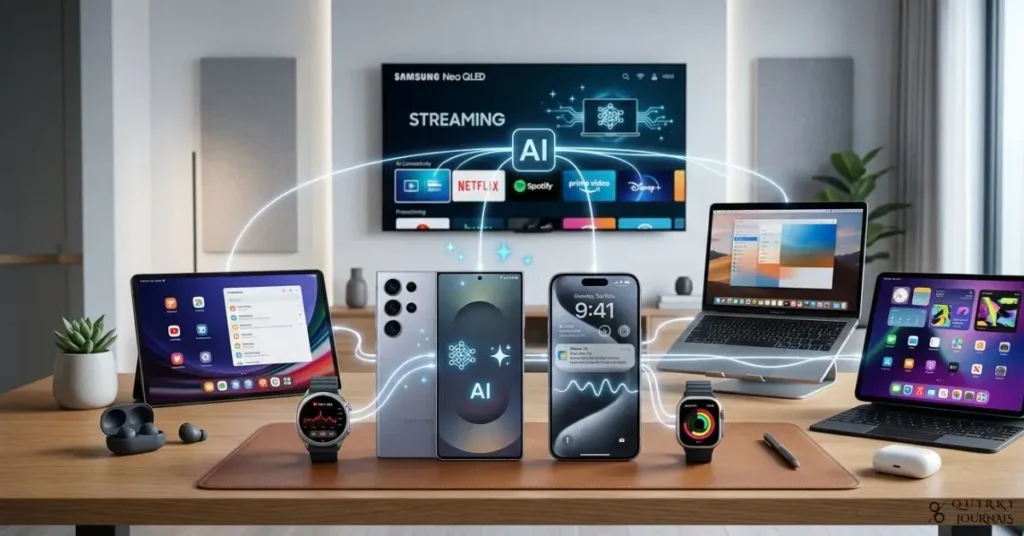
Second, ecosystem integration has become central to Samsung’s value proposition. It is no longer just about the smartphone. The pitch now involves the seamless pairing of Galaxy smartphones, Galaxy Watches, Galaxy Buds, Galaxy tablets, Samsung laptops, and even home appliances connected via SmartThings. The goal is to increase switching costs for consumers, making it more difficult to leave the Samsung family of products.
Third, Samsung has dramatically shifted its marketing focus. Advertisements have moved away from raw specification comparisons – RAM, megapixels, refresh rates – toward showcasing Galaxy AI experiences and lifestyle integration. This mirrors Apple’s long-standing philosophy of selling an experience rather than a spec sheet. Understanding these three pillars helps explain almost every major product and marketing decision Samsung has made since 2023.
How Samsung’s Marketing Has Changed
Compare a Samsung advertisement from 2015 with one from 2025; the differences are striking. Earlier campaigns mocked Apple users for standing in long queues. They boasted about larger screens, faster charging, and headphone jacks. Today, Samsung’s Galaxy S25 commercials instead highlight how the phone learns your habits, generates AI art on the fly, and connects smoothly with your Galaxy Watch. The mockery of Apple has largely disappeared. In its place is a premium lifestyle narrative that Apple would recognise immediately.
Furthermore, Samsung committed to seven years of software updates starting with the Galaxy S23 series – a direct response to Apple’s long-standing software support advantage. This is a business decision that incurs short-term costs but builds the kind of long-term brand trust that Apple has spent decades cultivating.
The Current Market Reality: Samsung and Apple in 2025-2026
Before assessing whether Samsung’s new strategy is working, it helps to understand what the market actually looks like right now. The data from 2025 and early 2026 is revealing.
Samsung and Apple remain locked in a tight duopoly at the top of global smartphone shipments. Samsung maintained a 19% global market share in Q3 2025, while Apple shipped approximately 247 million iPhones across the full year. Samsung, for its part, shipped around 241 million units in 2025, representing a 7.9% year-on-year increase. Both companies are operating at roughly the same scale.
The Galaxy S25 series delivered strong results. Counterpoint Research reported that the S25 series outperformed the S24 series by 5% year-on-year, covering February through December 2025. The Galaxy S25 Ultra specifically outperformed its predecessor by 7% and ended the year inside the global Top 10 best-selling smartphone models. That is a notable achievement in a market where Apple’s iPhones occupied seven of the top ten spots.
| Brand | 2025 Shipments (Est.) | Global Share (Q3 2025) | Key Strength |
| Samsung | ~241 million units | ~19% | Foldables, display tech, ecosystem |
| Apple | ~247 million units | ~17-20% | iOS ecosystem, premium loyalty, services |
| Xiaomi | ~170 million units | ~13% | Value hardware, fast charging, global push |
| vivo | ~120 million units | ~9% | Camera innovation, emerging markets |
| OPPO/OnePlus | ~115 million units | ~8% | Mid-range value, fast charging |
Table 1: Global Smartphone Market Overview, 2025 (Sources: Counterpoint Research, IDC)
However, the picture is not entirely rosy for Samsung. Apple continues to dominate the high-margin premium segment. Apple accounts for approximately 22% of global smartphone revenue despite selling fewer units than Samsung. That is the power of premium pricing and fierce brand loyalty. Samsung sells more phones but earns proportionally less per device at the premium tier.
Additionally, Chinese rivals such as Xiaomi, vivo, and OPPO continue to exert downward pressure on Samsung. These brands regularly deliver superior hardware specs – larger batteries, faster wired charging, and more aggressive camera systems – at lower price points. This two-front pressure is precisely why Samsung’s strategic repositioning matters so much.
Apple’s Model: What Samsung Is Actually Trying to Copy
To understand the Apple-fication of Samsung, you first need to understand what Apple actually does – and why it works so consistently. The common narrative is that Apple wins purely on brand mystique. That is an oversimplification. Apple wins because it has built a vertically integrated, strategically closed ecosystem where every component reinforces every other.
Consider what Apple actually controls. It designs its own chips, with the A-series and M-series processors serving as benchmarks that Android flagships regularly struggle to match in sustained performance. Apple controls iOS, iPadOS, macOS, watchOS, and tvOS. It controls the App Store, which remains the most profitable app marketplace. It controls iMessage, FaceTime, iCloud, Apple Pay, and, increasingly, services such as Apple Music, Apple TV+, and Apple Fitness+.
Therefore, the result is powerful lock-in. An iPhone user who also owns a Mac, iPad, Apple Watch, and AirPods experiences a level of device integration that is genuinely difficult to walk away from. Your messages sync everywhere. Photos appear on every screen without effort. Your watch unlocks your laptop. Your earbuds switch devices almost instantly. The experience is not about being flashy – it is about removing friction completely. That frictionless quality is what creates Apple’s industry-leading retention rates among smartphone users.
The Role of Services Revenue
One element that is often overlooked in Samsung-versus-Apple comparisons is the role of service revenue. Apple’s services division – covering the App Store, iCloud, Apple Music, Apple TV+, and Apple Pay – generated record revenues in 2025. This business is high-margin and recurring. It means Apple continues to earn revenue from iPhone users for years after the initial device sale. Samsung, by comparison, has no equivalent services empire built on top of its hardware. Google’s Play Store and Google’s services infrastructure run on Samsung devices, but Samsung does not directly capture that revenue.
This is a structural limitation that Samsung cannot easily overcome. Even as Samsung promotes Galaxy AI features and expands its ecosystem, the underlying software platform remains Google’s Android. The revenue from services and software that flows from Samsung users’ devices largely benefits Google, not Samsung. That gap matters when assessing whether the Apple-fication strategy can fully replicate Apple’s financial model.
Galaxy AI: Samsung’s Answer to Apple Intelligence
Artificial intelligence is now central to both companies’ strategies. Apple introduced Apple Intelligence with iOS 18, offering privacy-focused on-device AI processing combined with an optional ChatGPT integration for complex queries. Samsung responded with Galaxy AI – a suite of AI features embedded into One UI 7 that covers multimodal agents, on-device photo editing, real-time translation, and more.
The Galaxy S25 series uses a custom Snapdragon 8 Elite for Galaxy chip, which delivers roughly a 40% NPU (Neural Processing Unit) boost and a 37% CPU improvement over the previous generation. This additional processing power primarily enables more powerful on-device AI. Features like Generative Edit allow users to remove objects from photos, fill in backgrounds, and reshape compositions. Furthermore, the real-time translation feature works across calls and messaging apps, while Sketch to Image can turn rough drawings into polished visuals.
For 2026, Samsung has announced plans for ‘Agentic AI’ in the Galaxy S26 series. This would allow the phone to take multi-step actions on behalf of the user without manual input at each step. Samsung is also integrating Perplexity AI into an upgraded Bixby assistant for the S26. Basic device tasks will remain handled locally by Bixby, while complex queries will be passed to Perplexity’s reasoning models. This two-tier approach mirrors Apple’s split between on-device models and external ChatGPT integration quite laxy AI Driving Upgrades?
Despite the impressive feature list, consumer research tells a nuanced story. Counterpoint Research noted that AI features have not yet emerged as a primary driver of upgrades for most consumers. People still upgrade primarily because their old phone is slow, the battery has degraded, or they want a significantly better camera. Galaxy AI has added value for existing Samsung users, but it has not yet created the kind of ‘must-upgrade’ urgency that Samsung’s marketing suggests.
That said, Galaxy AI has clearly not hurt sales either. The S25 Ultra’s strong performance throughout 2025 – including unusual mid-cycle growth in July and October – suggests that the combination of hardware refinement and AI features is resonating with the premium segment. Specifically, the S25 Ultra ended the year in the global Top 10, suggesting that premium Android buyers see real value in the package Samsung is offering.
One UI 7 and the Ecosystem Push: Building a Walled Garden Without a Wall
One of the most Apple-like moves Samsung has made is the ongoing evolution of One UI. What started in 2018 as a cleaner Android skin has become something far more ambitious. One UI 7 now serves as an ecosystem-wide AI platform connecting phones, tablets, smartwatches, TVs, laptops, and home appliances. The design language emphasises what Samsung calls ‘seamless continuity’.
Start a document on your Galaxy Phone, and pick it up on your Galaxy Tab. Begin a note in a meeting, and finish it later on your Samsung laptop. Your Galaxy Watch tracks health data that is synced with the Health app on your phone and tablet. SmartThings integrates your connected home appliances into a single interface. In theory, this creates the kind of sticky, interconnected experience that makes Apple’s ecosystem so hard to leave.
In practice, real-world testing of Samsung’s ecosystem shows that the experience is genuinely impressive – especially the tight integration between the Galaxy S25+, Galaxy Tab S10 Ultra, and Galaxy Book 5 Pro. Multi-control features allow the phone to serve as a trackpad for the tablet. PC Auto Switch enables Galaxy Buds 3 to automatically switch between devices. The overall experience, while not as instantaneous as Apple’s equivalent features, is sufficiently good that experienced Apple users who switch describe it as a ‘surprisingly complete’ alternative.
The SmartThings Advantage: Samsung Is Not Fully Exploiting
One area where Samsung holds a structural advantage that Apple cannot easily match is the smart home. Apple’s HomeKit platform, while polished, is relatively limited in its support for third-party devices. Samsung’s SmartThings platform, by contrast, supports thousands of devices from hundreds of manufacturers. Moreover, Samsung makes its own smart TVs, refrigerators, washing machines, and air conditioners. No other smartphone brand can offer that level of hardware breadth under a single software umbrella.
Currently, Samsung has not fully capitalised on this advantage in consumer marketing. Most Galaxy users are unaware of the depth of SmartThings integration available to them. If Samsung were to invest seriously in promoting and simplifying the SmartThings experience – making it as easy to set up as Apple HomeKit – it could create a genuine ecosystem lock-in channel that Apple simply cannot replicate. This represents one of the clearest strategic opportunities that Samsung has not yet converted into a competitive advantage.
The Foldable Market: Samsung’s Last Major Hardware Moat
While Samsung has clearly embraced a more iterative approach to its slab flagship line, it has continued to invest heavily in foldable technology. The Galaxy Z Fold and Z Flip series now account for nearly 18% of Samsung’s premium segment sales. Seven years of foldable development have given Samsung a significant lead in hinge reliability, display durability, and software optimisation for folding form factors. No other brand can match that depth of accumulated engineering experience.
However, that moat faces a serious challenge in 2026. Apple is widely expected to enter the foldable market with its first foldable iPhone, likely launching alongside the iPhone 18 Pro line. Reports from supply chain sources and analysts suggest Apple’s foldable will feature an under-display camera, premium materials, and tight iOS integration. Given Apple’s track record in new form factor categories – consider how quickly Apple Watch became the best-selling smartwatch after launch – the threat to Samsung’s foldable dominance is real.
Furthermore, a 2025 forecast from multiple analyst firms suggested that Apple could seize the number-one position in the North American foldable market relatively quickly after entering the category. If that happens, Samsung loses its last undisputed hardware differentiation in the premium segment. The question then becomes: if Samsung is no longer the hardware innovator and has not fully built Apple-level ecosystem lock-in, where exactly does it stand?
| Metric | Samsung Foldables | Apple (Projected 2026 Entry) |
| Years on market | 7+ years (since 2019) | Debut in 2026 |
| Key model | Galaxy Z Fold 7 / Z Flip 7 | Foldable iPhone (iPhone 18 Pro line) |
| Software optimisation | Mature, well-developed | Will leverage iOS 19 + Apple Silicon |
| Ecosystem integration | Galaxy ecosystem | Full Apple ecosystem (iCloud, AirDrop, etc.) |
| Market risk for Samsung | Holds lead in 2025 | High risk in the 2026 North American market |
Table 2: Foldable Smartphone Competitive Comparison, 2025-2026
Samsung’s Financial Superpower: The Diversification Apple Lacks
One fact that is often overlooked in smartphone-focused discussions is that Samsung Electronics is not fundamentally a smartphone company. It is one of the world’s largest and most diversified technology conglomerates. This structural reality provides Samsung a financial safety net that Apple simply does not have, because Apple is, at its core, a consumer device company.
Samsung’s semiconductor division (DS) produces DRAM and NAND flash memory for the entire technology industry. It makes OLED displays that Apple itself purchases for iPhone screens. Its foundry business manufactures chips for dozens of companies. Even in a scenario in which Samsung’s mobile division struggled, the company’s semiconductor revenues would continue to generate substantial income.
The financial results from 2025 reflect this diversification powerfully. Samsung’s full-year revenue hit 333.6 trillion KRW, with operating profit of 43.6 trillion KRW – a 33% improvement year-on-year. The mobile and networks (MX) division alone reported an operating profit of approximately 12.9 trillion KRW (approximately $9 billion), driven by flagship device sales and strong wearables performance. These are not the numbers of a company in a strategic crisis.
AI Chips and the HBM Opportunity
Beyond traditional memory chips, Samsung has positioned itself to benefit directly from the global AI infrastructure boom. High Bandwidth Memory (HBM) chips are essential components in the AI accelerators and data centre GPUs that power large language models and AI services. Samsung is among the few companies worldwide capable of producing HBM at scale.
Therefore, even as Samsung navigates strategic uncertainty in its consumer smartphone business, its semiconductor division benefits from the same AI wave that is reshaping the smartphone software landscape. The company that is being ‘Apple-fied’ in terms of consumer philosophy is simultaneously supplying the chips that power the AI revolution. That is a remarkable strategic position that no other smartphone can match.
The Core Risk: Samsung Is Not Apple and Cannot Fully Become Apple
Despite Apple’s financial strength and genuine progress in ecosystem building, the Apple-fication strategy entails a structural vulnerability that Samsung’s leadership must acknowledge. Samsung cannot fully replicate Apple’s model because it does not own the operating system on which its devices run.
This is the central asymmetry. Apple’s ecosystem lock-in is effective because iOS is exclusive to Apple hardware. A dissatisfied iPhone user who wants to stay in the Apple ecosystem has only one option: buy another iPhone. There is no alternative iOS manufacturer. That exclusivity creates an enormous retention advantage. Samsung’s ecosystem sits on top of Android, which is open-source and available to every competitor. A dissatisfied Samsung user can migrate to a Google Pixel, a OnePlus, or a Xiaomi device while keeping their apps, their Google account, their Play Store purchases, and their Android muscle memory completely intact. The switching cost is far lower than leaving iOS.
Furthermore, Samsung’s brand identity has historically been built on being the anti-Apple. It was the choice for tech enthusiasts who wanted more RAM, more customisation, more hardware options, and more willingness to experiment with new form factors. That identity attracted a specific, valuable demographic – early adopters, power users, and developers who generate the word-of-mouth recommendations that influence mainstream buyers. Moving too far toward a polished but predictable premium experience risks alienating this core constituency.
The Competitor Squeeze That Does Not Relent
Samsung faces genuine competitive pressure from two very different directions simultaneously. From above, Apple continues to dominate high-margin premium sales and brand prestige. From below, Chinese manufacturers like Xiaomi, vivo, and OPPO consistently deliver hardware that outperforms Samsung on specific benchmarks – particularly battery capacity, wired charging speeds, and, increasingly, camera sensor specifications – at meaningfully lower price points.
In markets where Chinese brands can compete freely – Southeast Asia, India, Latin America, and most of Europe outside the premium tier – Samsung faces real pressure on market share. The protection Samsung enjoys in North America and parts of Western Europe largely stems from geopolitical and carrier-level barriers that limit the reach of Chinese manufacturers, rather than from an inherently superior product proposition. If those barriers were ever to weaken, Samsung’s mid-range position in those markets would face a more severe test.
Will Samsung’s Strategy Survive? An Honest Verdict
After reviewing the market data, financial results, and structural dynamics, it is possible to provide a clear and honest assessment. Samsung will survive the Apple-fication of its product line. The company is too large, too diversified, and too deeply embedded in the global technology supply chain to face existential risk from a consumer strategy pivot.
The mobile division will also remain profitable and competitive in the short to medium term. The Galaxy S25 series’ strong performance – including unusual late-cycle sales momentum in late 2025 – demonstrates that the current strategy is working commercially. Premium positioning is increasing average selling prices. Ecosystem products such as Galaxy Watch and Galaxy Buds are demonstrating B2C adoption. The overall package is resonating with enough consumers to justify the direction.
However, the strategy carries a long-term erosion risk if taken to extremes. Samsung’s edge over Chinese competitors in premium markets rests partly on a perceived hardware advantage. If that perception fades entirely – if Samsung becomes indistinguishable from Apple in philosophy but without Apple’s ecosystem depth – it risks losing on both fronts. It would be neither the hardware leader nor the ecosystem king.
The Three Paths Forward for Samsung
Samsung’s strategic future likely falls into one of three scenarios, each with different outcomes for the brand:
Path 1 – Successful Hybrid Execution: Samsung maintains its premium positioning while continuing to invest meaningfully in hardware differentiation (foldables, display technology, semiconductor-backed camera improvements) and deepening its ecosystem. This is the most likely outcome and the one current data supports. It keeps Samsung relevant across multiple market segments.
Path 2 – Full Apple-fication: Samsung doubles down entirely on the premium, iterative, ecosystem-first approach while letting hardware differentiation fade. This might improve short-term margins, but it creates a dangerous vulnerability once Apple enters foldables and as Chinese hardware continues to improve. Over five to seven years, this path erodes Samsung’s Android market leadership.
Path 3 – Course Correction: Samsung recognises the risks of full Apple-fication and pivots back toward more aggressive hardware innovation. It reclaims the tech enthusiast narrative, doubles down on foldables, and uses its vertical integration in displays and semiconductors to build devices that Chinese competitors genuinely cannot match. This would be a bold choice, but one that plays to Samsung’s genuine structural strengths.
| Strategy Path | Short-Term Outcome | Long-Term Risk | Probability |
| Successful Hybrid | Stable premium growth, strong S26 launch | Moderate – depends on Apple’s foldable impact | High (most likely) |
| Full Apple-fication | Margin improvement, simplified lineup | High ecosystem gap exposed over time | Low-Medium |
| Course Correction | Initial disruption, enthusiastic re-engagement | Low if executed well – plays to strengths | Low-Medium |
Table 3: Samsung’s Strategic Paths and Likely Outcomes, 2026-2030
What the Galaxy S26 Launch Will Tell Us
The Galaxy S26 series, expected to launch in late February or early March 2026, serves as a crucial early indicator of Samsung’s strategy. Several factors will define how the launch is received and what it signals about Samsung’s direction.
Pricing will be the first test. A global memory supply crunch has driven up component costs. Analysts have flagged that Samsung faces a difficult choice: absorb the additional cost to maintain competitive pricing, or pass it on to consumers and risk slowing premium growth. In a market where the average smartphone selling price is expected to rise 14% to $523 in 2026, further premium price increases pose a real risk to demand.
The Agentic AI implementation will be the second test. If Samsung can demonstrate genuinely useful multi-step AI actions – booking a restaurant, managing a calendar, summarising emails, and executing complex tasks across apps – it could establish a meaningful AI advantage over Apple Intelligence in terms of practical utility. If the features feel gimmicky or inconsistent, they will reinforce the narrative that Galaxy AI is more marketing than substance.
Finally, the reception of the Galaxy S26 design will signal whether Samsung is genuinely committed to pushing hardware boundaries. Leaked specifications and design renders suggest a slimmer, lighter form factor for 2026. If Samsung can deliver a meaningfully thinner device without compromising battery life or performance, it shows that iterative refinement and hardware ambition are not mutually exclusive.
The Bigger Picture: What This Means for the Consumer
Step back from the strategy analysis for a moment and consider what Samsung’s Apple-fication means for ordinary smartphone buyers. The answer, perhaps surprisingly, is largely positive.
Competition between two well-resourced, highly capable companies accelerates innovation. Samsung’s push into AI features has forced Apple to accelerate its own AI roadmap. Apple’s dominance in ecosystem integration has pushed Samsung to invest more seriously in SmartThings and cross-device continuity. The rivalry benefits consumers regardless of which brand they prefer.
Moreover, Samsung’s seven-year software update commitment directly benefits buyers. Previously, Android devices received only two or three years of OS updates before being left behind. Samsung’s commitment, which Google and several other manufacturers have since matched, means that a Galaxy device purchased today will receive critical security patches and feature updates through the early 2030s. That is a meaningful quality-of-life improvement for users who want to keep their devices longer.
The broader market dynamic is also worth noting. As Samsung pursues premium positioning and Apple continues to dominate the high-margin segment, the mid-range and budget segments remain highly competitive. Xiaomi, Realme, OPPO, and Transsion continue to innovate aggressively at lower price points, meaning consumers who cannot or do not want to spend flagship prices still have excellent choices available.
Ecosystem Choice Is Now a Genuine Consideration
One lasting consequence of Samsung’s strategy shift is that ecosystem choice has become a first-order consideration for smartphone buyers. Five years ago, most people chose a phone based on screen size, camera quality, and price. Today, the question is increasingly: which digital ecosystem do you want to live inside?
Apple’s ecosystem offers unmatched device-to-device fluidity within its closed environment. Samsung’s Galaxy ecosystem offers broader compatibility, greater hardware variety, and a willingness to integrate with Windows PCs, Google services, and third-party smart home devices. Neither is objectively better – they suit different users with different priorities. However, both are now mature enough that switching ecosystems entails genuine costs in terms of time, data migration, and habitational friction. That is precisely the outcome both companies have been engineering.
Key Takeaways: The Apple-fication of Samsung Summarised
After exploring all dimensions of this strategic shift, several clear conclusions emerge:
1. The Apple-fication of Samsung is real and deliberate. This is not a trend that has happened to Samsung. It is a strategic choice being executed deliberately, as evidenced by marketing, pricing, software update commitments, and ecosystem investments.
2. Samsung will survive and remain profitable. The financial results for 2025 confirm strong performance in the mobile division. Diversification into semiconductors and displays provides a financial safety net that makes any existential threat to the overall company implausible.
3. The structural gap with Apple remains real. Samsung’s inability to own its operating system prevents it from replicating Apple’s ecosystem lock-in. That gap will not close without a radical and unlikely shift in platform strategy.
4. Hardware differentiation still matters. Samsung must continue investing in hardware innovation – particularly foldables, display technology, and semiconductor-backed camera capabilities – to maintain a credible advantage over Chinese competitors and a point of differentiation from Apple.
5. The Galaxy S26 is a decisive early data point. How Samsung prices, markets, and positions the S26 will reveal whether the hybrid strategy is holding or whether the company is drifting toward one of the more dangerous strategic paths described earlier.
Spend some time on your future.
To deepen your understanding of today’s evolving financial landscape, we recommend exploring the following articles:
Bitcoin’s 50% Drawdown: How the US Budget War Hit Crypto Liquidity
War Economy Chapter 15: Liquidity Crises – When Cash Becomes King
Doom Spending and Financial Nihilism: Inside Gen Z’s Money Mindset
Startup Legal 101: Equity, Vesting and Incorporation
Explore these articles to get a grasp on the new changes in the financial world.
Disclaimer
This blog post is intended for informational and educational purposes only. The analysis, projections, and strategic assessments presented here are based on publicly available market data and analyst reports available at the time of writing. They do not constitute investment, financial, or business advice. Readers should conduct their own independent research before making any financial or purchasing decisions. All brand names, product names, and trademarks mentioned are the property of their respective owners.
References
[1] Counterpoint Research, ‘Samsung Galaxy S25 Series’ Sales Outpace S24 Series; S26 Series Launch a Key Flagship Indicator for 2026,’ Counterpoint Research, 2026. [Online]. Available: https://counterpointresearch.com/en/insights/samsung-galaxy-s25-series-sales-outpace-s24-series-s26-launch-key-flagship-indicator-2026
[2] Dataconomy, ‘Samsung Galaxy S25 Series Beats S24 With 5% Sales Growth,’ Dataconomy, February 2026. [Online]. Available: https://dataconomy.com/2026/02/25/samsung-galaxy-s25-series-beats-s24-with-5-sales-growth/
[3] FoneArena, ‘Samsung Galaxy S25 series posted 5% YoY sales growth in 2025: Counterpoint,’ FoneArena, 2026. [Online]. Available: https://www.fonearena.com/blog/476133/samsung-galaxy-s25-growth-2025.html
[4] SamMobile, ‘Something incredible is happening with Galaxy S25 sales,’ SamMobile, January 2026. [Online]. Available: https://www.sammobile.com/news/something-incredible-is-happening-with-galaxy-s25-sales/
[5] Trident Technology, ‘Samsung Sales: Market Share, Revenue & Statistics (2026),’ Trident Technology, 2026. [Online]. Available: https://tridenstechnology.com/samsung-sales-statistics/
[6] TechBuzz AI, ‘Samsung Doubles Down on AI-Powered Ecosystem Integration,’ TechBuzz AI, 2025. [Online]. Available: https://www.techbuzz.ai/articles/samsung-doubles-down-on-ai-powered-ecosystem-integration
[7] MacRumors, ‘Samsung Follows Apple’s AI Strategy With Perplexity-Powered Bixby,’ MacRumors, November 2025. [Online]. Available: https://www.macrumors.com/2025/11/24/samsung-perplexity-powered-bixby/
[8] MobileSyrup, ‘If you’re tired of Apple, Samsung’s ecosystem is a great alternative,’ MobileSyrup, May 2025. [Online]. Available: https://mobilesyrup.com/2025/05/04/samsung-ecosystem/
[9] TechTimes, ‘iPhone vs Android in 2025: Ultimate Apple vs Samsung Comparison,’ TechTimes, November 2025. [Online]. Available: https://www.techtimes.com/articles/312573/20251107/iphone-vs-android-2025-ultimate-apple-vs-samsung-comparison-smartphone-buying-guide-best-value.htm
[10] Oreate AI, ‘The Smartphone Showdown: Apple vs. Samsung Sales in 2025,’ Oreate AI Blog, January 2026. [Online]. Available: https://www.oreateai.com/blog/the-smartphone-showdown-apple-vs-samsung-sales-in-2025/ba03634337e63999b66d57834bad63d3
[11] AndroidHeadlines, ‘Samsung’s Galaxy S25 Series Beat S24 Sales Despite Minimal Upgrades,’ AndroidHeadlines, February 2026. [Online]. Available: https://www.androidheadlines.com/2026/02/samsungs-galaxy-s25-series-beat-s24-sales-despite-minimal-upgrades.html
[12] Vocal Media, ‘The Quiet War for Your Pocket: Samsung vs. Apple in 2025,’ Vocal Media, 2025. [Online]. Available: https://vocal.media/journal/the-quiet-war-for-your-pocket-samsung-vs-apple-in-2025