
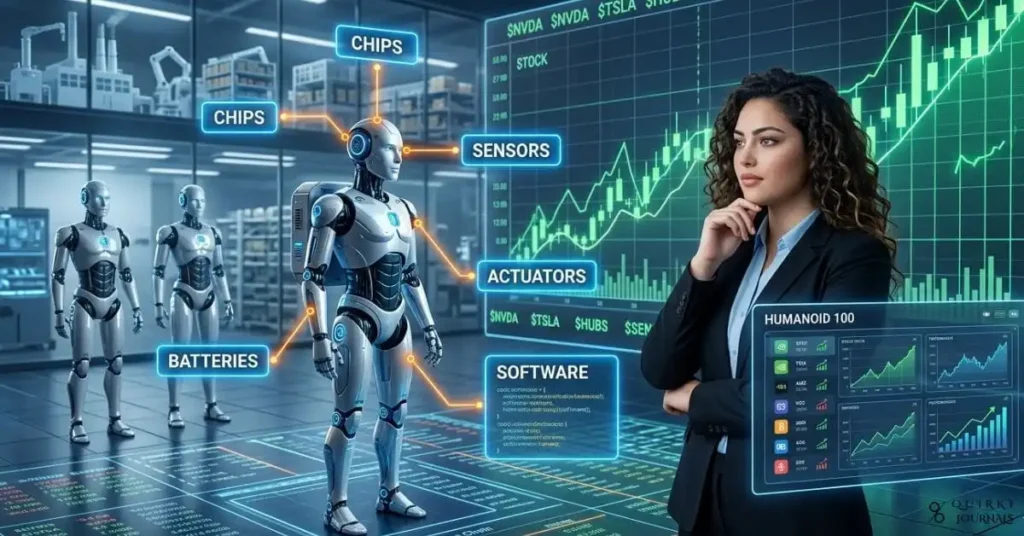
The Rise of Humanoid 100 Stocks: Beyond the Nvidia Era
Something profound is happening at the intersection of artificial intelligence and physical machines. For years, the dominant narrative in AI investing centred almost entirely on Nvidia and the race to build ever-faster semiconductor chips. That narrative is not over. However, a new chapter has opened, and it involves robots that walk, carry, and think.
Humanoid robots are no longer a science fiction concept. They are being deployed in warehouses, manufacturing plants, and logistics facilities around the world. Major investment banks are taking notice. Morgan Stanley has published a landmark report called the Humanoid 100, mapping the entire value chain of companies positioned to benefit from this wave. The index has already risen 11.1 per cent since its inception, outperforming major market indices.
This post explores what the Humanoid 100 is, why it matters for investors, and how the humanoid robot revolution is creating opportunities that stretch far beyond Nvidia’s graphics processing units. Furthermore, it examines the key players across the value chain, market size forecasts, and the risks that investors should carefully weigh before committing capital. Whether you are a seasoned portfolio manager or a retail investor exploring new themes, this guide provides essential context.
What Is the Morgan Stanley Humanoid 100?
The Humanoid 100 is a research framework published by Morgan Stanley that identifies and maps 100 companies across the humanoid robot value chain. The report divides these companies into distinct tiers based on their role in building, powering, or integrating humanoid robots. It covers businesses from semiconductor suppliers through to the companies assembling complete humanoid systems.
According to the Morgan Stanley report, 52 per cent of the 100 companies are already directly involved in humanoid development. The remaining 48 per cent are ‘either close competitors of companies known to be involved or ones that our analysts believe have material potential to be involved eventually.’ This forward-looking methodology distinguishes the Humanoid 100 from simple stock screens. It captures not just current participants but the companies most likely to enter the space as the market grows.
The index is also designed to evolve. Yahoo Finance reports that Morgan Stanley emphasised the Humanoid 100 is meant to be dynamic, continuously evolving along with industry developments and MS views.’ Consequently, it functions less like a static index and more like a living research tool that adapts as the technology matures, companies enter or exit the market, and analyst views shift.
The Market Opportunity: How Big Is the Humanoid Robot Industry?
Understanding why this investment theme is generating so much excitement requires looking at the underlying market projections. The numbers are striking. According to Betashares, Goldman Sachs forecasts the global humanoid robot market alone could reach US$38 billion by 2035. This represents a more than sixfold increase from a previous projection of just US$6 billion, reflecting rapidly improving confidence in the technology’s commercial viability.
The broader robotics market adds further context. Betashares notes that ‘the global robotic market is projected to reach US$111 billion by 2030, driven by persistent labour shortages, accelerating AI adoption, and better unit economics from increased competition.’ These three drivers reinforce each other. Labour shortages create demand. AI advances improve robot capability. Rising competition brings down per-unit costs and makes deployment economically attractive for a wider range of businesses.
Deployment figures confirm the acceleration. Roughly 16,000 humanoid robots were installed globally by the end of 2025. Annual shipments are forecast to reach 115,000 units by 2027, according to Betashares. That is a near-sevenfold increase in just two years. For investors, these shipment curves signal the inflexion point from prototype to commercial scale, a transition that historically generates outsized returns for early-positioned companies.
Humanoid Robot Market Size Forecasts
| Forecast | Projection | Timeframe | Source |
| Global humanoid robot market | US$38 billion | By 2035 | Goldman Sachs (via Betashares) |
| Previous humanoid market forecast | US$6 billion | By 2035 | Goldman Sachs (earlier estimate) |
| Global robotics market (all types) | US$111 billion | By 2030 | Betashares research |
| Global humanoid robot installations | ~16,000 units installed | End of 2025 | Betashares research |
| Annual shipment forecast | 115,000 units per year | By 2027 | Betashares research |
| Humanoid 100 index return since inception | +11.1% | As of early 2025 | Morgan Stanley / Yahoo Finance |
The Four Tiers of the Humanoid Value Chain
One of the most useful aspects of the Morgan Stanley Humanoid 100 framework is its segmentation of the value chain into distinct tiers. Each tier represents a different type of business exposure to the humanoid theme. Understanding these tiers helps investors identify which part of the supply chain aligns with their risk tolerance, investment horizon, and existing portfolio.
The first tier consists of component and semiconductor suppliers. These companies provide the chips, sensors, actuators, and electronic components that go into humanoid robots. This category naturally includes Nvidia, whose AI chips and Isaac GR00T foundation model underpin a large portion of humanoid robot development. However, the category extends well beyond Nvidia to include motion control components, precision gearboxes, and vision systems.
The second and third tiers cover what Morgan Stanley calls Enablers and Industrial Components suppliers. Enablers provide the software, training data, simulation environments, and AI platforms that make robots intelligent. Industrial Components suppliers manufacture the physical parts, including harmonic drives, linear actuators, end-effectors, and structural materials. Both tiers are critical. A humanoid robot with excellent AI but poor mechanical components will fail in the field, and vice versa.
The fourth tier consists of Integrators, the companies assembling complete humanoid systems and bringing them to market. This is the most visible tier and includes some of the most recognisable names in the space. Integrators carry the highest execution risk but also the greatest upside if their products achieve commercial scale. The Morgan Stanley report includes six automotive companies in this category, reflecting significant crossover between vehicle manufacturing expertise and humanoid robot development.
NVIDIA’s Role: The AI Brain Powering Humanoids
Any discussion of humanoid robot investing must acknowledge the central role of Nvidia. Its Isaac GR00T N1, launched in March 2025, was described as the world’s first open foundation model for generalised humanoid reasoning. According to Betashares, ‘the majority of humanoid developers use N1 as the common AI brain for their robots.’
NVIDIA CEO Jensen Huang has articulated this vision clearly. Betashares quotes him directly: ‘The ChatGPT moment for robotics is here. Breakthroughs in physical AI are unlocking entirely new applications.’ Similarly, Nvidia’s GTC 2025 session on humanoid robotics was titled ‘A New Era of Generalist Robotics: The Rise of Humanoids,’ featuring CEOs and CTOs from Boston Dynamics, Agility Robotics, 1X, and Skild AI. This cluster of industry leadership around Nvidia’s platform suggests it is building a robotics ecosystem similar to the one it built around CUDA for AI computing.
Nevertheless, Nvidia’s dominance in this space should not be taken as certain. Alternative AI platforms are under development. Several humanoid developers are investing in proprietary AI systems to reduce platform dependency. Furthermore, the emergence of open-source robotics foundation models could challenge Nvidia’s position over time. Investors who have enjoyed Nvidia’s extraordinary run should consider whether the next chapter of returns might lie further down the value chain.
Automotive Giants: An Unexpected Category of Humanoid Leaders
One of the most surprising aspects of the Humanoid 100 is the prominent role of automotive manufacturers. The Morgan Stanley report includesTesla, Hyundai (which owns Boston Dynamics), Toyota, BYD, GAC Group, and XPENG, all as Integrators in the humanoid space.
The rationale is compelling. Automotive companies have spent decades mastering precision manufacturing, supply chain management, and large-scale assembly operations. According to the Morgan Stanley report, ‘there are several automotive companies currently developing humanoids, likely due to the engineering and manufacturing overlap combined with potential in-house use cases to reduce labour intensity and improve margins over time.’ For car makers facing cost pressure from the electric vehicle transition, deploying humanoid robots in their own factories is both a product development activity and a cost reduction strategy.
Tesla’s Optimus programme is the most publicised of these efforts. Elon Musk’s comments on Optimus in early 2025 were specifically cited by Yahoo Finance as one of the events that sparked a significant rally in Asian industrial robotics stocks. Hyundai’s ownership of Boston Dynamics gives it one of the most sophisticated robotics development teams in the world. Toyota has been running humanoid research programmes for decades. These are not newcomers to the field.
Key Component Companies: Where the Real Returns May Hide
While integrators attract the most headlines, experienced investors often find superior risk-adjusted returns in component suppliers. Integrators face intense competition and must continuously out-execute rivals across hardware, software, and commercialisation simultaneously. Component suppliers, by contrast, can often sell to multiple competing integrators, reducing their exposure to any single company’s success or failure.
The Morgan Stanley report highlights several categories of industrial components essential to humanoid robots. Harmonic drive systems, which are precision gearboxes used in robot joints, are a critical bottleneck. Harmonic Drive Systems is specifically named in the Humanoid 100. Similarly, companies like Hiwin Technologies and Tuopu Group supply linear motion components that are fundamental to robot movement.
Korean robotics companies also feature prominently. The report includes Rainbow Robotics and UBTech Robotics in the component and integration categories. However, Yahoo Finance notes that some Asia-based industrial stocks experienced a reset in robotics expectations after the initial enthusiasm of early 2025 faded. This volatility underscores the importance of distinguishing between short-term sentiment and long-term structural demand when evaluating these positions.
Selected Humanoid 100 Companies by Value Chain Tier
| Company | Ticker | Country | Tier / Role | Primary Humanoid Involvement |
| Tesla | TSLA | USA | Integrator | Optimus humanoid robot programme |
| Hyundai / Boston Dynamics | 005380-KR | South Korea | Integrator | Atlas and Spot robots; full humanoid development |
| Toyota | 7203-JP | Japan | Integrator | Long-running humanoid and service robot research |
| BYD | 002594-CN | China | Integrator | Robotics division alongside EV manufacturing |
| XPENG | XPEV | USA/China | Integrator | Robotics and eVTOL alongside auto |
| Nvidia | NVDA | USA | AI Platform / Enabler | Isaac GR00T N1 foundation model; Jetson AI chips |
| Rainbow Robotics | 277810-KR | South Korea | Component / Integrator | Bipedal humanoid research and development |
| Harmonic Drive Systems | HLIT | Japan/Global | Industrial Component | Precision gearboxes for robot joints |
| Hiwin Technologies | Listed Taiwan | Taiwan | Industrial Component | Linear motion systems for robotic limbs |
| UBTech Robotics | 9880-HK | China | Integrator | Walker series humanoid robots |
NVIDIA’s Isaac GR00T: The Foundation Model Changing Everything
The concept of a foundation model for robotics is worth examining in depth. In the same way that large language models like GPT-4 provide a generalised base that can be fine-tuned for specific tasks, Nvidia’s Isaac GR00T N1 provides a generalised physical AI brain that humanoid developers can adapt for their specific robot designs and deployment environments.
The practical implication is significant. Rather than each humanoid developer building their AI stack from scratch, they can start from a common, well-trained foundation and focus their engineering resources on differentiation. This should accelerate the entire industry’s development timeline. Additionally, it means that improvements to the foundation model benefit all developers using it simultaneously, creating a compounding dynamic that could push the technology forward faster than many analysts currently project.
Betashares notes that GR00T N1 ‘was launched in March 2025 as the world’s first open foundation model for generalised humanoid reasoning.’ The word ‘open’ is strategically important here. By releasing the model in an accessible format, Nvidia encourages adoption, builds ecosystem lock-in, and positions itself at the centre of an emerging technology standard. This is a familiar playbook for Nvidia, and it has worked exceptionally well in the AI computing market.
The Chinese Humanoid Boom: A Geopolitical Investment Dimension
China’s involvement in the humanoid robot race adds an important geopolitical dimension to the investment thesis. The country’s government has identified advanced robotics as a strategic priority, and several of the world’s most ambitious humanoid programmes are operating out of Chinese companies. The Humanoid 100 includes BYD, GAC Group, XPENG, UBTech, and several component suppliers based in China.
The cultural moment at the Chinese New Year was particularly symbolic. Betashares describes how humanoid robots took centre stage throughout the CCTV Lunar New Year Gala, performing advanced martial arts routines that signalled both technical capability and national pride. This kind of public showcase carries significant strategic intent. China is demonstrating to domestic manufacturers, international markets, and geopolitical rivals alike that its humanoid robot industry is ready for the global stage.
For investors based outside China, this creates both opportunity and risk. Chinese humanoid companies often trade at lower valuations than their Western counterparts, partly due to geopolitical risk discounts. However, they also benefit from strong domestic government support, a deep domestic manufacturing base, and access to China’s vast labour-intensive industries that represent a large potential customer base. Assessing this exposure requires careful consideration of country risk alongside the fundamental investment case.
Performance Analysis: Who Won and Who Lagged in Early 2025
The Humanoid 100’s overall 11.1 per cent return since inception is an encouraging headline, but the distribution of returns beneath that figure tells a more nuanced story. Not every tier and not every geography performed equally. Understanding the divergence is important for investors seeking to position themselves thoughtfully rather than buying a broad basket.
According to Yahoo Finance, ‘bottom performers are dominated by Asia-based industrial stocks facing a reset in robotics expectations.’ Specifically, Harmonic Drive Systems, Rainbow Robotics, Tuopu, and Hiwin Technologies underperformed after being ‘initially lifted by enthusiasm in early 2025, sparked by events like Elon Musk’s comments on Tesla’s Optimus robot and Unitree’s appearance at the Chinese New Year Gala.’ This pattern is classic. Early enthusiasm lifts all ships in a theme, and then valuations reset as investors distinguish between near-term beneficiaries and longer-dated opportunities.
The reset in component stocks does not mean the underlying thesis is wrong. Rather, it suggests that some valuations moved ahead of near-term earnings visibility. For patient investors, these pullbacks in fundamental component suppliers can represent entry points. Precision gearboxes, linear actuators, and force sensors will be needed in enormous quantities as humanoid shipments scale from 16,000 to 115,000 units per year. The demand is not in question. The timing of when it flows through to earnings is the variable that markets are repricing.
The Software and AI Enabler Layer: Often Overlooked by Investors
Beyond chips and physical components lies a layer of the value chain that investors often overlook: the software and AI enablement tier. These are the companies building simulation environments, training data pipelines, reinforcement learning infrastructure, and the software stacks that allow humanoid robots to learn new tasks efficiently.
Simulation technology is particularly critical. Training a physical robot entirely in the real world is slow, expensive, and potentially dangerous. Sim-to-real transfer, the process of training a robot in a simulated environment and transferring those skills to the physical world, is a key enabling technology for scaling humanoid deployment. NVIDIA’s Isaac simulator is one major platform in this space. However, several startups and research institutions are building competing simulation environments.
Companies specialising in robot learning, teleoperation data collection, and embodied AI are at an early stage but carry potentially disproportionate upside. Skild AI, whose CEO participated in Nvidia’s GTC 2025 humanoid session alongside Boston Dynamics and Agility Robotics, represents the kind of AI-focused startup that may not yet be publicly listed but whose technology is shaping the trajectory of the entire sector. Monitoring this layer for public listings and acquisition activity is a key part of staying ahead of the humanoid investment theme.
Humanoid Robot Value Chain: Investment Characteristics by Tier
| Tier | Examples | Risk Level | Revenue Timing | Key Investment Consideration |
| AI Chips & Platforms | NVIDIA (NVDA) | Medium | Now (data centre) + future robotics | Ecosystem lock-in via GR00T; already priced in? |
| Industrial Components | Harmonic Drive, Hiwin, Tuopu | Medium-High | Near to medium term | High volume leverage as shipments scale; watch valuations after 2025 reset |
| Software / AI Enablers | Skild AI, simulation platforms | High | Medium to long term | Pre-revenue for many; seek listed proxies or wait for IPOs |
| Integrators (Western) | Tesla, Hyundai/Boston Dynamics | Medium-High | Medium to long term | High execution risk; large upside if flagship products succeed |
| Integrators (Chinese) | UBTech, BYD Robotics, GAC | High | Near to medium term | Valuation discount vs. geopolitical risk; government policy tailwind |
| Automotive Crossovers | Toyota, Hyundai, XPENG | Medium | In-house use cases first | Manufacturing synergies reduce the cost curve; dual revenue from auto + robotics. |
Risks Every Investor Should Understand
No investment theme, however compelling, comes without risk. The humanoid robot space carries several specific risks that investors must evaluate carefully before allocating capital. Overlooking these risks is precisely the kind of behaviour that turns exciting technology themes into painful portfolio experiences.
Technology execution risk is the most fundamental. Building a robot that can reliably perform useful tasks in unstructured real-world environments is extraordinarily difficult. Many highly funded robotics companies have produced impressive demonstrations that did not translate into commercially viable products. The gap between a compelling YouTube video and a robot that operates profitably in a warehouse twenty-four hours a day is enormous. Until humanoid robots demonstrate sustained commercial deployments at scale, technology risk remains elevated.
Valuation risk is equally important. Enthusiasm for humanoid stocks has already driven significant valuation premiums into many companies in the space. As the early 2025 reset in Asian industrial stocks demonstrated, sentiment-driven rallies can reverse quickly when earnings visibility does not materialise on expected timelines. Additionally, geopolitical risk, particularly around US-China technology restrictions and potential tariffs on robotics components, could disrupt supply chains and affect earnings across the value chain. Investors should also monitor labour market policy responses as governments may eventually regulate humanoid deployment to protect workers.
How Retail Investors Can Access the Humanoid Theme
Access to the humanoid robot investment theme is improving rapidly for retail investors. Several options are now available, ranging from direct stock ownership to thematic exchange-traded funds. Each approach carries different cost structures, diversification levels, and exposure characteristics.
Direct stock ownership in publicly listed companies such as Tesla (TSLA), Nvidia (NVDA), Hyundai, or XPENG provides the most direct exposure to specific parts of the value chain. This approach allows investors to express precise views about which tier or geography they believe will generate the best returns. However, it requires detailed research, ongoing monitoring, and acceptance of single-stock concentration risk.
Thematic exchange-traded funds (ETFs) focused on robotics and automation provide diversified exposure with a single trade. Funds such as the Global X Robotics and Artificial Intelligence ETF (BOTZ) or the iShares Robotics and Artificial Intelligence Multisector ETF (IRBO) include exposure to companies across the humanoid value chain. BetaShares and other fund managers globally are also launching robotics-focused products as investor interest accelerates. For most retail investors, an ETF approach provides a sensible balance of exposure and risk management.
Beyond Nvidia: The Next Layer of Humanoid Stock Opportunities
NVIDIA’s extraordinary returns over the past three years have made it the default answer when investors ask how to access the AI theme. That answer is becoming less satisfying. NVIDIA’s market capitalisation has grown to over a trillion dollars. At this scale, achieving the kind of multiples that early investors enjoyed becomes mathematically much harder. The question is not whether Nvidia continues to be a great business. It is whether the next increment of return will come from somewhere else.
The humanoid supply chain offers several categories of companies that are earlier in their adoption curves. Precision component suppliers are still relatively unknown to mainstream investors. Software enablers for physical AI are nascent. Several integrators, particularly in Asia, trade at valuations that do not yet fully reflect their humanoid potential. These situations resemble the opportunity in semiconductor equipment companies in the early 2010s: critical to a structural shift, underappreciated, and on the cusp of sustained demand growth.
Additionally, the crossover between automotive manufacturing and humanoid robotics opens a category of large-cap, profitable businesses with emerging robotics exposure. Toyota, Hyundai, and BYD are already global manufacturing leaders. If their humanoid programmes succeed even partially, the robotics contribution to their earnings could be significant over a five to ten-year horizon. Meanwhile, investors get exposure to a profitable core business that provides downside protection while waiting for the robotics optionality to materialise.
The Labour Market Context: Why Humanoids Are Economically Inevitable
No analysis of the humanoid robot investment theme is complete without understanding the labour market dynamics driving adoption. Demographics are working powerfully in favour of automation. Many developed economies face ageing populations and shrinking workforces. Japan, Germany, South Korea, and increasingly China all face structural labour shortages that no conventional immigration or training programme can fully address.
In manufacturing, logistics, and warehousing, the cost and availability of human labour have become a binding constraint on growth for many businesses. A humanoid robot that can perform comparable tasks at a lower total cost of ownership than a human worker will be adopted rapidly once that economic threshold is crossed. Betashares notes that ‘the demand for physical robotics is manifesting in areas of the economy where workflows are often considered monotonous or dangerous, including high-energy power plants, logistics warehouses and manufacturing facilities.’
This economic logic is reinforced by safety considerations. Some tasks are simply too dangerous for human workers to perform at scale. Robots that can operate in high-radiation environments, extreme temperatures, or confined spaces expand the range of work that can be done safely and efficiently. Consequently, the total addressable market for humanoid robots extends well beyond direct labour replacement into environments where human deployment would itself be impractical.
Investment Strategy: How to Think About Position Sizing and Timing
Positioning in the humanoid theme requires balancing conviction with humility about timing. The structural case is strong. The question every investor faces is how much of the eventual value creation is already priced into current valuations, and how long the market will take to recognise companies that are still under-appreciated.
A sensible approach is to build exposure across multiple tiers rather than concentrating on a single company or category. Combining a position in a broad robotics ETF with targeted positions in specific component suppliers or integrators captures both diversified exposure and the potential for alpha from deeper research. This layered approach also allows investors to add to high-conviction positions as the technology matures and de-risks.
Time horizon is equally important. Humanoid robots at a genuine commercial scale are a three to five-year story at minimum. Investors expecting rapid earnings growth in the next twelve months may be disappointed. By contrast, those willing to hold through periods of sentiment-driven volatility, like the reset seen in Asian industrials in early 2025, are better positioned to capture the full arc of value creation that this structural shift will produce. The Morgan Stanley Humanoid 100’s 11.1 per cent gain since inception suggests the market is already beginning to price this theme. Early movers still have an advantage, but the window is narrowing.
Conclusion: A New Investment Era Is Taking Shape
The Humanoid 100 represents far more than a stock list. It is a map of one of the most significant industrial transitions of the coming decade. Robots that can work alongside humans, in human-designed environments, using human-like dexterity, are moving from the research lab to the factory floor at a pace that is accelerating every quarter.
NVIDIA will remain important. Its AI chips, Isaac simulator, and GR00T foundation model are woven into the development stack of most humanoid programmes. However, the returns from being positioned only in Nvidia will increasingly be shared with the broader value chain. Component suppliers, software enablers, and integrators are the next layer of the humanoid investment story, and many of them have not yet attracted the attention or the valuations that their strategic importance warrants.
Goldman Sachs’ forecast of a US$38 billion humanoid robot market by 2035, combined with near-term shipment growth from 16,000 to 115,000 units annually by 2027, defines a clear growth trajectory. Morgan Stanley’s Humanoid 100 provides the framework to navigate it. For investors willing to do the research, manage the risks, and think in multi-year time horizons, the humanoid era may prove to be one of the defining investment opportunities of this generation.
Spend some time on your future.
To deepen your understanding of today’s evolving financial landscape, we recommend exploring the following articles:
How CBOE and Lockheed Martin Became Geopolitical Hedges
Attracting Gen Z Clicks: What Works in Advertising to Gen Z Clients
Startup Growth Hacking: Scalable Customer Acquisition That Works
Why Gold Prices Are Falling in 2026
Explore these articles to get a grasp on the new changes in the financial world.
Disclaimer
This article is for informational and educational purposes only. It does not constitute financial, investment, or professional advice. Nothing in this article should be construed as a recommendation to buy or sell any specific security or financial instrument. Past performance of any index, stock, or investment vehicle is not indicative of future results. All investments carry risk, including the potential loss of principal. Readers should consult a qualified financial adviser before making any investment decisions. The author and publisher accept no liability for losses arising from actions taken based on this content.
References
[1] Morgan Stanley. (2025). The Humanoid 100: Mapping the Humanoid Robot Value Chain. Morgan Stanley Research.
[2] Yahoo Finance. (2025 ). Morgan Stanley Humanoid 100 List Up 11.1% Since Inception. Yahoo Finance.
[3] NVIDIA. (2025). A New Era of Generalist Robotics: The Rise of Humanoids (GTC 2025). NVIDIA On-Demand.
[4] Betashares. (2025). A New Era: Physical AI and Humanoids Enter the Stage. Betashares Insights.
[5] Yahoo Finance. (2025). NVIDIA Corporation (NVDA) Stock Quote and News. Yahoo Finance.
[6] Goldman Sachs. (2024). Global Humanoid Robot Market Forecast. Cited in Betashares Research.
[7] Boston Dynamics. (2025). Atlas and Robotics Development. BostonDynamics.com.
[8] Investopedia. (2024). Exchange-Traded Fund (ETF). Investopedia.com.
[9] Global X ETFs. (2025). BOTZ: Global X Robotics and Artificial Intelligence ETF. Yahoo Finance.
[10] Brookings Institution. (2024). Automation and the Workforce. Brookings.edu.
[11] Investopedia. (2024). Country Risk. Investopedia.com.
[12] Investopedia. (2024). Large Language Model. Investopedia.com.
[13] Harmonic Drive Systems. (2025). Precision Gearboxes for Robotics. HarmonicDrive.net.
[14] Hiwin Technologies. (2025). Linear Motion Systems. Hiwin.com.
[15] NVIDIA Research. (2026). Isaac GR00T N1.6: Building Generalist Humanoid Capabilities. NVIDIA Developer Blog.