
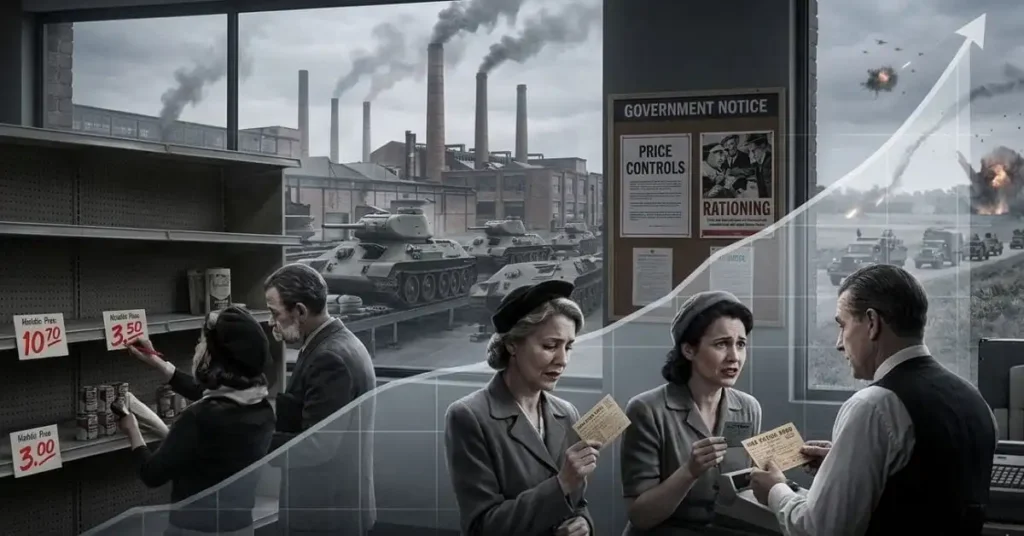
War Economy Chapter 17: Inflation, Hyperinflation, and Wartime Price Controls
War reshapes economies in ways that peacetime rarely matches. Governments spend at a scale that strains every resource. Factories shift from consumer goods to weapons. Workers leave farms and workshops for the front lines. As a result, the balance between supply and demand breaks down fast. Prices begin to climb, sometimes slowly, sometimes at a terrifying speed. Understanding the war economy means understanding why prices behave so differently when a nation is fighting for its survival.
Throughout history, wartime inflation has proven to be one of the most disruptive forces an economy can face. It erodes savings, punishes ordinary workers, and undermines the social contract. Furthermore, when inflation spirals into hyperinflation, entire monetary systems can collapse. Governments have responded to this threat in many ways. Price controls, rationing, and monetary tightening are among the most common tools. Each carries its own set of trade-offs.
This article explores the causes, mechanisms, and consequences of war economy inflation. It also examines how policymakers have tried to contain prices during conflicts. Additionally, it draws lessons from major historical episodes, including both World Wars, the 1970s oil shocks, and Hungary’s devastating post-war hyperinflation. Whether you are a student, an investor, or simply a curious reader, this guide offers a thorough look at one of economics’ most consequential subjects.
Why War Always Fuels Inflation
The link between war and inflation is not a coincidence. It follows a clear economic logic. When a government mobilises for conflict, it must fund enormous expenditures in a very short time. Tax revenues rarely cover the full cost. Therefore, governments typically resort to borrowing and, in many cases, printing money. This expands the money supply rapidly, which pushes prices upward.
At the same time, wars reduce the supply of goods available to civilians. Factories produce tanks instead of cars. Steel goes to shipyards instead of construction. Workers who would otherwise make consumer products are now in uniform. Consequently, demand stays high while supply falls sharply. According to Economics Help, cost-push inflation arises from shortages of goods and services as well as rising raw material prices, particularly oil.
There is also a psychological dimension to wartime price rises. Consumers anticipate shortages, so they buy more than they need. Hoarding becomes common. Sellers, in turn, raise prices to exploit the uncertainty. This feedback loop can accelerate inflation well beyond what underlying supply and demand alone would justify. Moreover, investor confidence often falls, weakening the currency and making imports more expensive.
RSM’s economists note that price instability over the past century peaked during the two World Wars and then again during the oil crises of the 1970s and 1980s. These episodes confirm that war, whether military or economic, consistently triggers inflationary spirals that are hard to control.
The Mechanics of Wartime Demand-Pull Inflation
Demand-pull inflation occurs when total spending in the economy exceeds the economy’s productive capacity. During wars, this gap widens dramatically. Government deficit spending pumps money into households through wages paid to soldiers and war workers. However, these workers cannot spend their income on the consumer goods they would normally buy, because those goods are no longer being produced in the same quantities.
NPR’s Planet Money describes this clearly: lots of deficit spending boosted demand in the economy, while war measures simultaneously reduced the economy’s capacity to supply and satisfy that demand. The result was a classic recipe for runaway inflation. Incomes rose, but the shelves were increasingly bare.
During World War I, the United States experienced this dynamic very sharply. Prices rose more than 80 per cent between 1917 and 1920, as noted by NPR. That figure includes the immediate postwar period, when returning soldiers flooded back into a consumer economy that had not yet recovered its full production capacity. Similarly, the UK, France, and Germany all experienced severe wartime price rises during the same period.
By the time World War II began, American policymakers had a fresh memory of WWI’s inflation. President Franklin Roosevelt’s administration was determined to prevent a repeat. Notably, they also had to prevent the kind of social resentment that price spikes generate, especially when the rich can afford to pay whatever it takes while the poor cannot.
Cost-Push Inflation and Wartime Supply Shocks
Beyond demand-pull forces, wars also create powerful cost-push inflation. This happens when the costs of production rise, forcing suppliers to charge more regardless of how much consumers want to buy. Raw material shortages are among the most common causes.
Oil is the clearest modern example. The 1973 Arab oil embargo and the 1979 Iranian Revolution both triggered oil supply shocks that sent inflation soaring across Western economies. Though neither event was a full-scale military conflict in the traditional sense, both were forms of economic warfare. In each case, the result was stagflation, a toxic mix of high inflation and slow growth that proved extremely difficult to cure.
Food is another critical input that wartime disrupts. Wars often destroy farmland, displace agricultural workers, and block trade routes. As a result, food prices spike. Furthermore, energy and food are deeply connected, since modern agriculture requires significant fuel inputs. When energy prices rise, food costs follow. This chain reaction can push up core inflation even in countries far from the actual fighting.
The Riksbank research paper on monetary policy and wartime inflation makes an important observation: war can cause higher inflation in the rest of the world, not just in the countries directly involved. Warring nations often export commodities like oil, grain, or metals that global markets depend on. When those supply chains are cut, prices rise everywhere.
Key Drivers of Wartime Inflation at a Glance
| Driver | Type | Example | Impact |
| Government deficit spending | Demand-pull | WWI USA 1917-1920 | Prices +80% |
| Money printing | Demand-pull | Hungary 1945-46 | Hyperinflation |
| Oil supply shock | Cost-push | 1973 Arab embargo | Stagflation |
| Food supply disruption | Cost-push | WWII Europe | Severe rationing |
| Currency devaluation | Imported inflation | Weimar Germany | Total collapse |
| Consumer hoarding | Psychological | WWII USA | Black markets |
Hyperinflation: When War Destroys Money Itself
Hyperinflation is inflation taken to its logical extreme. Economists generally define it as monthly price increases exceeding 50 per cent. In practice, severe cases are far worse. Hyperinflation typically occurs when a government has no other way to finance its obligations other than printing money at scale.
The most famous case is Weimar Germany after World War I. Germany had borrowed heavily to fund the war effort. After losing, the country owed massive reparations under the Treaty of Versailles. Unable to pay in gold and unwilling to slash public spending, the Weimar government printed marks. By 1923, German hyperinflation had reached astronomical levels. Workers were paid twice a day so they could spend their wages before they lost value. A wheelbarrow full of cash might not buy a loaf of bread.
However, even the German episode was surpassed by Hungary’s post-World War II collapse. The Riksbank paper cites Hanke and Krus (2012) in noting that at the peak of Hungarian hyperinflation in 1945-1946, prices doubled roughly every fifteen hours. This remains the most extreme hyperinflation ever recorded. Hungary’s economy had been devastated by the war, and money printing was the only tool the government had left.
Other notable cases include Zimbabwe in the 2000s, Venezuela in the 2010s, and Yugoslavia in 1994. In every case, the pattern is similar. A major economic or political shock destroys productive capacity. The government finances its spending by printing money. Public trust in the currency collapses. People abandon money in favour of barter or foreign currencies. Recovery requires either credible monetary reform or external financial support.
World War II and the American Experiment with Price Controls
By the time the United States entered World War II in late 1941, policymakers had a clear fear: wartime inflation could tear apart the social fabric just as WWI’s inflation had done. President Roosevelt, therefore, launched one of history’s most ambitious price control programs. The Office of Price Administration (OPA) was established to set ceilings on a vast range of goods.
The scope of the program was remarkable. Price caps covered dairy products, meat, sugar, tyres, gasoline, and clothing, among many others. A large bureaucracy sprang up to police these controls, supported by volunteer boards at the community level. According to the Cato Institute, the abandonment of market pricing was near absolute. The government was essentially deciding what almost everything should cost.
Officially, the program appeared to work. Consumer prices grew at roughly 5 per cent per year between 1942 and 1945, which was far lower than the inflation seen during and after World War I. However, critics pointed out that official statistics did not capture the full picture. Economists Milton Friedman and Anna Schwartz argued that effective price levels actually rose by about 27 per cent during the controlled period, well above the official 15.6 per cent estimate by Simon Kuznets.
The reason for this discrepancy was that price controls created hidden inflation. Sellers reduced product quality without lowering prices, a phenomenon sometimes called “skimpflation.” Black markets flourished for goods that were rationed or price-controlled. Furthermore, many transactions simply moved off the official books. Therefore, the true cost of living rose more than the government’s figures suggested.
The OPA: Bureaucracy, Black Markets, and Rationing
The Office of Price Administration became one of the largest peacetime bureaucracies the United States had ever seen. At its peak, the OPA employed tens of thousands of workers and oversaw millions of price decisions. Volunteer boards in local communities helped enforce regulations and report violations. Patriotism played a role, as many Americans accepted the controls as a wartime sacrifice.
Despite these efforts, black markets were widespread. Sellers found ways around the price caps, sometimes legally and sometimes not. The Cato Institute explains that because price ceilings crystallised excess demand, rationing became necessary. Ration books were issued for essential goods. Consumers needed both money and the right ration coupons to buy items like meat or gasoline. This two-currency system added enormous complexity to daily life.
Interestingly, some of the social effects were mixed. Harvey Levenstein’s research, cited by the Cato Institute, found that meat consumption among the poorest third of Americans actually rose by 17 per cent during the war years. Middle and upper-class consumers saw their consumption fall. In that sense, the price controls did somewhat redistribute access to food. However, it is difficult to separate this effect from broader full-employment conditions, as war work had raised incomes at the lower end of the scale.
NPR’s reporting highlights the broader irony of the WWII price control experiment. The controls kept a lid on official inflation during the war. Yet they also built up a massive reservoir of pent-up demand. When the controls were removed in 1946, that dam broke. Inflation surged to over 20 per cent in 1947, the highest annual rate the US has seen in the eight decades since.
US Inflation Before, During, and After WWII Price Controls
| Period | Inflation Rate | Policy in Place | Notable Effect |
| 1917-1920 (WWI) | +80% total | No controls | Severe social hardship |
| 1942-1945 (WWII) | ~5% per year (official) | OPA price controls | Hidden quality cuts, black markets |
| 1942-1945 (adjusted) | ~27% total (Friedman/Schwartz) | OPA price controls | True inflation understated |
| 1946 | Controls lifted | Removal of OPA | Pent-up demand released |
| 1947 | +20%+ annual | No controls | Highest US rate in 80 years |
What Happens When Price Controls End
The 1946-1947 American experience offers one of history’s clearest lessons about price controls and their aftermath. Before controls were lifted, a group of 54 respected economists published an open letter in the New York Times. They warned that removing controls too quickly would unleash the pent-up inflation that had been building during the war. They urged Washington to lift controls slowly and carefully.
Policymakers chose not to listen. Controls were removed rapidly, and inflation exploded. The lesson, according to NPR, is that price controls do not eliminate inflationary pressure. They merely delay it. If the underlying causes of inflation, primarily excess money supply and constrained production, are not addressed, prices will rise as soon as the caps are removed. The only question is when.
This dynamic repeats itself in other historical contexts. After the Korean War, controlled prices rebounded quickly once lifted. Similarly, many countries that imposed price controls during the 1970s oil shocks found that removing them caused immediate and painful price jumps. Therefore, the challenge for policymakers is not just whether to impose controls, but also how to exit them without triggering a price explosion.
Some economists argue that the solution is to address supply-side problems first. If production capacity recovers before controls are lifted, the inflationary overhang shrinks. Others suggest that gradual removal of controls, combined with tight monetary policy, can limit the shock. In practice, both approaches are politically difficult. Governments tend to lift controls when it is convenient, not necessarily when conditions are ideal.
Monetary Policy’s Role in Wartime Inflation
Central banks face a uniquely difficult task during wartime. On the one hand, they should restrict money supply growth to contain inflation. On the other hand, governments typically need cheap financing for the war effort, which means they prefer low interest rates and easy money. These two objectives are in direct conflict.
The Riksbank paper captures this tension well. It notes that raising taxes sufficiently is often politically difficult during a war. Governments, therefore, take what is politically easiest in the short term: printing money. This approach, however, is the most harmful in the longer term, as it almost inevitably leads to higher inflation.
In practice, many central banks during major wars effectively surrendered their independence to government financing needs. The US Federal Reserve, for example, maintained an agreement with the Treasury during WWII to keep bond yields low. This so-called “yield curve control” meant the Fed was essentially monetising government debt. Similarly, the Bank of England pegged gilt yields at low levels during the war, prioritising fiscal needs over price stability.
After the war, restoring central bank independence was a key challenge. In the US, the Federal Reserve-Treasury Accord of 1951 formally separated monetary policy from fiscal policy. This agreement is widely seen as a turning point for the Fed’s long-term credibility. In contrast, countries that did not restore monetary independence, or whose economies were too damaged to support recovery, often spiralled into hyperinflation or prolonged price instability.
The 1970s Oil Shocks: Economic War Without Armies
Not all economic warfare involves conventional military conflict. The 1973 Arab oil embargo demonstrated that economic weapons can inflict wartime-level damage on prices and growth. When Arab members of OPEC cut oil supplies to countries supporting Israel in the Yom Kippur War, the consequences for the global economy were severe.
Oil prices quadrupled almost overnight. Because oil is a fundamental input to nearly everything in a modern economy, cost-push inflation spread rapidly. Gas lines stretched for miles in American cities. Factories faced higher energy bills. Food costs rose as transport and agricultural energy costs spiked. Western governments scrambled to respond, with mixed results.
Some countries tried price controls again. The US imposed price caps on domestic oil production and gasoline, which led to severe shortages and the iconic gas station queues. This was a direct replay of the WWII lesson: price controls can temporarily suppress prices, but they create shortages, black markets, and pent-up inflation. Eventually, the controls were phased out, and energy prices adjusted upward.
The 1979 oil shock, triggered by the Iranian Revolution, compounded the problem. By this point, inflation expectations were entrenched in the US economy. Workers demanded higher wages to compensate for expected price rises. Employers passed on higher wage costs in the form of price increases. This wage-price spiral required the brutal Volcker shock of 1980-1982, which pushed interest rates to nearly 20 per cent and triggered a deep recession, to finally break.
Russia-Ukraine Conflict: A 21st Century War Economy Case Study
The Russia-Ukraine war that escalated in 2022 provided a stark real-time demonstration of the war economy inflation mechanism. Russia and Ukraine together supply a large share of global wheat, sunflower oil, and fertiliser. Ukraine is also an important exporter of corn. When the conflict disrupted these supply chains, global food prices spiked.
Energy markets were equally affected. Russia is one of the world’s largest natural gas and oil exporters. European nations that had depended heavily on Russian energy faced an acute supply shock. Gas prices in Europe surged to levels that threatened industrial production. Household energy bills soared. This pushed European inflation to multi-decade highs in 2022 and 2023.
RSM economists, writing in April 2022, noted that the current price shock would likely shave one to one-and-a-half percentage points off growth over the following twelve months. They also warned that while the US might avoid a recession, the European Union would likely not be so fortunate. This proved broadly accurate. Europe did experience a significant economic slowdown, while the US faced its own battles with post-pandemic inflation compounded by the conflict.
Interestingly, Europe’s response included elements of wartime economic policy. Several governments imposed windfall taxes on energy companies. Others offered direct subsidies to households and businesses to offset energy costs. Some countries capped energy prices temporarily. These measures echoed, in a modern form, the price control debates of the WWII era.
Rationing: The Other Side of Price Controls
Price controls and rationing almost always go together. When governments set prices below market-clearing levels, more people want to buy than there is supply available. Rationing is the mechanism that allocates scarce goods in the absence of prices. During WWII, ration books became a central feature of everyday life in most combatant countries.
In the United States, the OPA rationing system covered an extensive range of goods. Sugar was among the first to be rationed in early 1942, followed by coffee, meat, butter, canned goods, and gasoline. Each household received a ration book containing stamps that had to be surrendered at the point of purchase along with cash. This effectively created a two-tier currency system.
Britain’s rationing system was even more extensive and lasted longer. Food rationing in the UK began in January 1940 and, remarkably, continued until 1954, nine years after the war ended. The British government argued that rationing was necessary to ensure fair distribution of scarce goods during the postwar recovery period. Critics countered that the continued rationing was suppressing economic recovery and entrepreneurship.
Rationing systems face serious practical challenges. Fraud and black markets develop wherever goods are artificially cheap and scarce. People trade ration coupons illegally. Some sellers reserve goods for favoured customers. Furthermore, the bureaucratic cost of running a rationing system is substantial. Despite these drawbacks, rationing remains a standard tool of welfare economy management, particularly when the alternative is prices rising so fast that essential goods become unaffordable for lower-income households.
Comparing Wartime Rationing Systems
| Country | Conflict | Goods Rationed | Duration | Notable Outcome |
| USA | WWII | Sugar, meat, gas, tyres, coffee | 1942-1946 | Black markets, but food access improved for the poor |
| UK | WWII | Food, clothing, fuel | 1940-1954 | Longest Western rationing system |
| Germany | WWII | Almost everything | 1939-1948 | Collapsed into a barter economy by 1945 |
| USSR | WWII | Bread, meat, fats | 1941-1947 | Urban workers are prioritised over the rural population |
| USA | 1973 oil crisis | Gasoline | Odd/even day system | Long queues, public frustration |
Skimpflation: The Hidden Cost of Price Ceilings
One of the most underappreciated consequences of price controls is “skimpflation.” This term, popularised in the WWII context by NPR, describes the process by which sellers maintain official prices but quietly reduce product quality. Because the law sets a ceiling on price but not on quality, suppliers can comply with the letter of the regulation while undermining its intent.
During WWII, skimpflation was widespread. Bread became lighter. Meat was adulterated with lower-quality ingredients. Clothing was made with thinner fabric. Canned goods contained more liquid and less solid content. Each of these changes kept the official price stable while reducing the real value of what consumers received. Therefore, measured inflation looked lower than it actually was.
Modern economists recognise skimpflation as a significant measurement problem. Official price indices track prices paid, but not always the quality received. When quality falls while prices hold steady, the true inflation rate is higher than reported. This is precisely what Friedman and Schwartz were trying to capture with their adjusted inflation estimate of 27 per cent for the WWII control period, compared to the official figure of about 15.6 per cent.
Skimpflation is not only a wartime phenomenon. It reappears whenever strong inflationary pressures meet price sensitivity among consumers or price caps from regulators. In the post-pandemic period, many analysts pointed to product “shrinkflation,” where package sizes shrank while prices stayed the same, as a modern equivalent. The underlying economic logic is identical to what happened in the 1940s.
Long-Run Consequences of War Economy Inflation
The long-run effects of wartime inflation extend far beyond the period of active conflict. Wealth redistribution is one of the most significant. Inflation erodes the real value of debt. Therefore, debtors, including governments, benefit at the expense of creditors. After WWI, many European governments had accumulated enormous war debts. Inflation helped reduce the real burden of those debts, but it also wiped out the savings of middle-class citizens who had invested in government bonds.
This destruction of middle-class wealth had profound political consequences. In Germany, the hyperinflation of 1923 destroyed the savings of millions of families who had been financially comfortable before the war. Many historians argue that this economic catastrophe contributed to the political instability that eventually brought Hitler to power. The connection between wartime economic mismanagement and long-run political upheaval is well established in the historical literature.
Inflation also reshapes income distribution in ways that persist long after prices stabilise. Workers in industries with strong unions can negotiate wage increases that protect them from inflation. Others, particularly those on fixed incomes such as pensioners, lose ground permanently. Furthermore, if inflation leads to higher interest rates, as it typically does eventually, mortgage costs rise and housing affordability falls for a generation.
From an investor’s perspective, wartime inflation tends to favour real assets over financial ones. Gold, real estate, commodities, and inflation-indexed bonds tend to hold value better than nominal bonds or cash. Equity markets are mixed, as companies in some sectors benefit from inflation while others are squeezed. Understanding these dynamics is essential for anyone trying to protect wealth during a period of economic conflict.
Modern Parallels and Policy Lessons
The post-pandemic inflation surge of 2021-2023 drew striking parallels to wartime economics. Massive fiscal stimulus pumped money into households. At the same time, pandemic disruptions severely constrained supply chains. This combination of high demand and reduced supply was structurally similar to what happens in a war economy. Some economists explicitly used wartime analogies to describe what they were seeing.
Calls for price controls resurfaced in this environment. Progressive politicians in several countries argued that corporate greed, rather than monetary excess, was driving inflation. They proposed capping prices on essential goods. However, most mainstream economists cautioned against this approach, citing the historical record of price controls. The WWII experience, in their view, showed that controls delay rather than cure inflation.
RSM’s economists pointed out that the post-2022 environment required much higher interest rates than had been observed in recent years. They warned that this would reduce the probability of central banks achieving a soft landing. Their prognosis was broadly correct. The Federal Reserve and other central banks raised rates aggressively through 2022 and 2023, causing significant slowdowns in housing and credit markets while gradually bringing inflation back toward target.
The Riksbank, Sweden’s central bank, produced a thoughtful analysis of wartime monetary policy lessons. Their paper emphasised that there is no standard manual for economic policymakers when a major conflict erupts. Every war is different in scale, duration, and impact. Nevertheless, certain patterns recur. Printing money is always politically tempting and economically dangerous. Price controls suppress measured inflation but create hidden costs. Post-conflict inflation is often more severe than wartime inflation.
What Investors and Savers Should Know
For individuals trying to protect their finances during periods of war and economic inflation, history offers several practical lessons. First, cash and nominal bonds are the most vulnerable assets during inflationary periods. Their real value erodes steadily as prices rise. Holding too much of your wealth in these forms during awar economy is a reliable way to lose purchasing power.
Second, real assets tend to hold value better. Gold has historically served as a store of value during crises, though its performance is not perfectly correlated with inflation. Real estate provides both income and inflation protection, as rents and property values tend to rise with the general price level. Commodities, including energy and agricultural products, often benefit directly from the supply disruptions that drive wartime inflation.
Third, equity markets require careful analysis. Some sectors do well during wartime inflation, including defence companies, energy producers, and commodity extractors. Others suffer, particularly consumer discretionary businesses facing squeezed margins. Understanding sector rotation during inflationary periods is valuable knowledge for any investor.
Fourth, diversification across currencies and geographies can reduce risk. When one country’s war economy pushes its currency down, foreign assets held in stronger currencies preserve value. This is why wealthy individuals in hyperinflationary countries have historically moved assets into US dollars, Swiss francs, or gold. Ordinary savers can achieve a degree of this protection through international investment funds or foreign currency savings accounts.
The Debate: Do Price Controls Ever Work?
The debate over wartime price controls is genuinely contested among economists. Free-market advocates argue that price controls are almost always counterproductive. They distort incentives, create shortages, encourage black markets, and hide the true cost of inflation. The Cato Institute represents this view clearly, arguing that WWII price controls should not be romanticised.
On the other side, some economists argue that price controls can play a useful role in specific circumstances. When inflation is driven primarily by supply bottlenecks rather than excess demand, controlling prices can give supply chains time to recover without causing lasting distortions. Additionally, during genuine national emergencies, keeping essential goods affordable for lower-income households may be a legitimate social goal that outweighs some economic efficiency losses.
The key insight from the historical record is probably this: price controls can work as a short-term bridging measure if they are combined with genuine supply-side improvements and an exit strategy. What they cannot do is cure the underlying causes of inflation. If excess money creation or structural supply shortfalls are not addressed, controls merely delay and potentially amplify the eventual price adjustment. The 1947 US inflation spike after the removal of WWII controls is the clearest illustration of this principle.
Moreover, the institutional and political costs of maintaining a price control regime are high. The bureaucracy required is expensive. Enforcement generates resentment. Black markets undermine civic trust. These factors help explain why most modern governments, even those facing severe inflationary pressure, are reluctant to reimpose comprehensive price controls in the WWII mould.
Inflation’s Social and Political Dimensions
Inflation is never just an economic phenomenon. It carries deep social and political weight. Wartime inflation hits different groups differently. Workers with market power can protect themselves through wage bargaining. Asset owners see the value of their property rise in nominal terms. But fixed-income earners, pensioners, and the unbanked face real hardship as their purchasing power shrinks.
This distributional inequality fuels social tension. When ordinary citizens see food prices rising while wealthy households appear insulated, anger grows. Governments that fail to manage wartime inflation effectively face political backlash. The connection between economic mismanagement and political instability is well-documented. Weimar Germany’s hyperinflation is the most extreme example, but milder versions of this dynamic have played out in many countries across history.
Conversely, governments that successfully manage wartime inflation can strengthen public trust and social cohesion. Britain’s relatively equitable rationing system during WWII, despite its many inefficiencies, is often credited with maintaining public morale and national unity. The perception that sacrifice was shared across income groups mattered as much as the economic mechanics. This suggests that the political management of wage economy inflation is as important as the technical policy choices.
Key Takeaways: What History Teaches Us About War and Prices
Several clear lessons emerge from centuries of war economy inflation. Together, they form a framework for understanding how conflicts reshape prices and what policymakers and individuals can do about it.
First, war almost always causes inflation. The combination of deficit spending, money creation, supply disruption, and psychological pressure creates inflationary forces that are hard to contain. This pattern holds across very different types of conflicts, from total industrial wars to regional commodity shocks.
Second, price controls can suppress official inflation but rarely eliminate it. They redistribute access to goods, sometimes in socially beneficial ways, but they also create black markets, skimpflation, and pent-up inflationary pressure. The aftermath of lifting controls can be more disruptive than the inflation they were meant to prevent.
Third, hyperinflation represents a catastrophic failure of monetary management. It destroys wealth, undermines social trust, and can destabilise governments. Avoiding it requires maintaining central bank credibility and resisting the temptation to print money as a fiscal solution.
Fourth, the international dimension matters. As the 1973 oil shock and the 2022 Russia-Ukraine conflict both showed, a weak economy in one part of the world can generate inflationary shocks across the globe. In an interconnected economy, there is no such thing as someone else’s war inflation.
Spend some time for your future.
To deepen your understanding of today’s evolving financial landscape, we recommend exploring the following articles:
Beyond Nvidia: Why Humanoid Robot Stocks Are Taking Off
How CBOE and Lockheed Martin Became Geopolitical Hedges
Attracting Gen Z Clicks: What Works in Advertising to Gen Z Clients
Startup Growth Hacking: Scalable Customer Acquisition That Works
Explore these articles to get a grasp on the new changes in the financial world.
Disclaimer
This article is intended for general informational and educational purposes only. It does not constitute financial, investment, or legal advice. The historical data and economic analysis presented here draw on publicly available sources cited in the references below. Readers should consult a qualified financial or economic professional before making any investment or financial decisions. The author and publisher accept no liability for actions taken in reliance on the content of this article.
References
[1] RSM US LLP, “Life During Wartime: Inflation and Economic Conflict,” RSM Insights, April 5, 2022. [Online]. Available: https://rsmus.com/insights/economics/life-during-wartime.html
[2] K. Duffin, “Price Controls, Black Markets, and Skimpflation: The WWII Battle Against Inflation,” NPR Planet Money, Feb. 8, 2022. [Online]. Available: https://www.npr.org/sections/money/2022/02/08/1078035048/price-controls-black-markets-and-skimpflation-the-wwii-battle-against-inflation
[3] M. Apel and H. Ohlsson, “Monetary Policy and Inflation in Times of War,” Sveriges Riksbank Economic Review, 2022. [Online]. Available: https://www.riksbank.se/globalassets/media/rapporter/pov/artiklar/engelska/2022/221216/2022_2-monetary-policy-and-inflation-in-times-of-war.pdf
[4] T. Pettinger, “Economic Impact of War: Costs and Benefits,” Economics Help, updated 2023. [Online]. Available: https://www.economicshelp.org/blog/2180/economics/economic-impact-of-war/
[5] R. Bourne, “Let’s Not Romanticise World War II Price Controls,” Cato Institute Commentary, 2022. [Online]. Available: https://www.cato.org/commentary/lets-not-romanticize-world-war-ii-price-controls
[6] S. Hanke and N. Krus, “World Hyperinflations,” in The Handbook of Major Events in Economic History, R. Parker and R. Whaples, Eds. London: Routledge, 2012.
[7] M. Friedman and A. J. Schwartz, A Monetary History of the United States, 1867-1960. Princeton, NJ: Princeton University Press, 1963.