
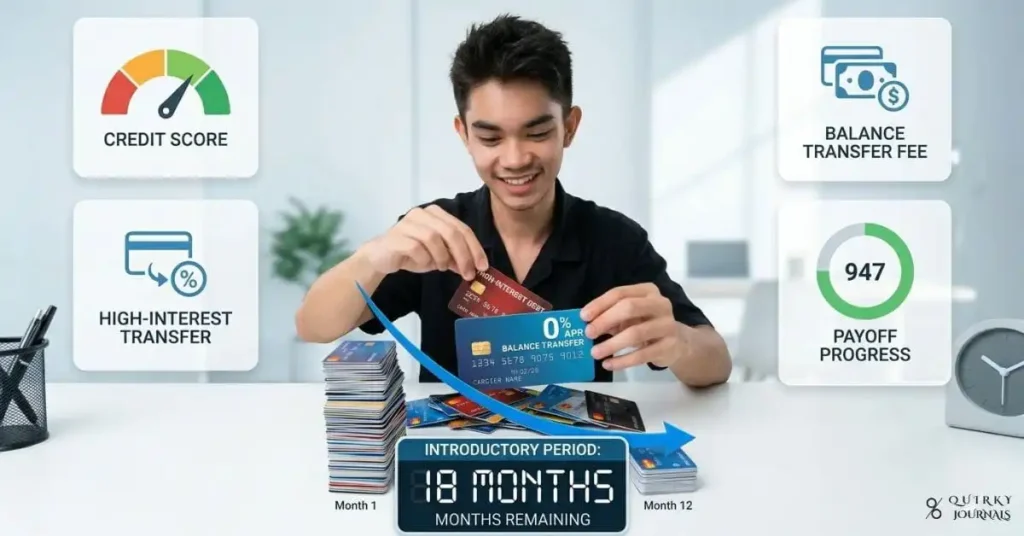
The Best Balance Transfer Credit Cards of 2026: Pay Zero Interest
Carrying credit card debt at high interest rates is one of the most expensive financial habits an American household can maintain. With average credit card APRs hovering above 20% in 2026, a balance of just five thousand dollars can cost you more than a thousand dollars per year in interest alone, with very little of your minimum payment actually reducing what you owe. Balance transfer credit cards offer a genuinely powerful solution to this problem, and the best options currently available can give you twelve to twenty-one months of zero interest to pay down debt without the clock running against you.
The concept is straightforward. You move existing high-interest debt from one or more credit cards onto a new card that charges 0% APR during an introductory period. Instead of watching your balance barely budge each month because interest charges eat most of your payment, every dollar you pay goes directly toward reducing your principal. Done correctly, a balance transfer can save hundreds or even thousands of dollars and accelerate your path out of debt significantly.
However, not all balance transfer cards are equal, and choosing the wrong one can cost you more than staying put. Transfer fees, the length of the promotional period, the ongoing APR after the intro period ends, and the credit score required to qualify all vary considerably between products. Some cards charge 3% to 5% upfront just to move your balance. Others combine a strong introductory offer with rewards that add long-term value. Understanding these variables is essential before you apply.
This guide covers the best balance transfer credit cards available in 2026, explains how to evaluate each option for your specific situation, walks through the mechanics of executing a successful transfer, and addresses the most common mistakes people make that turn a smart financial move into a costly one. Whether you are carrying a few thousand dollars or a more substantial balance, there is a card here that can genuinely help you pay zero interest while you work to eliminate your debt.
How Balance Transfer Credit Cards Work
Before diving into specific card recommendations, it is worth understanding exactly how balance transfers function. This knowledge helps you evaluate offers accurately and avoid the pitfalls that trip up first-time users of these products.
When you open a new balance transfer credit card, you request to move a balance from your existing cards to the new one. The new card issuer pays off your old balance, and the amount transferred becomes your new balance on the new card. During the introductory period, typically ranging from twelve to twenty-one months depending on the card, you pay 0% interest on that transferred balance. After the promotional period ends, the standard purchase APR applies to any remaining balance.
Most cards charge a balance transfer fee at the time you move the balance. This fee is typically expressed as a percentage of the amount transferred, usually between 3% and 5%. On a five-thousand-dollar transfer, a 3% fee means you immediately owe an additional one hundred and fifty dollars. A 5% fee on the same amount adds two hundred and fifty dollars. These fees are generally still worth paying when the alternative is months of interest at 20% or more, but they must be factored into your calculations. According to the Consumer Financial Protection Bureau’s credit card guidance, consumers should always calculate the total cost, including transfer fees, before deciding whether a balance transfer makes financial sense.
One critical rule applies to virtually all balance transfer cards: new purchases made on the card after the transfer typically accrue interest at the standard purchase APR, not the promotional rate. If you use your balance transfer card for everyday spending and do not pay off those new charges in full each month, you will accumulate fresh interest-bearing debt alongside your promotional balance. Keeping a balance transfer card separate from your regular spending card is the cleanest way to avoid this complication.
Credit score requirements for the best balance transfer offers are also important to understand. The most competitive cards generally require good to excellent credit, typically defined as a FICO score of 670 or above, with the longest promotional periods often requiring scores of 720 or higher. Knowing your credit score before applying helps set realistic expectations about which cards you are likely to be approved for and at what credit limit.
The Best Balance Transfer Cards of 2026 at a Glance
The table below provides a summary comparison of the leading balance transfer credit cards available in 2026. Detailed reviews of each card follow in subsequent sections.
| Card Name | 0% Intro APR Period | Transfer Fee | Regular APR (After Intro) | Annual Fee | Best For |
|---|---|---|---|---|---|
| Citi Simplicity Card | 21 months | 5% (min. $5) | 19.24% to 29.99% variable | $0 | Longest 0% period available |
| Wells Fargo Reflect Card | 21 months | 5% (min. $5) | 18.24% to 29.99% variable | $0 | Longest intro period, no annual fee |
| Chase Freedom Unlimited | 15 months | 3% (intro), 5% after | 20.49% to 29.24% variable | $0 | Cash back rewards alongside transfer |
| BankAmericard Credit Card | 18 months | 3% (first 60 days) | 16.24% to 26.24% variable | $0 | Low ongoing APR after intro period |
| Discover it Balance Transfer | 18 months | 3% | 17.24% to 28.24% variable | $0 | Cash back rewards on new purchases |
| Citi Double Cash Card | 18 months | 3% (first 4 months) | 19.24% to 29.24% variable | $0 | Best long-term cash back card |
| U.S. Bank Visa Platinum Card | 18 months | 3% | 18.74% to 29.74% variable | $0 | Cell phone protection perk |
Citi Simplicity Card: The Longest Zero Interest Period Available
The Citi Simplicity Card has consistently held its position as one of the top balance transfer cards in the market, and its 21-month introductory 0% APR period remains one of the longest currently available from any major issuer. For someone carrying a significant balance who needs maximum time to pay it down, this extended runway is genuinely difficult to beat.
The card charges a 5% balance transfer fee with a minimum of five dollars per transfer. While 5% is on the higher end of the fee range, the 21-month interest-free window more than compensates for this cost in most scenarios. Consider a balance of eight thousand dollars transferred to this card. The 5% fee adds four hundred dollars, bringing your total balance to eight thousand four hundred. Over 21 months, your required monthly payment to clear the balance completely before the promotional period ends would be approximately four hundred dollars. Compare that to paying 20% or higher APR on the same balance at your current card, and the savings are substantial.
Beyond the balance transfer offer, the Citi Simplicity Card distinguishes itself with a genuinely consumer-friendly policy structure. It charges no late fees and no penalty APR, meaning that a single missed payment will not trigger a sudden jump to a punitive interest rate. For someone already managing financial stress, this protection provides real peace of mind. According to NerdWallet’s annual credit card rankings, the Citi Simplicity Card has ranked among the top balance transfer products for several consecutive years precisely because of this combination of duration and borrower protections.
There is no annual fee on this card, which means you carry no fixed cost for keeping it open after your balance is paid off. Many financial advisors recommend keeping a card account open after paying it down because it contributes positively to your credit utilisation ratio and credit history length. The Citi Simplicity Card makes this effortless since there is no annual fee eating into your budget once the debt is gone.
The primary limitation of this card is that it offers no rewards programme. If you are looking for a card that simultaneously helps you pay down debt and earns cash back or points on ongoing spending, the Citi Double Cash or Chase Freedom Unlimited would be better choices. However, if your sole priority is the longest possible window to eliminate an existing balance at zero interest, the Citi Simplicity Card belongs at the top of your list.
Wells Fargo Reflect Card: Twenty-One Months With Flexibility
The Wells Fargo Reflect Card matches the Citi Simplicity Card’s 21-month introductory period and similarly charges no annual fee. It applies 0% APR to both balance transfers and new purchases during the promotional window, which gives it a slight edge over the Citi Simplicity in situations where you need to make some necessary purchases during the paydown period without accruing interest.
The balance transfer fee is 5%, the same as the Citi Simplicity, and the fee applies to transfers made within 120 days of account opening. This 120-day window is worth noting because it gives you a reasonable amount of time to consolidate balances from multiple cards rather than having to act immediately upon account approval. Some people carry balances on two or three different cards and want to move them all across strategically over a few months rather than all at once.
According to Bankrate’s 2026 balance transfer card analysis, the Wells Fargo Reflect Card consistently rates well for consumers who want simplicity combined with a maximum introductory period. The card does not carry the same penalty-free late fee structure as the Citi Simplicity, so it is important to set up autopayments to protect your promotional rate. Missing a payment could trigger the standard APR on your remaining balance.
The ongoing APR after the promotional period, ranging from 18.24% to 29.99% variable depending on creditworthiness, is comparable to industry peers. As with all balance transfer strategies, the goal should be to eliminate the transferred balance before month 22. Any remaining balance at that point will immediately begin accruing interest at whatever rate applies to your account.
One additional feature worth highlighting is the Wells Fargo Reflect Card’s access to My Wells Fargo Deals, a programme that offers personalised merchant discounts activated directly through the card. While this is not a formal rewards programme, it adds some ongoing value beyond the introductory period for cardholders who remain active users after their balance is cleared.
Chase Freedom Unlimited: Balance Transfer Plus Cash Back Rewards
The Chase Freedom Unlimited takes a different approach to the balance transfer category. Rather than offering the longest possible introductory period, it balances a solid 15-month 0% window with one of the most generous cash back structures available on a no-annual-fee card. For consumers who want to address existing debt while also building a long-term rewards strategy, this combination is particularly compelling.
The card earns 1.5% cash back on all purchases, plus 5% on travel purchases through Chase Ultimate Rewards, 3% on dining and drugstore purchases. This earning structure makes it one of the most rewarding everyday spending cards in the no-annual-fee category. After your balance transfer is paid off, you have a powerful everyday spending card that continues generating value rather than a card that simply sits in a drawer collecting dust.
The balance transfer fee structure is worth examining closely. Chase charges 3% for transfers made within 60 days of account opening, after which the fee rises to 5%. This means timing matters with this card. Apply, get approved, and initiate your transfers within the first 60 days to lock in the lower 3% fee. On a ten-thousand-dollar transfer, the difference between 3% and 5% is two hundred dollars, which is significant enough to warrant careful attention.
The 15-month promotional period is shorter than the 21-month windows offered by the Citi Simplicity and Wells Fargo Reflect cards. This means your monthly paydown requirement is higher for the same balance. A ten-thousand-dollar transfer on the Chase Freedom Unlimited requires approximately six hundred and seventy dollars per month to clear the balance before the promotional period expires. Someone carrying a very large balance relative to their monthly cash flow capacity may find 21 months a more realistic target than 15. However, for moderate balances where the math works, the added rewards value makes the Chase Freedom Unlimited a genuinely attractive choice.
Chase Freedom Unlimited cardholders also benefit from purchase protection, extended warranty coverage, and trip cancellation insurance. These protections add everyday utility beyond the financial mechanics of the balance transfer offer, making this card a strong long-term choice even after the debt paydown mission is complete.
BankAmericard Credit Card: Competitive Rate After the Intro Period
The BankAmericard Credit Card offers an 18-month introductory 0% APR on balance transfers and a particularly attractive feature that sets it apart from many competitors: a lower ongoing APR range after the promotional period ends. While most balance transfer cards carry ongoing rates starting around 18% to 20% for qualified borrowers, the BankAmericard can offer ongoing rates starting as low as 16.24% for those with excellent credit. For someone who might not fully pay off their balance within the introductory window, this lower default rate reduces the financial damage of carrying a remaining balance.
The transfer fee of 3% applies to balances moved within the first 60 days of account opening, making this one of the more cost-effective entry points in the balance transfer market. On a six-thousand-dollar transfer, a 3% fee amounts to just one hundred and eighty dollars, which will typically be recovered within the first two months of avoided interest compared to a card charging 20% APR.
According to Credit Karma’s 2026 credit card analysis, the BankAmericard performs particularly well for consumers who have existing Bank of America banking relationships, as the bank’s Preferred Rewards programme can add meaningful additional benefits for those who qualify. Maintaining qualifying deposit balances with Bank of America unlocks tiered benefits, including credit card rewards bonuses that enhance the long-term value of this card even without a formal rewards structure on the balance transfer product itself.
There is no annual fee, and the card also includes a $0 introductory APR on new purchases for the same 18-month period. This dual coverage, both transfers and purchases, provides more flexibility for cardholders who need to make necessary purchases during the paydown period without incurring immediate interest charges. Like all such arrangements, however, the discipline required is to ensure those new purchase balances are paid off in full before the promotional period ends, or the benefit is partially eroded.
Discover it Balance Transfer: Rewards While You Pay Down Debt.
The Discover it Balance Transfer card takes a creative approach to the balance transfer product by combining an 18-month 0% introductory period on transfers with a rotating 5% cash back programme on new purchases. This structure rewards cardholders for the spending they do make during the paydown period, adding value that partially offsets the upfront transfer fee.
The 5% cash back applies to rotating quarterly categories that Discover announces in advance, typically covering popular spending areas like grocery stores, gas stations, restaurants, and major online retailers like Amazon during peak shopping seasons. All other purchases earn 1% cash back. Critically, Discover also offers its Cashback Match programme for new cardholders: all cash back earned during the first year of card membership is automatically doubled at the end of that year. This match applies to both the 5% categories and the 1% baseline, making the first year of card ownership particularly valuable from a rewards perspective.
The balance transfer fee of 3% is competitive and falls in the lower tier of transfer costs. Importantly, Discover applies the 0% APR to transfers made within the first 18 months of account opening, which is a slightly more generous transfer window than some competitors that restrict the promotional rate to transfers initiated within the first 60 or 120 days only.
Discover’s customer service reputation is also a meaningful differentiator. J.D. Power’s Credit Card Satisfaction Study has consistently ranked Discover among the top credit card issuers for customer satisfaction, which matters when you may need to contact the issuer with questions about your transfer status, promotional rate, or payment schedule. Accessible, responsive customer service is an underrated factor in the overall balance transfer experience, particularly for first-time users of the product.
One limitation to note is Discover’s acceptance network. While Discover acceptance has expanded significantly in recent years and is now accepted at the vast majority of US merchants, it does not match the global acceptance of Visa and Mastercard. If you travel internationally or deal with merchants who do not accept Discover, this could be a minor inconvenience. For purely domestic use, however, acceptance is rarely an issue.
Citi Double Cash Card: The Best Long-Term Rewards Play
The Citi Double Cash Card earns a place on this list not just as a balance transfer vehicle but as one of the best overall credit cards for long-term value. Its 18-month introductory 0% APR on balance transfers provides substantial time to address existing debt, while its ongoing 2% cash back structure, 1% when you buy and 1% when you pay, creates a compelling incentive to make this your primary spending card after the transfer period concludes.
The 3% balance transfer fee applies during the first four months after account opening, after which it rises to 5%. This promotional fee window is shorter than some competitors’, so acting quickly after approval is important. However, the four-month window is still sufficient for most people to complete their planned transfers, particularly if they have a clear consolidation strategy ready before they apply.
What distinguishes the Citi Double Cash from many balance transfer-focused cards is its earning structure after the promotional period. Most no-annual-fee cards with strong balance transfer offers earn either no rewards or modest flat-rate cash back of 1% to 1.5%. The Double Cash Card’s effective 2% on all purchases places it in the top tier of flat-rate cash back cards, meaning you are not sacrificing long-term card quality for short-term balance transfer utility. You get both in the same product.
According to ValuePenguin’s credit card research, the Citi Double Cash Card consistently ranks among the best overall credit cards for consumers who want one product to handle both a current debt situation and future everyday spending. The combination of a competitive introductory offer and a market-leading ongoing rewards rate is relatively rare in the no-annual-fee card space.
Citi also allows Double Cash cardholders to convert their cash back into Citi ThankYou points if they also hold an eligible premium Citi card, which opens the door to airline miles and hotel point transfers that can generate significantly higher redemption value than straightforward cash back. This flexibility adds another dimension of long-term value for travel-oriented cardholders who start with the Double Cash for the balance transfer but evolve their card portfolio over time.
U.S. Bank Visa Platinum Card: Strong Transfer Offer With a Useful Perk
The U.S. Bank Visa Platinum Card offers an 18-month 0% introductory APR on balance transfers and purchases combined with a distinctive benefit that most balance transfer cards do not include: cell phone protection. When you pay your monthly cell phone bill with the card, you receive up to six hundred dollars per claim in coverage against damage or theft, subject to a 25-dollar deductible. For many people, this protection alone is worth several hundred dollars per year compared to purchasing a separate phone insurance plan.
The balance transfer fee of 3% is competitive, and the card charges no annual fee. Its ongoing APR range of 18.74% to 29.74% variable is broadly in line with peers, though slightly above the BankAmericard’s starting rate for top-credit borrowers. As with all balance transfer strategies, the objective is to clear the transferred balance well before the promotional period ends, making the ongoing rate less relevant for disciplined users.
The U.S. Bank Visa Platinum also provides free credit score access through the TransUnion credit score dashboard, which allows cardholders to monitor their credit improvement as they pay down debt. This is a practical feature for anyone who is using the balance transfer process as part of a broader credit health improvement strategy. Watching your credit utilisation ratio fall and your score improve as you pay down the balance can be genuinely motivating.
The card does not offer a rewards programme, which places it in the same category as the Citi Simplicity and Wells Fargo Reflect in terms of pure balance transfer utility without the added complexity of tracking earning categories. For consumers whose primary goal is debt elimination rather than rewards accumulation, this simplicity is a feature rather than a limitation. Additionally, WalletHub’s balance transfer card research notes that U.S. Bank consistently receives strong marks for customer service quality and account management tools.
How to Choose the Right Balance Transfer Card for Your Situation
Selecting the right balance transfer card depends on several factors specific to your financial situation. The following framework helps you identify which product makes the most sense for your needs.
Start with your balance size and monthly cash flow capacity. Divide your total balance by the number of months in the promotional period to determine your required monthly payment to clear the debt interest-free. If that number is comfortably within your budget, an 18-month card works. If you need more time, the 21-month options become important. The goal is always to match the card’s promotional duration to a payment schedule you can genuinely sustain.
Next, factor in transfer fees when comparing total cost. A card with a 3% fee and 18 months of 0% APR is not automatically better than a card with 5% and 21 months of 0% APR. The right comparison depends on how much of your balance you expect to pay off during each period and what the interest cost would be on any remaining balance. Use a CFPB balance transfer calculator to model the total cost of each option for your specific balance.
Consider whether rewards matter to you. If you are focused purely on debt elimination and plan to use the balance transfer card only for the consolidated balance, a no-rewards card like the Citi Simplicity or Wells Fargo Reflect is perfectly appropriate. If you want to build long-term value from the same card, the Citi Double Cash or Chase Freedom Unlimited add meaningful ongoing utility that justifies their place in your wallet after the transfer period ends.
Finally, review your credit score against each card’s typical approval requirements. Applying for multiple cards in a short period generates hard inquiries that can temporarily lower your score. Identifying the card most likely to approve you at your current credit standing and applying for that card first protects your credit from unnecessary inquiry stacking.
The Step-by-Step Process for Executing a Balance Transfer
Knowing which card is best is only half the equation. Executing the transfer correctly is equally important, and many people make avoidable mistakes. Following these steps in order maximises your chances of a smooth, cost-effective transfer.
Step one is to calculate your total debt and monthly payment capacity. List every card balance, its current APR, its minimum payment, and the total you owe. Add up the amounts you want to transfer and confirm this total falls within the credit limit you are likely to receive on your new card. Credit limits for balance transfer approvals often range from three thousand to fifteen thousand dollars, depending on your income and credit profile. If your balance exceeds what you can transfer to a single card, you may need to prioritise the highest-rate balances first.
Step two is to apply for your chosen card and wait for approval. Most applications receive a decision within minutes online, though some require additional review. During this waiting period, continue making minimum payments on your existing cards to protect your credit standing and avoid late fees or penalty rates triggered on those accounts.
Step three is to initiate the balance transfer immediately after receiving your new card. Most issuers allow you to request transfers online, by phone, or through the mobile app. You will need the account numbers and balances of the cards you want to pay off. Transfers typically take five to seven business days to process. During this window, keep making payments on your old cards to avoid missing a due date.
Step four is to confirm the transfers are complete by checking both your new card balance and your old card statements. Once the transfer appears on your new card and your old card shows a zero balance, you can stop using the old card for new purchases. Do not close the old account immediately. Keeping it open preserves your available credit and helps your utilisation ratio, which benefits your credit score.
Step five is to set up automatic payments on your new balance transfer card. At minimum, set up the minimum payment as an autopay to ensure you never accidentally miss a payment and trigger the end of your promotional rate. Ideally, set autopay to your calculated monthly paydown amount, the amount required to clear the full balance before the promotional period ends, so the payoff stays on track automatically.
Common Mistakes That Undermine a Balance Transfer Strategy
Even with the best card and the right intentions, several common errors can derail a balance transfer plan and leave you worse off than before. Being aware of these pitfalls in advance dramatically increases your probability of success.
The most frequent mistake is continuing to use the old card after the transfer. Once you have moved a balance to a new card, the old card now has available credit that feels like free money. Using it to make new purchases simply recreates the problem you were trying to solve. Putting the old card somewhere inaccessible, or cutting it up if you have the discipline to rely on only one card for day-to-day spending, prevents this self-defeating behaviour.
The second common mistake is making new purchases on the balance transfer card without understanding how payments are allocated. When you carry both a transferred balance at 0% and new purchases at the standard APR on the same card, your payments may be applied to the lowest-rate balance first, meaning your new purchases accrue interest while you slowly pay down the transfer. The CFPB clarifies that since 2010, issuers must apply any amount above the minimum payment to the highest-rate balance first, which is consumer-friendly. However, the minimum payment itself is still typically allocated to the lowest-rate balance. Avoiding new charges on the balance transfer card entirely is the cleanest solution.
The third mistake is not accounting for the transfer fee when calculating your payoff plan. If you transfer five thousand dollars and add a 3% fee, your starting balance is five thousand one hundred and fifty dollars. Your monthly payment calculation must be based on this higher number, not the original five thousand, to ensure you clear the full balance before the promotional period ends. Overlooking this adjustment by even one or two months can leave a small residual balance that immediately begins accruing interest at the standard rate.
A fourth mistake is applying for a balance transfer card when you are also planning to apply for another major credit product, like a mortgage or car loan, in the near future. Balance transfer applications generate hard inquiries that can temporarily lower your credit score by a few points. While this impact is usually modest and short-lived, it can matter in the months immediately before a major financing application. Timing your balance transfer well ahead of any planned major borrowing, ideally by at least six months, prevents any interaction between the two events.
The Credit Score Impact of Balance Transfers
Understanding how a balance transfer affects your credit score helps you plan the process as part of a broader credit health strategy rather than viewing it in isolation. The good news is that, executed correctly, a balance transfer typically improves your credit score over time, even though there is a short-term dip at the point of application.
When you apply for a new balance transfer card, the issuer performs a hard inquiry on your credit report. This inquiry typically reduces your score by a few points temporarily. Simultaneously, the new account lowers the average age of your credit accounts, which can have a modest negative effect on the length of your credit history component. Both of these effects are transient and generally minor in the context of a broader credit profile.
The positive effects begin almost immediately after the transfer is complete. Your credit utilisation ratio, which measures the proportion of your available credit that you are currently using, is one of the most significant factors in credit score calculations. When you open a new card and transfer a balance to it, you increase your total available credit by the new card’s limit while your total debt remains the same. This reduces your overall utilisation ratio, which has a positive effect on your score. According to FICO’s credit education resources, credit utilisation accounts for approximately 30% of your FICO score, making it one of the most impactful variables you can influence in the short term.
As you pay down your transferred balance over the promotional period, your utilisation ratio falls further, and your payment history strengthens. Both trends contribute positively to your score. By the time the promotional period ends and your balance is cleared, most people find their credit scores have improved meaningfully compared to where they stood before the transfer, often by twenty to fifty points or more, depending on their starting position and the size of the balance they eliminated.
Balance Transfers for Multiple Cards: Managing a Consolidation Strategy
Many people carrying significant credit card debt are not dealing with a single balance but with three, four, or even five cards, each carrying partial balances at varying interest rates. A balance transfer strategy can be applied to multiple cards simultaneously, but doing so effectively requires some additional planning compared to consolidating a single balance.
The first decision is whether to attempt to consolidate everything onto one card or spread transfers across two cards. A single card consolidation is simpler to manage, but the credit limit you receive may not be sufficient to absorb all of your balances. Most issuers cap the amount you can transfer at a percentage of your credit limit, typically 75% to 95%, so a five-thousand-dollar credit limit might allow you to transfer only three thousand seven hundred and fifty to four thousand seven hundred and fifty dollars.
If your total balance exceeds what one card can accommodate, applying for two balance transfer cards from different issuers and splitting the balance between them is a reasonable approach. This doubles the paperwork and the number of monthly payments to track, but it also doubles your interest-free capacity and can potentially extend your promotional coverage if the two cards have different promotional period end dates. Using a balance transfer comparison calculator helps model the total cost of different consolidation scenarios before you commit.
When managing multiple balances on multiple old cards, prioritise by interest rate. Transfer the highest-rate balances first and in full before moving to lower-rate balances. If your credit limit does not allow you to transfer everything, you should at least eliminate the most expensive debt first and maximise the interest savings on each dollar of transfer capacity you have available.
After the Promotional Period: What Happens to Your Remaining Balance
The most important planning milestone for any balance transfer is the promotional period end date. Marking this date on your calendar from the moment you receive your new card and building your monthly payment schedule around it is non-negotiable for a successful outcome.
When the promotional period ends, any remaining balance on the transferred amount begins accruing interest at the card’s standard variable APR. This rate can be substantially higher than the rates on the cards you paid off, particularly if your credit situation has changed or if market interest rates have risen. The standard rate on most balance transfer cards currently ranges from approximately 18% to 30%, depending on creditworthiness, which means an undisclosed remaining balance can become expensive very quickly.
If you are approaching the end of your promotional period and realise you will not be able to clear the remaining balance in time, you have several options. The most straightforward is to apply for another balance transfer card and perform a second transfer before the first promotional period expires. This extends your interest-free runway but adds another transfer fee and requires a new credit inquiry. Not every issuer allows you to transfer a balance from their own card to another of their own products, so this option typically requires moving to a different bank’s card.
Alternatively, if you are close to paying off the balance but need just a few extra months, contacting your current card issuer and asking for a temporary hardship arrangement or a promotional rate extension is worth attempting. Issuers are not obligated to grant these requests, but they may do so for customers with good payment records rather than risk losing the account. According to Federal Reserve consumer credit data, revolving credit conditions have tightened in 2026, making issuers modestly more willing to work with existing customers in good standing rather than face account closures.
Building Long-Term Financial Health After Your Balance Transfer
A balance transfer is a tool, not a solution. The real work of improving your financial position happens in the months of disciplined paydown that follow the transfer, and in the habits you build during and after that process. Using the breathing room that a 0% promotional period creates to establish a sustainable spending and saving pattern transforms a tactical financial move into a lasting improvement in your financial health.
Start by building a simple budget that ensures your monthly balance transfer payment is funded before discretionary spending. The CFPB’s budgeting resources offer straightforward frameworks for household budget construction that work alongside a debt paydown strategy. Treating your monthly balance transfer payment like a fixed expense, as immovable as rent or a car payment, prevents the monthly negotiation with yourself over how much to put toward the debt that derails many paydown attempts.
Simultaneously, consider what drove the credit card debt in the first place. For many people, debt accumulation reflects a period of income disruption, an unexpected expense, or a gradual drift in spending that exceeded earnings. Identifying the root cause and addressing it directly, whether through building an emergency fund, reviewing subscription and recurring expenses, or increasing income, prevents the next cycle of balance accumulation from starting before the current one is fully resolved.
Once your transferred balance is cleared, the card you used for the transfer becomes a powerful long-term financial tool. Keep it active with small regular purchases that you pay in full each month. This maintains the positive utilisation and payment history benefits while avoiding any new interest charges. If the card offers rewards, as the Citi Double Cash, Chase Freedom Unlimited, and Discover it Balance Transfer all do, you are now earning on your everyday spending while maintaining a clean, zero-balance credit profile.
Is a Balance Transfer Right for You in 2026?
Rising interest rates and elevated consumer debt levels in 2026 make balance transfer cards more valuable than they have been for many previous cycles. When average credit card APRs were in the 14% to 16% range, the urgency of moving to a 0% card was real but moderate. With rates now exceeding 20% on average, and some store and subprime cards charging 28% or more, the financial benefit of a twelve to twenty-one-month interest-free window has grown considerably.
According to the Federal Reserve’s consumer credit statistics for early 2026, revolving credit card debt in the United States remains at historically elevated levels. Millions of households are carrying balances on which they are paying substantial monthly interest without meaningfully reducing their principal. For anyone in this situation who has a credit score sufficient to qualify for a promotional balance transfer offer, acting now rather than waiting is almost always the better financial decision. Every month of delay on a high-interest balance is money permanently lost to interest charges that a balance transfer would have eliminated.
The key qualification is that a balance transfer is genuinely beneficial only if you can commit to making the required monthly payments to clear the balance before the promotional period ends, and you do not accumulate new debt on your old cards in the meantime. Without that commitment, you risk ending up with the same total debt but spread across more accounts, each charging interest. With it, you have one of the most effective and accessible debt reduction tools available in the consumer credit market.
Spend some time for your future.
To deepen your understanding of today’s evolving financial landscape, we recommend exploring the following articles:
Startup Funding Guide: Angels, VCs and Bootstrapping
How Finance Teams Can Upskill for the Digital Era
Inside Quant Trading Firms: What They Do & How They Work
9 Steps to Financial Clarity and Better Money Goals
Explore these articles to get a grasp on the new changes in the financial world.
Disclaimer
The information in this article is provided for general educational and informational purposes only. It does not constitute financial, legal, or credit advice. Credit card terms, interest rates, fees, and promotional offers are subject to change at any time and may vary based on individual creditworthiness and issuer policies. Always review the full terms and conditions of any credit card offer before applying. Consult a qualified financial professional regarding your specific financial situation. The author and publisher accept no liability for financial decisions made based on the content of this post.
References
- Consumer Financial Protection Bureau. (2026). Understanding Credit Cards. [Online]. Available: https://www.consumerfinance.gov/consumer-tools/credit-cards/understand-your-credit-card/
- NerdWallet. (2026). Best Balance Transfer Credit Cards. [Online]. Available: https://www.nerdwallet.com/best/credit-cards/balance-transfer/
- Bankrate. (2026). Best Balance Transfer Credit Cards of 2026. [Online]. Available: https://www.bankrate.com/credit-cards/balance-transfer/best-balance-transfer-credit-cards/
- Credit Karma. (2026). Best Balance Transfer Credit Cards. [Online]. Available: https://www.creditkarma.com/credit-cards/i/best-balance-transfer-credit-cards
- J.D. Power. (2025). U.S. Credit Card Satisfaction Study. [Online]. Available: https://www.jdpower.com/business/press-releases/2025-us-credit-card-satisfaction-study
- ValuePenguin. (2026). Best Balance Transfer Credit Cards. [Online]. Available: https://www.valuepenguin.com/best-balance-transfer-credit-cards
- WalletHub. (2026). Best Balance Transfer Credit Cards. [Online]. Available: https://wallethub.com/best-credit-cards/balance-transfer/
- FICO. (2026). Credit Utilisation and Your Score. [Online]. Available: https://www.myfico.com/credit-education/credit-scores/credit-utilization
- Consumer Financial Protection Bureau. (2026). How Payments Are Applied to Balances. [Online]. Available: https://www.consumerfinance.gov/ask-cfpb/when-i-make-a-payment-on-my-credit-card-how-is-it-applied-to-my-balances-en-30/
- Federal Reserve. (2026). Consumer Credit Statistical Release G.19. [Online]. Available: https://www.federalreserve.gov/releases/g19/current/
- Consumer Financial Protection Bureau. (2026). Balance Transfer Calculator. [Online]. Available: https://www.consumerfinance.gov/consumer-tools/credit-cards/balance-transfer-calculator/
- CreditCards.com. (2026). Balance Transfer Calculator. [Online]. Available: https://www.creditcards.com/calculators/balance-transfer/
- Consumer Financial Protection Bureau. (2026). Budgeting Resources. [Online]. Available: https://www.consumerfinance.gov/consumer-tools/budgeting/
- University of Michigan. (2026). Surveys of Consumers. [Online]. Available: https://www.sca.isr.umich.edu/
- Citi. (2026). Citi Simplicity Card. [Online]. Available: https://www.citi.com/credit-cards/citi-simplicity-credit-card
- Wells Fargo. (2026). Reflect Visa Credit Card. [Online]. Available: https://creditcards.wellsfargo.com/reflect-visa-credit-card/
- Chase. (2026). Freedom Unlimited Credit Card. [Online]. Available: https://creditcards.chase.com/cash-back-credit-cards/freedom/unlimited
- Discover. (2026). Discover it Balance Transfer Card. [Online]. Available: https://www.discover.com/credit-cards/balance-transfer/