
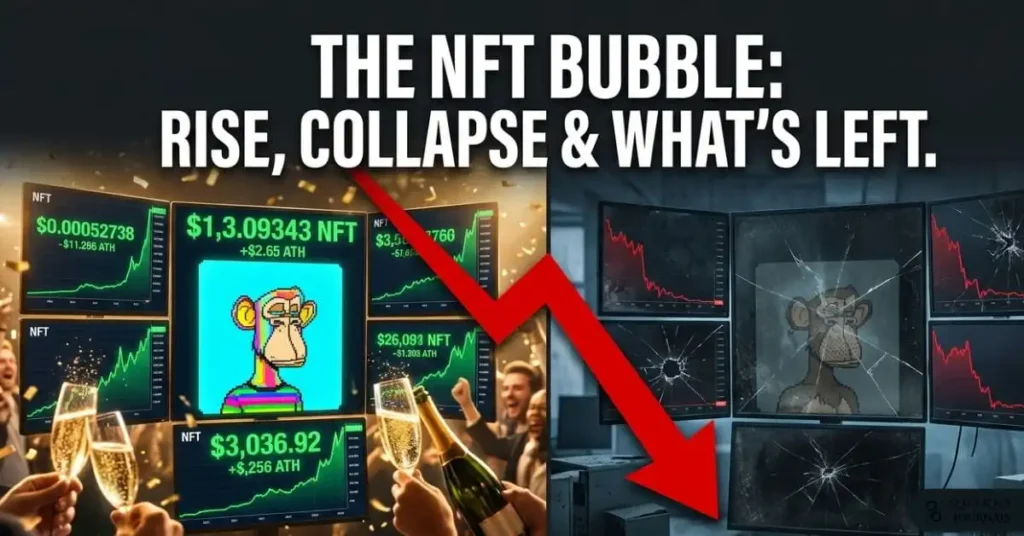
From $17 Billion to $23 Million: The Rise and Fall of the NFT Market
Introduction: The Rise and Spectacular Fall of the NFT Market
In March 2021, Christie’s auction house sold a digital mosaic for $69 million. The buyer received no canvas, no paint, and no physical object. What they got was a JPEG and a blockchain entry. That single sale, involving artist Beeple’s work “Everydays: The First 5000 Days”, fired a starting pistol heard around the financial world. Within months, NFTs were everywhere.
Four years later, the landscape looks very different. Around 96% of NFT collections are now considered dead, showing no trading activity, no sales, and no community. Weekly Ethereum-based NFT trading volumes sit at roughly $90 million, a fraction of the multi-billion-dollar peaks of 2021 and 2022. The party is over. But the lessons are just beginning.
This post-mortem takes an honest look at what happened, who got hurt, why the bubble formed, and what the wreckage left behind. More importantly, it explores what the underlying technology actually offers, now that the speculative frenzy has passed.
The Rise: How a $69 Million JPEG Sparked a Global Frenzy
To understand the fall, you have to understand the rise. NFTs, or non-fungible tokens, are unique digital assets stored on the blockchain. Unlike fungible tokens such as Bitcoin, each NFT is distinct and irreplaceable. Early experiments began around 2017 with CryptoKitties, a blockchain game where users bred and traded digital cats. The concept was novel, but the scale was limited.
The tipping point came in 2021. Government stimulus payments had injected cash into household savings. Interest rates were near zero. Risk appetite was high. In that environment, the Beeple sale acted as a legitimising signal. Traditional auction houses like Christie’s and Sotheby’s were suddenly involved. That validation attracted a new wave of buyers who had never touched crypto before.
Collections like Bored Ape Yacht Club (BAYC) minted in April 2021 at roughly $190 each. Within a year, individual apes fetched hundreds of thousands of dollars. The most expensive Bored Ape ever sold went for over $24 million. Profile-picture NFTs, or PFPs, became status symbols across social media. Owning one was the digital equivalent of parking a Ferrari outside your house.
By January 2022, monthly NFT trading volume hit approximately $17 billion. Active traders in the art NFT segment grew from fewer than 20,000 in 2020 to over 500,000 by 2022. New projects are launched daily. Celebrities jumped in. Athletes promoted collections on social media. The narrative was simple: own this today, sell it for ten times the price tomorrow.
Celebrity Culture and the Marketing Machine
No account of the NFT bubble is complete without examining the celebrity dimension. Jimmy Fallon and Paris Hilton discussed their Bored Apes on “The Tonight Show” in January 2022. Eminem, Snoop Dogg, Justin Bieber, Gwyneth Paltrow, Steph Curry, Madonna, and dozens more posted their apes on social media. The apparent enthusiasm seemed organic. The blockchain told a different story.
Independent journalists examining on-chain data found that large cryptocurrency payments often preceded celebrity purchases and promotional posts. Hours before Justin Bieber paid the equivalent of $1.3 million for a Bored Ape, he received Ethereum worth about $2.5 million in his crypto wallet. The pattern repeated across multiple celebrities. Payments flowed through MoonPay, a crypto payments company that later disclosed it had financial relationships with many of the same celebrities promoting BAYC.
A class action lawsuit followed in December 2022, naming Yuga Labs, MoonPay, Sotheby’s, and numerous celebrities. The case alleged that undisclosed paid promotions inflated BAYC prices and misled ordinary investors. The lawsuit was eventually dismissed in September 2025. However, legal victory did not restore public trust. The damage was done, and the reputational fallout for many celebrities proved lasting.
For ordinary retail investors who bought at the peak based on celebrity signals, the outcome was often devastating. Justin Bieber’s two Bored Apes, purchased for the equivalent of $1.3 million combined, had the highest bids of around $2,800 in early 2026. Eminem’s ape, acquired for $460,000, followed a similar trajectory. The celebrities absorbed losses many times larger than most retail buyers could imagine. Retail participants with smaller portfolios often lost everything they put in.
The Numbers Behind the Collapse
The data tells a story of extraordinary speed and scale on both the way up and the way down.
| Metric | Peak (2021-22) | By 2024-25 |
|---|---|---|
| Monthly trading volume | ~$17 billion (Jan 2022) | ~$23.8M (Q1 2025) |
| Art NFT trading volume | $2.9 billion (2021) | $197M (2024) |
| Active traders (Art NFTs) | 529,101 (2022) | 19,575 (Q1 2025) |
| Average Art NFT price | $2,044 (2021) | $475 (2023 low) |
| BAYC floor price (USD) | ~$420,000 (Apr 2022) | ~$40,000 (May 2024) |
| Dead NFT collections | 30% inactive (2023) | 96% dead (2025) |
Art NFT trading volume collapsed by 93% from the 2021 peak, falling from $2.9 billion to just $197 million by 2024, with Q1 2025 figures reaching a staggering low of $23.8 million. The average NFT token sale price fell 92% from May 2022 to February 2023, dropping from $3,894 to $293, according to Chainalysis data.
For individual collections, the numbers are equally sobering. A Bored Ape that fetched $420,000 at peak could find buyers at only around $40,000 by May 2024, a roughly 90% decline. Meanwhile, the broader index still implied a peak rise of approximately 60 times from pre-boom levels, which, according to CEPR researchers, would make the NFT bubble one of the largest in recorded financial history, potentially surpassing the South Sea Bubble of 1720.
Who Actually Made Money?
The distribution of profits in the NFT market was radically unequal. Research from CEPR examining 199 active intermediaries on the SuperRare marketplace found that their mean return was 94%. However, the median return was negative 85% when unsold inventory was valued at zero. Nearly two-thirds of active traders lost money. The average was pulled up by a small number of spectacular successes, with the maximum return reaching 73 times the initial investment.
This extreme concentration of gains is a defining feature of speculative bubbles. In the NFT market, less than 1% of trades accounted for the majority of profits. For most participants, especially those who entered after the Beeple sale in mid-2021, the outcome was negative. Early adopters, creators who minted first, and sophisticated traders who exited at peak were the primary beneficiaries.
Selection bias also distorted the market’s apparent health during the decline. Research highlighted by CEPR showed that because reluctant sellers held onto falling assets, transaction-based indexes kept recording sales of relatively better-performing NFTs. This created an illusion that the market was holding up better than it actually was. By the time the full picture became clear, most retail participants had already absorbed their losses.
The Mechanisms That Inflated the Bubble
Several interconnected forces inflated NFT prices beyond any defensible valuation. Understanding them matters not just for historians of this particular episode, but for anyone navigating speculative markets in the future.
Wash Trading: This practice involves a seller and buyer colluding to trade an asset between themselves to create artificial volume and price signals. Chainalysis estimated that wash trading was up 126% in February 2022. When you see an NFT trading $100,000 every day with only ten holders, something is wrong. The inflated statistics attracted genuine investors based on false signals, drawing in real capital to support phantom liquidity.
FOMO Marketing: The Fear of Missing Out is a powerful psychological force. Celebrities endorsing NFTs without disclosing payments amplified this pressure enormously. When Jimmy Fallon and Paris Hilton discuss their Bored Apes on a primetime chat show, millions of viewers receive a powerful social proof signal. Many viewers did not know that financial relationships may have underpinned those endorsements.
Oversaturation: At the height of the boom, thousands of new NFT projects launched every week. The market became flooded with low-quality assets, diluting the quality of the overall ecosystem. Projects that offered nothing beyond a JPEG and a promise of community flourished temporarily. When buyers became more selective, most of those projects collapsed to zero.
Macro Conditions: The Federal Reserve’s near-zero interest rate policy made risk-free returns unattractive. Stimulus payments provided households with surplus cash. Both factors pushed investors toward higher-risk speculative assets. When inflation hit 9.1% in June 2022, and the Fed began raising rates aggressively, that speculative capital rapidly retreated.
The Forces That Burst the Bubble
No single event caused the NFT crash. Instead, a confluence of factors converged from mid-2022 onward.
| Factor | Impact | Lesson |
|---|---|---|
| Wash trading | Inflated volume data | Verify sources independently |
| Celebrity promotions | FOMO-driven retail buying | Hype is not due diligence |
| Market oversaturation | Quality diluted rapidly | Scarcity requires limits |
| Rising interest rates | Risk capital withdrawn | Macro context always matters |
| Lack of utility | No floor price support | Assets need real use cases |
| FTX and LUNA collapses | Trust collapse across crypto | Contagion risk is real |
The broader crypto ecosystem collapse played a significant role. The implosion of TerraUSD and the LUNA token in May 2022 wiped out approximately $40 billion in value overnight and shook confidence across all digital assets. Then, in November 2022, the collapse of the FTX exchange caused a second severe confidence shock. Both events drained liquidity and trust from the broader crypto market, with NFTs absorbing much of the collateral damage.
Transaction costs also became a structural barrier. As network congestion grew on Ethereum, gas fees sometimes exceeded the value of the asset being sold. If you owned an NFT worth $500 but selling it cost $80 in fees, the market became effectively illiquid. Many small holders simply could not exit without losing more than the asset was worth.
Comparing the NFT Bubble to Other Financial Bubbles
History offers us a useful context for understanding what happened in the NFT market. Speculative bubbles follow recognisable patterns, even when the underlying asset is new.
| Bubble | Peak Year | Approx. Decline | What Survived |
|---|---|---|---|
| Dot-com | 2000 | ~78% | Amazon, Google |
| 1990s Comics | 1993 | ~90%+ | Key IP, classic issues |
| NFTs (Art) | 2021 | ~97%+ | Utility NFTs, blue-chip IP |
| South Sea Co. | 1720 | Near total | Regulatory reform |
The 1990s comic book bubble is particularly instructive. Like NFTs, the comic boom was driven by a belief that mass-produced collectables would appreciate because of their scarcity. Publishers responded to demand by printing massive quantities of special editions. The flood of supply made the supposed scarcity meaningless. Prices collapsed. However, genuinely rare key issues and foundational comics retained and eventually grew their value.
Both comparisons suggest that what survives a bubble tends to be the genuine infrastructure and use cases, not the speculative overlay. The question for NFTs is whether the underlying technology offers enough genuine utility to justify its continued existence. The evidence from 2025 suggests the answer is a qualified yes.
The Role of Blockchain Transparency as a Warning Tool
One underappreciated aspect of the NFT bubble is that the blockchain itself contained warning signs throughout. Every transaction, every listing, every wash trade was recorded permanently on the public ledger. The problem was that most participants lacked the tools or knowledge to read those signals.
Independent journalists who could read blockchain data identified suspicious patterns early. The celebrity payment flows connected to BAYC promotions were visible on-chain before any lawsuits were filed. Wash trading volumes were detectable by anyone with the right analytics tools. Researchers at CEPR noted that the blockchain’s transparency offers a model for market oversight that traditional markets lack.
This is a genuinely important legacy. The NFT experiment provided economists and regulators with an unprecedented real-time laboratory for bubble economics. Every stage of the cycle was recorded with granular detail. That data is now informing academic research, regulatory frameworks, and investor education in ways that may reduce harm in future speculative episodes.
Lessons Learned: What Investors Should Take Away
The NFT bubble generated an extraordinary amount of financial pain. However, it also produced clear lessons that apply well beyond the digital art market.
Lesson 1 – Verify metrics independently. Trading volume figures in illiquid and opaque markets are frequently unreliable. Wash trading inflated NFT volume data substantially throughout the boom. Before treating volume statistics as proof of demand, understand who is doing the trading and whether they benefit from the apparent activity.
Lesson 2 – Celebrity endorsement is not due diligence. Celebrities brought enormous audiences to NFT projects. Most had financial incentives that were not disclosed to their followers. Whether in crypto, supplements, or sports betting, celebrity promotion rarely aligns with the interests of the audience. Court cases may be dismissed, but the pattern of undisclosed paid promotion is a structural risk in any influencer-led market.
Lesson 3 – Scarcity requires genuine limits. The NFT market promised digital scarcity, but thousands of new projects are launched every week. Artificial scarcity within a collection meant nothing when infinite competing collections existed. True scarcity, the kind that supports long-term value, requires genuine constraints and authentic demand.
Lesson 4 – Macro context cannot be ignored. Speculative markets depend on available capital. When US inflation hit 9.1% in June 2022, and the Federal Reserve tightened aggressively, speculative capital evaporated rapidly. Any investment thesis that ignores the prevailing monetary environment carries hidden risk.
Lesson 5 – Asset utility is floor price support. Assets with no real-world use case have no fundamental floor. When sentiment shifts, they fall to zero because there is no utility demand to provide a price floor. This is not unique to NFTs. Any asset that derives its value entirely from the belief that someone else will pay more is vulnerable to complete collapse once that belief changes.
What the Technology Actually Offers: The Case for Utility NFTs
Separating the technology from the speculative excess reveals something more durable. NFTs, at their core, are programmable digital assets with verifiable ownership and enforceable rights. Those properties have genuine applications well beyond profile pictures and digital art trading.
The NFT ticketing market offers one of the clearest examples of real utility. In March 2025, SeatlabNFT partnered with a UK music festival to deploy NFT tickets for over 150,000 attendees. Blockchain verification eliminated counterfeit tickets, reduced scalping, and provided post-event memorabilia automatically. The global NFT ticketing market was valued at $1.12 billion in 2025 and is projected to reach $3.62 billion by 2034.
Music royalties represent another promising application. Rapper Nas created NFTs for two of his songs that entitle holders to a percentage of streaming royalties. Rihanna’s NFT holders have earned from her song royalties. These arrangements turn fans into partial investors with genuine economic stakes. They solve a real problem in the music industry, ensuring artists receive fair compensation while giving fans a new way to participate in the success of music they love.
In gaming, platforms like Axie Infinity, The Sandbox, and Decentraland allow players to own, trade, and monetise in-game assets. The in-game NFT revenue market is expected to grow from roughly $4 billion to $15 billion by 2027. Unlike traditional games,s where developers own all in-game assets, NFT-based games allow players to retain genuine ownership.
| Industry | Application | Example |
|---|---|---|
| Music | Royalty sharing, fan ownership | Nas’ song royalty NFTs |
| Events | Fraud-proof NFT ticketing | SeatlabNFT (150k festival tickets) |
| Gaming | Player-owned in-game assets | Axie Infinity, The Sandbox |
| Real estate | Fractional property ownership | Propy, Roofstock |
| Fashion | Digital-only garments, brand loyalty | Gucci, Adidas ALTS |
| Supply chain | Authenticity verification | Luxury goods certificates |
Real Estate, Supply Chains, and Luxury Goods
Beyond entertainment, NFT technology is finding serious commercial applications. Platforms like Propy enable property transactions recorded on blockchain, with smart contracts automating legal agreements. Fractional ownership of real estate through tokenised NFTs allows investors to purchase shares in properties that would otherwise require substantial capital.
Supply chain management is another area where NFT technology addresses real problems. Luxury goods companies face persistent counterfeiting challenges. Gucci and Louis Vuitton have explored NFTs as certificates of authenticity, allowing buyers to verify the provenance of high-value items with certainty. In pharmaceutical supply chains, NFTs could track the journey of medications from manufacture to dispensary, reducing the risk of counterfeit drugs entering the market.
Digital identity is an emerging application with potentially wide reach. Verifiable credentials issued as NFTs could replace traditional ID systems in specific contexts, providing individuals with portable and tamper-resistant proof of qualifications or memberships. Community platforms like Bytexplorers already use NFTs as gated passes to forums and events, ensuring genuine interest and participation from members.
The Survivors: What Held Its Value and Why
Not everything in the NFT space collapsed to zero. Understanding what survived and why reveals the conditions for sustainable digital asset value.
CryptoPunks, one of the earliest NFT collections created in 2017, topped the NFT sales charts in July 2025 with over $69.2 million in monthly sales. Their survival reflects genuine historical significance in the NFT space. They are foundational artefacts of a new medium, analogous to early internet domain names or the first editions of important books. Their value rests on authenticity and provenance rather than purely speculative demand.
Pudgy Penguins demonstrated a different path to survival. Rather than relying on speculation, the collection pivoted to physical product launches, with Pudgy Penguin toys entering Walmart stores. A 34.3% value surge in late 2024 reflected genuine consumer engagement. The collection showed that NFT projects can build bridges to mainstream audiences through tangible products and experiences.
Projects that built genuine communities around shared interests and ongoing utility also fared better than pure speculation vehicles. Dapper Labs, the company behind NBA Top Shot and CryptoKitties, has continued to develop NFT applications for major sports leagues and entertainment brands. Their original insight that crypto could be about digital ownership applied to massive fan communities has proven durable even as the speculative market collapsed.
The AI Parallel: Are We Watching the Next Bubble?
The NFT bubble has become a reference point for discussions about the current artificial intelligence investment boom. Several analysts have drawn explicit comparisons between the two cycles. Both involve genuine underlying technology. Both attracted enormous capital flows driven by narrative rather than near-term profitability. Both generated extraordinary valuations for early movers.
The differences matter too. AI has demonstrated near-term productivity improvements in real commercial contexts more rapidly than NFTs ever did. Major enterprises are integrating AI tools and reporting measurable efficiency gains. That is a different starting point from NFTs, where the primary use case for most of the boom period was speculation on digital images.
However, the lessons from the NFT era apply broadly. Technology can be genuinely transformative while still being subject to speculative excess. The infrastructure built during a bubble often outlasts the bubble itself. Whether AI investing follows the dot-com pattern of crash followed by enduring growth, or the NFT pattern of near-total collapse, will depend significantly on whether revenue validates the current valuations.
Where NFTs Stand Today: A Quiet Utility Revolution
By 2025, the NFT landscape looks nothing like its peak years. The era of cartoon apes selling for hundreds of thousands of dollars has passed. What has taken its place is smaller, quieter, and arguably more meaningful.
Transaction volume on Ethereum-based NFT marketplaces still runs at roughly $90 million per week. That is not zero. NFT sales reached $574 million in July 2025, the second-highest monthly total of the year. The average sale price climbed to a six-month high of $113.08 in that month, suggesting that fewer but higher-quality transactions are defining the current market. The speculative froth has cleared, leaving a smaller but more purposeful ecosystem.
Layer 2 networks such as Base from Coinbase and Zora are seeing increased NFT minting activity. Base averaged over one million daily active transacting addresses since late 2024. The cost of deploying large-scale NFT projects has fallen dramatically. Deploying 10 million compressed NFTs on Solana now costs roughly 7.7 SOL, making utility-focused applications economically viable at scale.
Regulatory Implications of the NFT Experiment
The NFT bubble left regulators with important questions to answer. Were some NFTs unregistered securities? The SEC investigated Yuga Labs in October 2022 amid concerns that BAYC NFTs may have constituted unregistered security offerings. No charges were ultimately filed in connection with that specific investigation, but the question of when a digital asset crosses the line from collectable to security remains unresolved.
The celebrity endorsement dimension also raises ongoing questions. The FTC generally requires endorsers to disclose when they have a financial interest in promoting a product. However, the application of those rules to crypto promotions proved difficult to enforce in real time. Better disclosure frameworks for influencer promotion of digital assets remain an unfinished piece of regulatory work.
The CEPR researchers who studied the NFT market argued that the blockchain’s transparency offers a model for market oversight that traditional illiquid asset markets should consider. If every housing or private equity transaction were recorded with the same permanence and accessibility as an NFT sale, regulators could detect wash trading and identify market manipulation with far greater speed and precision.
The Creator Economy: What Artists Learned
For digital artists, the NFT era was a genuine double-edged experience. Many artists earned life-changing sums during the boom. The technology offered something genuinely valuable: a way to sell digital work directly to collectors, receive royalties on secondary sales, and establish verifiable provenance for creations that could previously be copied infinitely at zero cost.
However, the collapse of the speculative market took most of the collector demand with it. Royalty enforcement became a casualty of the competitive marketplace wars, with most platforms making royalties optional to attract more trading volume. That change significantly undermined one of the core value propositions for artists.
The artists who built sustainable practices during the NFT era tended to be those who developed genuine collector relationships rather than chasing viral moments. Platforms like SuperRare and KnownOrigin continue to facilitate direct artist-to-collector sales for digital work, with more modest but more stable participation than the peak years.
What a Healthy Post-Bubble NFT Ecosystem Might Look Like
Drawing on the lessons of previous bubbles and the early evidence from the post-2022 market, a sustainable NFT ecosystem has identifiable characteristics.
First, genuine utility must underpin the asset. Tickets that work as keys. Royalty rights that pay out automatically. Gaming assets that players genuinely own and can trade. Membership tokens that gate real communities. These are use cases with demand that exists independently of speculative interest.
Second, the technology should be invisible to the end user. Platforms like Mintology allow event organisers to issue NFT tickets without requiring buyers to understand blockchain mechanics. Attendees buy a ticket, receive it in a digital wallet, and use it to enter an event. The NFT aspect is an implementation detail, not a selling point.
Third, revenue should justify valuation. Projects with real use cases generate real revenue. That revenue provides a fundamental basis for pricing that pure speculation cannot. When a music royalty NFT generates streaming income, its value is tethered to something measurable. That tethering provides resistance to the kind of collapse that wiped out image-only collections.
Fourth, the community must be authentic rather than manufactured through celebrity endorsement. Communities built around genuine shared interests and ongoing participation are more durable than those assembled through marketing campaigns. The NFT projects that have retained the most engaged communities post-collapse tend to be those where members chose participation based on genuine enthusiasm rather than investment speculation.
The Emotional Toll: Retail Investor Stories
Behind the market statistics are real human experiences. Many retail investors entered the NFT market on the basis of mainstream media coverage and celebrity endorsements, with no background in crypto and a limited understanding of the risks. Some invested savings. Others borrowed money. A significant number experienced losses that affected their financial stability.
The psychological dynamics of speculative bubbles are well-documented. FOMO drives initial purchases. Social proof from celebrities and peers reinforces the decision. Rising prices during the early stages create positive reinforcement. By the time prices begin falling, loss aversion makes it psychologically difficult to sell. Many holders refused to acknowledge losses until the decline was catastrophic.
Research shows that the disposition effect systematically inflated apparent returns during the NFT bust. Holders of losing positions refused to sell, while those with gains were more likely to take profits. This pattern delayed recognition of the true market level and prolonged the period during which new buyers could be drawn in at unsustainable prices.
Looking Forward: Blockchain Ownership in a Post-Hype World
The concept at the heart of NFTs, verifiable digital ownership recorded on a public blockchain, is not going away. The speculative overlay that dominated 2021 and 2022 has largely disappeared. What remains is a set of genuine technical capabilities looking for the right applications.
Digital ownership has never been more relevant. The rise of AI-generated content makes provenance and authenticity more valuable, not less. Knowing that a particular work was created by a specific person and has not been modified is increasingly difficult with traditional digital files, but becomes trivially verifiable with blockchain-recorded provenance. Artists, collectors, and institutions have genuine reasons to care about that capability.
The evolution of NFTs from speculative assets to programmable rights infrastructure is the real story of the post-bubble period. Smart contracts enable NFTs to respond to real-world conditions, unlock access, and change state based on user interaction. That programmability opens use cases that static ownership records cannot support.
Whether the next chapter of digital ownership is called NFTs or something else entirely may not matter much. The underlying question is whether blockchain-based ownership records can solve real problems better than existing alternatives. In ticketing, royalties, gaming, supply chain management, and digital identity, early evidence suggests the answer is sometimes yes. That is enough to justify continued development, even if it is far less exciting than the billion-dollar boom of 2021.
Spend some time for your future.
To deepen your understanding of today’s evolving financial landscape, we recommend exploring the following articles:
Currency Wars: Understanding Forex Dynamics in a Multipolar Economy
War Economy Chapter 22: Emergency Funds During Wartime
Portfolio Rebalancing: Managing Your International Assets
Acquisition or IPO? How to Plan Your Startup Exit the Right Way
Explore these articles to get a grasp on the new changes in the financial world.
Disclaimer
This article is provided for informational and educational purposes only. It does not constitute financial, investment, or legal advice. The NFT market is highly speculative and carries a significant risk of total loss. Nothing in this article should be interpreted as a recommendation to buy, sell, or hold any digital asset. Always conduct your own research and consult a qualified financial advisor before making any investment decisions. Past market events are not necessarily indicative of future outcomes.
IEEE-Format References
- [1] Fast Company, “What can the rise and fall of NFTs teach us about the AI bubble?” 2025. [Online]. Available: https://www.fastcompany.com/91417122/what-happened-with-nfts-lessons-ai
- [2] DappRadar, “NFT Art’s Shocking Collapse: From $2.9 Billion Boom to $23.8 Million Bust,” Mar. 2025. [Online]. Available: https://dappradar.com/blog/nft-arts-shocking-collapse-from-2-9-billion-boom-to-23-8-million-bust-what-went-wrong
- [3] CEPR VoxEU, “The non-fungible token bubble: What investors actually earned,” 2024. [Online]. Available: https://cepr.org/voxeu/columns/non-fungible-token-bubble-what-investors-actually-earned
- [4] Bloomberg, “NFT Trading Volumes Collapse 97% From 2022 Peak,” Sep. 2022. [Online]. Available: https://www.bloomberg.com/news/articles/2022-09-28/nft-volumes-tumble-97-from-2022-highs-as-frenzy-fades-chart
- [5] Blockworks, “NFT volume fell $14.5B in 2023,” Jan. 2024. [Online]. Available: https://blockworks.co/news/nft-trading-volumes-fall-from-2022
- [6] CryptoSlate, “The rise and fall of NFTs,” May 2025. [Online]. Available: https://cryptoslate.com/market-reports/the-rise-and-fall-of-nfts/
- [7] CNN Business, “A twisted tale of celebrity promotion and NFTs,” Feb. 2023. [Online]. Available: https://www.cnn.com/2023/02/10/business/crypto-nft-bored-ape-moonpay-lawsuits
- [8] Wikipedia, “Bored Ape,” 2025. [Online]. Available: https://en.wikipedia.org/wiki/Bored_Ape
- [9] Yahoo Finance, “Whatever happened to NFTs?” Jun. 2025. [Online]. Available: https://uk.finance.yahoo.com/news/nft-tokens-memes-tech-ethereum-blockchain-digital-141150386.html
- [10] Supra Academy, “The NFT Market Crash: The Complete Guide,” 2023. [Online]. Available: https://supra.com/academy/nft-market-crash/
- [11] NFT Plazas, “An Overview of the NFT Market Crash,” Jan. 2026. [Online]. Available: https://nftplazas.com/nft-market-crash/
- [12] University of St. Gallen, “The meteoric rise and fall of NFTs,” 2024. [Online]. Available: https://www.unisg.ch/en/hsg-at-a-glance/the-meteoric-rise-and-fall-of-nfts/
- [13] Artnet News, “What the NFT World Can Learn From the 1990s Comic Book Bubble,” Aug. 2022. [Online]. Available: https://news.artnet.com/art-world/nfts-90s-comic-book-bubble-1955239
- [14] NFT News Today, “Celebrities and Bored Ape Yacht Club NFT Lawsuit,” Oct. 2025. [Online]. Available: https://nftnewstoday.com/2025/10/03/celebrities-and-bored-ape-yacht-club-nft-lawsuit-what-really-happened
- [15] NFT Plazas, “Bored Ape Yacht Club Guide 2024,” Aug. 2025. [Online]. Available: https://nftplazas.com/bored-ape-yacht-club-guide-2024/
- [16] AI Multiple Research, “Top 10 NFT Use Cases in 2026,” 2025. [Online]. Available: https://research.aimultiple.com/nft-use-cases/
- [17] Mintology, “3 Game-Changing NFT Ticketing Use Cases,” Sep. 2025. [Online]. Available: https://blog.mintology.app/nft-ticketing-use-cases-revealed/
- [18] Mintology, “From Coachella to Conferences: NFT Ticketing Use Cases,” Oct. 2025. [Online]. Available: https://blog.mintology.app/from-coachella-to-conferences-real-world-use-cases-of-nft-ticketing-in-2025/
- [19] Gate Web3, “2025 Deep Dive into Leading NFT Projects,” Dec. 2025. [Online]. Available: https://web3.gate.com/en/blog/15541/top-nft-projects-2025-beyond-digital-art
- [20] Position Is Everything, “NFT Utility Beyond Art: Real-World Applications in 2025,” Feb. 2026. [Online]. Available: https://www.positioniseverything.net/nft-utility-beyond-art-real-world-applications-in-2025/
- [21] NFT and GameFi, “Top NFT Trends in 2025,” Jan. 2025. [Online]. Available: https://nftandgamefi.com/2025/01/15/top-nft-trends-in-2025-utility-ownership-and-rwas/
- [22] Medium (Blockchain App Factory), “NFTs in 2025: A Market Reborn or a Forgotten Trend?” Mar. 2025. [Online]. Available: https://medium.com/predict/nft-in-2025-market-reborn-or-forgotten-trend-041ed7a8234c
- [23] Edge of NFT, “Beyond Collectables: The Expanding Frontier of NFTs in 2025,” Aug. 2025. [Online]. Available: https://www.edgeofnft.com/podcasts/beyond-collectibles-the-expanding-frontier-of-nfts-in-2025
- [24] Emjay Writes, “Exploring Utility NFTs in 2025,” Aug. 2025. [Online]. Available: https://emjaywrites.com/utility-nfts-in-2025-guide/
- [25] Rolling Stone, “The NFT Bubble Has Burst, but the Value For Creators Is Just Heating,” 2023. [Online]. Available: https://www.rollingstone.com/culture-council/articles/the-nft-bubble-has-burst-but-the-value-creators-is-just-heating-up-1234631057/