
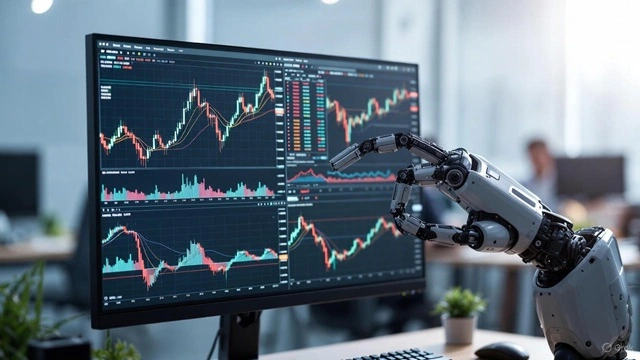
Algorithmic Trading: Can AI Beat the Stock Market?
Hey there, fellow market enthusiasts! If you’ve been keeping an eye on the world of finance, you’ve probably noticed a seismic shift happening. The way we approach investing, predict market movements, and execute trades is changing at an incredible pace, and a significant part of that change is driven by something truly revolutionary: Artificial Intelligence.
For decades, trading has evolved, moving from frantic shouts on trading floors to complex computer programs. This evolution led us to what we call algorithmic trading – where predefined rules drive automated trade execution. But then, Artificial Intelligence (AI) and Machine Learning (ML) burst onto the scene, promising to take things to a whole new level. They’re not just following rules; they’re learning, adapting, and making predictions.
This brings us to the burning question that’s on everyone’s mind: can AI consistently outperform human traders and the broader stock market? It’s a fascinating debate with significant implications for anyone involved in investing, from Wall Street giants to everyday retail investors. In this post, we’re going to dive deep into the foundations of algorithmic trading, compare AI’s capabilities against human intuition, explore the evidence for and against AI outperformance, look at the exciting future of human-AI synergy, and discuss some crucial real-world applications and regulatory challenges. So, let’s get started!
The Foundations of Algorithmic Trading
Defining Algorithmic Trading
At its core, algorithmic trading is simply the automated execution of trade orders based on predefined rules and parameters. Think of it like a highly sophisticated recipe: if the price of a certain stock hits X, and volume is above Y, then buy Z number of shares. Historically, this concept gained significant traction with High-Frequency Trading (HFT), where trades are executed in milliseconds to capitalize on tiny price differences. Over time, it’s evolved to encompass far more complex quantitative strategies that analyze market data to find opportunities.
How AI Enhances Algorithmic Approaches
While traditional algorithmic trading relies on fixed rules, AI and Machine Learning take this to a different dimension. Instead of just following “if-then” statements, AI can actually *learn* from vast datasets, *adapt* to changing market conditions, and *make predictions* about future price movements. What I mean is, ML algorithms are brilliant at identifying complex, non-linear market patterns that would be virtually impossible for a human analyst or even a simple algorithm to spot. This allows for far more dynamic and potentially profitable trading strategies.
AI vs. Human Traders: A Comparative Analysis
When it comes to the battle of wits and speed in the financial markets, let’s stack up AI against human traders across a few key areas:
Data Processing and Analysis Capabilities
- AI: Imagine processing millions of data points in real-time, 24/7. AI can do that, analyzing not just price movements but also unstructured data like news sentiment, social media trends, whale activity, and financial records. It never sleeps, never gets tired.
- Human: We’re incredible, but our cognitive capacity, processing speed, and ability to handle information are inherently limited. Information overload is a real thing for us!
Speed and Execution Precision
- AI: This is where AI truly shines. It can execute trades in milliseconds, capitalizing on fleeting market opportunities that humans wouldn’t even register. Plus, for large institutional trades, AI can minimize market signals, preventing other traders from reacting to big orders and causing adverse price swings.
- Human: We’re just inherently slower. Execution delays and human error are always factors, no matter how experienced the trader.
Emotional Discipline and Decision-Making
- AI: One of AI’s biggest strengths is its lack of emotion. It operates without greed, fear, panic-selling, or overconfidence, adhering strictly to its predefined rules and algorithms. This is crucial for consistent performance in investing.
- Human: Let’s be honest, emotions are a massive part of being human. In trading, they can lead to irrational choices, like cutting winners too soon or holding onto losers for too long, often resulting in significant losses.
Risk Management
- AI: AI can implement precise, automated risk management protocols. This includes dynamically adjusting stop-loss and take-profit orders to market shifts, safeguarding investments and minimizing exposure to risk.
- Human: Consistent risk management is a common struggle for many manual traders. We can easily become overconfident or neglect protective measures in the heat of the moment, leading to poor outcomes.
Accessibility and Learning Curve
- AI Trading Bots: What’s really cool is how accessible AI-powered tools are becoming. Many AI trading bots, like AlgosOne, are designed to be beginner-friendly, requiring minimal prior trading experience or even coding knowledge.
- Manual Trading: Typically, it takes a dedicated trader 1 to 3 years to become consistently profitable. That’s a huge commitment, largely due to the complex market factors and the need for strategy mastery.
The Central Debate: Can AI Consistently Outperform the Market?
This is the million-dollar question, right? And the answer, as I see it, is nuanced but compelling.
Evidence of AI Outperformance
Looking at the data, it’s increasingly clear that AI is making a strong case for itself. Statistical data from the past few years, for example, often indicates that AI consistently outperforms manual traders and even traditional algorithms over multi-year periods. There’s plenty of evidence, including recent 3-year performance data, suggesting that AI algorithms are successfully predicting stock market movements and delivering strong returns. What’s more, AI has shown remarkable risk-adjusted performance during market downturns, effectively mitigating downside risks when human traders might panic. Some algorithms have even been noted to beat the market time and again (see Reference 5).
Limitations and Challenges to Consistent Market Beating
However, AI isn’t a magic bullet, and it faces its own set of hurdles:
- Market Efficiency Hypothesis: This economic theory suggests that asset prices fully reflect all available information. If true, it becomes incredibly difficult for any system, even AI, to consistently find mispricings and “beat” the market.
- Overfitting: AI models are trained on historical data. If they’re too perfectly tuned to past patterns, they might “overfit” and fail spectacularly when faced with unprecedented or “black swan” market events that don’t resemble anything in their training data.
- Lack of Intuition: AI fundamentally lacks human intuition. It can’t interpret nuanced market sentiments, understand geopolitical developments, or make qualitative judgments based on abstract information – things a seasoned human trader might leverage effectively.
- Performance in Uptrend Markets: Interestingly, human-managed funds sometimes outperform AI in bullish markets. This is often attributed to humans’ ability to leverage those qualitative insights and adapt quickly to shifting narratives during periods of rapid growth.
- “Sometimes, but not consistently”: A common takeaway from experts is that while AI shows prowess in certain market conditions, its ability to *consistently* beat the market in *all* conditions remains debatable (see Reference 4). Its strengths might be more situational.
The Future: Human-AI Synergy in Trading
So, if AI isn’t an infallible oracle and humans have their weaknesses, what’s the ultimate solution? I believe the future of finance and investing lies in a powerful collaboration: Human-AI synergy.
Augmented Decision-Making
Imagine this: AI handles the heavy lifting – the data-intensive tasks, crunching millions of data points, and recognizing complex patterns faster than any human ever could. This frees human traders to focus on what they do best: developing strategic insights, making qualitative assessments, and exercising judgment on those nuanced factors AI can’t grasp. It’s about leveraging the best of both worlds.
Collaborative Risk Management
By combining AI’s precise, emotionless execution with human oversight, we can create more robust and adaptable trading strategies. AI can monitor for deviations and execute protective measures automatically, while human traders provide a higher-level check, intervening in truly unprecedented situations or when the model shows unexpected behavior. This creates a powerful layer of protection for any investment.
Continuous Learning and Adaptation
The beauty of this synergy is its potential for continuous improvement. AI’s relentless learning capabilities can be guided by human experience. As markets evolve, the AI learns new patterns, and human experts refine its parameters, creating an evolving, resilient trading system that constantly gets smarter. This approach enhances the overall investment strategy and helps achieve financial freedom.
Real-World Applications and Market Impact
It’s not just theory; AI is already making a huge impact across the financial landscape.
Institutional Adoption and Innovation
Algorithmic trading is no longer niche; it accounts for a significant percentage of equity trading volume, with estimates ranging from 60-73% in the US alone. Institutional players are all in. For instance, Investec, the Anglo-South African banking group, launched its ZebrA-X platform specifically for institutional investors. This platform focuses on incredibly efficient execution and minimizing market disruption, especially for large trades that could otherwise cause price swings.
Empowering Retail Investors
Perhaps even more exciting is how AI is democratizing advanced trading tools for individual traders. We’re seeing a rise in accessible AI-powered trading bots. Platforms like AlgosOne, CFI South Africa’s Kaiana AI, Cryptohopper, and 3Commas are making sophisticated strategies available to a wider audience.
AlgosOne is a prime example of this trend. It boasts a high trade success ratio (often >80%) and a surprisingly low deposit barrier (starting around $300), removing the need for years of prior trading experience or coding knowledge. Its process is a clear illustration of AI in action:
- Data Analysis: It scans the market 24/7, tracking price movements, whale activity, news, financial records, and social media sentiment.
- Pattern Recognition: It identifies patterns and trends from this massive dataset.
- Automated Trade Execution: After approval (often by a human oversight team), the bot executes trades with extreme precision.
- Risk Management: It employs built-in risk management tools to protect investments and minimize potential losses.
Market Growth and Diversification
The impact is evident in market growth statistics too. The AI crypto trading bot market, for example, is projected to surge from $40.8 billion in 2024 to an astonishing $985.2 billion by 2034, with a compound annual growth rate (CAGR) of 37.2%. Beyond just trade execution, AI is revolutionizing portfolio management, identifying optimal diversification strategies, and helping construct resilient investment portfolios designed to weather market turbulence.
Challenges and Regulatory Considerations
As with any powerful technology, AI in trading isn’t without its challenges and risks.
Regulatory Uncertainty and Oversight
Regulators worldwide are grappling with how to keep pace. The International Monetary Fund (IMF) has warned that AI-driven models can exhibit herd-like behavior, potentially accelerating sell-offs and amplifying price swings during economic disruptions. This highlights the urgent need for evolving regulatory frameworks to ensure transparency and manage systemic risks. Bodies like the South African Financial Sector Conduct Authority (FSCA) are actively working to address this.
Market Specificities and Liquidity
AI models face particular challenges in adapting to less stable market conditions and inconsistent liquidity, especially in developing financial ecosystems. What works perfectly in a highly liquid market might not translate well to another.
Systemic Risks
The very automated precision that makes AI trading so powerful can also create vulnerabilities. In extreme market conditions, algorithmic strategies could potentially trigger cascading events, amplifying volatility rather than containing it. This is a critical area of ongoing research and concern.
Conclusion: Redefining the Edge in Trading
So, can AI beat the stock market? My take is that AI undeniably brings significant advantages to the table: unparalleled speed, massive data processing capabilities, and absolute emotional discipline. It consistently outperforms human and traditional methods in many aspects, especially when it comes to identifying complex patterns and executing trades efficiently.
However, the quest for *absolute* and *consistent* market-beating performance across all scenarios remains a complex challenge, particularly given the unpredictability of “black swan” events and the nuances of human sentiment that AI can’t yet fully replicate. The prevailing view, and one I strongly agree with, is that the most effective approach isn’t AI replacing humans, but rather a powerful hybrid model where AI and human intelligence collaborate. AI provides the tools and the heavy lifting, while human traders provide the strategic oversight and qualitative judgment.
Ultimately, AI is not just transforming how institutions trade; it’s actively democratizing advanced trading tools, leveling the playing field for individual investors and fundamentally redefining the future of financial markets.
Disclaimer
Please note that this blog post is for informational purposes only and does not constitute financial advice. The financial markets involve inherent risks, and past performance is not indicative of future results. Before making any investment decisions, you should conduct your own research, consider your personal financial situation, and consult with a certified financial planner or professional financial advisor. Investing in stocks, cryptocurrencies, or any financial instrument carries the risk of loss, and you should only invest what you can afford to lose. This content is not an endorsement or recommendation of any specific trading platform, product, or investment strategy.
References
- Shakya, A. (2024, May 27). Can Artificial Intelligence Really Beat the Stock Market Over Time? DEV Community.
- AlgosOne. (n.d.). Can You Beat the Market with AI Trading? A Data-Driven Answer. Retrieved from https://algosone.ai/can-you-beat-the-market-with-ai-trading-a-data-driven-answer/
- McBain, W. (2025, April 3). The AI trading tools attempting to beat the market. African Business.
- InsiderFinance. (n.d.). Can AI Actually Beat the Market? My Take After Building Dozens of…. Retrieved from https://wire.insiderfinance.io/can-ai-actually-beat-the-market-my-take-after-building-dozens-of-models-7ee302d37ac1
- AlgosOne. (2023, April 20). AI Algorithmic Trading Beats The Stock Market… Again. YouTube.
Image Credit
3844328