War Economy

War Economy: Preparing for Uncertain Times

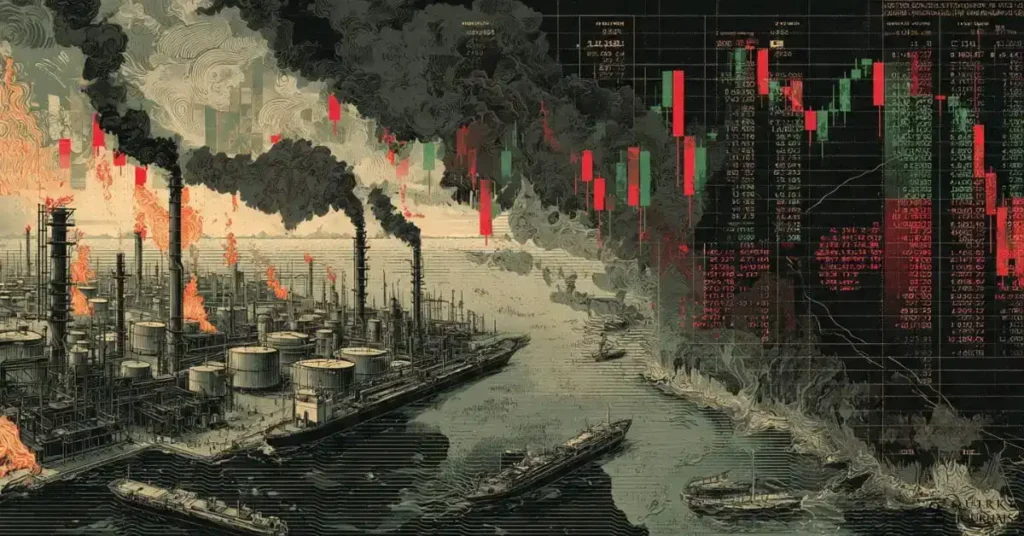
War reshapes the world in brutal and unpredictable ways. It both creates and destroys businesses—fueling growth in certain sectors while collapsing others. Entire markets can shift direction almost overnight.

In recent years, we have witnessed incompetent leadership and reckless decision-making on the global stage, repeatedly pushing the world to the brink of large-scale conflict. Over the past four years alone, global tensions have escalated to levels that were once considered unthinkable.

These are testing times.

When war becomes a real possibility, economic systems behave erratically. Supply chains fracture, currencies fluctuate, debt rises, and long-standing business ecosystems weaken. Families are torn apart, micro-economies collapse, and financial instability spreads faster than the conflict itself.

For those who are financially literate, this moment carries a responsibility. Preparing financially is not about exploiting suffering or fueling destruction. It is about building resilience—so you can protect your family, support your community, and help rebuild when stability eventually returns.

Profiting from wartime shifts does not mean selling weapons or endorsing violence. It means observing how markets respond, understanding changes in capital flows, energy, commodities, technology, and supply chains, and acting with discipline and foresight. The goal is long-term stability, not short-term greed.

We must accept a hard truth: the future is unknowable. Every war disrupts economic systems in ways that no model can fully predict. That is why preparation matters. We prepare for the worst while expecting the best—this is how resilience is built.

What’s Coming Next

We are planning a feature tutorial series on the war economy—what to expect, how economic systems historically behave under stress, and how individuals can prepare responsibly amid uncertainty.

These tutorials will focus on awareness, adaptability, and financial resilience—not speculation or fear-driven decisions.

With great power comes great responsibility.


Legal & Financial Disclaimer

The content presented is for educational and informational purposes only and does not constitute financial, investment, legal, or professional advice. Economic conditions—especially during times of conflict—are highly volatile and unpredictable. Past performance, historical patterns, or market behavior do not guarantee future outcomes.

Readers are solely responsible for their financial decisions and should conduct independent research or consult qualified financial professionals before making any investment or strategic decisions. The authors and publishers assume no liability for losses, damages, or consequences arising from the use or interpretation of this content.

Stay tuned for our upcoming tutorials on the war economy.

Discover how supply shocks, government spending, sanctions, and fear-driven trading combine to make prices jump, crash, and whipsaw throughout a conflict.

War Economy Chapter 14: Volatility Explained – Why Prices Swing Wildly in Wartime

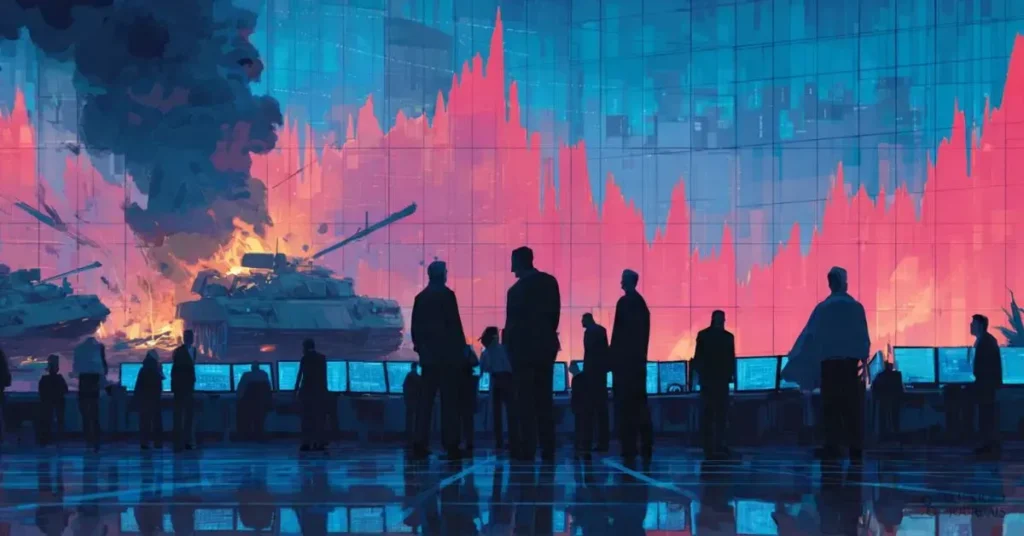
War turns “normal” price behaviour upside down. Oil, food, shipping, and currencies can spike or crash within days as supply lines break, sanctions bite, and governments scramble to fund military spending. At the same time, some equity markets and defence-linked sectors stabilise or even rally because investors suddenly view government contracts as guaranteed cashflow. This chapter unpacks those moving parts—supply shocks, demand shifts, money printing, sanctions, safe‑haven flows, and the famous “war puzzle”—to explain why prices don’t just move a lot in wartime, they move differently than they do in peacetime.

War Economy Chapter 14: Volatility Explained – Why Prices Swing Wildly in Wartime Read More »

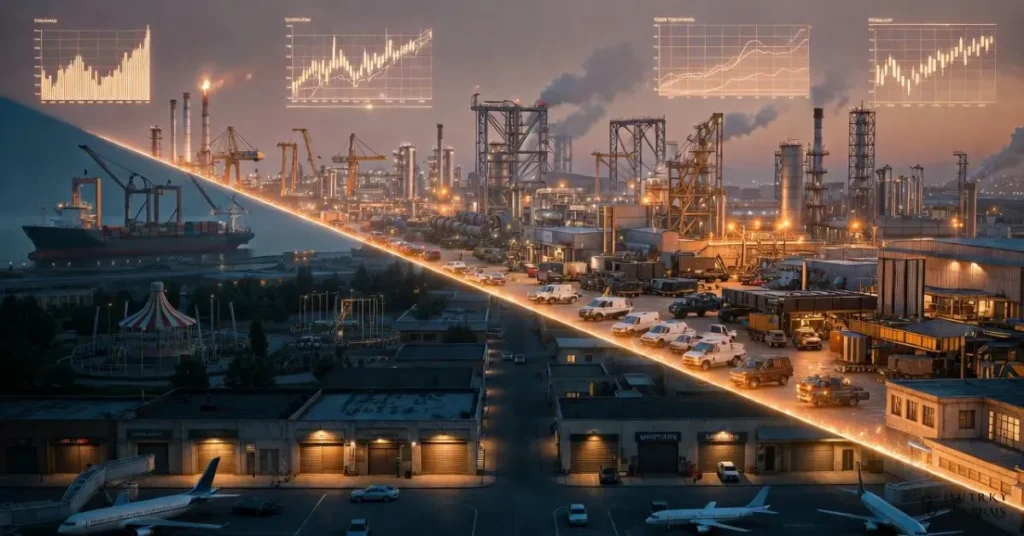
A 16:9 cinematic illustration showing a country’s economy split into two contrasting halves along a diagonal. On the brightly lit upper half: a dense industrial war complex in full production—modern factories assembling military vehicles and aircraft, shipyards loading cargo, oil refineries with flare stacks, and freight trains carrying containers—everything busy, lit with intense warm and metallic tones. On the darker lower half: a fading civilian economy—dimmed shopping streets with shuttered storefronts, an idle amusement park, and a quiet airport terminal with grounded planes, rendered in cooler, desaturated colours. Subtle charts or glowing data lines hover in the sky above the industrial side only, hinting at rising revenues and government contracts without any text. The overall mood should feel analytical and systemic rather than heroic or propagandistic, emphasizing how war spending shifts growth into specific industries while others stall.

War Economy Chapter 13: Which Industries Historically Grow During War

When governments pivot from peace to war, budgets follow. Spending that once flowed into schools, roads, and consumer programs is rapidly reallocated to weapons, logistics, and the raw materials needed to sustain a military campaign. Historically, that shift has reliably boosted defence and aerospace firms, energy and commodities producers, shipping and logistics networks, cybersecurity, and certain industrial manufacturers tied into the war supply chain. At the same time, discretionary sectors like travel, luxury retail, and some service industries often stall or shrink. This chapter maps which industries tend to grow in wartime, why their revenues and margins expand, and how those patterns have played out from World War II to post‑9/11 conflicts and the recent Ukraine era.

War Economy Chapter 13: Which Industries Historically Grow During War Read More »

War Economy Chapter 12 Which Sectors Collapse First During Conflict

War Economy Chapter 12: Which Sectors Collapse First During Conflict

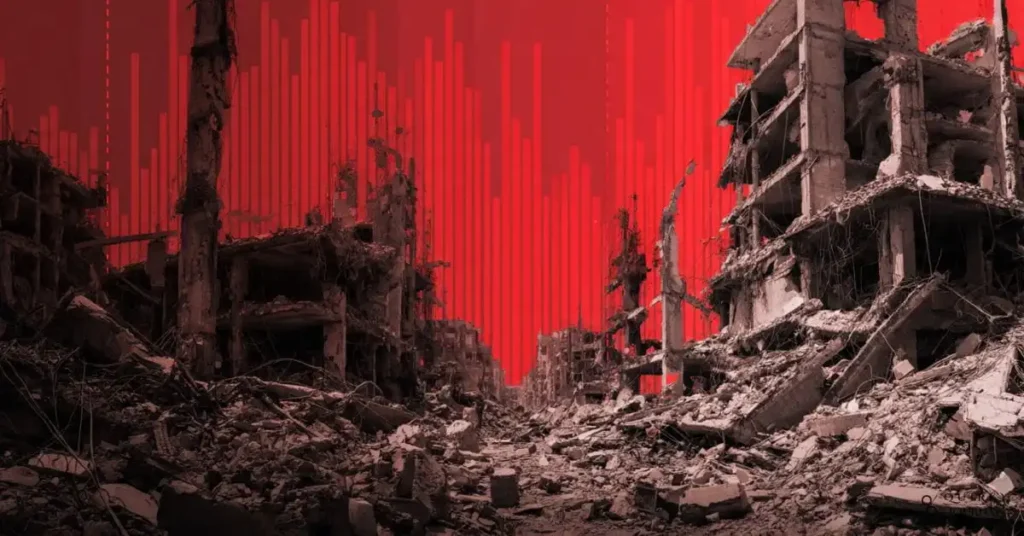
War is not an equal‑opportunity destroyer. Across conflicts from Yugoslavia to Iraq, Syria, and Ukraine, the same pattern repeats: financial systems seize up first, credit evaporates, and currencies collapse long before bombs take out factories. Once banks impose capital controls and lending freezes, small businesses can’t meet payroll, trade finance disappears, and import‑dependent sectors unravel. What follows is a domino effect through healthcare, logistics, retail, and eventually even basic utilities as tax bases shrink and infrastructure can no longer be maintained. This chapter maps that sequence of sector failures so policymakers, investors, and citizens can see which parts of the economy are likely to fail first—and where resilience efforts matter most.

War Economy Chapter 12: Which Sectors Collapse First During Conflict Read More »

War Economy Chapter 11 What Actually Happens to Stock Markets When War Begins

War Economy Chapter 11: What Actually Happens to Stock Markets When War Begins

Whenever war breaks out, headlines scream panic while history quietly tells a different story. Across conflicts from World War II to Iraq and Ukraine, equity markets have tended to fall in the tense run‑up to war, then often stabilise or even rise once fighting actually begins. The key is the “war puzzle”: markets price uncertainty more harshly than bad news itself. When the probability cloud collapses into a known conflict, investors can finally quantify risks, capital rotates between sectors instead of fleeing entirely, and long‑term trendlines reassert themselves. This chapter unpacks that pattern, shows how different asset classes behave, and offers a practical playbook for staying invested—rather than reacting emotionally—when the next geopolitical shock hits.

War Economy Chapter 11: What Actually Happens to Stock Markets When War Begins Read More »

War Economy Chapter 10: The Cost of Political Ego: When Decisions Override Economics

War Economy Chapter 10: The Cost of Political Ego: When Decisions Override Economics

The Cost of Political Ego: When Decisions Override Economics in War
Throughout history, wars have been initiated, prolonged, and escalated not by rational economic calculation, but by the unbending pride of leaders who couldn’t admit error. The phenomenon transcends culture, ideology, and era. From World War I’s trench warfare stalemate to the decades-long War on Terror, political egos have consistently overridden economic reality — transforming what should be calculated risk assessments into catastrophic wealth destruction on scales that beggar imagination.
The economic consequences of ego-driven warfare extend far beyond battlefield costs. They encompass lost human capital, environmental devastation that spans generations, technological development diverted from productive civilian uses, and institutional inertia that prevents peace dividends from ever materialising. Moreover, in our interconnected global economy, a single leader’s pride can trigger inflation cascades affecting populations thousands of miles from any combat zone.
This analysis dissects the true economic costs of political ego in warfare. We’ll examine the sunk cost fallacy that keeps conflicts grinding forward long after victory becomes impossible, the overconfidence bias that makes leaders grotesquely underestimate war duration and costs, and the brain drain that creates economic collapse persisting decades after peace treaties are signed. Understanding these dynamics matters because they continue operating today — and the next major conflict driven by political ego may already be in its planning stages.
The Sunk Cost Fallacy: ‘Too Much Sacrificed to Quit Now’
Perhaps no cognitive bias has proven more deadly in military history than the sunk cost fallacy. The logic appears deceptively compelling: ‘We’ve already sacrificed so much — 7,000 soldiers dead, $2 trillion spent. How can we quit now and let those deaths mean nothing?’ This argument surfaces reliably whenever withdrawal from failing conflicts is proposed. It sounds honourable. It sounds patriotic. It’s also completely irrational from any economic perspective.
The economic principle is straightforward: sunk costs are expenditures that cannot be recovered once made. Therefore, rational decision-making should ignore them entirely and focus only on future costs versus future benefits. If continuing a war will cost another $500 billion with minimal probability of achieving stated objectives, the $2 trillion already spent is irrelevant to whether continuation makes sense. Past costs cannot be changed. Only future costs can be avoided.
Yet political leaders repeatedly reject this logic. As military analyst Carl Forsling observes, ‘The military, more than any other institution, lives by sunk costs. Once a man is lost, seizing a piece of ground, it becomes hallowed. How can we give this up after all we’ve sacrificed?’ This emotional attachment transforms military decisions into monuments to past sacrifice rather than rational assessments of future options.

War Economy Chapter 10: The Cost of Political Ego: When Decisions Override Economics Read More »

War Economy Chapter 9 Sanctions, Trade Wars, and Economic Weapons Explained

War Economy Chapter 9: Sanctions, Trade Wars, and Economic Weapons Explained

Economic warfare has become one of the most powerful tools in international relations, allowing states to pursue strategic goals through financial systems, trade flows, and supply chains instead of direct military conflict. This chapter explains how sanctions, trade wars, and access to global payment networks like SWIFT are used to cut off revenue, block critical technology, and isolate target economies, as well as the limits, blowback, and long-term consequences of weaponising interdependence.

War Economy Chapter 9: Sanctions, Trade Wars, and Economic Weapons Explained Read More »

War Economy Chapter 8 Geopolitics for Investors Reading Tensions Without Speculating

War Economy Chapter 8: Geopolitics for Investors: Reading Tensions Without Speculating

Investors lose on geopolitics by misunderstanding war economies where ideology trumps economics. Germany’s €100B defense fund, Poland’s 4%+ GDP military spend show sunk costs make programs unkillable. Real costs hit via inflation (money printing), debt on future taxpayers, capital crowded out from growth. Framework: Track currency/bond signals, position for supply chain shifts (India/Vietnam), skip overpriced defense stocks.

War Economy Chapter 8: Geopolitics for Investors: Reading Tensions Without Speculating Read More »

War Economy Chapter 6 Incompetent Leadership and Economic Fallout

War Economy Chapter 6: Incompetent Leadership and Economic Fallout

Incompetent leadership during wartime often leads to economic decline and resource misallocation, exacerbating economic fallout and increasing poverty levels. Examples include Sudan’s war causing severe economic damage and Trump’s policies creating a crisis. Leadership failure can severely undermine economic stability.

War Economy Chapter 6: Incompetent Leadership and Economic Fallout Read More »