
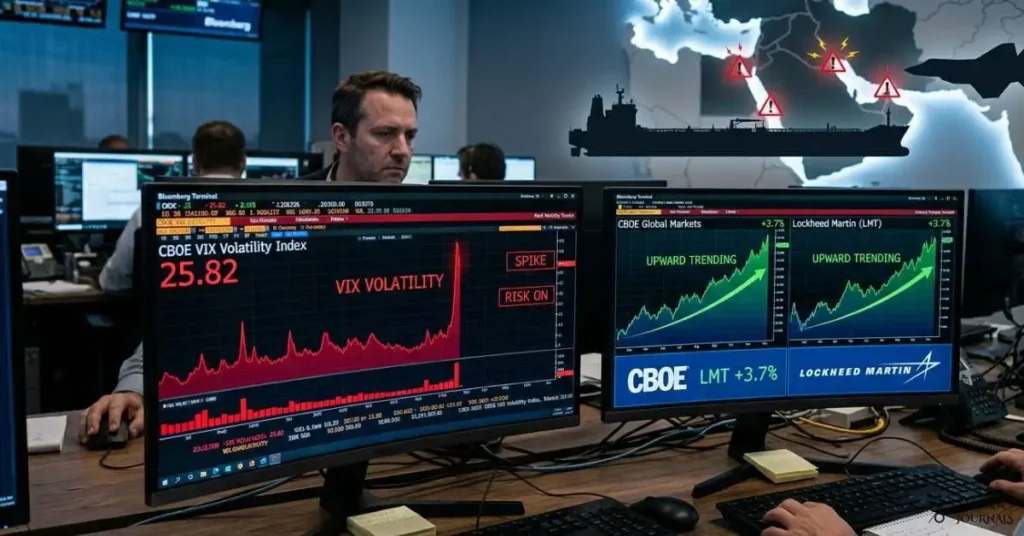
Geopolitical Escalation: Why CBOE and Lockheed Martin Are the New Volatility Hedge
Financial markets rarely stand still. In 2026, they are moving faster than ever. Rising geopolitical tensions, an escalating conflict in the Middle East, and wildly swinging energy prices have pushed investors toward a very specific group of assets. Among them, CBOE Global Markets (CBOE) and Lockheed Martin (LMT) stand out as the two most compelling volatility hedges in today’s environment. This post explores why both companies have become critical portfolio tools during periods of global instability, and how you can think about positioning yourself accordingly.
Naturally, any investment decision carries risk. However, understanding the underlying forces at work is the first step. So let us dig into what is actually driving this shift and why these two names continue to capture institutional attention.
The Geopolitical Backdrop Driving Market Fear
To understand the investment thesis, you first need to understand the broader environment. Since late 2025, a combination of kinetic conflict in the Middle East, rising tensions in the South China Sea, and shifting U.S. foreign policy has created a uniquely unstable global backdrop. Consequently, markets have repriced risk at virtually every level.
The most visible flashpoint has been the Persian Gulf. According to recent market data, the Strait of Hormuz, through which roughly 20% of the world’s daily oil supply flows, has been severely disrupted by naval mines and drone threats. Shipping insurance providers have cancelled coverage for large parts of the region. Tankers are stranded. Commercial traffic has effectively halted.
For investors, this is not a background story. It is a direct market event. Oil price volatility has surged to levels not seen since the 2020 COVID crash, when crude went negative. Furthermore, credit markets have responded sharply, with the VIXIG Index nearly tripling from its January 2026 low. These are the conditions under which defensive positioning becomes not just prudent but necessary.
What the VIX Is Telling Us Right Now
The Cboe Volatility Index (VIX), widely known as Wall Street’s ‘fear gauge,’ surged 3.25% to close at 25.74 on March 11, 2026. That breach of the psychologically important 25 level is significant. It signals that institutional traders have moved beyond ‘buying the dip’ and into aggressive defensive positioning.
Historically, a sustained VIX above 25 marks a regime shift. Rather than isolated volatility spikes, markets enter a period of persistent uncertainty. During such periods, both retail and institutional investors dramatically increase demand for hedging instruments. That demand, in turn, directly benefits CBOE as the primary marketplace where those instruments are traded.
Moreover, it is worth noting that oil volatility, tracked by the OVX Index, climbed another 15 points in a single week to reach 120%, the highest on record outside of 2020. Combined with elevated equity vol, this multi-asset volatility environment is unusual and, for CBOE, highly profitable.
CBOE Global Markets: The Infrastructure of Fear
CBOE is not simply another financial exchange. Rather, it is the dominant global marketplace for options and volatility products. The company owns and operates the VIX Index, VIX futures, VIX options, and dozens of related derivatives that investors use to manage risk. In short, every time global fear rises, CBOE’s business model benefits directly.
According to analysis from Kavout, CBOE’s business model is inherently asset-light. It generates substantial revenue from licensing its franchise assets and facilitating trading across derivatives and cash markets. This structure insulates it from the direct damage of geopolitical events while simultaneously benefiting from the increased trading volumes those events create.
Think of it this way: CBOE is the casino operator, not the gambler. When more people rush to hedge, CBOE collects more transaction fees. When fear drives volume, its revenue rises. That is the core of the investment thesis.
CBOE’s Dual Revenue Engine
CBOE runs two parallel revenue streams, and both are highly defensive. First, its fee-based exchange operations generate revenue each time a contract is traded. Volume is the driver here, and volatility guarantees volume. Second, its high-margin data and analytics business sells real-time and historical market data to institutional clients globally.
According to Seeking Alpha, CBOE has differentiated itself by building a niche product, specifically the VIX Index, that has grown into its own asset class. That product is now an indispensable global benchmark. Pension funds, hedge funds, and sovereign wealth funds all reference it. Very few competitors can claim that level of market infrastructure dominance.
Therefore, even in economic downturns, institutional demand for CBOE’s data products remains sticky. Clients cannot simply switch providers. The VIX is not replicable. This combination of transaction fee revenue and recurring data subscription income gives CBOE a resilience that most financial companies simply lack.
| Revenue Stream | Driver | Volatility Sensitivity | 2026 Outlook |
| Exchange Transaction Fees | Options & futures volume | Very High | Strong growth |
| Data & Analytics Licensing | Institutional subscriptions | Moderate | Stable/Growing |
| Access & Capacity Fees | Technology infrastructure | Low | Steady |
| Market Data Royalties | VIX Index licensing | High | Expanding globally |
Table 1: CBOE Revenue Streams and Their Volatility Sensitivity (2026)
VIX Products: How Sophisticated Investors Use Them
Beyond simply tracking the VIX as an indicator, sophisticated investors actively trade VIX derivatives to hedge their portfolios. CBOE introduced VIX futures on the Cboe Futures Exchange in 2004. Since then, VIX options have become a core tool for institutional risk management.
Common strategies include buying VIX call options, which gain value when fear spikes. Others hold VIX futures as a tail-risk hedge, aiming to generate positive returns precisely when equity portfolios are falling. The Cboe VIX Tail Hedge Index (VXTH) tracks exactly this approach, combining S&P 500 exposure with rolling one-month VIX call options.
For most investors, direct VIX exposure comes through exchange-traded products. However, owning CBOE equity itself provides indirect exposure to the entire volatility ecosystem. As trading volumes in these products rise, CBOE’s earnings benefit accordingly. This is why many portfolio managers treat CBOE stock as a meta-hedge, a position that profits from the very instruments others use to hedge.
Why CBOE Is Different From Traditional Safe Havens
Traditionally, investors seeking safety have turned to gold, U.S. Treasuries, or the Japanese Yen. While those assets still play a role, they carry their own risks in today’s environment. Gold is susceptible to dollar strength. Treasuries face inflation and fiscal concerns. The Yen has been under structural pressure.
CBOE, by contrast, benefits from something none of those traditional hedges offer: a direct revenue connection to market fear itself. Additionally, it is not correlated with commodity prices or foreign exchange dynamics. As Kavout’s analysis highlights, CBOE acts as a ‘perennial hedge’ because its revenue model is structurally tied to uncertainty rather than any single macro variable.
Furthermore, CBOE has been actively expanding internationally. Its acquisition of EuroCBOE and its growing presence in Asia-Pacific derivatives markets mean the company captures volatility premiums across multiple geographies. Geopolitical risk is increasingly a global phenomenon, and CBOE’s footprint has grown to match.
Lockheed Martin: Defence Spending in a New Era
While CBOE benefits from financial market volatility, Lockheed Martin benefits from the physical reality of conflict. As the world’s largest defence contractor, Lockheed Martin produces the F-35 fighter jet, the Javelin missile system, the PAC-3 missile defence platform, and a wide range of satellite and intelligence systems. Each of these is in high demand when geopolitical tensions escalate.
The underlying investment case is straightforward: when governments perceive greater threats, they increase defence budgets. Those budgets flow to companies like Lockheed Martin through multi-year contracts. Because procurement cycles are long and contracts are difficult to cancel, LMT’s revenue visibility is exceptionally strong even in uncertain economic environments.
According to Kavout’s defence sector analysis, Lockheed Martin has already forecast upbeat profit and revenue figures for 2026. The company’s massive, multi-year secured backlogs provide significant revenue stability, even as broader economic uncertainties persist. For investors, this translates to a rare kind of predictability.
The Defence Budget Supercycle
What makes Lockheed Martin particularly compelling right now is the scale of the global defence spending shift. Analysts are increasingly describing this as a multi-year ‘supercycle’ rather than a cyclical bump. NATO members have committed to raising defence budgets as a percentage of GDP. European nations are rearming at a pace not seen since the Cold War. Asian democracies are expanding their military budgets significantly.
This is not simply a reaction to the current Middle East conflict. Rather, it reflects a structural reassessment of global security. As a result, defence companies like Lockheed Martin are being re-rated by analysts who now see elevated spending as a decade-long trend rather than a temporary spike. Some forecasts project global defence budgets to double within the next decade.
Moreover, the U.S. defence budget itself remains the single largest driver of Lockheed Martin’s revenue. With bipartisan support for defence spending in Washington, there is very limited political risk to LMT’s core contract base. That political insulation is a meaningful differentiator in an otherwise unpredictable macro environment.
| Product / System | Category | Key Customer | Demand Trend |
| F-35 Lightning II | Fighter Aircraft | U.S. Air Force, NATO allies | Very High |
| PAC-3 Missile Defense | Air Defense | U.S. Army, Saudi Arabia, Japan | Surging |
| Javelin Missile | Anti-Armor | Ukraine, NATO, U.S. Army | Extremely High |
| THAAD System | Missile Defense | U.S., UAE, Saudi Arabia | High |
| Trident II D5 | Strategic Deterrence | U.S. Navy, UK Royal Navy | Stable/Critical |
Table 2: Key Lockheed Martin Products and Current Demand Outlook (2026)
Lockheed Martin’s Backlog: A Multi-Year Revenue Wall
One of Lockheed Martin’s most powerful financial characteristics is its contract backlog. At any given time, LMT holds tens of billions of dollars in signed, funded contracts that will generate revenue over the coming years. This backlog effectively acts as a ‘revenue wall,’ providing visibility that few companies in any sector can match.
For investors concerned about economic slowdowns, this backlog is particularly valuable. Unlike consumer-facing businesses that see immediate revenue declines when conditions worsen, Lockheed Martin continues delivering on existing contracts regardless of short-term macro conditions. Governments do not cancel jet-fighter orders because of a recession.
Additionally, LMT’s consistent dividend record makes it attractive to income-focused investors. The company has maintained and grown its dividend through multiple market cycles. During geopolitical escalation, that combination of dividend income and capital appreciation potential is a compelling total return story. You can review LMT’s investor relations page for the latest dividend and earnings data.
Comparing CBOE and LMT as Hedging Instruments
Both CBOE and Lockheed Martin offer defensive characteristics during geopolitical escalation, but they work through very different mechanisms. Understanding the distinction is essential before adding either to a portfolio.
CBOE is a pure financial market play. Its revenues rise when investors seek hedging instruments, regardless of whether any actual conflict occurs. As a result, it performs well during periods of market fear, even fear that does not materialise into real-world consequences. In contrast, Lockheed Martin’s revenues are tied to actual defence procurement, which follows government budget cycles and can lag conflict escalation by months or years.
Therefore, in a portfolio context, the two names actually complement each other rather than overlap. CBOE provides near-term sensitivity to market volatility spikes. LMT provides longer-duration exposure to the structural defence spending supercycle. Combining them creates a layered hedge against geopolitical uncertainty across multiple time horizons.
| Characteristic | CBOE Global Markets | Lockheed Martin |
| Primary Hedge Mechanism | Financial market volatility | Defense procurement spending |
| Revenue Trigger | High trading volumes / VIX level | Government defense contracts |
| Reaction Speed | Immediate (market-driven) | Lagged (procurement cycles) |
| Dividend Yield (approx.) | ~1.2% | ~2.8% |
| Backlog Visibility | Moderate | Very High (multi-year contracts) |
| Geopolitical Sensitivity | Indirect (via fear premium) | Direct (via budget allocations) |
| Time Horizon | Short to medium term | Medium to long term |
Table 3: CBOE vs. Lockheed Martin as Geopolitical Hedges (2026 Comparison)
Oil Volatility and the Indirect Connection
The current oil volatility story creates an interesting secondary effect on both companies. For CBOE, the OVX Index surge has driven significant demand for crude oil options, generating additional transaction fee revenue beyond equity volatility products. Positioning in the oil options market has remained consistently bullish, with demand for call options far outpacing puts, indicating sustained fear of oil supply disruption.
For Lockheed Martin, oil price dynamics matter in a less obvious way. Higher oil revenues for Middle Eastern producers have historically translated into larger defence procurement budgets for countries like Saudi Arabia and the UAE, both of which are significant LMT customers. Furthermore, U.S. energy security concerns tend to accelerate defence spending approvals through Congress when the oil supply is threatened.
Consequently, both companies sit at the intersection of the same geopolitical forces, though they monetise those forces through entirely different mechanisms. This dual exposure is precisely what makes them interesting portfolio tools rather than simple sector plays.
How Institutional Investors Are Currently Positioned
Institutional positioning in both names has shifted meaningfully in recent months. According to market data from CBOE’s own insights platform, professional investors have moved from ‘monetising hedges’ during brief calm periods to maintaining persistent defensive positions. This behavioural shift suggests they expect volatility to remain elevated rather than reverting to 2024 norms.
In credit markets, the VIXIG Index, which measures volatility in investment-grade credit, has nearly tripled from its January 2026 low. This is particularly notable because credit volatility had previously been the cheapest cross-asset vol measure, reflecting confidence in the U.S. economy. That confidence has clearly eroded. As a result, institutional demand for CBOE’s credit volatility products has grown alongside equity vol demand.
On the LMT side, defence sector ETFs have seen significant inflows. The iShares U.S. Aerospace & Defence ETF (ITA) and the Invesco Aerospace & Defence ETF (PPA) have both attracted meaningful capital in 2026. Institutional buyers are not merely reacting to headlines; they are repositioning for what they see as a structurally different security environment.
Risks Worth Considering
No investment thesis is complete without an honest look at the risks. For CBOE, the primary risk is mean reversion. If geopolitical tensions de-escalate sharply and markets enter a period of prolonged calm, volatility will decline. Lower VIX levels mean lower trading volumes and lower transaction fees. CBOE stock has historically underperformed during low-volatility bull markets.
Additionally, regulatory risk exists for financial exchanges. Changes to derivatives rules or margin requirements could impact trading volumes. CBOE is also exposed to technology disruption as new decentralised finance platforms attempt to replicate some of its functions, though this remains a longer-term risk rather than an immediate threat.
For Lockheed Martin, the key risks centre around budget politics and cost overruns. Large defence programs have a history of running over budget and over schedule. The F-35 program, in particular, has faced repeated scrutiny from Congress over cost. Furthermore, any meaningful peace agreement in current conflict zones could reduce the urgency of near-term procurement, though longer-cycle programs would likely continue.
Macroeconomic Headwinds to Monitor
Beyond company-specific risks, broader macroeconomic conditions matter. Sustained high oil prices could dampen global economic growth, reducing corporate earnings broadly and creating headwinds even for defensive stocks. Additionally, rising interest rates, if central banks respond aggressively to oil-driven inflation, could compress equity valuations across the board.
For CBOE, higher interest rates can actually be positive, as the company holds substantial cash and benefits from rising returns on that capital. However, if rate hikes trigger a credit event or banking stress, the market disruption could briefly depress trading volumes before volatility recovers. Monitoring Federal Reserve policy statements closely remains important in this environment.
For Lockheed Martin, the company’s large pension obligations mean that interest rate changes can affect reported earnings. Nevertheless, the core operating business, driven by long-term government contracts, is relatively insulated from most macroeconomic cycles. The key variable to watch is the U.S. federal budget process, specifically the annual defence authorisation and appropriations bills.
Building a Geopolitical Hedge Portfolio: Practical Approaches
For investors looking to implement a geopolitical hedge strategy, there are several practical approaches depending on risk tolerance and investment horizon. Direct equity ownership of CBOE and LMT is the most straightforward method. Both trade on major U.S. exchanges and offer strong liquidity.
Alternatively, sector ETFs provide broader exposure to defence and financial exchange themes. The Global X Defence Tech ETF (SHLD) focuses specifically on next-generation defence technology. For CBOE-adjacent exposure, financial sector ETFs with significant exchange holdings are another option.
Options strategies on CBOE itself can create a leveraged volatility-on-volatility position, though this is generally appropriate only for sophisticated investors comfortable with derivatives. Similarly, purchasing LMT call options ahead of major defence budget announcements has historically been a tactical approach for short-term traders following the defence procurement calendar.
Historical Precedents: What Past Conflicts Tell Us
Looking at historical precedents provides useful context. During the Gulf War in 1991, defence stocks dramatically outperformed the broader market. Similarly, after September 11, 2001, defence contractors saw sustained multi-year outperformance as the U.S. entered extended military campaigns in Afghanistan and Iraq.
For volatility-related instruments, the 2008 financial crisis and the 2020 COVID crash both demonstrated that VIX-related products can deliver exceptional returns during market stress. Importantly, CBOE as a business also benefited from both events through surging trading volumes, even as its stock price experienced short-term selling pressure during the acute phase of market dislocation.
Therefore, the historical pattern suggests that timing matters. Both CBOE and LMT tend to perform best when investors position ahead of escalation rather than chasing performance after the fact. By the time a conflict is headline news, much of the initial move has often already occurred. Building these positions during periods of relative calm, precisely when they feel least urgent, has historically produced the best outcomes.
The Case for Holding Both Simultaneously
Given the complementary nature of these two positions, holding both simultaneously may be more effective than choosing between them. CBOE provides sensitivity to near-term fear and volatility spikes. LMT provides longer-duration exposure to the structural re-rating of defence spending globally.
Furthermore, they exhibit low correlation with each other under most market conditions. CBOE is a financial sector company, while LMT is an industrial/defence company. Their earnings drivers, valuation metrics, and business cycles are largely independent. Combining them, therefore, reduces single-stock concentration risk while maintaining thematic exposure to geopolitical escalation.
A simple framework might allocate a small percentage of a portfolio to each, treating them as long-term structural positions rather than short-term tactical trades. Rebalancing periodically when either position grows significantly larger due to price appreciation is a sensible approach. Both companies also pay dividends, which helps to offset holding costs during quiet periods when their prices may underperform.
What to Watch in the Months Ahead
Several specific catalysts deserve close monitoring in the coming months. For geopolitical escalation, the status of the Strait of Hormuz is the single most important variable. Any further deterioration in maritime security would almost certainly push OVX and VIX higher, directly benefiting CBOE. Conversely, a credible peace agreement in the region could trigger a vol sell-off.
For Lockheed Martin, the key near-term catalyst is the U.S. National Defence Authorisation Act (NDAA) and associated appropriations. Any expansion of key programs, such as increased F-35 orders or additional PAC-3 funding, would be directly positive for LMT’s earnings and backlog. European defence budget announcements are also worth tracking closely, as NATO allies account for a growing share of LMT’s international sales.
Finally, Federal Reserve decisions on interest rates will shape the macroeconomic backdrop for both stocks. A policy error in either direction, either premature easing or overly aggressive tightening, could temporarily disrupt the thesis even if the underlying geopolitical fundamentals remain intact. Staying broadly diversified while maintaining these positions as specific thematic hedges is generally the most prudent approach.
The Broader Lesson: Infrastructure of Crisis
Perhaps the most important insight from this analysis is the concept of investing in the ‘infrastructure of crisis’ rather than trying to predict specific crisis outcomes. Predicting exactly which conflicts will escalate, how long they will last, or how severe they will become is essentially impossible. Even the best-informed geopolitical analysts get these predictions wrong frequently.
However, two things are reliably true during periods of geopolitical stress: investors seek protection, and governments spend more on defence. CBOE serves the first need. Lockheed Martin serves the second. By investing in the infrastructure rather than the outcome, investors can profit from the geopolitical risk premium without needing to correctly predict the specific events.
This framing also suggests why both positions should be thought of as long-term structural holdings rather than short-term trades. Geopolitical risk is a permanent feature of the global investment landscape. The specific flashpoints change, but the underlying dynamic, fear driving hedging demand and governments responding to threats with spending, remains constant. Positions in CBOE and LMT are bets on this structural reality, not on any single news cycle.
Final Thoughts on Portfolio Construction
Geopolitical escalation in 2026 has forced investors to rethink traditional approaches to defensive positioning. Gold, bonds, and cash still have roles to play. However, for investors seeking assets that actively benefit from geopolitical uncertainty rather than merely preserving capital, CBOE and Lockheed Martin represent a genuinely differentiated opportunity.
CBOE offers exposure to the financial ecosystem of fear, generating revenue from every hedge, every tail-risk strategy, and every volatility trade that institutional investors make in response to global instability. Lockheed Martin, meanwhile, sits at the centre of the global defence spending supercycle, backed by multi-year contracts, an unassailable competitive position, and growing international demand.
Together, they form a two-sided geopolitical hedge that is difficult to replicate with traditional safe-haven assets. As you consider your own portfolio construction, both names deserve serious attention as long-term structural positions in an increasingly uncertain world. You can start your research with CBOE’s investor relations materials and Lockheed Martin’s annual reports to understand the full financial picture behind each company.
Spend some time for your future.
To deepen your understanding of today’s evolving financial landscape, we recommend exploring the following articles:
Attracting Gen Z Clicks: What Works in Advertising to Gen Z Clients
Startup Growth Hacking: Scalable Customer Acquisition That Works
Why Gold Prices Are Falling in 2026
A $450 Billion Blow: RAM Markets Plummet 30% Following Google’s TurboQuant Reveal
Explore these articles to get a grasp on the new changes in the financial world.
Disclaimer
This blog post is intended for informational and educational purposes only. Nothing in this article constitutes financial, investment, or legal advice. The author is not a registered investment adviser. All investments carry risk, including the potential loss of principal. Past performance is not indicative of future results. Always consult a qualified financial professional before making any investment decisions. References to specific securities do not constitute buy or sell recommendations.
References
[1] CBOE Global Markets. ‘Spot Down, Vol Down as Investors Monetised Hedges.’ CBOE Insights, 2026.
[2] Seeking Alpha. ‘Cboe Global Markets: Good Hedge for High Volatility.’ Seeking Alpha, 2025.
[5] Kavout. ‘Is Global Conflict Driving a New Era for Defence Stocks?’ Kavout Market Lens, 2026.
[7] CBOE. ‘VIX Futures.’ CBOE Futures Exchange, 2026.
[8] CBOE. ‘CBOE VIX Tail Hedge Index (VXTH).’ CBOE Index Dashboard, 2026.
[10] NATO. ‘Defence Expenditure of NATO Countries.’ NATO, 2026.
[11] iShares. ‘iShares U.S. Aerospace & Defence ETF (ITA).’ BlackRock, 2026.
[12] Invesco. ‘Invesco Aerospace & Defence ETF (PPA).’ Invesco, 2026.
[13] Federal Reserve. ‘Press Releases.’ Board of Governors of the Federal Reserve System, 2026.
[15] Lockheed Martin. ‘Investor Relations.’ Lockheed Martin Corporation, 2026.