
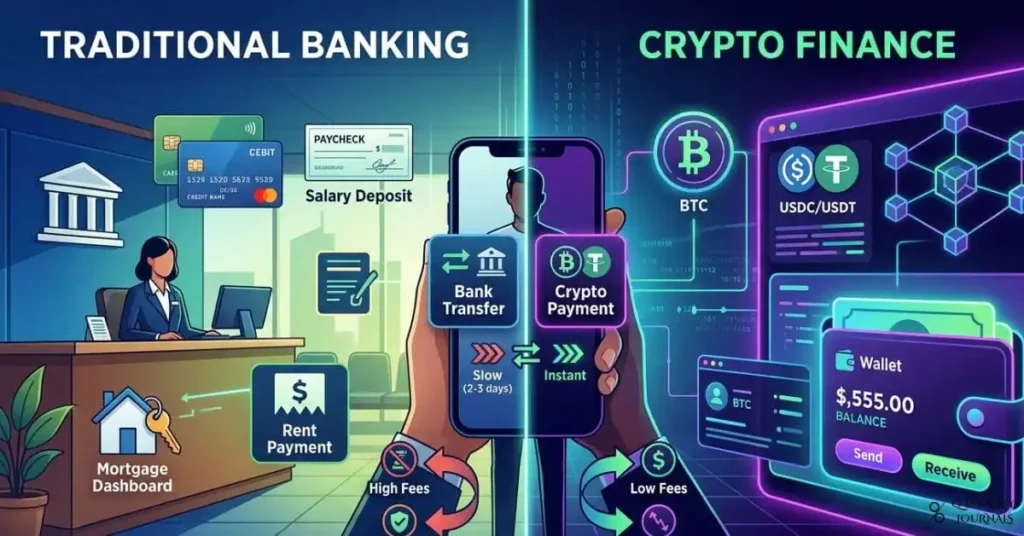
Crypto vs. Traditional Banking: Why Digital Assets Still Fail the Everyday Use Test
Few financial debates generate more heat than the one between crypto and traditional banking. Supporters of digital assets argue that blockchain technology will revolutionise money. Critics counter that cryptocurrency is too volatile, too complicated, and too risky for ordinary people to rely on. Both sides make valid points. Yet after more than a decade of crypto growth, the reality on the ground remains telling: most people still pay their rent, buy their groceries, and receive their salaries through traditional banking systems.
This is not a dismissal of digital assets. Blockchain technology has genuinely changed certain parts of finance. Cross-border payments are faster for some users. Decentralised finance has opened investment opportunities that did not exist before. Stablecoins are reshaping wholesale banking settlements. Nevertheless, when it comes to the most basic financial needs of everyday consumers, cryptocurrency still falls short in several critical ways.
This article takes an honest look at the strengths and weaknesses of both systems. It examines the practical barriers that prevent crypto from replacing traditional banks in daily life. Furthermore, it explores where the two systems are beginning to converge and what that means for ordinary consumers. Whether you are a sceptic, an enthusiast, or simply someone trying to understand where money is heading, this guide covers the full picture.
The Scale Gap: Traditional Banking Still Dominates
Numbers are a good place to start. Traditional banks serve over 90 per cent of adults worldwide. They provide mortgages, wealth management, insurance-linked savings accounts, and a full spectrum of financial products. This is not simply market share; it reflects the deep integration of banking into how modern economies function. Wages are paid into bank accounts. Taxes are collected through banking systems. The national payment infrastructure is built around bank-to-bank settlement.
By comparison, the cryptocurrency market had a market capitalisation of approximately 3.2 trillion euros at its recent peak. That sounds large. However, it includes speculative assets that most users hold as investments rather than spending. The stablecoin market, which is the portion of crypto best suited for actual payments, stood at around 213 billion euros in circulation. That is a fraction of the daily transaction volume processed by global banking networks.
This scale gap matters enormously for everyday use. A payment system only works if both the sender and the receiver can use it. Today, the overwhelming majority of merchants, landlords, employers, and service providers accept payments through traditional banking infrastructure. Therefore, even a consumer who strongly prefers crypto for ideological reasons must maintain a bank account to function in the economy. Crypto supplements the traditional system for most people; it does not replace it.
Volatility: The Fundamental Problem for Everyday Spending
The most cited barrier to everyday crypto use is volatility. Cryptocurrency values change dramatically in short periods. Bitcoin, the most prominent and mature cryptocurrency, has experienced multiple swings of 50 per cent or more within a single year. Ethereum, the second-largest by market cap, has seen even larger percentage moves. This level of price volatility is incompatible with the core functions of money.
Think about what money needs to do. It must serve as a medium of exchange, a unit of account, and a store of value. A currency that might be worth 20 per cent less next week than it is today is a poor medium of exchange. Nobody wants to accept it as payment if they think its value will drop before they spend it. Similarly, businesses cannot price their goods in bitcoin if they have to revise their price list every few hours. A stable unit of account is essential for normal commercial life.
Currency Transfer notes that Bitcoin is increasingly referred to as “digital gold” rather than a daily payment tool. It functions more like a store of value or inflation hedge than a medium of exchange. This is a significant admission. Gold is not used to buy coffee. The comparison underscores that Bitcoin’s primary role in most portfolios is speculative or defensive, not transactional. Consequently, calling it a replacement for everyday banking is misleading.
Stablecoins attempt to solve this problem by pegging their value to fiat currencies. They largely succeed in maintaining price stability. However, they introduce a different problem: they are only as trustworthy as the institution backing them. Furthermore, regulatory uncertainty around stablecoins remains high in many jurisdictions. These factors limit their adoption as a true banking substitute.
Volatility Comparison: Crypto vs. Traditional Financial Assets
| Asset | Typical Annual Volatility | Suitable for Daily Payments? | Primary Use Case |
| Bitcoin (BTC) | 50-100%+ | No | Speculative investment/store of value |
| Ethereum (ETH) | 60-120%+ | No | Smart contracts/investment |
| Stablecoins (USDC, USDT) | Near 0% (pegged) | Potentially | Payments, remittances, DeFi |
| US Dollar (cash) | Low (1-4% inflation) | Yes | All everyday transactions |
| Euro (EUR) | Low (1-5% inflation) | Yes | All everyday transactions |
| Gold | 10-20% | No | Store of value/hedge |
Accessibility: Who Can Actually Use Crypto?
Crypto advocates often cite accessibility as a key advantage. Cryptocurrency platforms operate 24/7, from any location with an internet connection. In theory, this makes them available to the 1.4 billion unbanked adults worldwide who cannot access traditional financial services. This is a genuinely important point. In countries with dysfunctional banking systems or restrictive capital controls, crypto has provided real value.
However, the practical reality of crypto accessibility is more complicated. To use cryptocurrency, a person needs a smartphone or computer, reliable internet access, a funded digital wallet, and sufficient technical knowledge to avoid costly mistakes. In the countries where the unbanked are most concentrated, these requirements are often unmet. Rural areas in Sub-Saharan Africa, South Asia, and Latin America may have poor internet infrastructure. Many potential users lack the digital literacy to safely manage private keys and crypto wallets.
By contrast, traditional banks maintain physical branches and ATM networks. A person who cannot read, has no smartphone, or lives in an area with unreliable power can still visit a bank branch and conduct transactions in person. Mobile banking has extended reach further, but even the simplest bank account is generally easier to open and use than a cryptocurrency wallet for a first-time user.
Additionally, traditional banking operates within limited hours in some respects. Branch banking is typically confined to business hours. However, most essential functions, including transfers, bill payments, and balance checks, are available 24/7 through online banking apps. The practical accessibility gap between the two systems is therefore narrower than crypto advocates sometimes suggest.
Security: Different Risks, Different Protections
Security is where the two systems differ most sharply in the type, rather than level, of risk they present. Traditional banks provide government-backed deposit insurance and established fraud protection. In the United States, the FDIC insures deposits up to 250,000 dollars per account holder per institution. In the European Union, deposit guarantee schemes cover up to 100,000 euros. If your bank is hacked, your deposits are protected. If your card is fraudulently used, you can dispute the charge and get your money back.
Cryptocurrency offers no such protection. The decentralisation that makes crypto attractive to libertarians and privacy advocates is precisely what removes any safety net. If you lose your private key, your funds are gone forever. If you send crypto to the wrong address, the transaction cannot be reversed. If a crypto exchange is hacked or collapses, as happened spectacularly with FTX in 2022, customers can lose everything with no recourse. The blockchain may be technically secure, but the ecosystem around it is vulnerable to human error and institutional failure.
Vezgo describes the challenge well: crypto banking requires users to carefully manage private keys and choose reliable exchanges. For a software engineer or a financially sophisticated investor, this is manageable. For the average person who struggles to remember passwords and has no background in cryptography, it is a serious barrier. Security that depends on perfect user behaviour is not practical security for the mass market.
Traditional banks, despite their many flaws, have spent decades building fraud detection systems, customer service infrastructure, and regulatory compliance frameworks. These systems are far from perfect, but they provide a meaningful safety net for ordinary users. Until crypto security reaches a comparable level of user protection, it will struggle to replace banking for everyday transactions.
Transaction Speed and Cost: The Real Picture
Crypto advocates frequently highlight speed and cost as compelling advantages. Certainly, some cryptocurrencies offer fast transfer speeds regardless of geographical distance. Sending bitcoin from London to Lagos can be faster and cheaper than an international wire transfer through the SWIFT banking network. For cross-border remittances, this is a meaningful real-world advantage, particularly for migrant workers sending money home to families.
However, the picture is more nuanced for domestic transactions. Most developed countries now have fast payment systems that settle transactions in seconds. The UK’s Faster Payments Service, Europe’s SEPA Instant, and the US’s FedNow system all offer near-instant bank transfers at low or zero cost to retail users. Compared to these systems, the speed advantage of crypto is much less pronounced for everyday domestic payments.
Transaction costs in crypto also vary significantly. During periods of high network congestion, fees on the Bitcoin and Ethereum networks can spike dramatically. In 2021, average Ethereum transaction fees briefly exceeded 50 dollars per transaction. This makes them entirely impractical for small purchases. Layer-2 solutions like the Lightning Network for Bitcoin and Polygon for Ethereum reduce these costs, but they add technical complexity that further limits mainstream accessibility.
Furthermore, converting crypto back to fiat currency, which is necessary for most everyday spending, adds another layer of cost and friction. Exchange fees, withdrawal fees, and currency conversion charges all erode the theoretical cost savings of crypto transactions. When all these costs are factored in, the advantage over traditional banking is often smaller than it first appears.
The Regulatory Gap and What It Means for Users
Regulation is a double-edged sword in this debate. Traditional banking is heavily regulated, which some users find restrictive, but which provides critical protections. Government regulation ensures that banks meet capital requirements, protect customer data, prevent money laundering, and maintain solvency. When regulations fail, as they did in the 2008 financial crisis, the consequences are severe. However, the regulatory framework at least provides a structure for accountability and redress.
Cryptocurrency regulation is rapidly evolving but remains inconsistent across jurisdictions. The European Union has established the Markets in Crypto-Assets (MiCA) regulation, which provides a comprehensive framework for digital asset issuers and service providers. This is a significant step forward. However, many other major economies, including the United States, have yet to establish equally clear rules. This regulatory uncertainty creates risks for consumers and institutions alike.
For everyday users, the regulatory gap creates practical problems. Without clear rules, crypto service providers operate with varying levels of consumer protection. Some exchanges are well-capitalised and well-governed. Others are not. The collapse of FTX in 2022, which wiped out billions in customer funds, occurred partly because insufficient regulatory oversight allowed a deeply flawed institution to operate at a massive scale. Traditional banking regulation is designed to prevent exactly this kind of failure.
Moreover, regulatory requirements around know-your-customer (KYC) and anti-money-laundering (AML) rules are increasingly applying to crypto exchanges. This erodes one of crypto’s claimed advantages, anonymity, while adding compliance burdens that make the user experience less seamless. As regulations tighten, crypto will inevitably become more similar to traditional banking in some respects.
Regulatory Environment Comparison
| Factor | Traditional Banking | Cryptocurrency |
| Deposit protection | Yes (FDIC up to $250k, EU up to €100k) | No government guarantee |
| Fraud reversal | Yes (chargebacks, disputes) | No (transactions are irreversible) |
| Regulatory framework | Comprehensive and mature | Emerging; varies by country |
| AML / KYC requirements | Strict and standardised | Increasing but inconsistent |
| Central oversight | Central banks, FCA, SEC, etc. | No central authority |
| Consumer redress | Established ombudsman systems | Limited; mostly self-help |
| EU-specific rules | CRD, PSD2, MiFID II | MiCA (2024 onwards) |
Where Banks Are Actually Adopting Crypto
Despite these challenges, the boundary between crypto and traditional banking is genuinely blurring. Visa describes this shift clearly: what began as institutional wariness toward crypto has evolved into active participation as regulatory frameworks have matured and client demand has grown impossible to ignore. Today’s leading banks offer cryptocurrency custody, trading services, and yield-generating products to both retail and institutional customers.
This shift is driven partly by client expectations, particularly from younger demographics and high-net-worth individuals who view digital asset exposure as an essential part of a modern portfolio. Major platforms like PayPal and Visa are incorporating cryptocurrencies into their services. Meanwhile, banks are beginning to offer crypto loan products, allowing customers to borrow against digital assets as collateral.
Stablecoins are at the centre of this convergence. Banks are incorporating stablecoins into their payment offerings, particularly for cross-border transfers and wholesale settlement between institutions. Some forward-thinking banks are even issuing their own stablecoins. This allows them to leverage blockchain benefits, such as programmability and 24/7 settlement, while staying within existing regulatory frameworks. This middle path is proving especially attractive for institutions that want to innovate without taking on excessive regulatory risk.
BlackRock’s decision to include Bitcoin in ETF offerings is another landmark development, cited by Currency Transfer as evidence that cryptocurrency is gaining recognition as an important asset class. When the world’s largest asset manager builds Bitcoin exposure into mainstream investment products, it signals a permanent shift in institutional attitudes. Nevertheless, this represents adoption as an investment asset, not as a medium of everyday exchange.
The Legacy IT Problem: Why Banks Struggle to Adapt
One underappreciated barrier to crypto adoption is the technical gap inside traditional banks themselves. The Financial Brand explains that traditional banking cores were built as contained, predictable systems. Transactions move through established networks and reconcile according to defined schedules. Controls, reporting, and oversight were all designed around this model. Stablecoin operations, by contrast, do not stop at 5 p.m. on Friday.
A single stablecoin transfer requires interacting with an external blockchain, confirming settlement, updating internal ledgers, and maintaining compliance and reporting standards at any hour of the day. Reconciling a 24/7 external network with systems built for business-day processing creates friction across finance, risk, operations, and IT departments. This is not a minor technical challenge. It requires significant investment and organisational change.
The proposed solution for most banks is a “side core,” described by the Financial Brand as an interoperable layer between the bank’s existing systems and new services needed to interact with stablecoins, tokens, and blockchains. This approach allows institutions to modernise at the edges without a disruptive internal rebuild. However, it also means that most banks will offer digital asset services as an add-on rather than a core capability for the foreseeable future.
Interestingly, data from a KlariVis study of community banks found that 90 per cent have customers actively transacting with Coinbase. Furthermore, the ratio of outflows to inflows was approximately 2.77 to 1, meaning that for every dollar returned from the platform, nearly three dollars left the bank and did not come back. This suggests that customers are already engaging with digital assets outside the traditional banking system, putting quiet but real pressure on banks to respond.
CBDCs: Government Crypto as a Middle Path
Central Bank Digital Currencies (CBDCs) represent perhaps the most significant institutional response to the crypto challenge. Currency Transfer describes the CBDC as a potential bridge between the two worlds, offering the benefits of a digital asset while preserving government sovereignty over the currency. Dozens of central banks around the world are actively researching or piloting CBDCs.
A CBDC would combine the programmability and efficiency of blockchain technology with the stability and trust of a government-issued currency. Payments could settle instantly. Cross-border transfers could become faster and cheaper. Smart contract functionality could automate certain financial processes. Crucially, all of this would happen within the existing regulatory and monetary policy framework, without the volatility risk of decentralised cryptocurrencies.
However, CBDCs also raise serious concerns. Privacy is the biggest issue for many observers. A government-issued digital currency would, in principle, allow authorities to monitor every transaction in real time. This is a very different proposition from physical cash, which is anonymous. Furthermore, if CBDCs are widely adopted, they could disintermediate commercial banks, reducing their role in the payment system and potentially destabilising bank funding models.
Whether CBDCs represent the future of money or a dead end remains to be seen. What is clear is that governments and central banks are taking the challenge of digital currency seriously. Their response will shape the competitive landscape between crypto and traditional banking for years to come.
Comparing Crypto, CBDCs, and Traditional Banking at a Glance
| Feature | Decentralized Crypto | CBDC | Traditional Bank |
| Issuer | No central authority | Central bank | Commercial bank (regulated) |
| Price stability | Low (volatile) | High (fiat-pegged) | High (fiat) |
| Anonymity | Pseudonymous | Low (monitored) | Low (KYC required) |
| Deposit insurance | None | Government-backed | Government-backed |
| 24/7 availability | Yes | Yes (planned) | Partial |
| Transaction reversibility | No | Potentially yes | Yes (fraud cases) |
| Mainstream merchant acceptance | Very limited | Planned | Universal |
| Regulatory clarity | Low to medium | High | High |
Challenger Banks: The Often-Overlooked Alternative
Lost in the crypto vs. banking debate is often a third option: challenger banks. These are fully regulated digital-first banks, typically without physical branches, that offer a seamless mobile experience at very low cost. Vezgo notes that the digital age has significantly transformed banking products, making them more accessible, easier to understand, and quicker to manage.
Companies like Revolut, Monzo, Starling, Chime, and N26 have attracted tens of millions of customers by solving many of the friction points that push people toward crypto. They offer instant notifications, fee-free foreign exchange, split bills, savings pots, and round-the-clock customer service, all through a smartphone app. Unlike crypto platforms, they are fully regulated, offer deposit protection, and integrate seamlessly with the existing financial system.
Furthermore, many challenger banks are now adding crypto features within their regulated environment. Revolut, for example, allows users to buy, hold, and sell cryptocurrencies alongside traditional currencies in the same app. This gives users exposure to digital assets without sacrificing the safety and usability of a regulated bank account. In this model, the bank acts as a trusted intermediary that manages the crypto complexity on the user’s behalf.
This approach may prove to be the practical path forward for most consumers. Rather than abandoning traditional banking for the technical complexity and risk of self-custodied crypto, most people will likely access digital assets through regulated financial institutions that handle the infrastructure. This is less ideologically pure than the crypto maximalist vision, but it is far more practical for everyday use.
Real-World Crypto Adoption: Where It Actually Works
Being fair to crypto requires acknowledging where it has genuinely delivered value. Cross-border remittances are the clearest success story. Migrant workers sending money home to families in developing countries often pay 5 to 10 per cent in fees through traditional wire transfer services. Crypto, and especially stablecoins, can reduce these costs dramatically. For a family receiving 300 dollars a month from a relative working abroad, the difference between paying 15 dollars in fees and paying 1 dollar is genuinely significant.
In countries with dysfunctional local currencies, crypto has provided a genuine lifeline. Venezuelans, Argentinians, Turks, and Nigerians have all turned to Bitcoin or stablecoins as a hedge against collapsing local currencies. When a government inflates its currency to the point where it loses most of its purchasing power within months, a decentralised digital asset provides an exit. This is a real and important use case that traditional banks, which operate in the local currency, cannot easily replicate.
El Salvador’s adoption of Bitcoin as legal tender in 2021 was a bold experiment, cited by Currency Transfer as a landmark event. The country aimed to reduce reliance on expensive remittance services and extend financial access to its unbanked population. Results have been mixed. Adoption among the general population has been lower than hoped. Nonetheless, the experiment has generated valuable data about the practical challenges of using a volatile cryptocurrency for everyday transactions.
Decentralised Finance (DeFi) has also opened genuine opportunities for sophisticated users. Earning yield on stablecoin deposits, accessing loans without a credit check, and participating in global liquidity pools are all possible through DeFi protocols. These capabilities go beyond what traditional banks offer. However, DeFi also carries smart contract risk, rug pull scams, and regulatory uncertainty that make it unsuitable as a primary financial system for most people.
The User Experience Gap: Crypto’s Hidden Barrier
Beyond security, regulation, and volatility, there is a simpler reason why cryptos fail the everyday user test: the user experience is still poor for most people. Setting up a self-custodied crypto wallet involves generating a seed phrase, storing it securely offline, transferring funds from an exchange, and paying gas fees for transactions. Making one mistake at any of these steps can result in permanent loss of funds.
Traditional banking, for all its bureaucracy, has spent decades refining customer experience. Opening a bank account is increasingly possible online in minutes. Sending money requires entering a sort code and account number. Checking your balance is a single tap on a phone. The experience is not exciting, but it works reliably for people of all technical backgrounds. The digital banking revolution led by challenger banks has made it even more seamless.
Crypto wallet interfaces have improved significantly, but they still require users to understand concepts like gas fees, network selection, and private key management. Sending funds to the wrong network, such as accidentally sending Ethereum-based tokens to a Bitcoin address, can result in irrecoverable loss. These failure modes simply do not exist in traditional banking. Therefore, until the user experience of crypto reaches a comparable level of simplicity and safety, it will remain the preserve of technically proficient users.
Environmental Concerns: An Underappreciated Constraint
The environmental impact of proof-of-work cryptocurrencies, particularly Bitcoin, is an often-underappreciated barrier to mainstream adoption. Bitcoin mining consumes enormous amounts of electricity, comparable in scale to the annual energy consumption of medium-sized countries. This has prompted significant backlash from environmentally conscious consumers, corporations, and regulators.
Several institutional investors have cited environmental, social, and governance (ESG) concerns as a reason to limit or exclude Bitcoin from portfolios. Tesla briefly accepted Bitcoin as payment before reversing course, specifically citing environmental concerns. The EU considered, though ultimately rejected, a ban on proof-of-work mining during MiCA deliberations. These tensions are not going away as climate considerations become more central to financial regulation.
Ethereum’s transition to proof-of-stake in 2022, known as “the Merge,” reduced its energy consumption by approximately 99 per cent. This was a significant development that addresses the environmental concern for Ethereum specifically. However, Bitcoin has shown no signs of moving away from its energy-intensive consensus mechanism. This remains a genuine constraint on its adoption by ESG-conscious institutions and retailers.
The Convergence Path: Where Both Systems Are Heading
The most honest assessment of the crypto vs banking debate is that the two systems are converging rather than one replacing the other. Traditional banks are adopting blockchain technology for back-office settlement, cross-border payments, and digital asset custody. Crypto platforms are increasingly complying with banking regulations, adopting KYC requirements, and seeking banking licenses.
Visa’s perspective is instructive: the boundary between crypto-native fintech and traditional banking is blurring as both sides race to create comprehensive financial experiences that span conventional and digital assets. This convergence is driven by client demand, regulatory pressure, and the genuine technical advantages that blockchain offers for certain use cases.
The stablecoin market is at the centre of this convergence. Stablecoins have emerged as the crucial link connecting the traditional banking system with cryptocurrency innovations. They provide the price stability needed for everyday financial use cases while delivering the programmability and efficiency of blockchain technology. Banks incorporating stablecoins into payment offerings, particularly for cross-border transfers and wholesale settlement, signal a pragmatic middle path.
Moreover, tokenised deposits, digital asset-based lending, and rewards programs built on blockchain rails are all emerging use cases that will increasingly blur the line between crypto banking and traditional banking. In ten years, the question may not be “crypto or bank” but rather which blockchain-enabled services your bank offers alongside its traditional products.
What Everyday Consumers Should Actually Do
For the average consumer trying to make practical financial decisions today, the answer is fairly clear. Traditional banking remains the right primary financial system for most people. It provides deposit protection, fraud reversal, universal acceptance, and a level of simplicity that crypto cannot yet match for everyday needs. Salary accounts, mortgage payments, utility bills, and grocery shopping all work best through traditional banking infrastructure.
That said, crypto can play a valuable supplementary role for the right user in the right context. If you regularly send money internationally, stablecoins or crypto-enabled services like Wise or Revolut can save meaningful amounts in fees. If you want speculative exposure to a high-growth asset class, allocating a small portion of your investment portfolio to Bitcoin or Ethereum is a decision that many mainstream financial advisors now consider reasonable, provided the risk is understood.
Additionally, if you live in a country with high inflation or currency instability, cryptocurrency may offer genuine protection for savings. Holding a portion of savings in stablecoins denominated in stable foreign currencies can be a sensible hedge in economies where the local currency is unreliable. Furthermore, if you are technically sophisticated and interested in earning yield through DeFi, the opportunities are real, though the risks are equally real.
The key takeaway is this: do not let crypto enthusiasm lead you to abandon the protections that traditional banking provides. Use the two systems together, each for what it does best, rather than treating them as mutually exclusive alternatives. This pragmatic approach is how most financially savvy people are actually using both systems today.
The Future of Money: Realistic Expectations
Predicting the future of money with precision is impossible. Nevertheless, several trends are clear enough to state with confidence. Blockchain technology will become more deeply embedded in financial infrastructure, but largely invisibly. Just as most people do not know which database technology their bank uses, most will not know or care whether their payment settled on a blockchain or a traditional ledger.
Stablecoins will likely grow in importance, both as a payment tool and as infrastructure for financial services. The stablecoin market at roughly 213 billion euros is already substantial. As regulatory clarity improves under frameworks like MiCA, institutional adoption will accelerate. Wholesale stablecoin settlement between banks could become routine within a decade, dramatically reducing the cost and time of international financial transactions.
Speculative cryptocurrencies like Bitcoin will likely persist as an asset class. They may become a mainstream investment category, much as gold has been for centuries. However, they are unlikely to replace everyday currency for most users unless their volatility problem is structurally solved, which currently appears very difficult without sacrificing the decentralisation that makes them distinctive.
The most transformative development could come from CBDCs. If major economies successfully launch digital currencies that are as convenient as crypto but as stable as fiat money, they could capture much of the value proposition of stablecoins while preserving the trust and oversight of the existing monetary system. How much this threatens private crypto adoption will depend heavily on design choices around privacy and programmability.
Key Takeaways: Crypto vs. Traditional Banking
Several clear conclusions emerge from this analysis. Together, they paint an honest picture of where each system stands today and where both are heading.
First, traditional banking still wins for everyday use. Its combination of deposit protection, fraud reversal, universal merchant acceptance, and proven infrastructure makes it the right primary financial system for most consumers in most situations. Nothing in the crypto world yet matches this for daily financial needs.
Second, crypto does solve real problems. Cross-border remittances, protection against currency collapse, and access to financial services for the unbanked are genuine use cases where digital assets deliver value that traditional banking does not.
Third, the two systems are converging. Banks are adopting blockchain technology. Crypto platforms are adopting banking regulations. Stablecoins are becoming infrastructure for both. The future is integration, not replacement.
Fourth, regulation will determine outcomes. As frameworks like MiCA mature and spread, the crypto industry will become more like banking in terms of consumer protection. This will reduce some of crypto’s risk profile but also some of its distinctive appeal. Ultimately, the regulated crypto banking hybrid is likely to serve most consumers better than either pure system alone.
Spend some time for your future.
To deepen your understanding of today’s evolving financial landscape, we recommend exploring the following articles:
ETF vs. Mutual Fund: Minimising Fees for Maximum Growth
War Economy Chapter 17: Inflation, Hyperinflation, and Wartime Price Controls
Beyond Nvidia: Why Humanoid Robot Stocks Are Taking Off
How CBOE and Lockheed Martin Became Geopolitical Hedges
Explore these articles to get a grasp on the new changes in the financial world.
Disclaimer
This article is for general informational and educational purposes only. It does not constitute financial, investment, legal, or tax advice. Cryptocurrency investments involve significant risk, including the possible total loss of funds. Readers should seek qualified professional advice before making any financial decisions. The author and publisher accept no liability for any actions taken based on the information provided in this article.
References
[1] KvaPay, “Crypto vs Traditional Banking: Real Advantages and Disadvantages,” KvaPay Blog. [Online]. Available: https://kvapay.com/blog/post/crypto-vs-traditional-banking-real-advantages-disadvantages
[2] Visa, “Crypto in Banking: What You Need to Know,” Visa Corporate Blog. [Online]. Available: https://corporate.visa.com/en/products/visa-direct/blog/crypto-in-banking-what-you-need-to-know.html
[3] Vezgo, “Crypto Banking vs Digital Banking: The Future of Money,” Vezgo Blog. [Online]. Available: https://vezgo.com/blog/crypto-banking-vs-digital-banking/
[4] The Financial Brand, “Can Your Bank’s IT Meet the Challenge of Digital Assets?” The Financial Brand. [Online]. Available: https://thefinancialbrand.com/news/banking-technology/side-core-bank-digital-asset-stablecoin-196447
[5] Currency Transfer, “Cryptocurrency vs Traditional Currency: Key Differences Explained,” Currency Transfer Expert Analysis. [Online]. Available: https://www.currencytransfer.com/blog/expert-analysis/cryptocurrency-vs-traditional-currency
[6] European Parliament, “Markets in Crypto-Assets (MiCA) Regulation,” Official Journal of the European Union, 2023.
[7] S. Nakamoto, “Bitcoin: A Peer-to-Peer Electronic Cash System,” Bitcoin.org, 2008. [Online]. Available: https://bitcoin.org/bitcoin.pdf