
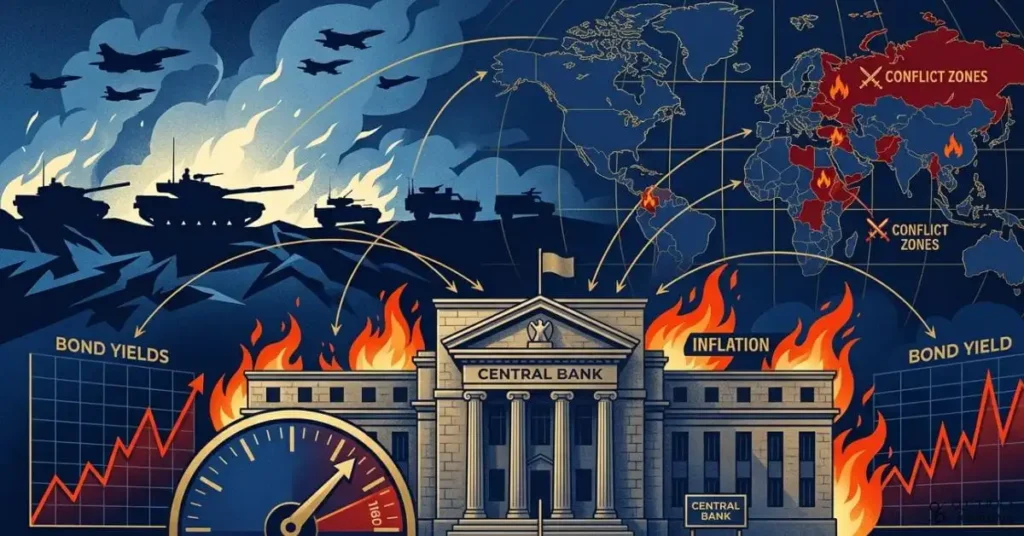
War Economy Chapter 19: How Armed Conflict Shapes Interest Rates and Monetary Policy
War does not just redraw borders. It rewrites economic rules. When a nation enters armed conflict, the normal levers of monetary policy are pulled in competing directions simultaneously. Governments need to borrow enormous sums almost overnight. Central banks face pressure to keep borrowing costs low. Inflation begins to stir from the heat of military spending. All of this happens while investors, households, and businesses are recalibrating their expectations in real time.
The relationship between war and interest rates is one of the most fascinating and least discussed topics in economic history. It cuts across fiscal policy, monetary policy, geopolitical risk, and investor psychology all at once. Yet the lessons embedded in wartime monetary history remain urgently relevant today, as conflicts in Ukraine, the Middle East, and beyond continue to shape central bank decisions worldwide.
This post explores how war economies affect interest rates, drawing on historical evidence from World War I, World War II, and more recent conflicts. We will also examine how modern central banks navigate the treacherous terrain where military conflict meets monetary policy, and what all of this means for investors, policymakers, and anyone trying to understand the global economy today.
Why War Creates an Immediate Economic Shock
The outbreak of armed conflict creates a distinctive and immediate economic shock. Unlike recessions or financial crises, which typically unfold gradually, wars arrive with a sudden surge in government demand. Military equipment, logistics, personnel, and infrastructure all require enormous funding, and they all require it now.
As research published by the National Bureau of Economic Research has shown, the onset of war fundamentally alters what economists call intertemporal demand. In plain terms, wartime nations need resources today rather than tomorrow. Success in battle requires rifles, ships, aircraft, and fuel in the present, not in some postwar future. This shift in demand compresses enormous consumption into a short window, putting upward pressure on prices and borrowing costs simultaneously.
At the same time, war creates profound uncertainty about the future. Investors holding long-term bonds suddenly face an unfamiliar set of risks. Will the war be won? Will the government default on its debts? Will inflation erode the real value of bond holdings? Each of these questions pushes investors to demand higher compensation for lending money over long periods, which is another way of saying that long-term interest rates face upward pressure at the outbreak of conflict.
The Historical Pattern: World War I as a Starting Point
World War I offers one of the first well-documented case studies of war’s impact on interest rates in a modern economy. According to historical data compiled by the Federal Reserve Bank of St. Louis, interest rates behaved with notable complexity during and around the conflict.
In the period leading up to the war, from 1913 to 1914, the United States economy was actually in recession. Short-term interest rates were declining through much of this phase. The yield on prime commercial paper fell from roughly 4.50 per cent in early 1914 to 3.45 per cent by November 1915. There was, however, a notable spike of uncertainty in the summer and early autumn of 1914 at the war’s actual outbreak, reflecting the immediate fear and dislocation that accompanied the opening of hostilities in Europe.
Once the United States committed to the conflict, the picture changed considerably. The government faced the challenge of financing an enormous military mobilisation. Taxes were raised, but they covered only a fraction of the spending. The remainder came from borrowing. According to research published in the Proceedings of the National Academy of Sciences, approximately 74.3 per cent of total World War I war-related spending was financed through the growth of interest-bearing debt, with taxes covering only about 20.8 per cent. The rest came from money creation and other mechanisms.
War Bond Campaigns and the Suppression of Market Rates
Governments at war rarely allow markets to set interest rates freely. The cost of financing a conflict at market rates, reflecting the genuine risk and uncertainty involved, would be prohibitively expensive. Historically, authorities have therefore intervened aggressively to suppress borrowing costs, using a combination of direct controls, patriotic appeals, and institutional pressure on banks to absorb government debt at below-market yields.
During World War I, the United States launched a series of Liberty Bond campaigns, urging citizens and corporations alike to lend to the government at fixed rates. These campaigns were enormously successful from a fundraising perspective. They also effectively bypassed the normal market mechanism for setting interest rates. The government was essentially offering rates it could afford to pay rather than rates the market would demand for genuine risk assessment.
This approach to war finance had predictable consequences. By suppressing nominal interest rates while military spending simultaneously drove up prices, governments created conditions for sharply negative real interest rates. Lenders who bought government bonds at a 4 per cent nominal yield while inflation ran at 8 or 10 per cent were effectively subsidising the war effort. This is a form of taxation through financial repression that governments have relied on across virtually every major conflict in modern history.
World War II and the Birth of Yield Curve Control
The most dramatic example of wartime interest rate manipulation in American history occurred during World War II. What the Federal Reserve implemented from 1942 onward would today be recognised immediately as a form of yield curve control, a policy that only recently re-entered mainstream policy discussions when the Bank of Japan adopted a similar approach in 2016.
Upon entering the war after Pearl Harbour in December 1941, the United States faced the challenge of financing what would become one of the most expensive military campaigns in human history. The solution was strikingly direct. The Federal Reserve agreed to peg interest rates at specific levels across the yield curve, from short-term Treasury bills at just three-eighths of one per cent per year, to long-term government bonds at a ceiling of two and a half per cent. These rates were set modestly above the levels that had prevailed in November 1941, just before the attack on Pearl Harbour, but well below what free markets might have demanded given the risks involved.
According to the Federal Reserve’s own historical records, the interest-rate peg became formally effective in July 1942 and remained in place through June 1947, two full years after the war ended. The Federal Reserve achieved this peg by standing ready to purchase any quantity of Treasury bills offered at the target rate. If market participants wanted to sell government bonds, the Fed would buy them, injecting money into the system. This mechanism gave the Treasury essentially unlimited access to cheap credit for the duration of the conflict.
How the WWII Rate Peg Actually Worked
Understanding the mechanics of the wartime rate peg reveals a great deal about the tension between war finance and monetary stability. The Federal Reserve’s commitment to maintain rates at artificially low levels meant that it effectively surrendered control of the money supply. If investors sold government bonds back to the Fed, the Fed had to pay for them by creating new money. The alternative was allowing rates to rise, which would have increased the cost of financing the war and risked destabilising the government bond market.
This arrangement worked relatively smoothly during the war itself, partly because of other controls on the economy. Price controls, rationing, and restrictions on consumer spending all helped limit inflation despite the rapid expansion of the money supply. The Office of Price Administration employed hundreds of thousands of people and managed an extraordinarily complex system of price ceilings and ration stamps covering everything from meat to gasoline to clothing.
When price controls were lifted after the war’s end in 1946, the suppressed inflation that had built up during the conflict was unleashed rapidly. The cost of meat doubled almost overnight in the summer of 1946 as controls expired. Yet the rate peg remained in place, meaning bondholders continued to earn nominal yields far below the rate at which their purchasing power was being eroded. This amounted to an enormous, largely hidden transfer of wealth from creditors (bondholders) to the government debtor.
The Treasury-Fed Accord of 1951: The End of Wartime Finance
The tension created by maintaining artificially low rates in an inflationary postwar environment eventually became untenable. By 1950, with the outbreak of the Korean War adding fresh inflationary pressure, the Federal Reserve was facing a crisis of credibility. Keeping rates pegged at wartime levels while prices continued to rise was clearly incompatible with the Fed’s mandate to maintain price stability.
The resolution came in the form of the Treasury-Fed Accord of March 1951, a landmark agreement that freed the Federal Reserve from its obligation to support government bond prices at fixed levels. For the first time since before Pearl Harbour, the Fed could set interest rates based on economic conditions rather than government financing needs. This moment is widely regarded as the birth of modern independent central banking in the United States.
The aftermath of WWII demonstrated something important about wartime rate suppression. Research published by the International Monetary Fund found that the dramatic decline in America’s debt-to-GDP ratio from 106 per cent in 1946 to 23 per cent by 1974 was not primarily the result of economic growth, as is often assumed. Rather, surprise inflation combined with the artificially low interest rates of the pre-Accord period played a central role. Bondholders bore a significant share of the war’s cost through the erosion of their real returns.
The Real Interest Rate Theory of Wartime Borrowing
From a theoretical perspective, the impact of war on interest rates is complex. According to the framework developed by economists Daniel Benjamin and Levis Kochin, whose work was published in an NBER volume on war, prices, and interest rates, the key driver of wartime interest rate movements is the real rate of interest, not the nominal rate.
Their argument runs as follows. War creates an urgent demand for currently available goods relative to future goods. A rifle produced after the war is useless in fighting it. Nations at war, therefore, compete to borrow from the global pool of savings to fund current consumption of military goods, pushing up the real cost of capital. This is the fundamental economic force driving real interest rates upward during conflict, regardless of what nominal rates do under government suppression.
Interestingly, the same analysis suggests that the effect should be felt not just in the belligerent nations but also abroad. Wars generate increased demand for goods from neutral countries. During the American Civil War and the Mexican-American War, both the British interest rate and price level rose, even though the British government was not increasing its own defence expenditures. The global demand for savings, not just domestic demand, sets the real cost of capital during a conflict.
War Finance: Taxes, Debt, and Money Creation
Every government that has fought a major war has faced the same fundamental financing challenge: military spending rises far faster than tax revenues can be increased. The gap must be filled somehow, and historically it has been filled through some combination of debt issuance and money creation.
The research published in the Proceedings of the National Academy of Sciences, analysing fiscal-monetary consequences across three major conflicts, provides a useful breakdown. During World War I, new interest-bearing debt covered 74.3 per cent of war-related spending. During World War II, that share fell to 46 per cent, with money creation (10.1 per cent) and other mechanisms accounting for a larger share. In both wars, taxes were increased significantly, but still covered only a minority of total expenditures.
The mix of financing methods matters enormously for interest rates. Heavy reliance on debt issuance competes for savings in financial markets and puts upward pressure on rates. Reliance on money creation (essentially printing money to pay bills) inflates the money supply and tends to push prices up. When governments suppress nominal interest rates while pursuing both strategies simultaneously, the result is a prolonged period of negative real rates, which amounts to a gradual confiscation of value from holders of government bonds.
| Conflict | Tax Financing (%) | Debt Financing (%) | Money Creation (%) | Rate Environment |
|---|---|---|---|---|
| World War I (US) | 20.8% | 74.3% | 6.9% | Rising nominal rates, negative real rates |
| World War II (US) | 30.2% | 46.0% | 10.1% | Pegged nominal rates, sharply negative real rates |
| Korea (US) | Higher share | Moderate debt | Limited | Inflationary surge in the late 1960s and 1970s |
| Vietnam (US) | Tax surcharge added late | Significant borrowing | Elevated | Inflationary surge in late 1960s and 1970s |
The Vietnam War and the Seeds of the 1970s Inflation
The Vietnam War offers a powerful cautionary example of what happens when war finance is mismanaged. Unlike World War II, where price controls and rationing suppressed inflation during the conflict, the Johnson administration chose not to raise taxes sufficiently to fund escalating military spending in Southeast Asia. President Johnson feared that a tax increase would prove politically toxic and might jeopardise his ambitious domestic spending programmes.
The result was a classic case of deficit-financed military spending flowing into an economy that was already operating near full capacity. By the late 1960s, inflation was climbing steadily. The Federal Reserve, still operating under a framework influenced by the Treasury’s preferences, was slow to raise rates aggressively enough to contain the resulting price pressures. The inflationary seeds planted during the Vietnam era took years to fully germinate, eventually contributing to the severe stagflation of the 1970s that required the drastic rate hikes of the Volcker era to finally break.
The Vietnam experience illustrates a principle that runs through all wartime monetary history: when fiscal and monetary policy pull in opposite directions, the consequences are paid for later, and usually by a different government than the one that created the problem. Suppressing interest rates while running large deficits is a choice that transfers the cost of the war from current taxpayers to future holders of bonds and the broader holders of financial savings.
How Modern Central Banks Respond to Geopolitical Shocks
The relationship between armed conflict and interest rates has evolved considerably since the era of explicit yield curve pegs. Modern central banks operate under mandates focused on price stability and, in some cases, maximum employment. They are institutionally independent, at least in formal terms, and they are not obligated to finance government spending at below-market rates. However, geopolitical shocks still create powerful pressures on monetary policy through several channels.
Research published in Finance Research Letters examining Federal Reserve and European Central Bank responses to geopolitical risk from 1994 to 2024 found that both central banks typically react to geopolitical risk events by tightening monetary policy to fend off inflationary pressures. However, the effect is often temporary. Policymakers tend to adopt more accommodative stances when geopolitical shocks coincide with economic contractions. Furthermore, the study found that in recent years, both the Fed and the ECB have reacted more strongly and more immediately to geopolitical risks than their predecessors did in earlier decades.
The primary transmission channel through which war affects modern monetary policy is energy and commodity prices. Conflicts in or near major oil-producing regions reliably drive up global energy costs, which feed through into broader consumer price inflation. A central bank facing energy-driven inflation then confronts a difficult choice: raise rates to contain inflation and risk choking off a potentially fragile economy, or hold rates steady and risk allowing the inflationary impulse to become entrenched.
Russia-Ukraine War: A Modern Case Study
The Russian invasion of Ukraine in February 2022 provides the clearest recent illustration of how armed conflict reshapes the interest rate environment. According to data from the Federal Reserve, geopolitical risk spiked 4.6 standard deviations above its historical mean in March 2022, an extreme reading by any historical standard.
The consequences were felt almost immediately across commodity markets. Russia’s role as a major exporter of natural gas, oil, wheat, and fertiliser meant that the conflict disrupted global supply chains in ways that hit consumer prices across Europe and beyond. European natural gas prices surged to extraordinary levels. Food prices rose sharply globally as Ukrainian wheat exports were disrupted. Together, these supply shocks drove inflation to multi-decade highs across the developed world.
Central banks responded by raising interest rates aggressively. The US Federal Reserve pushed its policy rate from near-zero to over 5 per cent in just two years, one of the most rapid tightening cycles in modern history. The European Central Bank raised rates at a similarly aggressive pace. In both cases, the stated rationale focused on inflation, but the underlying catalyst was substantially the supply shock created by the war in Ukraine. As noted in analysis from Mourant’s global economic outlook, global inflation peaked at multi-decade highs in 2022, driven substantially by energy prices and geopolitical conflicts.
The Middle East Conflict and Ongoing Rate Uncertainty
The October 2023 outbreak of conflict in the Middle East added another layer of geopolitical complexity to an already challenging environment for monetary policy. According to the BBC, the Federal Reserve voted to hold interest rates steady in 2025 as a spike in oil prices following the US-Israel conflict with Iran raised economic uncertainty and threatened to drive up inflation afresh. The Fed’s key interest rate remained in the range of 3.5 to 3.75 per cent, where it had stood since December, with Federal Reserve Chairman Jerome Powell noting it was “too soon” to say how the war would affect the inflation outlook.
Meanwhile, as reported by Global Banking and Finance, most global central banks held rates steady in early 2026, citing economic uncertainty linked to the Middle East conflict, volatile oil prices, and persistent inflation risks. Australia stood out as a notable exception, raising rates by 25 basis points. In emerging markets, responses were varied: Russia cut rates, Brazil cut rates, and Colombia raised rates aggressively amid its own domestic pressures. The diversity of responses underscores how geopolitical shocks interact differently with each country’s economic starting conditions.
What is striking about the current environment is the degree to which geopolitical risk has replaced domestic economic data as the dominant driver of central bank uncertainty. As an Invesco survey published by the World Economic Forum found, 83 per cent of central bank reserve managers identified geopolitical tensions as the main risk to global growth, surpassing concerns about high inflation (73 per cent) and ranking ahead of virtually every other macroeconomic risk on their radars.
Geopolitical Risk, Inflation, and the Two-Way Relationship
A crucial insight from recent academic research is that geopolitical risk and inflation do not always move together in a simple, predictable way. Research published in the Journal of International Economics by Dario Caldara and colleagues found that while historically, periods of high geopolitical risk have been associated with high inflation in both advanced and emerging economies, the direction of the effect is theoretically ambiguous.
On the supply side, wars can destroy capital, disrupt trade, interrupt supply chains, and trigger surges in commodity prices. These forces push inflation upward. On the demand side, however, adverse geopolitical events can undermine consumer confidence, deter business investment, and tighten financial conditions. These forces exert downward pressure on inflation. The net effect in any given conflict depends on which channel dominates. For commodity-exporting belligerents, supply-side effects typically prevail. For commodity-importing nations, the balance is more complex.
Furthermore, research cited in a Federal Reserve working paper from the Fed’s own notes showed that geopolitical risk shocks produce a sharp but relatively short-lived decline in investment, distinct from the more prolonged effects of general economic policy uncertainty. This has implications for interest rate setting: a central bank that raises rates sharply in response to a geopolitical inflation shock may find that the shock fades faster than its policy response, leaving it having over-tightened into a subsequent slowdown.
Safe-Haven Flows and the Bond Market During War
Not all of war’s effects on interest rates point upward. In some cases, armed conflict drives a flight to safety that pushes certain interest rates down rather than up. When investors are frightened, they tend to seek the safety of high-quality government bonds, particularly US Treasuries. This surge in demand for safe-haven assets drives bond prices up and yields down, at least initially.
This safe-haven dynamic is particularly visible in the early stages of conflicts that do not directly involve major Western powers. When a regional war breaks out in a distant part of the world, the first reaction in financial markets is often a flight to quality. Money flows into US Treasuries, gold, and other perceived safe assets, pushing yields lower even as the broader uncertainty increases. Only later, as the inflation implications of higher oil prices and disrupted supply chains become apparent, do markets begin to price in the prospect of central bank rate hikes.
This two-phase response, initial safe-haven buying followed by inflation-driven rate expectations, has been visible in markets across multiple recent conflicts. Understanding this dynamic matters for investors trying to navigate the interest rate environment during a geopolitical crisis. The initial signal from bond markets may point in the opposite direction from where rates will ultimately settle once the full economic consequences of the conflict become clear.
Emerging Markets: A Different Interest Rate Story
For emerging market economies, the relationship between war and interest rates is often more direct and more severe than for advanced economies. Many emerging markets are heavily dependent on commodity exports or imports, making them acutely sensitive to the price dislocations that wars create. They also tend to have less credible monetary institutions, making it harder to anchor inflation expectations when geopolitical shocks strike.
The Central Banking survey on geopolitical risks found that reserve managers at emerging market central banks were particularly concerned about capital flight toward safe-haven markets. When a geopolitical shock hits, investors in emerging markets tend to pull capital out of those markets and move it toward the perceived safety of US Treasuries or other developed-market assets. This capital outflow depresses the emerging market currency, raises import costs, and typically forces the central bank to raise rates to defend the currency, even if the domestic economy is already slowing.
The survey found that if a regional war breaks out, “higher inflation and, consequently, higher rates will produce a negative impact on balance sheets and lower reserve levels,” in the words of a Europe-based central bank official. Importantly, the IMF’s World Bank Global Economic Prospects report lists the persistence or escalation of conflicts as a primary downside risk to growth in emerging and developing economies, precisely because the combination of capital outflows, commodity price volatility, and the need to raise rates creates a particularly damaging cocktail of pressures.
The Military Spending Channel: Defence Budgets and Bond Markets
One often-overlooked channel through which war affects interest rates is the direct fiscal impact of sustained increases in military spending. Modern conflicts rarely end quickly. Prolonged commitments to higher defence budgets require governments to issue substantially more debt than they would during peacetime. This additional supply of government bonds must be absorbed by financial markets, and if demand does not rise proportionately, yields must rise to attract buyers.
This dynamic has become increasingly relevant in Europe following the Russian invasion of Ukraine. Multiple European nations have announced significant increases in their defence budgets, with Germany notably abandoning its longstanding constitutional limits on debt to fund military spending. These fiscal commitments translate directly into higher government bond issuance, which has contributed to upward pressure on European yields even as the European Central Bank was attempting to ease monetary conditions to support a sluggish economy.
Academic research is clear on this point. The paper on geopolitical risks and inflation by Caldara and colleagues found that increased military spending and rising public debt exert upward pressure on inflation through fiscal channels, consistent with the broader fiscal theory of price levels. When governments borrow heavily to fund wars and markets question whether that debt will be repaid through genuine fiscal surpluses rather than inflation, the result is a rise in both inflation expectations and interest rates. This is the mechanism that historians call fiscal dominance, and it has been a recurring feature of war economies throughout history.
Central Bank Independence Under Wartime Pressure
A theme that runs consistently through wartime monetary history is the pressure that armed conflict places on central bank independence. Governments at war need cheap financing. Central banks with mandates focused on price stability often find themselves in conflict with that need. In the past, the government typically won that argument. In the modern era, the picture is more nuanced.
The WWII experience, in which the Federal Reserve operated essentially as a financing arm of the Treasury for nearly a decade, is the most extreme American example. However, even in recent years, the tension has been visible. As reported in the analysis of the current rate environment, US President Trump applied intense pressure to Federal Reserve Chairman Powell to cut rates, including during a period when geopolitical uncertainty from the Iran conflict was already complicating the rate-setting calculus. Powell’s response, emphasising the Fed’s data-dependent approach and noting that it was too early to understand the war’s economic implications, illustrates the institutional tension between political demands and the central bank’s mandate.
The long-run lesson from historical episodes is clear: governments that compromise central bank independence to finance wars cheaply almost always pay for it eventually through higher inflation and, ultimately, higher interest rates. The inflationary legacy of wartime financial repression has repeatedly proven far more costly than the short-term interest savings it produces.
What War Economies Teach Investors About Interest Rate Risk
For investors, the historical record of interest rates during conflict offers several important insights. These lessons are not merely academic. They are directly applicable to portfolio construction in an era when geopolitical risk has re-emerged as a dominant force in global markets.
First, the initial market reaction to conflict is typically a flight to safety that temporarily suppresses yields on high-quality sovereign bonds. Investors who mechanically buy bonds at the outbreak of a conflict may be buying into temporary strength rather than durable value, particularly if the conflict is likely to be inflationary.
Second, sustained conflicts that require heavy government borrowing and money creation are reliably inflationary over time. The history of WWI, WWII, and Vietnam all confirm this pattern. Inflation-linked bonds, commodities, and real assets have historically outperformed nominal bonds during such periods. Third, the post-conflict normalisation of interest rates, as central banks raise rates to contain the inflationary legacy of wartime finance, can be painful for holders of long-duration fixed-income investments.
Comparison of Wartime Interest Rate Environments
To synthesise what history shows us, here is a comparison of key wartime interest rate environments and their main characteristics:
| Conflict | Country | Key Rate Policy | Inflation Outcome | Post-War Rate Move |
|---|---|---|---|---|
| World War I (1914-1918) | USA | Moderate suppression via Liberty Bonds | Sharp postwar inflation spike (1919-1920) | Sharp rate increases in 1920-21 |
| World War II (1939-1945) | USA | Full yield curve peg (0.375% to 2.5%) | Suppressed during war; released in 1946 | Gradual rise; Accord freed rates in 1951 |
| Vietnam War (1965-1975) | USA | Inadequate rate response to fiscal expansion | Rates held steady amid uncertainty; the cut cycle paused | Volcker shock: rates to 20% by 1981 |
| Russia-Ukraine War (2022-present) | Global | Aggressive rate hikes to fight supply-driven inflation | Multi-decade high inflation in 2022-2023 | Gradual easing from 2024 onward |
| Middle East Conflict (2023-present) | Global | Rates held steady amid uncertainty; cut cycle paused | Oil price volatility; inflation risk remains | Ongoing uncertainty; divergent responses |
The Stagflation Trap: When War Produces Both Inflation and Weakness
Perhaps the most challenging scenario for central banks is when armed conflict produces stagflation: rising prices combined with slowing economic growth. This was the defining economic problem of the 1970s, when the oil shocks associated with Middle Eastern conflicts hit an economy already burdened with the inflationary legacy of Vietnam-era deficit spending. The Federal Reserve faced an almost impossible choice: raise rates to fight inflation and risk pushing a weakening economy into recession, or hold rates down to protect growth and allow inflation to entrench.
A similar, if less extreme, version of that dilemma has re-emerged in recent years. The Russian invasion of Ukraine drove up energy prices, pushing inflation higher. Simultaneously, higher energy costs acted as a tax on consumers and businesses, slowing growth. Central banks that raised rates aggressively to contain the inflation risked exacerbating the growth slowdown. The S&P Global economic outlook noted that in Europe, which was more exposed to the energy shock than the United States, recession risk became a serious concern even as inflation remained elevated.
Navigating stagflation requires central banks to make judgments about which risk is greater at any given moment. Rate hikes that are too aggressive will crush growth without necessarily solving supply-side inflation. Rate cuts that are premature will allow inflationary expectations to become unanchored. There is no clean solution. The history of wartime monetary policy is, in large part, the history of central banks trying and often failing to thread this needle.
Fiscal Dominance and the Long Shadow of War Finance
Modern economists use the term fiscal dominance to describe a situation in which a government’s financing needs override the central bank’s ability to conduct independent monetary policy. Historically, war has been the primary driver of fiscal dominance episodes. When a government needs to finance a conflict at almost any cost, the pressure on the central bank to keep rates low, absorb government debt, and effectively monetise the deficit becomes overwhelming.
The risk of fiscal dominance has not disappeared in the modern era. Multiple major economies are carrying historically high levels of public debt relative to GDP. The additional borrowing required by sustained conflicts or even large increases in defence budgets could push debt-to-GDP ratios to levels where markets begin to question sovereign creditworthiness. At that point, governments face a choice between austerity, higher inflation, or financial repression, and the historical record suggests that financial repression through below-market interest rates is often the politically preferred path.
The Central Banking survey found that 86 per cent of reserve managers identified rising geopolitical fragmentation and protectionism as the most significant long-term threat to the global economy over the next decade. If this fragmentation leads to sustained increases in military spending across major economies, the pressure on public finances and the risk of fiscal dominance episodes will intensify, making the historical lessons about wartime interest rate management more relevant than ever.
What the Historical Record Tells Us About Today
Pulling all of this history together, several consistent patterns emerge about how war shapes interest rates and what those patterns mean for the present moment. The first pattern is that wars are reliably inflationary over time, even when governments succeed in suppressing nominal interest rates during the conflict itself. The inflation may be delayed by price controls, rationing, or financial repression, but it typically arrives eventually.
The second pattern is that governments consistently rely more heavily on debt financing than on taxation when funding wars, creating sustained upward pressure on the supply of government bonds. Unless central banks absorb this supply directly (as the Fed did during WWII), this increased bond supply requires rising yields to attract buyers.
The third pattern is that post-war normalisation of interest rates is almost always painful and prolonged. The return to market-determined rates after WWII took nearly a decade and required the landmark Treasury-Fed Accord. The unwinding of Vietnam-era monetary looseness required the punishing Volcker shock of 1979 to 1981. Similarly, the normalisation process after the Ukraine-driven inflation surge has been slow, complicated, and politically contentious.
Today’s interest rate environment reflects all three of these dynamics simultaneously. Global debt levels are near historic highs. Multiple active conflicts are creating inflationary pressure through energy and commodity markets. Central banks are navigating the narrow path between fighting inflation and avoiding recession, while defending their independence against political pressure to cut rates. The tools are different from those available in 1942 or even 1981. However, the underlying economic forces shaping this environment are, in many important respects, the same ones that have operated through every major conflict in modern economic history.
Spend some time for your future.
To deepen your understanding of today’s evolving financial landscape, we recommend exploring the following articles:
How to Pay Down Credit Card Debt With a Balance Transfer
Startup Funding Guide: Angels, VCs and Bootstrapping
How Finance Teams Can Upskill for the Digital Era
Inside Quant Trading Firms: What They Do & How They Work
War Economy Chapter 18: Government Debt Explosions
Explore these articles to get a grasp on the new changes in the financial world.
Disclaimer
This article is provided for informational and educational purposes only. Nothing contained in this post constitutes financial, investment, or economic advice. All references to historical events, economic data, and current market conditions are believed to be accurate at the time of writing but may be subject to revision. Past patterns in interest rates or economic outcomes during historical conflicts do not guarantee similar outcomes in current or future situations. Always consult a qualified financial or economic professional before making investment decisions.
References
- [1] D. K. Benjamin and L. A. Kochin, “War, Prices, and Interest Rates,” in A Retrospective on the Classical Gold Standard, National Bureau of Economic Research. [Online]. Available: https://www.nber.org/system/files/chapters/c11138/c11138.pdf
- [2] C. B. Luttrell and N. N. Bowsher, “Interest Rates, 1914-1965,” Federal Reserve Bank of St. Louis Review, FRASER. [Online]. Available: https://fraser.stlouisfed.org/files/docs/publications/frbslreview/pages/1965-1969/62472_1965-1969.pdf
- [3] Chicago Federal Reserve, “Yield Curve Control in the United States, 1942 to 1951,” Economic Perspectives. [Online]. Available: https://www.chicagofed.org/publications/economic-perspectives/2021/2
- [4] G. J. Hall and T. J. Sargent, “Three World Wars: Fiscal-Monetary Consequences,” Proceedings of the National Academy of Sciences, vol. 119, 2022. [Online]. Available: https://www.pnas.org/doi/10.1073/pnas.2200349119
- [5] Federal Reserve History, “The Federal Reserve’s Role During WWII.” [Online]. Available: https://www.federalreservehistory.org/essays/feds-role-during-wwii
- [6] Federal Reserve History, “From WWII to the Treasury-Fed Accord.” [Online]. Available: https://www.federalreservehistory.org/essays/wwii-to-the-treasury-fed-accord
- [7] Federal Reserve History, “The Second World War and Its Aftermath.” [Online]. Available: https://www.federalreservehistory.org/essays/wwii-and-its-aftermath
- [8] IMF Working Paper, “Did the US Really Grow Out of Its World War II Debt?” IMF Working Papers, vol. 2024, Issue 005. [Online]. Available: https://www.elibrary.imf.org/view/journals/001/2024/005/article-A001-en.xml
- [9] Global Banking and Finance Review, “Central Banks Hold Rates as War Muddies Economic Outlook.” [Online]. Available: https://www.globalbankingandfinance.com/global-central-banks-mostly-hold-war-muddies-economic/
- [10] BBC News, “Federal Reserve Holds Interest Rates as Iran War Triggers Inflation Fears.” [Online]. Available: https://www.bbc.com/news/articles/c36364d06x3o
- [11] ScienceDirect, “Understanding Central Bank Responses to Geopolitical Risks: Evidence from the Fed and ECB,” Finance Research Letters. [Online]. Available: https://www.sciencedirect.com/science/article/abs/pii/S1572308925000816
- [12] D. Caldara et al., “Do Geopolitical Risks Raise or Lower Inflation?” Journal of International Economics, 2026. [Online]. Available: https://www.matteoiacoviello.com/research_files/JIE_2026.pdf
- [13] Federal Reserve Board, “Costs of Rising Uncertainty,” FEDS Notes, April 2025. [Online]. Available: https://www.federalreserve.gov/econres/notes/feds-notes/costs-of-rising-uncertainty-20250424.html
- [14] Central Banking, “Geopolitical Risks to Reserve Adequacy: 2024 Survey,” November 2024. [Online]. Available: https://www.centralbanking.com/central-banks/reserves/7962622/geopolitical-risks-to-reserve-adequacy-2024-survey
- [15] Invesco / World Economic Forum, “Geopolitics Replaces Inflation as the Top Worry for Central Banks and Sovereign Wealth Funds,” August 2024. [Online]. Available: https://www.weforum.org/stories/2024/08/geopolitics-inflation-central-banks/
- [16] Mourant, “Global Debt, Interest Rates, and Inflation: Navigating the Path to 2025.” [Online]. Available: https://www.mourant.com/news-and-views/news-2024/global-debt–interest-rates–and-inflation–navigating-the-path-to-2025.aspx
- [17] U.S. Bank, “How Global Monetary Policy Affects the Economy,” 2025. [Online]. Available: https://www.usbank.com/corporate-and-commercial-banking/insights/economy/macro/global-monetary-policy.html
- [18] S&P Global, “Impact of Geopolitics: Global Economic Outlook.” [Online]. Available: https://www.spglobal.com/en/research-insights/market-insights/geopolitical-risk/impact-of-geopolitics-global-economic-outlook
- [19] World Bank, “Global Economic Prospects,” 2025. [Online]. Available: https://www.worldbank.org/en/publication/global-economic-prospects
- [20] NPR Planet Money, “Price Controls, Black Markets, and Skimpflation: The WWII Battle Against Inflation,” February 2022. [Online]. Available: https://www.npr.org/sections/money/2022/02/08/1078035048/price-controls-black-markets-and-skimpflation-the-wwii-battle-against-inflation