
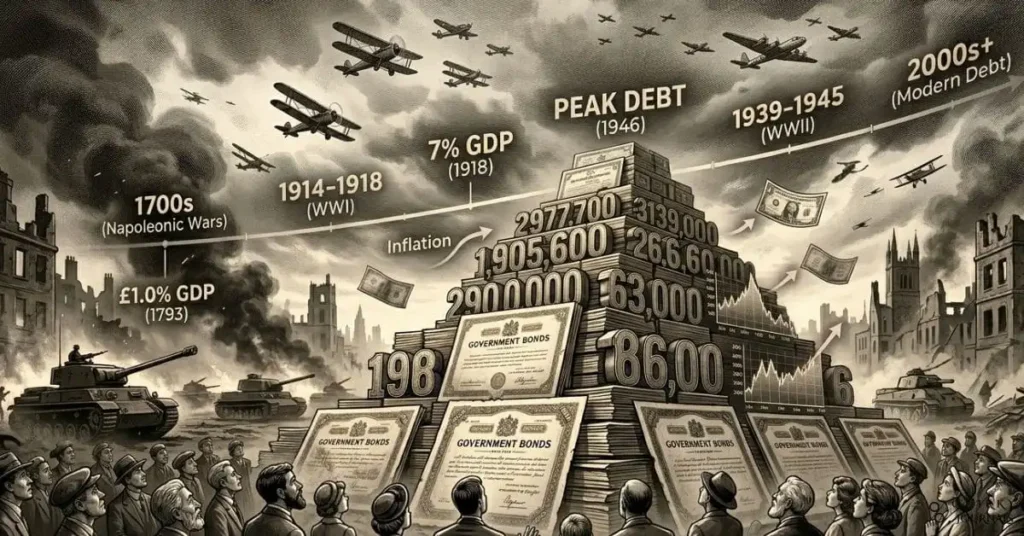
War Economy Chapter 18: Government Debt Explosions
War is the most expensive activity any government can undertake. Throughout history, the moment a nation commits to armed conflict, its public finances change in ways that reverberate for decades. Taxes rise, borrowing accelerates, and the national debt frequently explodes to levels that would have seemed unimaginable in peacetime. Understanding this pattern is essential for anyone studying fiscal policy, economic history, or the long-term consequences of geopolitical conflict.
The evidence spanning three centuries of warfare is striking and consistent. Yahoo Finance reports research showing that ‘wars typically triggered large increases in government spending, averaging about 7% of GDP annually during the first four years.’ Tax hikes alone were rarely sufficient to cover these costs. Consequently, governments borrowed heavily, printed money, and engaged in financial strategies that shifted the burden of war onto future generations through accumulated debt.
This post traces the history of wartime debt explosions from eighteenth-century Britain through to modern conflicts. It examines how governments financed their wars, what happened to bond markets and inflation, and what the long-term economic consequences were for ordinary citizens. Furthermore, it considers the contemporary relevance of these historical patterns in an era when the US national debt has already reached extraordinary levels, and new conflicts continue to place pressure on public finances worldwide.
The Mechanics of Wartime Debt: Why Borrowing Becomes Inevitable
When a country goes to war, its government faces an immediate and enormous funding problem. Modern industrial warfare is extraordinarily expensive. Armies need weapons, ammunition, fuel, food, transportation, and salaries for millions of service members. Military equipment must be manufactured at scale and replaced continuously as it is lost, damaged, or destroyed. None of this can be funded gradually or at peacetime budget levels.
Governments have three main options for financing wartime expenditure. They can raise taxes on citizens and businesses. They can borrow money by issuing government bonds. Alternatively, they can instruct their central bank to create new money. In practice, most major wars have required all three approaches simultaneously. Tax revenues, however large, rarely keep pace with the sudden and dramatic increase in wartime spending.
According to research from the Congressional Research Service, the US government during World War II ‘relied on all four methods of financing’ because of the sheer size of the associated expenditures. Even with record government revenues as a share of GDP, non-military expenditure fell to less than half its pre-war level. The remaining gap was filled by borrowing, bond sales to the public, and, uniquely among modern US conflicts, direct money creation through the Federal Reserve.
Britain’s Second Hundred Years’ War: The First Modern Debt Explosion
The most sustained and well-documented example of wartime debt accumulation in Western history is Britain’s fiscal experience between 1692 and 1815. Professor Gregory Clark’s economic history research documents what he calls the ‘Second Hundred Years War’ with France, a period of nearly continuous conflict that included the War of the Austrian Succession, the Seven Years War, the American War of Independence, and the Napoleonic Wars.
The fiscal consequences were staggering. War expenditures typically accounted for over 90 per cent of British government spending before 1799. Most of this spending was not immediately covered by taxes. Instead, it was financed by government borrowing on an unprecedented scale. By the end of the Napoleonic Wars in 1815, Britain’s accumulated national debt had reached around 600 million pounds, an enormous sum relative to the economy of the time.
Even more striking is the international dimension of this debt. Clark’s research notes that the debt during the Revolutionary and Napoleonic Wars was ‘financed in part by capital from France, the Netherlands, and Germany fleeing the confiscatory appetites of the French Army.’ This meant that British war finance depended partly on foreign investors seeking safety in British government securities. The dynamic is a precursor to the role that U.S. Treasury bonds play today as a global safe-haven asset in times of crisis.
US National Debt Before and After Major Wars: Historical Comparison
| War / Period | Pre-War Debt (approx.) | Post-War Debt (approx.) | Key Financing Method |
| World War I (1914-1918) | $2.9 billion (1914) | $25 billion (1920) | Liberty Bonds, taxes |
| Great Depression (1929-1941) | $17 billion (1929) | $49 billion (1945, incl. WWII) | New Deal borrowing |
| World War II (1939-1945) | $43 billion (1940) | $259 billion (1945) | War bonds, taxes, and money creation |
| Vietnam War (1965-1975) | ~$320 billion (1965) | ~$620 billion (1975) | Deficit spending, inflation |
| Post-9/11 Wars (2001-2022) | ~$5.8 trillion (2001) | ~$24 trillion (2022) | Deficit spending, QE |
| Current (as of 2026) | N/A | $39 trillion+ | Ongoing deficit spending |
World War I: Liberty Bonds and a Debt That Tripled
When the United States entered World War I in 1917, the national debt stood at a manageable level. The government faced an immediate need to fund an enormous military expansion across the Atlantic. Tax revenues, while increased through new income taxes, were wholly inadequate for the task. The solution was a massive public borrowing programme centred on what became known as Liberty Bonds.
According to TreasuryDirect, ‘the Government raised money by selling Liberty Bonds. Americans bought the bonds to help the Government pay for the war. Later, they were paid back the value of their bonds plus interest.’ By the end of the war, the government’s debt had risen to more than $25 billion. That represented a more than eightfold increase from the $2.9 billion outstanding in 1914. In percentage of GDP terms, the debt rose from around 3 per cent to over 30 per cent in just a few years.
The Liberty Bond programme was one of the most successful public finance campaigns in American history. It combined patriotic appeals with financial incentives, encouraging ordinary citizens to lend money to their government. Celebrities, war heroes, and community leaders all participated in bond drives. The campaign not only raised essential funds but also helped to suppress private consumption, reducing inflationary pressure at a time when wartime production was absorbing enormous quantities of resources.
World War II: The Largest Debt Explosion in American History
World War II produced the most dramatic peacetime debt explosion in the history of the United States. Government spending reached levels that would have seemed unimaginable just a decade earlier during the depression years. According to TreasuryDirect historical data, the national debt rose from around $43 billion at the start of the war to $259 billion by 1945. As a share of GDP, debt peaked at over 110 per cent.
The financing methods used during World War II were notably diverse. The Congressional Research Service analysis explains that ‘about one-quarter of the debt financing of World War II occurred through the war bond program, which sold small-denomination, non-marketable bonds to private citizens.’ This retail bond programme served dual purposes. It raised funds directly. Simultaneously, it absorbed private purchasing power that might otherwise have fuelled inflation.
World War II was also unique in another important respect. According to the Congressional Research Service, it was the only conflict examined in which the government relied on money creation as a significant source of revenue.’ The Federal Reserve implemented yield-curve control, capping Treasury rates and launching massive bond-buying programmes. This financial repression held interest rates below inflation, effectively transferring wealth from bondholders to the government through negative real returns on their savings.
The Bond Market’s Verdict: 300 Years of Wartime Losses
For investors holding government bonds during wartime, the historical record is sobering. Research covering three centuries of conflicts, reported by Yahoo Finance, concludes that wars are ‘always disaster times for holders of government bonds.’ The analysis, from authors including researchers Zhengyang Jiang, Hanno Lustig, Stijn Van Nieuwerburgh, and Mindy Xiaolan, found that ‘government bonds have repeatedly generated substantial real losses during these extreme episodes.’
Remarkably, bonds even underperformed equities and real estate during wartime, despite those assets being traditionally regarded as riskier. The reason is inflation. According to the research, ‘a key factor in bond losses is inflation,’ with the cumulative rate averaging about 20 per cent in the first four years of wars. When inflation runs at 5 per cent per year, and bond yields are held below that level by government policy, real purchasing power erodes rapidly. Bondholders effectively lend the government money and receive back less in real terms than they originally invested.
Financial repression is the mechanism that makes this possible. Governments prevent bond yields from rising to levels that would compensate for inflation by using central bank intervention, capital controls, and regulatory requirements that force institutions to hold government debt. The Yahoo Finance analysis notes that financial repression ‘prevents bond yields from keeping pace with inflation,’ locking in real losses for bondholders while reducing the government’s real debt burden. This mechanism has been a feature of war finance from Napoleonic Europe to twenty-first-century America.
Crowding Out: How War Debt Affects Private Investment
One of the most debated economic consequences of wartime borrowing is its effect on private investment. The crowding-out hypothesis holds that when the government borrows heavily in financial markets, it competes with private borrowers for a limited pool of savings. This competition drives up interest rates, making it more expensive for businesses to borrow for investment. The result is a reduction in private sector activity that partially offsets the government’s increased spending.
Professor Clark’s research on British war finance between 1727 and 1840 addresses this directly. His analysis asks whether the enormous accumulation of British government debt during the Napoleonic Wars suppressed private investment and raised the cost of capital. The evidence is nuanced. Some crowding out appears to have occurred, but the effect was moderated by capital inflows from Continental Europe and by the economy’s ability to sustain higher savings rates during periods of wartime austerity.
Modern wartime finance complicates this picture further. When central banks like the Federal Reserve purchase government bonds directly, they artificially suppress interest rates below market-clearing levels. This prevents traditional crowding out of private borrowers by keeping rates low. However, it creates different distortions, including asset price inflation, currency devaluation risk, and the eventual need to normalise monetary policy, which can itself cause significant market disruption.
Wartime Financing Methods: Mechanisms and Economic Consequences
| Financing Method | How It Works | Economic Consequence | Who Bears the Cost |
| Tax Increases | The government raises income, sales, or wealth taxes | Reduces private consumption and investment | Current taxpayers |
| Government Bond Sales (Public) | Citizens buy bonds voluntarily (e.g., Liberty Bonds) | Absorbs private savings, suppresses inflation | Future taxpayers via repayment |
| Government Bond Sales (Institutional) | Banks and pension funds are required or incentivised to hold bonds | Potential crowding out of private credit | Future taxpayers, investors via low yields |
| Central Bank Money Creation | The central bank buys government bonds, expanding the money supply | Inflation erodes purchasing power | All currency holders (inflation tax) |
| Financial Repression | Interest rates were held below inflation via regulation and intervention | Negative real returns on bonds | Savers and bondholders |
| Foreign Borrowing | Selling bonds to foreign governments and investors | External debt obligations; currency risk | Future taxpayers: exchange rate exposure |
America’s Post-9/11 Wars: An $8 Trillion Debt Addition
The most recent major episode of wartime debt accumulation in the United States followed the September 11 attacks of 2001. The subsequent wars in Afghanistan and Iraq, along with broader counter-terrorism operations, represented the longest sustained military commitment in American history. The fiscal cost was correspondingly enormous.
Economist Jeffrey Sachs has calculated the scale of this debt increase directly. Writing on his official website, Sachs notes that if US government debt had remained at its 2000 level of 35 per cent of GDP, today’s debt would be approximately $9 trillion. Instead, it reached $24 trillion by 2022. ‘According to the Watson Institute at Brown University, the cost of US wars from fiscal year 2001 to fiscal year 2022 amounted to a whopping $8 trillion, more than half of the extra $15 trillion in debt.’
Sachs describes the US government’s relationship with military spending as an ‘addiction to war and military spending.’ The remaining $7 trillion in excess debt, according to his analysis, arose roughly equally from the 2008 financial crisis and the Covid-19 pandemic. Together, these three crises transformed the United States from a country with manageable debt levels at the turn of the millennium into one carrying a debt burden that now exceeds $39 trillion. This trajectory has significant implications for interest costs, future fiscal flexibility, and the long-term value of the US dollar.
The Inflation Transmission Mechanism: How War Debt Devalues Money
War debt does not simply sit on a government balance sheet as an abstract number. It interacts with the broader economy in ways that affect prices, wages, and purchasing power for every citizen. Understanding this transmission mechanism is essential for grasping the full economic cost of wartime borrowing.
The first channel is direct money creation. When a central bank purchases government bonds, it creates new money. More money chasing the same quantity of goods produces inflation. This mechanism was explicitly deployed during World War II, when the Federal Reserve directly supported the Treasury’s borrowing needs. The result was controlled wartime inflation followed by a sustained postwar period of higher price levels.
The second channel is expectations-driven inflation. When investors observe a government running large deficits and accumulating debt rapidly, they begin to expect inflation as the eventual resolution. These expectations feed into wage bargaining, price setting, and bond market yields. Higher expected inflation raises nominal interest rates, which increases the government’s borrowing costs, which in turn worsens the deficit, creating a self-reinforcing dynamic. Breaking this cycle typically requires sustained fiscal consolidation combined with credible central bank communication.
The third channel involves the gold standard. Yahoo Finance’s research notes that wartime inflation was ‘often the result of policy choices to reduce debt burdens without explicitly defaulting, such as by suspending gold standard commitments.’ When a government suspends convertibility of its currency to gold, it removes the external discipline that limits money creation. Both World War I and World War II saw major economies abandon the gold standard, enabling them to print currency far in excess of their gold reserves and thereby inflate away a portion of their debt burden.
The Vietnam War: Debt Through Guns and Butter
The Vietnam War represents a distinct and instructive example of wartime debt accumulation. Unlike World War II, the Johnson administration refused to choose between guns and butter. While fighting an expensive and escalating war in Southeast Asia, it simultaneously expanded domestic social programmes under the Great Society initiative. This combination of military and social spending without commensurate tax increases produced sustained deficit spending.
The Congressional Research Service analysis notes that excessive money creation during the Vietnam era was ‘influenced by a desire or belief by the government that the economy could or should grow faster than was actually possible.’ This optimism about the economy’s sustainable rate of growth led to overly accommodative monetary policy that, combined with the fiscal stimulus of wartime spending, generated the inflation surge of the late 1960s and early 1970s.
The consequences were severe and long-lasting. Inflation, which had been subdued for decades, became embedded in wage expectations and price-setting behaviour. The Nixon administration’s decision to abandon the dollar’s gold peg in 1971 removed the last external constraint on money creation. The result was the inflation spiral of the 1970s, which was eventually broken only by the Federal Reserve’s aggressive tightening under Paul Volcker, which itself caused one of the deepest recessions in postwar US history.
Government Bond Crises: When Debt Markets Lose Confidence
The most dramatic consequence of wartime debt accumulation is a crisis of confidence in government bonds. When investors begin to doubt a government’s ability or willingness to repay its debts in real terms, they demand higher yields. Rapidly rising yields can themselves destabilise public finances by dramatically increasing interest costs, creating a vicious spiral that can lead to a debt crisis.
The contemporary relevance of this risk is acute. Yahoo Finance reports that with the United States engaged in military conflict and the national debt having exploded to $39 trillion, Treasuries and government debt from other countries have sold off sharply as surging oil prices have raised expectations for elevated inflation, while budget deficits are also seen worsening. Since the war began, the US 10-year yield has soared more than 40 basis points.’
A sustained rise in Treasury yields creates compounding problems for the federal budget. The US government must refinance trillions of dollars of debt annually. When the interest rate at which it refinances rises, the annual interest cost increases accordingly. Higher interest costs widen the deficit further, requiring more borrowing, which can push yields higher still. Managing this dynamic is one of the central challenges of wartime public finance in the modern era.
Wartime Inflation and Bond Market Performance: Key Episodes
| War / Period | Avg. Annual Inflation (War Years) | Bond Market Outcome | Primary Inflation Driver |
| Napoleonic Wars (1793-1815) | ~3-5% (UK) | Real losses for holders of consols | Government borrowing, money creation |
| US Civil War (1861-1865) | ~25% (Union, peak) | Greenback depreciation vs. gold | Paper currency (greenbacks) was issued |
| World War I (1914-1918) | ~15-20% (US, peak) | Liberty Bond’s real value eroded | Money creation after gold suspension |
| World War II (1939-1945) | ~5-7% (US, suppressed) | Yield curve control; negative real returns | Financial repression + money creation |
| Vietnam Era (1965-1975) | ~6-10% (rising trend) | Stagflation; bond bear market | Guns-and-butter deficit spending |
| Post-9/11 Wars (2001-2022) | Low initially, then ~8% (2021-22) | Nominal gains; real losses 2021-22 | QE, then post-pandemic supply shock |
| Current conflicts (2022-present) | Elevated and volatile | Sharp sell-off; yields rising sharply | Fiscal deficits + commodity price shocks |
The Debt Ceiling and Political Constraints on War Finance
Modern democracies have developed political institutions that theoretically constrain wartime borrowing. In the United States, the debt ceiling is a statutory limit on the total amount the federal government can borrow. In theory, this mechanism forces Congress to explicitly approve any increase in borrowing, creating political accountability for debt accumulation. In practice, the ceiling has been raised, suspended, or circumvented dozens of times.
The political economy of wartime debt is complex. Raising taxes to fund wars is politically unpopular. Cutting spending is equally difficult, particularly when it means reducing benefits for veterans, military families, and defence contractors. Borrowing is the path of least political resistance. It allows governments to fund wars today while shifting the cost to future taxpayers who have no vote in the current decision. This intergenerational transfer is one of the most significant moral and economic dimensions of wartime debt.
Jeffrey Sachs identifies this dynamic explicitly. He argues that the United States has made strategic choices about military engagement that prioritised short-term geopolitical objectives over long-term fiscal sustainability. The consequence is that future Americans will pay significantly higher taxes, receive reduced public services, or face higher inflation to service debt accumulated by decisions made before they were voters or, in some cases, before they were born. This accountability gap is a fundamental challenge for democratic fiscal governance in an age of permanent war readiness.
International Comparisons: How Other Nations Manage War Debt
The United States is not alone in accumulating war-related debt. Looking at how other nations have managed wartime borrowing provides a useful comparative perspective. Some countries have handled wartime debt more sustainably than others, and the differences are instructive for policymakers.
The United Kingdom’s experience provides the most long-term comparison. After World War II, Britain carried a debt-to-GDP ratio well above 200 per cent. The country repaid this debt gradually over several decades through a combination of strong economic growth, sustained primary budget surpluses, and a degree of inflation that eroded the real value of the debt. The Marshall Plan, which provided American financial support for European reconstruction, also played a critical role in enabling Britain to rebuild its economic base without being crushed by its debt burden.
Germany’s postwar experience offers a contrasting example. After World War I, Germany faced reparations demands combined with its own wartime debt. The attempt to service these obligations through money creation produced the catastrophic hyperinflation of 1923, which wiped out the savings of the German middle class and laid the groundwork for the political instability that eventually brought the Nazi party to power. The lesson is stark: when debt is resolved through inflation rather than genuine fiscal consolidation, the social and political consequences can be profound and lasting.
War Debt and the Dollar’s Reserve Currency Status
One factor that has allowed the United States to accumulate war debt on a scale that no other country could sustain is the dollar’s status as the world’s primary reserve currency. Foreign governments, central banks, and investors hold trillions of dollars in US Treasury bonds as their primary store of value and medium of international trade settlement. This creates an essentially captive global demand for US government debt that allows the country to borrow at lower interest rates than any other sovereign borrower.
This privilege is not unlimited. As the Yahoo Finance research notes, the CEPR findings have particular relevance for US debt as Treasuries continue to form the foundation of the global financial system with the dollar serving as the world’s reserve currency.’ However, three centuries of evidence also show that even reserve currency status does not fully protect bondholders from wartime losses. When governments choose inflation, financial repression, or gold standard suspension as mechanisms for managing war debt, holders of government bonds suffer real losses regardless of the currency’s international status.
The sustainability of the dollar’s reserve currency status in an era of explosive debt accumulation is one of the most consequential open questions in international finance. Several countries, including China, Russia, and members of the BRICS group, are actively working to reduce dependence on the dollar in international trade and finance. If this effort succeeds even partially, it would reduce the global demand for US Treasuries, putting upward pressure on yields and making the existing debt burden harder to service. This geopolitical dimension of wartime debt management is a growing concern for investors and policymakers alike.
Lessons for Investors: How to Position Around Wartime Debt
For private investors, the historical record of wartime debt and bond performance carries clear practical implications. Understanding these patterns can help investors protect their portfolios during periods of elevated geopolitical risk and associated fiscal expansion. The evidence across three centuries points toward a consistent set of principles.
First, nominal government bonds tend to underperform in wartime. The combination of rising inflation, financial repression, and expanding fiscal deficits creates a difficult environment for fixed-income instruments. Inflation-linked bonds, such as US Treasury Inflation-Protected Securities (TIPS), provide partial protection by adjusting their principal value with the consumer price index. However, even these instruments can underperform in severe inflationary episodes where measured inflation lags actual price increases.
Second, real assets tend to preserve value better than paper assets during wartime. Historical research confirms that equities and real estate have outperformed government bonds during major conflicts, despite being traditionally classified as riskier assets. Companies that produce essential goods, commodities, and defence equipment often see revenues and profits rise during wartime, providing a degree of inflation linkage that nominal bonds cannot offer. Furthermore, gold has historically served as a store of value during periods of currency debasement and sovereign debt stress, although its performance has been variable across different wartime episodes.
Policy Responses: How Governments Attempt to Manage War Debt
Governments have developed several approaches for managing the debt accumulated during wars. Each approach has different economic consequences and distributes the burden differently across society. Understanding these mechanisms is important for assessing the long-term economic outlook in countries carrying elevated war-related debt.
Economic growth is the most benign resolution. When GDP grows faster than the debt stock, the debt-to-GDP ratio falls without requiring explicit fiscal tightening. The postwar boom of the late 1940s and 1950s allowed the United States and Britain to reduce their war debt ratios substantially without imposing austerity. This outcome requires strong productivity growth, favourable demographics, and a stable international environment. Replicating it in today’s environment, characterised by slower productivity growth, ageing populations, and ongoing geopolitical uncertainty, is considerably more challenging.
Fiscal consolidation through spending cuts and tax increases is the most explicit approach. It is also politically difficult. Post-war austerity programmes have historically generated significant social and political tensions, particularly when they fall disproportionately on lower-income groups who depend on government services. Inflation and financial repression offer governments a way to reduce real debt burdens without the political confrontation of explicit cuts and tax rises. That is precisely why they have been the preferred mechanisms in so many historical wartime debt episodes, and why central bank independence remains so important as a check on these tendencies.
Contemporary Relevance: The Current Wartime Debt Landscape
The historical patterns examined in this post are not merely of academic interest. They are directly relevant to the current global economic environment. Multiple active conflicts, rising defence budgets across Europe and Asia, and already-elevated debt levels in most major economies create a combination of fiscal pressures that echoes previous wartime debt episodes.
The United States carries a national debt of over $39 trillion, according to Yahoo Finance, while the Pentagon is seeking additional hundreds of billions for military operations. European governments have sharply increased defence spending in response to the conflict in Ukraine. Japan, historically constrained by pacifist constitutional principles, has committed to doubling its defence budget. These spending increases, coming on top of the fiscal expansion triggered by the pandemic, are producing debt trajectories that several independent agencies and academic economists have described as unsustainable over the medium term.
The bond market is already responding. The sharp rise in Treasury yields reported by Yahoo Finance reflects a market pricing in both higher near-term inflation and increased supply of government bonds. If this yield rise continues or accelerates, it will increase the government’s annual interest costs, potentially crowding out other government spending and compressing the available fiscal space for future economic stabilisation. Three hundred years of wartime debt history suggest this dynamic rarely resolves easily or quickly.
Conclusion: The Enduring Fiscal Cost of Armed Conflict
War is expensive in ways that extend far beyond the battlefield. The debt accumulated during armed conflicts takes decades to repay, reshapes the financial landscape for generations, and imposes costs on citizens through inflation, higher taxes, and reduced public services. From Britain’s Second Hundred Years’ War through to America’s post-9/11 military campaigns, the pattern is consistent and striking.
Government bonds suffer real losses during wartime as inflation erodes their purchasing power. Financial repression prevents yields from rising to compensate. Money creation expands the money supply beyond productive output. The cumulative result, averaging roughly 20 per cent inflation in the first four years of major conflicts, represents a significant hidden tax on savers and fixed-income investors.
Jeffrey Sachs’s calculation that US wars added $8 trillion to the national debt between 2001 and 2022 provides one of the starkest modern illustrations of this phenomenon. Combined with pandemic and financial crisis spending, it has produced a debt level that constrains fiscal flexibility, threatens dollar reserve currency status, and leaves future generations with an enormous inherited burden. Understanding the history of wartime debt explosions is not merely an academic exercise. It is an essential foundation for informed citizenship, sound investment decisions, and responsible economic policymaking in an increasingly conflict-prone world.
Spend some time for your future.
To deepen your understanding of today’s evolving financial landscape, we recommend exploring the following articles:
Quantitative Trading Explained: What Is a Quant Firm?
Startup Cash Flow, Burn Rate and Runway Explained
9 Influencer Scams to Avoid: How to Protect Your Money Online
Why Bitcoin Still Can’t Replace Your Bank Account
War Economy Chapter 17: Inflation, Hyperinflation, and Wartime Price Controls
Explore these articles to get a grasp on the new changes in the financial world.
Disclaimer
This article is provided for informational and educational purposes only. It does not constitute financial, investment, or legal advice. Historical data and research cited reflect the sources listed below at the time of publication. Past economic patterns do not guarantee future outcomes. Readers should consult qualified financial and legal advisers before making investment or financial decisions. The author and publisher accept no liability for losses arising from reliance on this content.
References
[1] Clark, G. (1999). Government Debt, War, and Crowding Out: England 1727-1840. UC Davis Economics.
[2] Sachs, J. D. (2023). America’s Wars and the US Debt Crisis. JeffSachs.org.
[3] Yahoo Finance / CEPR. (2026). 300 Years of Wars Show They Are ‘Always Disaster Times’ for Holders of Government Bonds. Yahoo Finance.
[4] TreasuryDirect. (2024). World War I (1914-1918) to the Great Depression (1929-1941). US Treasury.
[5] Congressional Research Service. (2001). Financing Issues and Economic Effects of American Wars. EveryCSRReport.com.
[6] Investopedia. (2024). Fiscal Policy. Investopedia.com.
[7] Investopedia. (2024). Government Bond. Investopedia.com.
[8] Investopedia. (2024). Financial Repression. Investopedia.com.
[9] Investopedia. (2024). Inflation. Investopedia.com.
[10] Investopedia. (2024). Crowding Out. Investopedia.com.
[11] Investopedia. (2024). Treasury Bond. Investopedia.com.
[12] Investopedia. (2024). Treasury Inflation-Protected Securities (TIPS). Investopedia.com.
[13] Brookings Institution. (2024). Fiscal Rules in an Era of High Debt. Brookings.edu.
[14] Britannica. (2024). Marshall Plan. Britannica.com.
[15] Investopedia. (2024). Hyperinflation. Investopedia.com.