
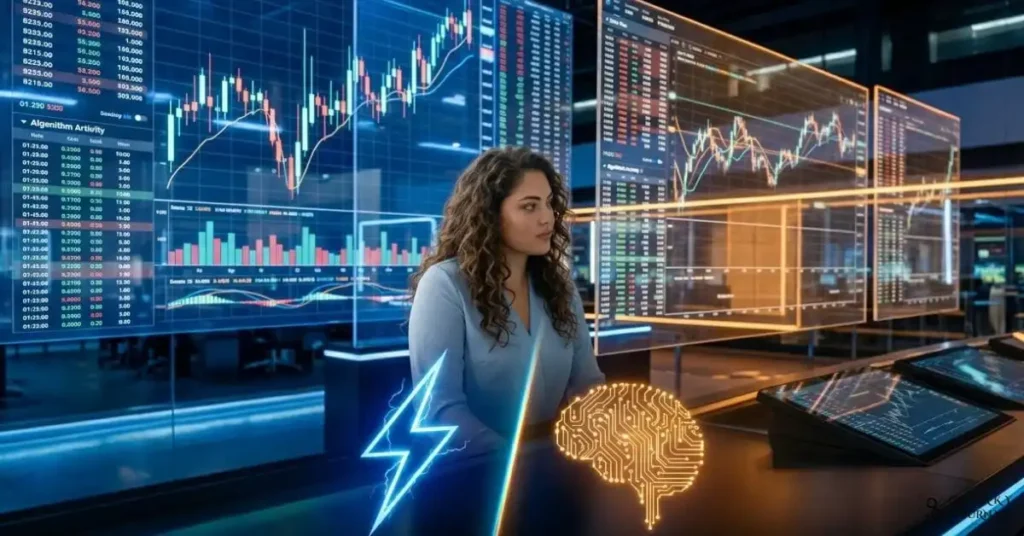
Speed vs. Logic in Algo Trading: A Deep Dive into Execution and High-Frequency Trading
Every day, trillions of dollars change hands across global financial markets. Most of those transactions never touch a human hand. Behind the prices you see on a screen, a vast, invisible ecosystem of algorithms and automated systems is making split-second decisions, executing orders, and shaping market behaviour in ways that were unimaginable just a generation ago.
At the heart of this ecosystem lies a fundamental tension: speed versus logic. Should a trading system prioritise getting to market first, or should it invest more in the quality of its decisions? Does it matter more to be faster than everyone else or smarter than everyone else? The answer, as this guide will show, depends entirely on what you are trying to achieve.
This article provides a thorough and accessible exploration of algorithmic trading and high-frequency trading. We will cover what each approach actually involves, how they differ from one another, what technologies power them, and what it means for every kind of market participant, from institutional traders to individual investors. Whether you are exploring a career in quantitative finance, managing a portfolio, or simply curious about how modern markets work, this guide is for you.
What Is Algorithmic Trading? The Foundation of Modern Execution
Algorithmic trading uses computer programs to execute trades based on pre-defined rules. It automates buying, selling, or holding decisions using market data, including price, volume, and time. No human intervention is required during execution. The algorithm simply follows its instructions with speed and precision.
The scope of algorithmic trading is broader than many people realise. It encompasses everything from basic execution tools like Volume Weighted Average Price (VWAP) algorithms, which split large orders into smaller pieces to reduce market impact, all the way to fully autonomous systems that generate trade ideas, size positions, and execute across multiple asset classes simultaneously.
Algorithmic trading has reshaped financial markets profoundly. Algorithms process vast data, react to news instantly, and execute trades faster than humans. They significantly boost market liquidity, tighten bid-ask spreads, and minimise market impact for large orders. Today, the majority of global trading volume is algorithmic. According to various industry estimates, algorithmic trading accounts for over 60 to 75 per cent of all equity market volume in developed markets.
The core insight behind algorithmic trading is simple. Human traders are slow, emotional, and prone to inconsistency. Algorithms are fast, emotionless, and perfectly consistent. In a market where execution quality directly affects profitability, those properties are enormously valuable.
The Key Distinction: Algorithmic Trading vs. High-Frequency Trading
A common misconception is that algorithmic trading and high-frequency trading are the same thing. They are not. Understanding the difference is essential for anyone trying to navigate the landscape of modern quantitative finance.
Algorithmic trading is an execution tool. There is a genuine investment decision behind it, a view about the market, a position to build or unwind, a risk to manage. The algorithm’s job is to execute that decision as efficiently as possible. Smart order routing (SOR) and basic execution algorithms like VWAP are not high-frequency trading methods. These tools automate the execution of large orders with the aim of minimising market impact.
High-frequency trading, by contrast, is largely characterised by the speed of execution rather than by the investment logic behind it. GreySpark’s definition captures this well: HFT is computerised and automatic trading characterised by order submission rates that are much higher than what is humanly possible. HFT is mainly conducted by principal traders in hedge funds and, to a lesser degree, by trading desks in large investment banks.
Put more simply, algorithmic trading can operate at any speed. HFT operates specifically at the boundary of what technology allows. An institutional fund executing a large equity order over several hours using a VWAP algorithm is using algorithmic trading. A prop firm exploiting a two-microsecond price discrepancy between two exchanges is doing high-frequency trading. Both are algorithmic. Only one is high-frequency.
Inside High-Frequency Trading: What Actually Happens
High-frequency trading pushes algorithmic trading to its extreme. These systems execute thousands of trades in fractions of a second, using ultra-low latency and lightning-fast data pipelines. The entire process runs without human involvement from the moment a market signal is detected to the moment an order is filled.
The workflow inside an HFT system follows a consistent pattern. First, data collection continuously streams raw market data from global exchanges. Second, pattern recognition algorithms detect pricing anomalies or temporary imbalances in the order book. Third, execution places orders automatically in milliseconds, leveraging co-located servers for maximum speed. Fourth, risk control monitors and adjusts every trade within a structured, predefined framework.
Speed is measured in microseconds and even nanoseconds at the cutting edge of HFT. Over the past century, the time required to execute a trade has fallen dramatically. Originally, human traders in a pit used open outcry to match orders, a process taking seconds or longer. In the 1980s, trading shifted to electronic platforms with the rise of desktop computers. Starting in the 2000s, HFT emerged, using the fastest CPUs in colocation facilities to execute trades, reducing trade times from several seconds to less than a microsecond.
Today, the fastest systems use Field Programmable Gate Arrays (FPGAs) to implement trading logic directly in hardware, bypassing software layers entirely. This approach, sometimes called Gateware Defined Networking, achieves ultra-low latency by offloading time-critical functions to dedicated chips. The result is execution measured in tens of nanoseconds, far beyond what any software-based system can achieve.
The Role of Colocation and Network Infrastructure
Speed in HFT is not just about software or algorithms. It is fundamentally about physical proximity to exchanges. Colocation is the practice of placing trading servers in the same data centres where exchange matching engines operate. By reducing the physical distance that data must travel, HFT firms reduce latency to its theoretical minimum.
Major exchanges, including the New York Stock Exchange, Nasdaq, and CME Group, operate colocation facilities where firms pay premium fees to house their servers. The closer a server is to the matching engine, the lower the round-trip latency. Even small differences matter enormously at HFT speeds.
Beyond colocation, HFT firms invest heavily in network connectivity. Firms use dedicated fibre optic cables, and some have gone further by deploying microwave and millimetre-wave transmission networks. These technologies transmit data through the air rather than through cables, travelling faster than light through glass fibre. The famous microwave network connecting the Chicago Mercantile Exchange to New York is approximately 100 miles shorter in signal path than the fibre route, saving roughly 100 microseconds.
Firms like Algo-Logic have developed Tick-to-Trade (T2T) systems that generate profit by instantly sending orders to an exchange in response to market data. These systems achieve ultra-low latency by implementing algorithms in logic instead of software, utilising pre-built and proven logic cores that offload time-critical trading functions directly to hardware.
Execution Algorithms: The Logic Side of the Equation
While HFT prioritises speed above all else, the broader world of execution algorithms prioritises logic, specifically the intelligent management of large orders in a way that minimises cost and market impact. These tools represent the workhorses of institutional trading and deserve careful attention.
VWAP (Volume Weighted Average Price) algorithms distribute a large order across the trading day in proportion to historical volume patterns. The goal is to execute at a price close to the day’s volume-weighted average, ensuring that the institution’s large order does not disproportionately move the market. Fund managers and institutional traders use VWAP benchmarks widely when evaluating execution quality.
TWAP (Time Weighted Average Price) algorithms take a simpler approach, dividing an order equally across a defined time period. TWAP is useful when volume patterns are uncertain or when an institution wants predictable, even execution regardless of market conditions.
Implementation Shortfall algorithms, sometimes called arrival price algorithms, aim to minimise the difference between the price at the time a trading decision is made and the actual average execution price. These algorithms are more aggressive than VWAP or TWAP, trading faster when conditions are favourable and slowing down when market impact is high.
Smart Order Routing (SOR) systems automatically direct orders to whichever execution venue offers the best price and liquidity at any given moment. As equity markets have fragmented across dozens of trading venues, including exchanges, dark pools, and electronic communication networks, SOR has become essential for obtaining best execution.
HFT Strategies: What High-Frequency Traders Actually Do
Not all high-frequency trading is the same. Several distinct strategies operate under the HFT umbrella, each with different risk profiles, market impacts, and profitability drivers.
Market making is the most common HFT strategy. High-frequency market makers continuously quote bid and ask prices across thousands of instruments simultaneously. They earn the bid-ask spread on each round-trip trade. Because they hold positions for very short periods, inventory risk is managed in near-real time. The speed advantage allows them to update quotes faster than any manual trader can respond to changing market conditions.
Statistical arbitrage at high frequency exploits tiny price discrepancies between related securities. When an ETF and its underlying basket of stocks diverge by a fraction of a per cent, for instance, an HFT firm can simultaneously buy the cheaper instrument and sell the more expensive one, capturing a near-riskless profit before the gap closes. These opportunities last only milliseconds, which is precisely why speed is the prerequisite for capturing them.
Latency arbitrage involves exploiting the information advantage that comes from seeing market data faster than other participants. When a large order moves prices on one exchange, an HFT firm that detects this first can trade on related instruments on other exchanges before slower participants can react. This strategy is controversial because it profits from informational asymmetry rather than genuine liquidity provision.
Momentum ignition is a more aggressive and often scrutinised strategy. It involves placing a series of orders intended to trigger other algorithms’ momentum signals, then profiting from the price movement that follows. Regulators have examined this strategy closely, as it can border on market manipulation depending on implementation.
The Technology Stack Behind Algorithmic Trading
Understanding what algorithmic trading does requires understanding the technologies that make it possible. The technology stack in a modern trading firm spans hardware, network infrastructure, software, and data systems, each optimised for minimal latency and maximum reliability.
At the hardware level, the fastest HFT systems use FPGAs to implement trading logic. FPGAs are reprogrammable chips that can execute specific computations in parallel, achieving single-digit microsecond latency or better. For slightly less latency-sensitive applications, optimised CPUs running highly optimised C++ code are standard. GPU acceleration is increasingly used for machine learning model inference and parallel data processing.
At the network level, firms use kernel bypass networking to eliminate operating system overhead from the data path. Technologies like RDMA (Remote Direct Memory Access) allow network cards to write data directly into application memory, bypassing the CPU entirely and reducing latency by microseconds. Every component in the data path is chosen and configured for minimum latency.
At the software level, trading systems are typically written in C++ for the most latency-sensitive components, with Python and other higher-level languages used for research, backtesting, and less time-sensitive processes. Execution management systems, FIX protocol interfaces, and order management systems form the operational backbone of institutional trading operations.
Market Data: The Lifeblood of Algorithmic Systems
Every algorithmic trading system, whether focused on speed or logic, depends on the quality and speed of its market data feeds. The data landscape for algo traders has grown increasingly rich and complex over the past decade.
Level 1 market data provides the best bid and ask prices for each security, along with last trade information. This is the minimum data required for any trading algorithm. Level 2 data, also known as market depth or the order book, shows all pending orders at every price level, giving algorithms a detailed picture of supply and demand dynamics.
Beyond traditional price data, the rise of alternative data has transformed algorithmic trading over the past decade. News sentiment feeds powered by natural language processing, social media sentiment analysis, satellite imagery, credit card transaction data, and web traffic metrics are now incorporated into trading models at the most sophisticated firms.
Automated news-based trading systems react to financial announcements, corporate earnings, or macroeconomic data in real time. By using algorithms that interpret news feeds, firms can automate responses to events without manually monitoring every headline. The fastest of these systems can parse and trade on a news event within milliseconds of its release, long before any human analyst could finish reading the headline.
Data quality and normalisation are significant operational challenges. Market data arrives from dozens of exchanges in varying formats, at varying speeds, and with varying levels of reliability. Firms invest substantially in data infrastructure, including feed handlers, normalisation engines, and time-synchronisation systems, to ensure that their models operate on clean, consistent, and timely data.
Risk Management in Algorithmic and HFT Systems
Speed without risk management is a recipe for disaster. The history of algorithmic trading includes several high-profile failures where automated systems caused enormous losses in a very short time. Understanding how risk is managed in these systems is therefore essential.
Pre-trade risk controls are the first line of defence. Before any order reaches an exchange, it passes through a series of automated checks. These checks verify that the order does not exceed position limits, does not violate concentration limits, falls within permitted price ranges, and does not breach daily loss limits. Algo-Logic’s systems include Pre-Trade Risk Checks (PTRCs) that reduce losses from bad trades, implemented in hardware to ensure they add minimal latency to the execution path.
Kill switches are an essential safeguard in any algorithmic trading environment. These mechanisms allow a risk manager or operator to immediately halt all trading activity if a system behaves unexpectedly. Regulatory requirements in many jurisdictions mandate kill switch functionality for algorithmic trading systems.
Post-trade monitoring tracks positions, profit and loss, and risk exposures in real time after execution. Alerts trigger automatically when positions approach defined limits. Drawdown controls pause or terminate strategies when losses exceed predefined thresholds. Every trade is monitored and adjusted within a structured, predefined framework.
The SEC’s Market Access Rule in the United States requires brokers and trading firms to implement risk controls before accessing markets electronically. These requirements have formalised many of the practices that leading firms already follow and created a baseline standard across the industry.
Comparing Speed and Logic: A Framework for Understanding
The distinction between speed-focused and logic-focused approaches in algorithmic trading is not a binary one. Rather, it represents a spectrum, and the optimal position on that spectrum depends on the strategy, the market, and the competitive environment.
Speed-focused approaches, exemplified by HFT, are most effective in markets where informational edges are short-lived. When a pricing discrepancy exists for only microseconds, only the fastest systems can capture it. The edge in these strategies erodes as competitors become faster, which is why HFT firms must continuously invest in infrastructure improvements just to maintain their relative position.
Logic-focused approaches are most effective where the quality of the investment decision dominates the impact of execution speed. A systematic fund running a month-long trend-following strategy cares far less about microsecond execution latency than about the accuracy of its signal models, the robustness of its risk management, and the disciplined application of its investment process. Execution matters, but even imperfect execution cannot erase a genuine edge in model quality.
Many modern trading operations blend both. A systematic hedge fund might use sophisticated, logic-driven models to generate trade signals while employing execution algorithms that incorporate real-time market microstructure awareness to optimise fill quality. The logic and speed are complementary rather than competing.
A Comparison: Algorithmic Trading vs. High-Frequency Trading
| Dimension | Algorithmic Trading (Broad) | High-Frequency Trading (HFT) |
|---|---|---|
| Primary Goal | Efficient execution of investment decisions | Capture ultra-short-term market inefficiencies |
| Time Horizon | Milliseconds to months | Microseconds to seconds |
| Capital Source | Proprietary or client capital | Almost exclusively proprietary capital |
| Core Edge | Decision quality, model sophistication | Speed and infrastructure advantage |
| Key Infrastructure | Execution platforms, data feeds, risk systems | FPGAs, colocation, microwave networks |
| Position Holding Period | Variable, from seconds to months | Rarely overnight, often milliseconds |
| Key Risks | Model failure, execution slippage | Technology failures, latency arms race |
| Regulatory Scrutiny | Moderate | High, especially around market manipulation concerns |
| Examples of Strategies | VWAP, TWAP, trend following, mean reversion | Market making, stat arb, latency arbitrage |
The Institutional Edge: Why Large Firms Dominate Algo Trading
For hedge funds and proprietary trading firms, HFT and algorithmic trading represent the technological backbone of market-making and liquidity provision. They help improve efficiency, tighten spreads, and enhance price discovery, all while reducing execution costs for the firms themselves.
Scale creates enormous advantages in this space. Large firms can amortise the fixed costs of technology infrastructure, data subscriptions, and quantitative talent across larger trading volumes. They can negotiate better colocation rates with exchanges, access more exotic data sources, and attract more experienced engineers and researchers than smaller competitors can afford.
The barriers to entry are substantial. Building a competitive HFT operation from scratch requires millions of dollars in infrastructure investment, access to top-tier engineering and quantitative talent, and years of iterative development. For this reason, the HFT industry remains concentrated among a relatively small number of dominant players, including Virtu Financial, Citadel Securities, IMC, and Jump Trading.
However, the picture is more nuanced for logic-focused algorithmic trading. There, the barriers are not primarily about capital or infrastructure. They are about intellectual capital, specifically the quality of the models, the depth of the research process, and the discipline of the investment framework. This creates a more level playing field where smaller, well-organised teams can and do compete effectively against larger institutions.
How Algo Trading and HFT Affect Regular Investors
A natural question for anyone outside the world of professional trading is: Does any of this affect me? The answer is yes, though the effects are more nuanced than headlines sometimes suggest.
On the positive side, algorithmic trading has dramatically improved execution quality and reduced transaction costs for all market participants. Bid-ask spreads have narrowed significantly across most asset classes over the past two decades, largely because algorithmic market makers compete fiercely to provide the best prices. For a retail investor buying a stock today, the cost of execution is a fraction of what it was in the pre-algorithmic era.
Market liquidity has also improved in normal conditions. Algorithmic market makers provide continuous two-sided quotes across thousands of instruments, ensuring that investors can buy or sell at predictable prices without large market impact. This benefits everyone who participates in financial markets.
On the negative side, there are legitimate concerns about algorithmic trading’s contribution to market instability during stress events. The Flash Crash of May 6, 2010, during which the Dow Jones Industrial Average fell nearly 1,000 points in minutes before rapidly recovering, highlighted how interacting algorithmic systems can produce extreme, self-reinforcing price moves. Subsequent events have raised similar concerns about the fragility of algorithmic markets under stress.
Furthermore, latency arbitrage strategies, where HFT firms profit by trading with slower participants at prices those participants did not intend, have attracted criticism. Whether this represents a meaningful extraction of value from ordinary investors or a negligible cost of the liquidity benefits HFT provides remains a genuinely contested question among economists and regulators.
Regulatory Landscape: How Authorities Oversee Algo and HFT Activity
The rapid growth of algorithmic trading has prompted significant regulatory attention globally. Authorities have sought to ensure that these technologies benefit markets broadly rather than creating unfair advantages or systemic risks.
In the European Union, MiFID II introduced comprehensive requirements for algorithmic and HFT firms. These include mandatory algorithm testing before deployment, real-time risk controls, obligations to provide liquidity as a market maker during stressed conditions if the firm benefits from rebates, and detailed transaction reporting. Firms that engage in HFT must register with their national regulator and disclose their strategies.
In the United States, the SEC and CFTC have pursued enforcement actions against specific HFT practices they consider manipulative, including spoofing, layering, and momentum ignition. Fines and criminal charges have been levied against traders and firms found to have engaged in these practices. Additionally, the Financial Industry Regulatory Authority (FINRA) monitors algorithmic trading activity for signs of manipulation and best execution violations.
The ongoing regulatory challenge is that technology evolves faster than regulatory frameworks. As AI-driven trading systems become more autonomous and less interpretable, regulators face the difficult task of overseeing systems that even their operators cannot fully explain. This is driving interest in algorithmic accountability frameworks and explainability requirements for trading systems.
AI and Machine Learning: The Next Frontier in Algo Trading
Artificial intelligence and machine learning are rapidly transforming both the speed and logic dimensions of algorithmic trading. Their impact is already substantial and continues to grow.
On the speed side, AI is being applied to optimise execution in real time. Reinforcement learning algorithms learn optimal execution strategies by interacting with live market conditions, adapting their behaviour dynamically based on observed outcomes. These approaches go beyond static VWAP or TWAP schedules to achieve execution that responds intelligently to the specific market environment at any given moment.
On the logic side, deep learning models are increasingly used to generate trading signals from unstructured data. Natural language processing of earnings call transcripts, news feeds, and regulatory filings can surface information that traditional quantitative models miss. Computer vision techniques are applied to satellite and aerial imagery to infer economic activity, inventory levels, or retail foot traffic before that information becomes available through official channels.
AI-driven hardware-accelerated trading systems, like those developed by Algo-Logic in partnership with Supermicro, integrate AI model inference directly into the trading pipeline. These systems use an AI cluster to generate signals, an analytics server for real-time processing, and a tick-to-trade server for ultra-low-latency execution. The result is a system that combines the logical sophistication of machine learning with the speed of hardware-accelerated execution.
Nevertheless, challenges remain. Machine learning models trained on historical data can fail unexpectedly when market conditions change in ways not represented in training data. The overfitting problem, where a model learns patterns that exist only in historical data rather than genuine market relationships, is a persistent challenge. Robust model validation, out-of-sample testing, and ongoing monitoring are essential safeguards.
Careers in Algorithmic and High-Frequency Trading
The world of algorithmic trading offers some of the most intellectually demanding and financially rewarding careers in finance. However, the skills required differ significantly between the speed-focused and logic-focused ends of the spectrum.
For HFT-focused roles, the premium is on systems programming expertise, particularly C++ and FPGA development, combined with a deep understanding of market microstructure and network infrastructure. Candidates with backgrounds in physics, computer engineering, or electrical engineering are highly valued. The interview process at leading HFT firms is notoriously rigorous, often involving complex algorithmic puzzles and real-time problem-solving under pressure.
For quantitative research and systematic trading roles, the emphasis shifts to mathematical modelling, statistical analysis, and research methodology. A strong background in mathematics, statistics, or a quantitative science is typically expected, often at the doctoral level. Python is the dominant programming language in research, with C++ used for production implementation. Familiarity with machine learning frameworks like TensorFlow or PyTorch is increasingly expected.
For execution-focused roles at institutional asset managers and banks, a solid understanding of market structure, execution algorithms, and transaction cost analysis is key. These roles often require strong communication skills as well, since execution quality must be explained and justified to portfolio managers and clients. The CFA designation, combined with quantitative skills,s is a competitive combination for these positions.
The Future of Algorithmic Trading: Where Is This Heading?
The trajectory of algorithmic trading points toward greater automation, greater intelligence, and greater integration across asset classes and data types. Several specific trends are worth watching.
First, the latency arms race in HFT is approaching physical limits. As transmission speeds near the speed of light and hardware latency falls to single nanoseconds, the marginal benefit of further speed improvements is diminishing. This is shifting competition in HFT from raw speed toward model quality, risk management sophistication, and the breadth of strategies deployed.
Second, the adoption of AI across trading workflows is accelerating. From signal generation to execution optimisation to risk management, machine learning is becoming embedded in every part of the algorithmic trading process. Firms that build the most robust AI development and deployment infrastructure will have durable advantages.
Third, new asset classes are increasingly algorithmic. Cryptocurrency markets, once dominated by retail traders, are now heavily algorithmically traded. Decentralised finance (DeFi) protocols are being explored as venues for algorithmic strategies. Carbon credit markets and other emerging asset classes are attracting algorithmic participants as they mature.
Fourth, regulatory requirements around algorithm explainability and accountability are likely to increase. As AI systems become more autonomous and their decision-making less transparent, regulators will demand greater insight into how these systems work and what safeguards constrain them. Firms that invest in interpretability and governance infrastructure will be better positioned to navigate this environment.
Practical Takeaways for Traders and Investors
Even if you never write a line of trading code or deploy an algorithm, understanding the algorithmic trading landscape makes you a more effective market participant. Several practical insights apply across different types of investors and traders.
First, execution timing matters more than most investors realise. Algorithmic activity follows predictable patterns throughout the trading day. Volume and liquidity are typically highest in the opening and closing hours, when algorithmic systems are most active. Executing large orders during these windows often results in better fill prices and lower market impact.
Second, unusual price moves are often algorithmic rather than news-driven. When you see a sudden price spike that reverses quickly, a stock pinning near a round number at expiration, or a gap between correlated instruments, these are frequently artefacts of systematic trading behaviour. Recognising this can prevent you from over-interpreting events that are structurally driven rather than informationally significant.
Third, transaction cost awareness is essential. For frequent traders, the cumulative impact of bid-ask spreads, market impact, and commissions can easily exceed the alpha generated by even a good strategy. Algorithmic execution tools, now available to institutional and increasingly to sophisticated retail traders through platforms like Interactive Brokers’ algorithmic trading suite, can help minimise these costs.
Spend some time for your future.
To deepen your understanding of today’s evolving financial landscape, we recommend exploring the following articles:
Launching Too Early? Here’s What It Really Costs Your Startup
How to Make $1,000/Month With AI in 2026 — No Tech Skills Needed
The 4 Income Streams Every Smart Earner Should Have
War Economy Chapter 21: Protecting Family Finances During War
The Algo Trading Blueprint: Backtest Like a Scientist
Explore these articles to get a grasp on the new changes in the financial world.
Disclaimer
The information in this article is for general educational and informational purposes only. It does not constitute investment, financial, or professional advice. Readers should conduct their own research and consult qualified professionals before making any investment or trading decisions. The author makes no warranties regarding the accuracy, completeness, or currency of the information provided.
References
- [1] GreySpark Partners. “The Subtle Difference Between High Frequency and Algorithmic Trading.” https://greyspark.substack.com/p/the-subtle-difference-between-high
- [2] InvestmentNews. “Top HFT Trading Software for High-Speed Execution.” https://www.investmentnews.com/transformation/hft-trading-software/263152
- [3] Supermicro and Algo-Logic. “T2T Solution Brief.” https://www.supermicro.com/solutions/Solution_Brief_Algo-Logic_T2T.pdf
- [4] Investopedia. “Algorithmic Trading.” https://www.investopedia.com/terms/a/algorithmictrading.asp
- [5] SEC. “Findings Regarding the Market Events of May 6, 2010.” https://www.sec.gov/news/studies/2010/marketevents-report.pdf
- [6] ESMA. “MiFID II and MiFIR.” https://www.esma.europa.eu/policy-rules/mifid-ii-and-mifir
- [7] CME Group. “Exchange Overview.” https://www.cmegroup.com/
- [8] Reuters. “Microwave Towers Give High-Frequency Traders an Edge.” https://www.reuters.com/technology/microwave-towers-give-high-frequency-traders-edge-2019-01-03/
- [9] SIFMA. “Capital Markets Fact Book.” https://www.sifma.org/resources/research/fact-book/
- [10] CFA Institute. “CFA Program.” https://www.cfainstitute.org/en/programs/cfa