
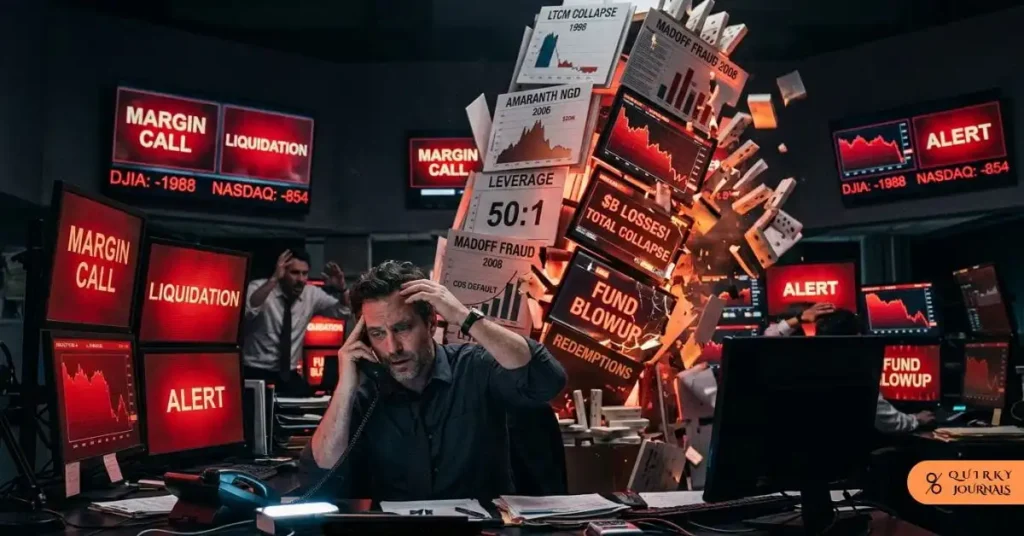
Billion-Dollar Hedge Fund Failures and What They Reveal
Picture a phone ringing at 2 a.m. in Greenwich, Connecticut. On the other end is a prime broker asking for more collateral, right now, or the positions will be liquidated. That call has ended careers, vaporised fortunes, and occasionally rattled the entire global financial system. It is the sound every hedge fund manager fears most, and it has played out in boardrooms from New York to Singapore more often than the industry likes to admit.
Hedge funds sell a simple promise. Smarter money, better risk management, returns that do not care which way the market moves. Yet some of the smartest people in finance, including actual Nobel laureates, have managed to lose more money faster than almost anyone in history. The pattern repeats with eerie consistency. Confidence builds. Leverage creeps up. Then a single shock turns a winning strategy into a death spiral.
This piece walks through the biggest blowups in modern hedge fund history. We will look at what these funds actually did, where the wheels came off, and what the wreckage teaches anyone who manages risk for a living, or just wants to understand how billions can disappear in a weekend. Some of these names will be familiar from headlines. Others faded quickly, even though their losses were just as real.
Why Hedge Funds Implode: The Anatomy of a Billion-Dollar Mistake
Before we dig into individual case studies, it helps to understand the shared DNA of a hedge fund collapse. Despite different strategies and decades, the failures below share a handful of structural fingerprints. Spotting them early is the entire game.
First, there is leverage. Hedge funds borrow to amplify returns, and that same borrowing amplifies losses. A 5% market move against a fund leveraged 10 to 1 can wipe out half its equity overnight. Second, concentration creeps in. Diversification sounds wise in a prospectus, but it is boring, and boring rarely produces the eye-popping returns that attract billions in new capital. So funds drift toward concentrated, correlated bets.
Third, opacity plays a role more often than people assume. Several of the implosions below involved instruments or structures specifically designed to hide exposure from regulators, lenders, or investors. Fourth, and perhaps most human of all, success breeds overconfidence. A great track record convinces a manager that the model is the market, not just a map of it. That confusion has ended more careers than bad luck ever has.
Context matters here too. According to industry data on hedge fund assets, total assets under management across the global hedge fund industry reached roughly $4.5 trillion by the end of 2024. That figure is down from an all-time high above $5.1 trillion. Thousands of funds operate at any given time, and most never make a headline. The handful below is not typical. They are outliers, and that is exactly what makes them instructive.
| Failure Pattern | What It Looks Like | Funds Below That Show It |
|---|---|---|
| Excessive leverage | Borrowing many multiples of equity to juice returns | LTCM, Archegos, Amaranth |
| Concentration risk | Outsized bets in one sector, commodity, or trade | Amaranth, Melvin Capital, Three Arrows |
| Hidden exposure | Structures that mask true risk from outsiders | Archegos, Madoff, Bayou Group |
| Outright fraud | Fabricated returns or a Ponzi structure | Madoff, Bayou Group |
| Crowd dynamics | Retail or market sentiment is overwhelming a position | Melvin Capital, GameStop short sellers |
Long-Term Capital Management: The Nobel Prize Curse
The Setup
No collapse looms larger over modern finance than Long-Term Capital Management, known simply as LTCM. Founded in 1994 by former Salomon Brothers bond chief John Meriwether, the fund recruited a roster that looked more like an economics faculty than a trading desk. Myron Scholes and Robert Merton, who later shared a Nobel Prize for their work on options pricing, joined as partners. So did David Mullins, a former vice chairman of the Federal Reserve.
The strategy was elegant on paper. LTCM hunted for tiny pricing gaps between related securities, betting that prices would eventually converge. Because each trade offered a razor-thin edge, the fund needed enormous leverage to turn pennies into real profits. By early 1998, LTCM held a balance sheet north of $100 billion against equity of roughly $4.8 billion, a leverage ratio that would make most risk officers break out in a cold sweat.
The Break
Then Russia happened. In August 1998, Russia defaulted on its government debt and devalued the ruble, triggering a global flight to safety. Markets that LTCM assumed were only loosely correlated suddenly moved together, in the wrong direction, all at once. Within weeks, the fund’s equity collapsed from roughly $4.7 billion to about $600 million.
What makes LTCM different from most collapses on this list is scale relative to the system. Its derivative book touched nearly every major bank on Wall Street. Regulators feared that a disorderly unwind would trigger fire sales across global markets and drag down the institutions still standing.
The Fallout
On September 23, 1998, the Federal Reserve Bank of New York brokered a private bailout. Fourteen banks injected roughly $3.6 billion in exchange for 90% ownership of the fund, avoiding a fire sale while putting no taxpayer money directly at risk. Warren Buffett had separately offered to buy the portfolio outright for $250 million, an offer Meriwether let expire before the consortium deal closed.
LTCM was eventually wound down profitably for the rescuing banks. The lasting damage was not financial but conceptual. The episode normalised the idea that systemically important funds might get rescued, a precedent that economists still point to when discussing moral hazard ahead of the 2008 financial crisis.
Amaranth Advisors: The Natural Gas Gamble That Backfired
From Convertible Bonds to Energy Futures
Founded by Nicholas Maounis in 2000, Amaranth Advisors climbed quickly using a convertible arbitrage strategy, the same kind of relative-value trading that LTCM had pioneered. By 2005, the fund managed roughly $9 billion and had posted annualised returns of nearly 86%. Behind those numbers, though, the firm had quietly shifted enormous weight onto a single energy trader, Brian Hunter, and his bets on natural gas futures.
Hunter’s positions were not modest hedges. He built spread trades wagering on the gap between winter and summer natural gas prices, sizing them so large that Amaranth reportedly controlled a meaningful share of certain futures contracts. When natural gas prices moved against those positions in September 2006, there was no graceful way out. Trying to unwind a position that size in an illiquid market only pushed prices further away from the fund.
A Six-Week Collapse
The result was staggering. Amaranth lost roughly $6.5 billion in a matter of weeks, gutting a fund whose name translated from Greek to mean unfading. The irony was not lost on financial journalists at the time. Investors who had piled in chasing those 86% returns watched most of their capital disappear before the fund formally wound down in 2006.
Regulators eventually fined Amaranth a relatively modest sum for related securities violations, but the real lesson had nothing to do with penalties. A single trader, granted enough rope and enough capital, can take down a multi-billion dollar firm if nobody is willing to challenge the position sizing. According to a 2008 Congressional Research Service report, the broader natural gas market absorbed the shock without lasting damage, which is more than can be said for Amaranth’s investors.
Tiger Management: When the Best Trader in the World Got It Wrong
Julian Robertson founded Tiger Management in 1980 and built it into one of the defining hedge funds of the era. By 1993, Tiger managed nearly $7 billion and had just delivered an 80% annual return, numbers that turned Robertson into a Wall Street legend. His approach combined deep fundamental research with concentrated, high-conviction bets, a style that worked brilliantly for nearly two decades.
It stopped working in 2000. Two trades in particular hurt badly: a long position in US Airways that soured as the airline struggled, and a bet against the Japanese yen that blew up when the currency rallied unexpectedly. Combined with a brutal stretch where growth and technology stocks outran value-oriented strategies, Robertson’s losses mounted quickly enough that he chose to close the fund rather than fight the tide.
What survived Tiger was arguably more influential than the fund itself. Dozens of Tiger alumni went on to launch their own firms, widely nicknamed Tiger Cubs, several of which became hugely successful in their own right. Sometimes a collapse seeds an entire industry, even as it ends a single career. Robertson himself stayed active afterwards, seeding many of those same Tiger Cubs with early capital rather than disappearing from the industry he helped define.
Bayou Group and Bernie Madoff: When the Fund Was Never Real
Bayou’s Fabricated Track Record
Not every collapse on this list involved a strategy that simply failed. Some never had a real strategy at all. Bayou Group, founded by Samuel Israel III in 1996, claimed to have earned $43 million in 2003 across its funds. In reality, according to the SEC, the firm had lost roughly $49 million that same year. To paper over the gap, Bayou’s founders allegedly created a fake auditing firm to sign off on fabricated numbers, defrauding investors of more than $400 million before the SEC froze the firm’s assets in 2005.
This was not a risk management failure. It was a deliberate, sustained fraud built to keep new investor money flowing in long enough to mask earlier losses, a structure that should sound familiar to anyone who has studied a Ponzi scheme.
Madoff: The Ponzi Scheme That Ate Decades
Bernie Madoff ran the same basic playbook on a vastly larger scale, and for far longer. For roughly two decades, Madoff convinced thousands of investors that his firm consistently generated steady, attractive returns. Behind the marketing, there was no actual trading strategy generating those gains. New investor deposits simply paid off earlier investors, the textbook definition of a Ponzi scheme, until the 2008 financial crisis triggered enough redemption requests to expose the hole.
Madoff was arrested in December 2008 and later sentenced to 150 years in prison, dying in custody after serving roughly 12 years. According to Repool’s account of the scandal, the scheme remains one of the largest financial frauds ever uncovered, with estimated investor losses running into the tens of billions of dollars.
The lesson from both Bayou and Madoff is uncomfortable but essential. Operational due diligence, meaning independent verification of custody, auditing, and actual trade execution, matters as much as analysing a strategy’s logic. A fund can look brilliant on a pitch deck and still be hollow underneath.
SAC Capital and Galleon Group: Insider Information as a Business Model
Steven Cohen’s SAC Capital Advisors built one of the most consistently profitable track records in hedge fund history. The firm reportedly compounded at roughly 30% annually after fees for years. That performance eventually drew scrutiny from federal prosecutors, who alleged that a pattern of insider trading ran through parts of the firm. Several employees were convicted of securities fraud and conspiracy. SAC itself pleaded guilty and paid a fine reported in the billions, even though Cohen personally was never criminally charged.
Cohen went on to found Point72 Asset Management. He later became a public figure as the owner of the New York Mets, a reminder that consequences for firms and consequences for the people who ran them do not always match.
Galleon Group followed a similar script. At its peak, founder Raj Rajaratnam managed billions of dollars while allegedly building a network of corporate insiders feeding him material nonpublic information. The case became one of the highest-profile SEC enforcement actions of its era, and Rajaratnam was convicted on multiple counts of securities fraud and conspiracy. Pequot Capital Management faced comparable allegations tied to trading around Microsoft shares, eventually shutting down under regulatory pressure described in Repool’s retrospective on hedge fund scandals.
These cases share a common thread that differs from the leverage-driven blowups elsewhere on this list. The funds were not undone by markets moving against them. They were undone by the same edge that built them, an information advantage that crossed a legal line.
Melvin Capital: How Reddit Took Down a Hedge Fund
A Decade of Outperformance, Undone in Weeks
Gabriel Plotkin founded Melvin Capital in 2014 and built it into one of the best-performing funds of its size, averaging roughly 30% annual returns between 2014 and 2020. Part of that edge came from aggressive short selling, betting against struggling companies whose stock prices the firm expected to fall. GameStop, a brick-and-mortar video game retailer many analysts viewed as obsolete, became one of Melvin’s short targets.
Retail traders organised on the Reddit forum r/WallStreetBets noticed how heavily shorted GameStop had become and began buying shares and call options en masse. As the stock price climbed, short sellers were forced to buy shares to cover losing positions, which pushed the price even higher in a feedback loop known as a short squeeze.
Billions Lost in a Single Month
By the end of January 2021, Melvin had lost 53% of its value, according to the Wall Street Journal’s reporting at the time. Citadel and Point72 injected a combined $2.75 billion to stabilise the fund mid-crisis, an emergency lifeline rather than a vote of confidence in the trade itself. Melvin finished 2021 down more than 39%, a brutal result in a year the S&P 500 climbed nearly 29%.
Plotkin announced in May 2022 that Melvin would close and return the remaining capital to investors. Assets under management had fallen from roughly $12.5 billion at the start of 2021 to under $8 billion by the time the firm shut its doors. Melvin’s collapse remains a vivid case study in how internet-organised retail trading can overwhelm even a well-capitalised institutional short seller, a dynamic that regulators and lawmakers examined closely in subsequent congressional hearings.
Archegos Capital Management: The $100 Billion Family Office Nobody Saw Coming
Building a Hidden Empire
Bill Hwang’s story might be the single wildest entry on this list. After his earlier fund, Tiger Asia Management, pleaded guilty to insider trading and paid a fine, Hwang converted the firm into Archegos Capital Management in 2013, structured as a family office. Family offices face far lighter disclosure requirements than registered hedge funds, a regulatory gap Hwang used to his advantage.
Archegos built concentrated positions in a handful of stocks, including ViacomCBS, Baidu, and Vipshop, using total return swaps arranged through multiple investment banks. These derivative contracts let Archegos gain economic exposure to stocks without technically owning them, which meant the firm avoided the ownership disclosure thresholds that would normally flag a concentrated position. Different banks, including Credit Suisse, Nomura, Goldman Sachs, Morgan Stanley, and UBS, each saw only their own slice of Hwang’s exposure. No single institution was aware of the full picture, which reportedly totalled close to $100 billion.
The Fastest Wealth Destruction in Modern History
When the underlying stocks started falling in March 2021, Archegos faced margin calls it could not meet across multiple banks simultaneously. Banks began liquidating positions to limit their own losses, and the resulting fire sale crushed the stock prices further, deepening losses for whoever hadn’t sold yet. Bloomberg later reported that Hwang lost roughly $20 billion in two days, one of the fastest destructions of personal wealth ever recorded.
The banks involved absorbed enormous collective losses, with Credit Suisse alone reporting roughly $5.5 billion in damage, a hit serious enough that the bank later shut down its prime brokerage business entirely. Federal prosecutors eventually charged Hwang with racketeering conspiracy and securities fraud, alleging he used Archegos as a vehicle for market manipulation. He was convicted and sentenced to 18 years in prison in November 2024.
Archegos pushed regulators to revisit family office oversight, with policy researchers at the Congressional Research Service noting that the firm had never filed the disclosure forms typically expected from positions of that size. The episode showed how a single under-regulated structure could quietly accumulate systemic risk in plain sight.
Three Arrows Capital: Crypto’s Hedge Fund Unravels
A Decade of Credibility, Built on Borrowed Money
Su Zhu and Kyle Davies founded Three Arrows Capital, often shortened to 3AC, back in 2012, starting in emerging market currency trading before pivoting hard into crypto. By March 2022, the firm managed roughly $10 billion in crypto assets, much of it built on a strategy of borrowing heavily across the industry and redeploying that capital into other, often unproven, crypto projects.
The fund’s downfall traces directly to the collapse of TerraUSD, an algorithmic stablecoin, and its companion token Luna, in May 2022. Three Arrows had invested an estimated $200 million in Luna, and when the token’s value collapsed to near zero within days, that capital essentially vanished overnight.
The Margin Calls Nobody Could Meet
The Luna collapse triggered a wave of margin calls from 3AC’s lenders, including crypto platforms Genesis and BlockFi. Three Arrows could not meet them. A British Virgin Islands court ordered the firm into liquidation in late June 2022, and the fund eventually filed for Chapter 15 bankruptcy protection in the United States. According to Wikipedia’s documentation of the case, the fund lost more than $4.2 billion across 2021 and 2022, making it one of the largest hedge fund trading losses on record.
The contagion spread well beyond 3AC itself. Crypto lender Voyager Digital filed for bankruptcy after Three Arrows failed to repay roughly $670 million it had borrowed. Singapore’s Monetary Authority later reprimanded the firm for exceeding asset limits tied to its registration and for providing misleading information to regulators, according to CNBC’s reporting on the fallout. Founder Su Zhu was later arrested at Singapore’s Changi Airport while attempting to leave the country, sentenced for failing to cooperate with liquidators.
Three Arrows is the newest entry on this list chronologically, but the underlying mechanics are old news dressed in new technology. Borrowed money, concentrated bets, and a lack of hedging, all wrapped in confident public messaging that turned out to be wildly disconnected from the firm’s actual financial health.
Honourable Mentions: Smaller Blowups Worth Knowing
Wood River Capital Management
Not every collapse needs a dramatic market crash to explain it. Wood River Capital Management failed largely because of a basic conflict of interest. The firm put roughly 85% of its assets into a single company in which its own founder held a personal stake. When that company’s stock crashed, Wood River had no diversification left to cushion the blow, and the bulk of investor assets disappeared with it. Regulators later found the firm had misled the SEC about the arrangement rather than disclosing it upfront.
D1 Capital Partners and Light Street Capital
The 2021 GameStop short squeeze did not stop at Melvin Capital’s door. D1 Capital Partners, managing roughly $20 billion, reportedly lost around $4 billion, or about 20% of its capital, as the broader short squeeze rippled through crowded positions across the hedge fund industry. Light Street Capital, a smaller Bay Area firm with around $3.3 billion under management, deflated by roughly 20% in 2021. The episode hit hard enough that the firm later closed and returned capital to investors entirely.
Activist short seller Andrew Left of Citron Research also got caught in the crossfire. According to reporting cited by Infinity Investing’s breakdown of the GameStop episode, Left covered the majority of his GameStop short at what he described as a total loss. The firm subsequently announced it would stop publishing short-sell research altogether. Across the industry, the GameStop squeeze is estimated to have cost short sellers roughly $19.75 billion in January 2021 alone, a reminder that crowded trades rarely punish just one fund.
The Regulatory Aftermath
Each wave of collapses tends to produce a wave of new rules, though rarely fast enough to prevent the next one. LTCM’s near-collapse pushed regulators to study systemic risk from large, leveraged, lightly regulated pools of capital, a conversation that resurfaced a decade later during the 2008 financial crisis and eventually fed into the Dodd-Frank reforms.
Archegos reopened a similar debate around family offices specifically. Because family offices manage only the wealth of a single family rather than that of outside investors, they have historically faced far lighter SEC reporting requirements than registered investment advisers. Policy researchers and consultants pushing for reform make a simple point. Exempting an entity capable of building $100 billion in hidden exposure from basic oversight no longer makes sense. Industry lawyers counter that registration costs would be disproportionate for the vast majority of smaller, lower-risk family offices.
The Madoff and Bayou frauds, meanwhile, pushed harder on custody and audit verification rules, encouraging institutional investors to demand independent fund administrators rather than trusting a manager’s own internal numbers. None of these reforms eliminates risk. They simply raise the cost of hiding it, which is often the most regulators can realistically achieve.
The Wreckage, Side by Side
Looking at these failures together makes the recurring patterns easier to spot than examining any single case in isolation. The table below lines up the headline numbers.
| Fund | Peak AUM / Exposure | Approximate Loss | Primary Cause | Year of Collapse |
|---|---|---|---|---|
| Long-Term Capital Management | $126B portfolio / $4.8B equity | ~$4.6 billion | Extreme leverage, correlated market shock | 1998 |
| Tiger Management | ~$7 billion | Multi-billion dollar drawdown | Concentrated directional bets, style shift | 2000 |
| Bayou Group | Hundreds of millions | ~$400 million | Outright fraud, fabricated audits | 2005 |
| Amaranth Advisors | ~$9 billion | ~$6.5 billion | Concentrated natural gas futures bets | 2006 |
| Bernie Madoff Investment Securities | Tens of billions claimed | Tens of billions | Ponzi scheme | 2008 |
| SAC Capital | Tens of billions | Billions in fines | Insider trading | 2013 (guilty plea) |
| Melvin Capital | ~$12.5 billion | ~$6.8 billion (53% in Jan. 2021) | Crowded short squeezed by retail traders | 2022 (closure) |
| Archegos Capital Management | ~$100 billion exposure | ~$20 billion personal, ~$10B+ to banks | Hidden leverage via swaps, concentration | 2021 |
| Three Arrows Capital | ~$10 billion | ~$4.2 billion | Crypto leverage, Terra/Luna collapse | 2022 |
Notice how little the underlying asset class matters. Government bonds, natural gas futures, meme stocks, and crypto tokens have all hosted the exact same failure pattern: borrowed money plus a concentrated bet plus a shock nobody priced in.
The Pattern Beneath the Wreckage
Leverage Turns Small Mistakes Into Career-Ending Ones
Every leveraged trade is a bet that you can survive long enough to be right. LTCM and Archegos both ran portfolios many multiples larger than their actual equity, which meant a relatively modest adverse move could wipe out the entire capital base. Leverage does not just amplify gains. It compresses your margin for error to almost nothing.
Risk managers often talk about value at risk models as a safeguard, but LTCM’s own VaR models badly underestimated the odds of multiple markets moving together during a crisis. Models trained on historical correlations tend to break exactly when correlations spike, which is precisely the moment leverage matters most.
Concentration Is a Silent Killer
Amaranth’s natural gas bet, Melvin’s GameStop short, and Three Arrows’ crypto exposure were each concentrated enough that a single adverse move could overwhelm the entire fund. Diversification is unglamorous. It also happens to be one of the few genuinely free tools available to limit catastrophic loss, which is exactly why ambitious managers chasing huge returns tend to abandon it.
Opacity Buys Time, Then Destroys Trust
Archegos used swaps to stay invisible to regulators. Bayou and Madoff used fabricated numbers to stay invisible to investors. In both cases, hiding the truth did not prevent the underlying losses; it just delayed the reckoning and made it worse when it finally arrived. Transparency is inconvenient when things are going badly, but it is the only thing that lets counterparties manage their own risk appropriately.
Crowds Can Move Faster Than Models
Melvin Capital is the freshest illustration of a newer risk: coordinated retail sentiment moving fast enough to overwhelm institutional positioning. Quantitative models built on historical liquidity assumptions did not account for millions of retail accounts piling into a single name within days. That risk is not going away, and funds that ignore social sentiment as a market force do so at their own peril.
Could It Happen Again? Almost Certainly
It would be comforting to treat these nine collapses as relics, lessons already absorbed by an industry that has matured past them. The honest answer is messier. New leverage hides in new places now, and the instruments change faster than the regulators tracking them.
Multi-strategy funds, the so-called pod shops that dominate today’s hedge fund landscape, run dozens of independent trading teams under one roof, each allocated capital and risk limits by a central office. That structure spreads risk across more uncorrelated bets than a single-strategy fund like Amaranth ever could. It also means something else. A sudden, simultaneous deleveraging across many pods at once, sometimes called a basis trade unwind, can still ripple through markets quickly if enough funds are forced to sell similar assets at the same time.
Private credit is the newer frontier worth watching. Hedge funds and private equity firms have moved aggressively into direct lending over the past several years, often to companies that traditional banks now avoid post-financial crisis. Those loans are illiquid, lightly marked, and largely untested through a full credit cycle at this scale. Nobody fully knows how that asset class behaves once defaults start clustering, and that uncertainty is precisely the kind of gap that produced LTCM and Archegos.
Then there is leverage hiding inside derivatives once again, just like it did at Archegos. Total return swaps, structured notes, and other synthetic exposure vehicles still let sophisticated investors build large positions without the disclosure that direct stock ownership requires. Regulators have tightened reporting rules since 2021, but the fundamental incentive to stay under the radar has not gone anywhere.
Algorithmic and social-sentiment-driven trading adds yet another layer. Melvin Capital was blindsided by a relatively low-tech version of crowd dynamics, organised on a forum and executed through retail brokerage apps. Faster information flow is changing the math too. Automated trading bots now react to sentiment in real time, and an increasingly online retail trading population means future short squeezes could move even faster than GameStop did. That leaves even less room for an orderly unwind.
None of this means collapse is inevitable for any specific fund today. It means the underlying conditions that produced every blowup in this article, leverage, concentration, opacity, and overconfidence, have not been engineered out of the system. They have just changed costumes.
What Retail Investors Can Actually Learn From This
It is tempting to read these stories as entertainment, a parade of billionaires losing absurd sums of money. There is a more useful takeaway underneath the spectacle, and it applies whether you manage $10 billion or $10,000.
- Leverage cuts both ways, always. Borrowed money magnifies whatever happens next, good or bad, and the bad outcomes tend to arrive faster than the good ones.
- Concentration risk is the most underrated risk. A position that feels like a sure thing is usually the one capable of doing the most damage.
- Track record is not the same as due diligence. Madoff’s returns looked steady for decades. Steady returns with no transparency around custody and execution deserve more scrutiny, not less.
- Crowded trades can reverse violently. If everyone you know is on one side of a position, ask who is left to take the other side when sentiment shifts.
- Regulatory gaps get exploited. Family offices, offshore structures, and unregistered vehicles exist partly because lighter oversight is attractive to people with something to hide.
None of this means hedge funds are inherently reckless or that leverage is always a mistake. Plenty of funds manage risk responsibly for decades without making headlines. The funds in this article made headlines precisely because they were the exception, not the rule.
Somewhere right now, a fund is quietly building the position that becomes next year’s case study. Nobody at the desk thinks it’s them. That’s always how it starts.
Disclaimer
This article is provided for general informational and educational purposes only and does not constitute financial, investment, legal, or tax advice. The information presented has been compiled from publicly available news reports, regulatory filings, academic case studies, and historical accounts. Figures related to losses, assets under management, and dates may vary between sources due to differences in reporting methodology and timing. Past performance of any fund, strategy, or manager discussed here is not indicative of future results. Readers should conduct their own independent research and consult a licensed financial advisor, attorney, or tax professional before making any investment decision. The author and publisher accept no liability for actions taken based on the content of this article.
Spend some time for your future.
To deepen your understanding of today’s evolving financial landscape, we recommend exploring the following articles:
Doom Spending Is Real — And It’s Why Your Savings Account Is Empty Despite a Good Salary
The Quiet Panic: Why High Earners Are the Most Financially Anxious People in America
Position Sizing Strategies Every Global Trader Needs to Master
NFT Boom, Bust, and Beyond: The Honest Post-Mortem
Explore these articles to get a grasp on the new changes in the financial world.
References
- Business Insider, “The Most Spectacular Hedge Fund Implosions of All Time,” 2012. [Online]. Available: https://www.businessinsider.com/the-most-spectacular-hedge-fund-implosions-of-all-time-2012-8
- M. Jickling, “Hedge Fund Failures,” Congressional Research Service, Order Code RL33746, Sep. 2008. [Online]. Available: https://www.everycrsreport.com/files/20080930_RL33746_80c8097009846699db2d27b2e2f19d74396e9b34.pdf
- Repool, “Horrific Hedge Fund Scandals: The 4 Biggest.” [Online]. Available: https://repool.com/blog/horrific-hedge-fund-horror-stories
- Worth, “What the Hell Happened to Hedge Funds?” [Online]. Available: https://worth.com/what-the-hell-happened-to-hedge-funds
- S. Van de Wetering, “Why Do Hedge Funds Fail?, Empaxis, Jan. 2025. [Online]. Available: https://www.empaxis.com/blog/reasons-hedge-funds-fail
- Wikipedia, “Long-Term Capital Management.” [Online]. Available: https://en.wikipedia.org/wiki/Long-Term_Capital_Management
- Federal Reserve History, “Near Failure of Long-Term Capital Management.” [Online]. Available: https://www.federalreservehistory.org/essays/ltcm-near-failure
- Wikipedia, “Archegos Capital Management.” [Online]. Available: https://en.wikipedia.org/wiki/Archegos_Capital_Management
- Wikipedia, “Bill Hwang.” [Online]. Available: https://en.wikipedia.org/wiki/Bill_Hwang
- Bloomberg, “How Bill Hwang of Archegos Capital Lost $20 Billion in Two Days,” Apr. 2021. [Online]. Available: https://www.bloomberg.com/news/features/2021-04-08/how-bill-hwang-of-archegos-capital-lost-20-billion-in-two-days
- Congressional Research Service, “Family Office Regulation in Light of the Archegos Fallout.” [Online]. Available: https://crsreports.congress.gov/product/pdf/IF/IF11825/3
- Wikipedia, “Melvin Capital.” [Online]. Available: https://en.wikipedia.org/wiki/Melvin_Capital
- Wikipedia, “GameStop short squeeze.” [Online]. Available: https://en.wikipedia.org/wiki/GameStop_short_squeeze
- CNBC, “Melvin Capital, hedge fund that bet against GameStop, lost more than 50% in January,” Feb. 2021. [Online]. Available: https://www.cnbc.com/2021/01/31/melvin-capital-lost-more-than-50percent-after-betting-against-gamestop-wsj.html
- Wikipedia, “Three Arrows Capital.” [Online]. Available: https://en.wikipedia.org/wiki/Three_Arrows_Capital
- CNBC, “How the fall of Three Arrows, or 3AC, dragged down crypto investors,” Jul. 2022. [Online]. Available: https://www.cnbc.com/2022/07/11/how-the-fall-of-three-arrows-or-3ac-dragged-down-crypto-investors.html
- The Washington Post, “Three Arrows Capital falls into liquidation after crypto crash,” Jun. 2022. [Online]. Available: https://www.washingtonpost.com/business/2022/06/29/three-arrows-liquidation-crypto/
- K. Amadeo, “How a 1998 Bailout Led to the 2008 Financial Crisis,” The Balance. [Online]. Available: https://www.thebalancemoney.com/long-term-capital-crisis-3306240
- U.S. Securities and Exchange Commission, “About the Division of Enforcement.” [Online]. Available: https://www.sec.gov/about/divisions-offices/division-enforcement