
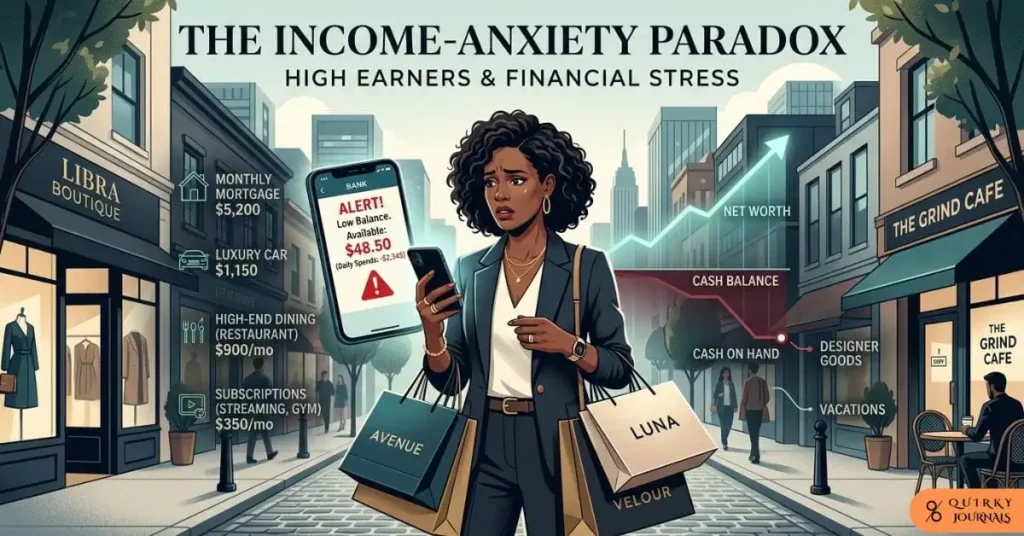
Picture someone making $180,000 a year. Good neighborhood. Late-model car. Nice dinners on Fridays. Now picture them checking their bank balance before buying groceries. Pretending their Venmo isn’t working to dodge splitting a dinner bill and quietly using buy-now-pay-later for a $60 purchase.
That person exists. In fact, that person is shockingly common right now.
According to The Harris Poll’s 2025 Income Paradox Survey, 64% of six-figure earners say their income isn’t a marker of success — it’s just the bare minimum to stay afloat. Meanwhile, a 2026 Acorns survey covered by CNBC found that 26% of people earning $150,000 or more per year still report feeling financially anxious. Not broke. Not unemployed. Anxious.
So what’s actually happening here? And more importantly, what do you do about it?
The Income-Anxiety Paradox Is Real, and the Data Is Uncomfortable
Most people assume that financial anxiety is a money problem. Earn more, stress less. Simple math. But the numbers don’t back that up.
The Acorns data tells an interesting story. Just over 51% of people earning under $20,000 a year reported financial anxiety. That number drops as income rises — but barely. Among those earning $60,000 to $80,000, the figure was 46%. Among those making $150,000 or more, it was 26%. That’s a 25-point drop across an income range spanning $130,000. The anxiety doesn’t evaporate. It just changes shape.
Even more striking is the Harris Poll data. Among Americans earning $200,000 or more per year, the survival tactics look almost identical to those used by people with far less income:
| Behavior | Six-Figure Earners | $200k+ Earners |
|---|---|---|
| Use rewards points to cover essentials | 58% | 64% |
| Check the bank balance before buying groceries | 53% | 51% |
| Split payments across multiple credit cards | 45% | 51% |
| Used BNPL for a purchase under $100 | 40% | 50% |
| Rely on credit cards to make ends meet | 43% | 46% |
| Delayed medical care due to cost | 42% | 45% |
Source: Harris Poll Income Paradox Survey, November 2025
These aren’t struggling households. These are people in the top 10% of American earnwho are ers making financial decisions that mirthose of ror working-class households under duress. That gap between income and financial security — between what people earn and how they feel — is exactly what we need to unpack.
Lifestyle Inflation: The Trap That Never Announces Itself
Let’s start with the most obvious culprit. Most people know what lifestyle inflation is. Very few actually recognise it in themselves until it’s already done the damage.
Here’s how it works in practice. You earn $80,000. You feel stretched. You grind, you hustle, and eventually you land a promotion. Now you’re at $120,000. You breathe out. You upgrade the apartment. You switch from cooking at home four nights a week to eating out four nights a week. You book a better vacation. Your car gets newer. Your wardrobe gets sharper.
Six months later, you feel exactly as stretched as before. Sometimes more.
The AOL analysis of this phenomenon is blunt: people making $120,000 can feel nearly as financially stressed as they did making half that — especially when the Camry became a lease on something. The Florida beach trip became a flight to Tahiti. Every dollar of extra income gets absorbed almost automatically by a higher-cost life. The margin never grows because the spending grew first.
This isn’t a willpower problem. It’s a systems problem. When income rises, the social and environmental cues around spending rise with it. New colleagues in the new salary bracket have different lunch habits. The neighbourhood you moved into has different norms. The benchmarks shift, and you shift with them without noticing.
Why Lifestyle Inflation Is Harder to Fight at Higher Incomes
At lower income levels, every dollar has a clear job. Rent. Food. Utilities. The budget more or less enforces itself. At $150,000 a year, there’s room to make decisions — and that room is where lifestyle inflation does its best work. There’s no immediate crisis forcing you to review your subscriptions or question the $400-a-month car payment. So you don’t. And the spending compounds quietly over the years.
According to Credit Karma, lifestyle creep is particularly dangerous because it happens in small increments. No single decision feels dramatic. The cumulative effect, though, is a high income with no margin, no savings growth, and a very fragile financial position. One bad month — a medical bill, a layoff, a car repair — and the whole system wobbles.
The Debt Load Is Much Bigger Than Most People Admit
High earners tend to carry high debt. That isn’t necessarily a problem in isolation, but it becomes one when the debt is the wrong kind, at the wrong cost, with too little cushion underneath it.
A peer-reviewed study in the PMC/NIH database confirmed that total debt is actually higher among higher-income households than lower-income ones. Mortgages are bigger. Car loans are larger. Private school tuition often involves financing. Home equity lines of credit get used to fund renovations. The assets are real, but so are the obligations.
What matters isn’t the size of the debt. It’s the ratio of debt payments to income, and the fragility of the income itself. A $4,500 monthly mortgage is sustainable on a $200,000 salary — until the salary disappears. And right now, a lot of high earners are quietly aware that their salary could disappear.
The Layoff Fear Is Not Irrational Right Now
As CNBC’s financial anxiety coverage noted, fears around AI-driven layoffs, ongoing economic uncertainty, and rising prices are all hitting simultaneously. High earners in sectors like tech, finance, and professional services have watched peers with six-figure salaries get cut with little warning. The higher the salary, the bigger the target in a cost-cutting exercise.
That awareness changes how financial anxiety presents at higher income levels. It’s less “I can’t pay this bill” and more “I’m one bad quarter away from not being able to pay anything.” The anxiety is prospective. It lives in worst-case scenarios that feel plausible rather than paranoid.
Financial planner Winnie Sun, quoted across major outlets, has noted that high earners often feel their financial security is more performance-dependent than asset-dependent. You’re not secure because you own things. You’re secure because you keep landing clients, keeping the job, keeping the performance reviews clean. That’s a fundamentally different — and more anxious — kind of security.
Net Worth Is the Actual Variable That Calms People Down
Here’s the most important finding buried in all this data. The Acorns survey didn’t just measure anxiety by income. It measured anxiety by net worth. And that’s where the picture changes.
Among Americans with a net worth between $500,000 and $800,000, 43% still reported financial anxiety — meaningful, but lower. Among those with a net worth above $800,000, that figure dropped to just 24%. Compare that to the 26% of people earning $150,000 per year who reported anxiety. In other words, owning assets reduces anxiety more effectively than earning income does.
Income is a flow. Net worth is a stock. A flow can be interrupted. A stock, if managed correctly, is structural. It doesn’t go away when the job does. This distinction is at the heart of why two households with identical incomes can have wildly different levels of financial confidence.
What Net Worth Actually Means for Financial Anxiety
Consider two households, each earning $180,000 a year. Household A has $900,000 in assets — a paid-down home, investment accounts, and six months of liquid savings. Household B has $180,000 in a 401(k), a heavily mortgaged house, two leased cars, and $14,000 in credit card debt. Same income. Completely different risk profiles. Completely different anxiety levels.
Building net worth requires making decisions that feel counterintuitive at high income levels. It means not upgrading the car just because you can. Not leasing the bigger house just because the mortgage is technically affordable. It means treating saving and investing as non-negotiable line items, not optional moves after other spending is sorted.
The data from Fidelity shows a troubling pattern: as inflation has outpaced wages, more Americans — including higher-income ones — are tapping retirement savings and relying on credit to cover expenses. That behaviour erodes net worth even as income stays high. It’s the slow leak in the financial boat that most people don’t notice until they’re bailing.
The ‘Illusion of Affluence’ and What It Costs You Socially
The Harris Poll nailed a phrase that deserves its own section: “living the illusion of affluence.” It captures something real and uncomfortable about modern high-earning life.
The social performance of financial success is expensive. The neighbourhood signals wealth expectations. So does the school district, the friend group, the job title. A principal at a top consulting firm doesn’t show up to client dinners at Applebee’s. A senior manager in a big-city tech company doesn’t opt out of the team happy hours because drinks are $18 each. The social cost of stepping outside the expected lifestyle is real, and most people aren’t willing to pay it.
According to the Fortune analysis of the Harris Poll data, high earners are skipping meals to save money, working side hustles, and cutting back on therapy — while simultaneously maintaining the external markers of success. That gap between internal reality and external performance is its own source of psychological strain.
The Hidden Cost of Status Maintenance
Researchers studying financial stress and social comparison have long understood that people don’t evaluate their financial situation in isolation. They evaluate it relative to their reference group. For a high earner in a high-status environment, the reference group is other high earners. The benchmarks are set by people in the room, not by objective measures of security.
If your colleagues are buying beach houses and your peers are sending kids to private school, the psychological pressure to do the same — regardless of whether your balance sheet supports it — is intense. This is social comparison theory in action, and it hits hardest at income levels where the choices are real, but the costs are high.
The truth is that a lot of high earners are funding a lifestyle designed to impress people they don’t really know, using money they don’t really have, creating anxiety they never talk about. That’s a treadmill with no finish line.
Six Behavioural Patterns Driving the Crisis
The research paints a clear picture of what’s actually happening. Let’s name the patterns directly, because vague awareness doesn’t change behaviour.
1. Spending Scaled to Income, Not to Goals
Most high earners have never seriously defined what financial security actually looks like for them. Without a clear target, spending fills the available space. Zero-based budgeting isn’t sexy, but it works — and very few people in the $150,000+ income bracket use it.
2. No Emergency Fund Worth Mentioning
The standard advice is three to six months of expenses in liquid savings. Most high earners don’t have it. The Federal Reserve’s household survey data consistently show that a significant portion of Americans across income brackets would struggle to cover a $400 unexpected expense without borrowing. At higher income levels, it’s often not that they couldn’t save it — it’s that they never prioritised it.
3. High Fixed Monthly Obligations
Mortgages, car payments, private school tuition, gym memberships, subscriptions — these are fixed costs that don’t flex when income dips. A high earner with $8,000 in monthly fixed obligations and a $14,000 monthly take-home has a lot less room than the salary suggests. Debt-to-income ratios matter at every income level.
4. Retirement Contributions That Don’t Match Income
Maxing out a 401(k) at the 2024 limit of $23,000 feels like a big contribution when you’re earning $60,000. At $200,000, it’s 11.5% of gross income — well below what most financial advisors recommend for high earners with ambitious retirement goals. The math on retirement savings at high income levels requires intentionality that most people skip.
5. No Clear Plan for the Tax Burden
High earners face a tax burden that lower earners don’t. Federal marginal rates, state income taxes, payroll taxes — combined, they can eat 35-45% of incremental income at higher salary levels. Many high earners are not working with a tax strategy beyond whatever their HR department sets up by default. Proactive tax planning through tax-deferred accounts, HSAs, and smart deductions can meaningfully change the net picture — but most people leave that money on the table.
6. Conflating Income Security With Financial Security
This is the root behavioural error. Income security means the paycheck keeps coming. Financial security means your life doesn’t crater if it stops. High earners are often very good at securing income and very bad at building the asset base that makes them truly resilient. The difference shows up when things go wrong.
The Psychological Dimension: Why More Money Doesn’t Buy More Calm
There’s a deeper layer to this that goes beyond budgeting advice. The PMC/NIH research on financial worries and psychological distress found that employment, income, and assets are all protective factors against anxiety — but the relationship is complex, not linear.
Financial anxiety at higher income levels is often rooted in identity and control, not in actual scarcity. Evans, the financial expert quoted in CNBC’s coverage, described it well: “It’s more about your individual sense of security, your individual sense of safety — ‘can I take care of myself or my family if something catastrophic happened?'” That existential question doesn’t get answered by a bigger paycheck. It gets answered by a stronger balance sheet and a clearer plan.
The Control Variable Nobody Talks About
Research in financial psychology consistently shows that perceived control over one’s financial situation is more strongly correlated with well-being than income itself. People who feel they understand their money, have a plan, and can handle surprises report less anxiety — regardless of how much they earn.
That’s actually empowering news. It means the lever isn’t “earn more.” It’s “take control of what you have.” The high earner who spends 20 minutes a month reviewing their budget, who has a clear investment strategy, who knows their net worth within $5,000 — that person is psychologically better positioned than the higher earner flying blind with a bigger gross salary.
This is also why Evans’ warning carries weight: “Please do not make financial decisions or move any money when you are feeling stressed out or in crisis.” Anxiety-driven financial decisions are usually short-sighted. Selling investments during a downturn. Tapping retirement accounts for non-emergencies. Taking on new debt to cover cash flow gaps. These moves feel like relief and function like accelerants.
What Actually Works: A Framework for High-Earning Households
Enough diagnosis. Here’s the practical framework, structured around the actual problem: income is high, but financial anxiety remains because the system underneath the income is fragile.
Step 1: Build a Net Worth Statement, Not Just a Budget
A budget tracks flow. A net worth statement tracks stock. You need both, but most people only have the first — and even then, inconsistently. Sit down with every asset: checking, savings, investment accounts, retirement funds, home equity, and any other real assets. Then subtract every liability: mortgage balance, car loans, student loans, and credit card balances. The resulting number is your actual financial position. Do this quarterly. Make it a habit. Tools like Personal Capital or Mint automate much of this.
Step 2: Separate Fixed Costs from Variable Costs — Ruthlessly
Fixed costs are the enemy of financial resilience at high income levels. The bigger they are, the less flexibility you have when income drops. Aim to keep fixed monthly obligations below 50% of your take-home pay. If you’re above that, it’s time to audit — the car lease, the subscription stack, the gym, the storage unit. None of these individual items is the problem. The aggregate is.
Step 3: Treat Emergency Savings as Infrastructure
At higher income levels, the emergency fund needs to be larger in absolute terms, not just in months. Six months of expenses for a household spending $12,000 a month is $72,000. That’s the target. Park it in a high-yield savings account where it earns something real while remaining fully liquid. This is not an investment. It’s infrastructure. It’s the thing that prevents a bad quarter from becoming a financial catastrophe.
Step 4: Automate the Wealth-Building Behaviours
Willpower is an exhaustible resource. Automation is not. Max out the 401(k). If your employer offers a mega backdoor Roth, understand it and use it. Set up automatic monthly transfers to a taxable brokerage account. At higher income levels, this isn’t optional financial advice. It’s the only mechanism that actually builds the net worth that, per the Acorns data, is the variable that reduces anxiety.
Step 5: Get a Real Tax Strategy
If you’re earning over $150,000 and you’ve never had a dedicated conversation with a fee-only financial planner or a certified tax professional about your specific situation, you are almost certainly paying more tax than necessary and missing optimisation opportunities. An HSA, a SEP-IRA if you have any self-employment income, tax-loss harvesting, charitable giving strategies — these are not exotic manoeuvres. They’re standard tools that most high earners underuse.
Step 6: Define “Enough” Before Lifestyle Does
This is the hardest one. What does financial security actually mean for you, in concrete terms? What net worth number makes you feel safe? What does a genuinely secure retirement look like in annual spending? Work backwards from a specific answer. Without a target, every spending decision is made in a vacuum, and lifestyle inflation wins by default. With a target, you can actually measure progress — and that sense of forward motion is itself an anxiety reducer.
The Macro Picture: Why This Matters Beyond Individual Finances
There’s a reason economists are paying close attention to high-earner anxiety right now. As Moody’s chief economist Mark Zandi noted, the top 20% of earners have been the primary engine driving U.S. economic growth. “As long as they keep spending, the economy should avoid recession,” he said. “But if they turn more cautious, for whatever reason, the economy has a big problem.”
That’s an uncomfortable position for anyone who cares about economic stability. The entire growth thesis depends on a group of people continuing to spend at high levels while privately anxious, financially stretched, and increasingly aware of the fragility underneath their income. That’s not a durable foundation.
What the Data Signals About the Broader Economy
When six-figure earners are using buy-now-pay-later plans for purchases under $100, that’s not a sign of financial sophistication. It’s a sign of cash flow stress at the top of the income distribution. When 46% of $200,000-earners say they rely on credit cards to make ends meet, the phrase “make ends meet” is doing a lot of heavy lifting. Those ends should not need meeting at that income level — and yet they do, because the spending architecture has been allowed to grow without structural constraint.
The combination of persistent inflation, high housing costs, childcare expenses, and debt service is putting real pressure on households that look, from the outside, like they have everything figured out. The quiet panic is quiet because admitting it would disrupt the performance. But it’s there.
The Mental Health Dimension Nobody Is Addressing
We’d be leaving something important out if we only talked about spreadsheets and savings rates. Financial anxiety has a real psychological and physical cost, and high earners are not exempt from it.
The Harris Poll data found that high earners are cutting back on therapy and medical care to save money. That’s a particularly self-defeating pattern, because unmanaged financial anxiety tends to degrade decision-making — exactly the faculty you need most to fix the underlying problem. Stressed people make short-sighted financial decisions. They sell low, borrow high, and defer the maintenance that becomes expensive repairs.
The NIH research details that financial worries are meaningfully correlated with psychological distress, and the causal relationship runs in both directions. Anxiety makes financial problems worse. Worse financial problems deepen anxiety. Breaking that cycle requires intervention — whether that’s working with a financial counsellor, a therapist familiar with financial anxiety, or simply a trusted advisor who can bring objectivity to a situation that’s become emotionally loaded.
The Value of Financial Clarity Over Financial Perfection
Many high earners avoid looking closely at their finances because the gap between what they earn and how they feel doesn’t make sense, and confronting it is uncomfortable. But clarity — even when it reveals problems — is almost always better than avoidance. Knowing your net worth is negative, even on a high income, is painful. But it’s actionable. You can work with painful and actionable. You can’t work with vague dread.
The research on financial control and well-being consistently shows that people who understand their financial picture, even an imperfect one, report lower anxiety than people who earn more but avoid looking. The solution is not a better salary. It’s a clearer system.
A Direct Word on What Not to Do Right Now
The advice industry tends to swing between two unhelpful poles when financial anxiety spikes. One pole says, “Invest aggressively now, the market always comes back.” The other says, “Move everything to cash and wait it out.” Both are bad answers when you’re operating from a place of fear.
Evans’ advice from the CNBC coverage deserves repeating: do not make significant financial moves when you’re in crisis mode. That’s when the decisions are most emotionally driven and least analytically sound. The right time to build an investment strategy is when you’re not panicking. The right time to sell investments is rarely driven by anxiety about the news cycle.
That said, doing nothing when the system is structurally broken is also a mistake. There’s a difference between reactive panic and proactive restructuring. If your fixed costs are genuinely unsustainable, restructure them deliberately — not in response to a bad week, but as part of a planned process. If your emergency fund is inadequate, build it systematically, not by raiding investments after a scare.
The Honest Summary Nobody Wants to Hear
High earners are financially anxious in America right now because income, without structure, creates spending. And spending, without limits, destroys the margin that security actually requires. The paradox isn’t mysterious once you see the mechanism clearly.
More money did not automatically bring more security because the system under the income was never designed for security. It was designed for consumption. The fix is not exotic. But it is uncomfortable, because it requires saying no to the lifestyle inflation that high income makes easy, and yes to the boring, patient accumulation of net worth that actually changes the anxiety equation.
The data is unambiguous on this. Income reduces anxiety marginally. Net worth reduces it structurally. Building net worth on a high income is a choice — one that the majority of high earners are, right now, actively not making.
That can change. But it requires being honest about what’s actually happening behind the polished exterior. And then doing something about it before the next unexpected expense decides for you.
Spend some time for your future.
To deepen your understanding of today’s evolving financial landscape, we recommend exploring the following articles:
Position Sizing Strategies Every Global Trader Needs to Master
NFT Boom, Bust, and Beyond: The Honest Post-Mortem
Currency Wars: Understanding Forex Dynamics in a Multipolar Economy
War Economy Chapter 22: Emergency Funds During Wartime
Explore these articles to get a grasp on the new changes in the financial world.
Disclaimer
The content in this article is intended for general informational and educational purposes only. It does not constitute financial, legal, tax, or investment advice. The data cited reflects third-party survey results and academic research and is subject to change. Individual financial situations vary significantly. Readers are encouraged to consult with a qualified, licensed financial professional before making any financial decisions. The author and publisher assume no liability for actions taken based on the information provided herein.
References
- Ma, J. (2025, November 23). Six-figure earners are ‘living the illusion of affluence’ while privately struggling. Fortune. https://fortune.com/2025/11/23/six-figure-earners-affluence-illusion-high-income-economic-financial-anxiety
- CNBC. (2026, May 30). Why higher income may not reduce financial anxiety. CNBC. https://www.cnbc.com/2026/05/30/why-higher-income-may-not-reduce-financial-anxiety.html
- Harris Poll. (2025, November). Income Paradox Survey: The Six-Figure Paradox — How Today’s High Earners Are Redefining Wealth and Financial Stability. Harris Insights & Analytics LLC. https://theharrispoll.com/wp-content/uploads/2025/11/Income-Paradox-Survey-November-2025.pdf
- Choi, S. L., Heckman, S. J., & Montalto, C. P. (2022). The relationship between financial worries and psychological distress among U.S. adults. PLOS ONE / PMC. https://pmc.ncbi.nlm.nih.gov/articles/PMC8806009
- AOL Finance. (2024). Why do so many Americans feel broke even with good incomes? AOL. https://www.aol.com/articles/why-many-americans-feel-broke-103007000.html
- Consumer Financial Protection Bureau. (2024). What is a debt-to-income ratio? CFPB. https://www.consumerfinance.gov/ask-cfpb/what-is-a-debt-to-income-ratio-en-1791/
- Federal Reserve. (2024). Report on the Economic Well-Being of U.S. Households. Board of Governors of the Federal Reserve System. https://www.federalreserve.gov/publications/2024-economic-well-being-of-us-households-in-2023-dealing-with-unexpected-expenses.htm
- American Psychological Association. (2023). Stress and financial issues. APA. https://www.apa.org/topics/stress/financial