
How Social Media Made Pump and Dump Faster, Bigger, Deadlier
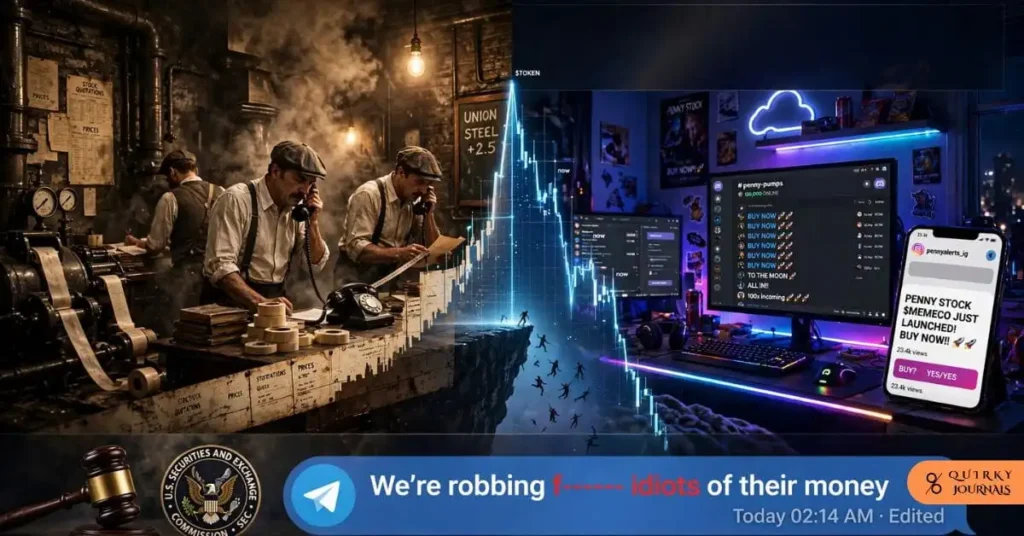
There is a recording that the SEC included in its 2022 criminal complaint against the Atlas Trading group. On that recording, influencer Daniel Knight, speaking over a Discord voice chat, says about their followers: “We’re robbing f—— idiots of their money.”
That quote is not embellished. It is from the court filing. And it captures something important: the people running these schemes are not confused about what they are doing. They know. The innovation is not the fraud itself. It is the delivery mechanism. Because for the first time in the history of market manipulation, a fraudster with 300,000 Twitter followers and a Discord server can reach more marks in 20 minutes than a boiler room full of cold-callers could reach in a month.
Pump-and-dump is the oldest financial fraud in the book. What changed is the infrastructure. And that change is reshaping who gets victimised, how fast the damage happens, and how regulators scramble to respond. This piece covers it all, without the promotional spin that most online coverage of this topic attracts.
First, the Mechanics: What a Pump and Dump Actually Is
Strip it down to basics. A pump-and-dump scheme is market manipulation in three acts.
In act one, the operators quietly accumulate a large position in a thinly traded, low-liquidity asset, typically a penny stock or microcap security, or more recently, a newly minted cryptocurrency token. Low liquidity is not incidental. It is essential. In thin markets, a relatively small coordinated buying effort can move the price meaningfully. This is deliberate targeting, not coincidence.
In Act Two, the operators promote aggressively. Historically, this meant cold calls, fake press releases, and stock tip newsletters sent to mailing lists. Today, it means social media posts, Discord server announcements, Twitter threads, Instagram stories, TikTok videos, and paid podcast mentions. The content is almost always the same: a stock or token framed as an unmissable opportunity, often with vague references to “insider knowledge,” momentum, or guaranteed returns.
In act three, when the price has risen enough due to retail investors buying into the hype, the operators dump their positions. Simultaneously and quietly. The price collapses as the artificial buying pressure disappears. Late retail investors, who bought at the elevated price, are left holding an asset that has lost most of its value. The operators walk away with the spread.
The fraud is not complicated. The Securities Act of 1933 makes it criminal to obtain money by means of any untrue statement of a material fact. The core legal issue is that the operators are promoting an asset while concealing their intent to sell at the elevated price. They are representing their enthusiasm as genuine while secretly planning the exit. That deception is the fraud.
A Hundred Years of the Same Playbook
The scheme is not new. Not remotely. In the early 1990s, the penny-stock brokerage Stratton Oakmont artificially inflated the price of its own stock through false and misleading positive statements. Firm co-founder Jordan Belfort was criminally convicted for it. You know the rest: memoir, Academy Award-nominated film, speaking circuit.
Before Stratton Oakmont, there were literal boiler rooms. Rows of salespeople in leased office space, burning through call lists targeting inexperienced investors with high-pressure pitches for worthless stocks. The scheme starts when the operators quietly accumulate a large position in a penny stock at a rock-bottom price, then the boiler room goes to work. The premise has not changed since the 1920s. The technology has.
Even the internet era was not new. During the dot-com bubble, a 15-year-old named Jonathan Lebed allegedly bought penny stocks and promoted them on stock message boards. He made hundreds of thousands of dollars before the SEC caught up with him. That was 2000. The underlying mechanics are indistinguishable from what Atlas Trading did twenty years later. What is different is the scale, the speed, and the audience.
Discord, Twitter, and the Atlas Trading Case
In December 2022, the SEC and Department of Justice charged eight social media influencers in what became the defining pump-and-dump case of the social media era. The group had operated primarily through Twitter and a Discord server called Atlas Trading, which they described as the “largest free stock trading community.” By early 2021, it had grown to 150,000 members.
According to the SEC, since at least January 2020, the defendants promoted themselves as successful traders and cultivated hundreds of thousands of followers on Twitter and in stock trading chatrooms on Discord. They purchased certain stocks, posted price targets, and indicated they were buying or adding to their positions. When prices rose, they sold their shares without ever disclosing their intent to dump.
The defendants in total had more than 1.5 million Twitter followers. The alleged scheme ran until about April 2022 and resulted in at least $114 million in profits. Each charge carried a maximum sentence of 25 years.
The operational model was sophisticated and specifically designed to exploit social media architecture. Using their Instagram pages full of pictures of exotic cars, multiple credit cards, and designer clothes to lure in marks, finance influencers typically offer access to an “exclusive” Discord server where they promise private and valuable communication about trading. The luxury lifestyle aesthetic was not incidental. It was the brand. It was the proof of concept that their “trading strategies” worked. And it attracted exactly the audience they needed: inexperienced investors who aspired to the lifestyle and trusted the influencers because of it.
Why Discord Was Ideal for This
Discord is not primarily a financial platform. It started as infrastructure for gaming communities. But several features made it particularly useful for coordinated market manipulation.
First, server access can be gated behind payment, creating both revenue streams and the illusion of exclusivity. Paying for access to “alpha” makes the content feel more valuable, regardless of whether it is. Second, voice chat functionality allowed the Atlas Trading group to coordinate in ways that were harder to surveil than public posts, though not hard enough, as the SEC’s inclusion of voice chat transcripts in the complaint demonstrated. Third, Discord servers can scale to hundreds of thousands of members while maintaining the feel of an “in-group,” which is psychologically powerful for manipulation purposes.
The combination of Instagram for brand-building and Discord for orchestration was not accidental. It was a precision instrument. Instagram establishes lifestyle credibility. Discord converts the followers into a captive audience for stock tips. The stock tips are the pump mechanism. The exit is the dump. Each platform plays a specific role in the scheme.
The Celebrity Dimension: Kim Kardashian and the Broader Pattern
The Atlas Trading case involved people who were famous primarily for their follower counts and their claims of trading expertise. But the same architecture applies when actual celebrities enter the picture. Sometimes celebrities are complicit. Sometimes they are simply paid without adequate disclosure. The legal and practical consequences differ, but the investor harm is often comparable.
The most visible example is Kim Kardashian. In 2022, the SEC charged Kim Kardashian with promoting EthereumMax on Instagram without disclosing she was paid $250,000. She settled, paying $1.26 million in penalties, disgorgement, and interest, and agreed to a three-year ban on promoting crypto securities. Her Instagram post reached 225 million followers. The reach is not analogous to a boiler room making a few hundred calls per day. It is categorically different in scale.
Paul Pierce, the former NBA star, was separately charged for promoting the same EMAX token while receiving over $244,000 in compensation, which he also failed to disclose. Both cases highlight the SEC’s focus on celebrity endorsements in the crypto space and the Section 17(b) requirement that any paid promoter of a security must disclose the nature, scope, and amount of compensation.
Then there is the Justin Sun circle. In February 2021, Lindsay Lohan tweeted to her more than 8 million followers that she was “exploring” decentralised finance and “liking” Tronix tokens, failing to disclose the $10,000 she received from the Tron Foundation. The SEC alleged that the Tron founder instructed her and seven other celebrity promoters, including Soulja Boy and Jake Paul, to keep quiet about their compensation.
| Individual / Entity | Platform | Asset Promoted | Outcome |
|---|---|---|---|
| Kim Kardashian | EthereumMax (EMAX) | $1.26M fine; 3-year crypto promo ban | |
| Paul Pierce | Twitter/X | EthereumMax (EMAX) | SEC charges; undisclosed $244K comp |
| Lindsay Lohan | Tronix (TRX) | SEC action; undisclosed $10K payment | |
| Atlas Trading Group (8 defendants) | Twitter + Discord | Various exchange-traded stocks | Criminal + civil charges; $114M+ profits alleged |
| M1 Finance (firm) | Multiple platforms | Margin lending products | FINRA $850K fine; 39,400 accounts affected |
| SafeMoon promoters (incl. Jake Paul, Nick Carter, Lil Yachty) | Twitter, Instagram | SafeMoon token | Class-action lawsuit; token lost 80%+ value |
| FCA UK (9 Love Island / TOWIE defendants) | FX / CFD scheme | Criminal charges; trial set for 2027 |
The Crypto Dimension: Why Tokens Made This Worse
Stock pump-and-dump schemes require the operators to find and accumulate existing shares. Regulatory reporting requirements for large share positions in public companies create friction. The SEC monitors for unusual trading patterns. FINRA has surveillance systems. The barriers are not insurmountable, as Atlas Trading demonstrated, but they exist.
Cryptocurrency removed most of those barriers. What makes crypto especially susceptible to this ploy is that organisers do not have to search very hard for thinly traded assets; they can just create them. The barrier to creating a new cryptocurrency is a small amount of research and coding knowledge. A group of operators can mint a token, allocate a large percentage of the supply to themselves, build a social media presence around it, and launch a coordinated pump within days.
The SQUID token in late 2021 is the textbook example. The token launched with a hook: it was themed around the Netflix series Squid Game, which was at peak viral relevance at the time. The price soared from pennies to over $2,800 within days. Then it crashed to essentially zero when the creators cashed out. The whole cycle took less than two weeks. And because the token was essentially unregulated, on a decentralised exchange with anonymous creators, most of those responsible faced no legal consequences.
SafeMoon was a larger and more sustained operation. In 2021, celebrities including Jake Paul, Soulja Boy, Lil Yachty, and Nick Carter started tweeting about SafeMoon. Prices shot up as millions of people bought in. By the end of the year, SafeMoon had lost more than 80% of its value. A class-action lawsuit was filed in 2022 alleging that the team and promoters secretly owned large portions of the token and sold during the hype while telling ordinary investors to hold.
In May 2025, a meme coin called $HAWK launched, backed by Haliey Welch, the viral “Hawk Tuah” social media personality. Within hours, it reached a market cap of nearly $500 million. Blockchain analysis found that 80% to 90% of the total supply was controlled by just a few wallets. One of them was dumped within two hours, walking away with $1.3 million. The token crashed by more than 90%. The SEC investigated but filed no penalties. Welch denied profiting from it.
Why Crypto Is Structurally Vulnerable
The structural features that make cryptocurrency pump-and-dumps so prevalent are not accidental. They are inherent to the technology and the market’s current state.
Low market capitalisation and illiquidity mean a small group of coordinated wallets can push prices up fast. Anonymous development teams can disappear after the dump. Decentralised exchanges operate without centralised oversight that could flag unusual trading. Social media platforms like Telegram, X, Discord, and TikTok allow misleading claims, fake insider news, and coordinated hyprealiseread rapidly, drawing in retail investors who may not realise the price action is artificially engineered.
There is also the regulatory gap. Many crypto tokens exist in legal grey zones regarding whether they qualify as securities under the Howey Test. When something is not clearly defined as a security, the full weight of securities law does not automatically apply. This ambiguity has historically been exploited by operators who deliberately structure tokens to stay outside clear regulatory definitions, even while functionally operating like investment schemes.
The Audience: Who Is Actually Getting Hurt
Understanding who bears the losses matters. It is not abstract. It is young, frequently inexperienced investors who came to financial markets through social media and who are disproportionately trusting of the information they find there.
The numbers on social media as a financial advice source are striking. A 2023 Bankrate survey found that 76% of Gen Z and 65% of millennials seek financial advice through social media. A FINRA study found that over 60% of US investors under age 35 use social media as a source of investment information, compared to just 57% who use actual financial professionals. A broader study found that 79% of millennial and Gen Z consumers are steered toward financial advice through social media algorithms.
More troubling: only 31% of Gen Z and millennials regularly check the experience and qualifications of people who supply them with financial advice on social media. A BaFin study found that 37% of young investors were unaware that finfluencers typically receive payment for their recommendations. Among those who purchased products via a finfluencer link, 15% were unaware of the compensation practices at all.
This is not about stupidity. It is about the environment. When 80% of your peers get investment information from the same platform you use for entertainment, and when the content is indistinguishable from organic enthusiasm until you know to look for the tell-tale signs of coordination, the vulnerability is structural. The fault is not primarily with the audience. It is with the people exploiting the environment and with the regulatory frameworks that failed to keep pace.
The Research Is Clear: Following Finfluencers Loses Money
Academic research is not ambiguous on this point. Research on crypto influencer tweets found that average cumulative returns ending 10, 30, and 90 days after the tweet are -2.24%, -6.53%, and -18.90%, respectively. These results are even worse for smaller market cap tokens. The more expert the adviser claimed to be, the steeper the loss. Self-described “financial professionals” among finfluencers produced worse investment outcomes than general social media influencers.
That research is consistent with the mechanics of pump-and-dump. The influencer posts when they have already accumulated their position. Their followers buy after the post, pushing the price up further. The influencer sells into that buying pressure. The price declines. The followers who bought at the elevated price lose money. Averaged across many schemes, the post-tweet return curve bends negatively almost immediately and worsens over time.
The Cambridge Judge Business School notes an additional dynamic worth understanding. Beyond pump-and-dump, influencers have at least four other exploitation strategies: encouraging HODLing to support money laundering liquidity, pushing followers toward exclusive paid events, selling branded merchandise, and churning followers from one token to the next to generate ongoing fee and commission revenue. The pump-and-dump is the most legally actionable version, but it is not the only mechanism of harm.
The Regulatory Response: Catching Up to Speed
Regulators were not blind to these problems. They were slow. And the gap between the pace of social media fraud and the pace of regulatory response is genuinely costly to retail investors.
The SEC has used existing statutes with increasing aggression. Section 17(b) of the Securities Act prohibits promoting a security without disclosing compensation. The Market Abuse provisions of the Securities Exchange Act of 1934 cover the coordination and manipulation elements. In 2025, the SEC introduced guidelines requiring crypto influencers to register as investment advisers if they provide personalised advice, though enforcement remains challenging due to the sheer volume of content.
FINRA launched a targeted examination called the Finfluencer Sweep in September 2021, focusing on how broker-dealers manage customer acquisition through social media. In 2024, FINRA settled three finfluencer-related enforcement actions, with fines imposed on firms including M1 Finance ($850,000) and TradeZero America ($250,000) for failing to supervise finfluencer content. The M1 Finance case revealed that 39,400 accounts had been opened through 1,700 influencers, some of whom promoted products with false claims, without adequate firm oversight.
In the UK, the Financial Conduct Authority finalised guidance on financial promotions on social media in March 2024. In May 2024, the FCA charged nine individuals, including several reality television personalities, in connection with an unauthorised foreign-exchange scheme promoted through Instagram. In June 2025, the FCA coordinated a week of action with eight other regulators, making three arrests, issuing 50 warning alerts, and triggering more than 650 takedown requests on social platforms.
In the EU, the Markets in Crypto-Assets Regulation (MiCA) now applies in full as of December 2024. It imposes “fair, clear and not misleading” standards on crypto marketing communications and extends these requirements to finfluencer content distributed on behalf of regulated entities.
The Enforcement Gap Remains Real
None of this means the problem is solved. The fundamental challenge is scale asymmetry. A single coordinated pump-and-dump can reach millions of people across multiple platforms simultaneously. The SEC’s Investor Advisory Committee has documented that the rapid pace of social media content creation outstrips traditional oversight mechanisms, making real-time monitoring difficult. By the time regulators detect a scheme, file for emergency relief, serve defendants, and attempt to freeze assets, the dump is often long over, and the money has moved.
International jurisdiction compounds the problem. Regulating finfluencers presents challenges due to the global nature of social media and varying regulatory frameworks. A promoter in one jurisdiction can target investors in dozens of others. The coordination required to prosecute across borders is slow. Criminal extradition, when foreign actors are involved, is slower still.
The FTC’s data is stark. In the first six months of 2023 alone, investors lost $2.7 billion from investment-related fraudulent scams initiated on social media in the US. Some 37% of those fraud losses were reported by investors aged 20 to 29. The CertiK security firm documented that over $1 billion was lost to crypto scams in the 18 months following the start of 2021, with a majority of those scams starting on social media platforms.
The Psychology of Why It Works: Trust, FOMO, and the Luxury Signal
The mechanics of the fraud are clear. Less discussed is why it works so consistently on so many people. The answer is not that victims are unsophisticated. It is that the scheme is specifically engineered to defeat ordinary decision-making processes.
Start with the trust architecture. Gen Z is almost five times more likely to get financial advice from social media platforms than people aged 41 or over. This is partly about channel preference. But it is also about institutional distrust. Many young investors watched their parents navigate the 2008 financial crisis. They inherited a justified scepticism toward traditional financial institutions. Into that vacuum walked the finfluencer: a relatable peer, apparently self-made, sharing strategies that institutional advisers either would not or could not. The trust transfer from institutions to individuals is real, and it creates vulnerability.
The luxury lifestyle signal serves a specific psychological function. The exotic cars, the watches, the credit cards fanned out on a table: these are not just social media aesthetics. They are proof-of-concept. They tell the audience that this person’s trading strategy works. The implied logic is: you follow the strategy, you get the lifestyle. This is pure persuasion architecture. It is also essentially impossible to verify. The car might be rented. The cards might be maxed out. The “trading profits” might be from selling Discord server subscriptions to people chasing those exact images.
FOMO is the accelerant. Social media creates real-time awareness of what other people are doing. When a Discord server with 150,000 members is buzzing about a stock, and multiple influencers with millions of combined followers are simultaneously posting about it, the experience for an individual observer is that something is happening that they are about to miss. That urgency, manufactured or real, dramatically compresses the time available for due diligence. Messages promising “guaranteed profits” or urging buyers to act quickly are frequent hallmarks of pump activity. The urgency is not accidental. It is a feature.
The “Exclusive Access” Premium
One specific mechanism worth highlighting is the paid Discord server. It is not uncommon for these influencers to ask people to pay to get access to their servers. This serves multiple functions in a pump-and-dump operation.
First, it generates direct revenue independent of the trading scheme. Second, it creates a sunk-cost dynamic: users who have paid for access are psychologically invested in the idea that the content is valuable, which makes them more likely to act on the tips they receive. Third, it builds the impression of selectivity and exclusivity, which further validates the apparent quality of the “alpha” being shared. Fourth, it filters the audience toward people who are ready to deploy capital, which makes the promotion more effective at moving markets.
The gating mechanism also creates network effects of trust. When you pay to join a group, you tend to assume the other members have done meaningful due diligence. The collective action of the group feels like evidence of validity. In reality, every member is experiencing the same manufactured trust signal. This is a social proof trap at scale.
Red Flags: What the Pattern Actually Looks Like
Understanding the mechanics is useful. Knowing what to look for in real time is more useful. The patterns are recognisable, once you know what to search for.
Sudden unexplained price spikes with no fundamental news. If a low-cap token or a thinly traded small stock spikes 50% in a day and there is no material business development, earnings release, or regulatory approval driving it, that spike is almost certainly manufactured. The first red flag is a sudden, unexplained price spike in a low-liquidity or low-market-cap token, often accompanied by abnormal trading volume and no real news to justify it.
Lifestyle-heavy, credentials-light promoters. The person showing you their cars and watches is performing wealth. The person showing you their CFA designation, their FINRA registration, or their SEC-registered advisory firm is demonstrating verifiable qualification. These are entirely different things. Research by BaFin found that 37% of young investors were unaware that finfluencers typically receive payment for their recommendations.
Coordinated multi-platform promotion within a short window. When multiple influencers you follow are all posting about the same asset on the same day, and those influencers appear to know each other, you are likely watching a coordinated campaign. Organic investment enthusiasm does not typically emerge simultaneously across dozens of unrelated accounts.
Urgency language. “Buy now before it’s too late.” “This is the last chance to get in at this price.” “I’m only sharing this with my inner circle.” These phrases are manipulation templates. They create time pressure that prevents the decision-making process from functioning normally.
Vague fundamentals with no verifiable white paper or business model. Legitimate investment opportunities can be analysed. They have financial statements, product roadmaps, identifiable development teams with verifiable track records, and understandable business models. If the entire case for an investment rests on social proof and hype, that is not an investment thesis. It is a momentum trade built on borrowed time.
Token supply concentration. Blockchain analysis of the $HAWK token revealed that 80% to 90% of the total supply was controlled by a few wallets, which is a reliable signal of pump-and-dump architecture. Tools like Bubblemaps and blockchain explorers can show wallet concentration on most public-ledger tokens. If insiders hold most of the supply, any buyer is effectively funding their exit.
What Legitimate Looks Like: Distinguishing Good from Bad
Not all financial content on social media is fraudulent. Some finfluencers provide genuine, accurate, well-disclosed content. The distinction matters because conflating all social media financial content with fraud pushes young investors toward precisely the institutional distrust that makes them vulnerable to the bad actors.
Legitimate financial content on social media typically involves: clear disclosure of compensation and conflicts of interest; no promotion of specific securities without appropriate licensing or registration; general financial education rather than specific actionable stock or token picks; consistent disclosure that the content is not personalised financial advice; and verifiable track records or credentials.
The SEC’s own guidance is clear: anyone promoting a security for compensation must disclose the nature, scope, and amount of that compensation, even if they are not a licensed broker or adviser. The FTC requires disclosure of material connections between promoters and the products they promote. These requirements apply even to a single Instagram post. The standard is not whether you are a financial professional. It is whether you disclosed that you were paid to say what you said.
The most important signal is conflict of interest disclosure. A paid promotion that says “I was paid to tell you about this” is not an ethical analysis. But it is at least honest. An undisclosed paid promotion that presents itself as organic enthusiasm is deceptive in a way that actively harms the audience. The law treats them very differently, and so should investors.
The Regulators’ Next Problem: AI-Generated Hype
The landscape is already shifting again. The current enforcement environment is beginning to catch up with the 2020–2023 wave of influencer-driven manipulation. But the next generation of the problem is AI-generated content at scale.
AI can now produce convincing investment analysis, fabricated testimonials, synthetic social proof signals, and automated engagement across dozens of accounts simultaneously. A pump-and-dump operation that in 2021 required eight human influencers to coordinate manually can, in theory, now be executed by a much smaller group using AI-generated content across synthetic accounts. The coordination problem that the SEC was able to identify and prosecute in the Atlas Trading case, where humans were leaving voice chat records and messaging each other on platforms, becomes much harder to detect when the “influencers” are algorithmically generated.
On 16 December 2025, the SEC’s Division of Examinations published a risk alert highlighting persistent failures to provide required disclosures at the point of dissemination across websites, social media, lead-generation firms, and referral networks. That alert was focused on current failures. The forward-looking challenge is significantly harder.
Regulators are aware of this. The global patchwork of frameworks, including MiCA in the EU, the FCA’s updated guidance in the UK, SEC’s updated Marketing Rule, and FINRA’s finfluencer sweep, is attempting to build a foundation before the next wave. Whether that foundation is adequate is an open and genuinely uncertain question.
The Platform Accountability Gap
One dimension that regulation has not adequately addressed is platform liability. Currently, platforms like Instagram, TikTok, Discord, and X bear very limited legal responsibility for the financial fraud content they host and distribute. Section 230 of the Communications Decency Act in the US provides broad immunity to platforms for third-party content.
That immunity made sense in the early internet era. It is harder to justify when a platform’s recommendation algorithm actively amplifies a coordinated pump-and-dump campaign to millions of users in real time. The question of whether and how to hold platforms accountable for algorithmic amplification of financial fraud is unresolved. It is also likely the most consequential remaining policy question in this space.
The top 10 finfluencers have more than six times the followers of the top 10 financial institutions globally. The platforms that host those finfluencers are, in effect, the distribution infrastructure of the modern financial advice market. Treating them as neutral pipes is increasingly difficult to defend.
Practical Self-Defence: What You Can Actually Do
This is where we move from analysis to application. Because the regulatory environment, while improving, is not going to protect every investor from every scheme, self-defence matters.
Treat free “insider” information as a product you are paying for with your money. When a Discord server offers you exclusive stock tips for $20 a month, you are the product. The “alpha” is the bait. The trading tips are the pump mechanism. Your buy-in is what they need to execute the dump profitably. There is no free lunch in financial markets. There is certainly no discount lunch in a paid Discord server.
Check the SEC’s EDGAR and FINRA’s BrokerCheck before acting on any individual’s financial advice. FINRA’s BrokerCheck is free and publicly available. Investment advisers registered with the SEC are searchable on EDGAR. If someone is giving you specific investment advice and they do not appear in either database, they are either a legitimate educator who is not providing advice (in which case, why are you treating their content as advice?) or they are operating outside the law.
Look at on-chain data for any crypto investment. Tools like Etherscan, Solscan, and Bubblemaps allow you to see how a token’s supply is distributed and who is selling. If the top ten wallets hold 70% of the supply, you do not need a regulator to tell you what the risk profile looks like.
Wait. Intentionally slow down. The urgency in pump-and-dump promotions is manufactured specifically to prevent this. If a trade is genuinely good, it will still be good in 48 hours. If the opportunity only exists in the next 20 minutes, that urgency is telling you something about who benefits from you acting fast.
Report suspicious activity. The SEC’s Tips, Complaints, and Referrals portal accepts reports of suspected market manipulation. The FTC’s ReportFraud.ftc.gov handles scams of all kinds. Individual reports matter. The Atlas Trading complaint was built partly on evidence gathered over time from multiple sources. Regulators cannot act on what they do not know about.
The Structural Tension That Nobody Wants to Fully Address
There is a harder argument underneath all of this that enforcement actions and “how to spot a scam” articles tend to avoid: the financial media environment that makes pump-and-dump so effective was not created by the fraudsters. It was created by the legitimate attention economy.
The reason finfluencers have millions of followers is that traditional financial institutions failed to speak to younger investors in accessible, human terms. The reason Discord servers with exclusive stock tips feel valuable is that professional financial advice is expensive, jargon-heavy, and often inaccessible to people with less capital. The reason FOMO works on young investors is that economic anxiety, driven by housing costs, student debt, stagnant wages, and climate uncertainty, is genuinely high among precisely the demographic most targeted by these schemes.
The fraudsters did not manufacture that anxiety. They are exploiting it. And regulation, however well-designed, cannot address the underlying conditions that make exploitation so effective at scale. Finfluencers, as a relatively new phenomenon, are not currently subject to direct regulation in the United States: they need not have any qualifications to provide investment advice, need not disclose if they are being paid for promoting specific products, and need not fear being sued by regulators under current frameworks. Closing that gap is necessary. But it will not resolve the attention economy dynamics that make the market for financial influence so enormous in the first place.
Final Thought
The Wolf of Wall Street made Jordan Belfort a cultural figure. The Atlas Trading case made @MrZackMorris a defendant. The production values changed. The mechanism did not. Buy low. Hype loudly. Sell into the buying pressure. Leave the followers holding the bag.
What changed is that the boiler room is now a public Instagram profile with 400,000 followers. The sucker list is an algorithmic feed. The cold call is a Discord notification. And the marks are people who followed someone because they liked their content, trusted them because they seemed wealthy, and acted because every signal in their environment said: act now, or miss out.
The regulators will keep improving. The enforcement environment is meaningfully better than it was five years ago. But the schemes will also keep evolving. The next iteration, probably involving AI-generated hype at scale, is already in development somewhere. The best protection is not a regulator. It is understanding, in granular mechanical detail, exactly how the fraud works. Because the people running these schemes are counting on you not to know. That is the only bet they cannot rig.
Spend some time for your future.
To deepen your understanding of today’s evolving financial landscape, we recommend exploring the following articles:
Buy, Borrow, Die: How the Ultra-Wealthy Avoid Taxes Legally
Algo Trading Safety Net: Risk Management for Automated Systems
AI Crash 2026: Kospi Halts, Nasdaq Slides, Chip Stocks Bleed
College Majors That Leave You Drowning in Debt (And the Ones That Don’t)
Explore these articles to get a grasp on the new changes in the financial world.
Disclaimer
The information in this article is provided for general informational and educational purposes only. Nothing in this article constitutes legal, financial, investment, or securities advice. References to specific enforcement actions, court cases, or regulatory findings are drawn from publicly available sources and reflect events as documented at the time of writing; they should not be treated as s current legal status of any individual or entity. Securities laws vary significantly by jurisdiction. Do not rely on this article as guidance for specific investment or legal decisions. Consult a licensed securities attorney or registered investment adviser for advice specific to your situation. The author and publisher accept no liability for decisions made on the basis of content in this article.
References
- U.S. Securities and Exchange Commission. (2022). SEC Charges Eight Social Media Influencers in $100 Million Stock Manipulation Scheme Promoted on Discord and Twitter. Press Release No. 2022-221. Available online: https://www.sec.gov/newsroom/press-releases/2022-221
- NBC News / Tenbarge, K. (2022). SEC says social media influencers used Twitter and Discord to manipulate stocks. Available online: https://www.nbcnews.com/tech/tech-news/sec-says-social-media-influencers-used-twitter-discord-manipulate-stoc-rcna61673
- CNN Business / Fung, B. (2022). US government charges 8 social media influencers over alleged pump-and-dump scheme. Available online: https://www.cnn.com/2022/12/14/tech/sec-influencers-pump-and-dump/index.html
- CNBC. (2022). DOJ and SEC charge social media influencers in alleged $100 million stock pump-and-dump scheme. Available online: https://www.cnbc.com/2022/12/14/sec-charges-social-media-influencers-in-alleged-100-million-fraud-scheme.html
- Fortune. (2022). Social media influencers are charged with an alleged pump-and-dump stock scheme. Available online: https://fortune.com/2022/12/14/social-media-influencers-pump-and-dump-stock-scheme
- do t.LA. (2022). Eight Men Indicted In Discord Pump and Dump Scheme. Available online: https://dot.la/pump-and-dump-discord-2658970824.html
- SEC Investor Advisory Committee. (2024). Finfluencer Recommendation. Available online: https://www.sec.gov/files/sec-iac-finfluencer-recommendation-11222024.pdf
- Securities Lawyer 101. (2025). Regulation of Financial Influencers: Navigating Securities Law Violations and SEC Enforcement. Available online: https://www.securitieslawyer101.com/2025/regulation-of-financial-influencers/
- Carlton Fields. (2024). FINRA and SEC Float Concerns Over Social Media Finfluencers. Available online: https://www.carltonfields.com/insights/expect-focus/2024/finra-and-sec-float-concerns-over-social-media-finfluencers
- Sedric. (2025). Influencer and Finfluencer Compliance Guide 2026 (FCA, SEC, FINRA). Available online: https://www.sedric.ai/blog/influencer-compliance
- AWISEE. (2025). SEC and FINRA Examples and Regulation of Financial Influencers In 2026. Available online: https://awisee.com/blog/regulation-of-financial-influencers/
- Better Markets. (2024). Unregulated Financial Influencers. Available online: https://bettermarkets.org/wp-content/uploads/2025/01/BetterMarkets_Financial_Influencers_Final.pdf
- CertiK. (2023). Social Media Crypto Scams. Available online: https://www.certik.com/resources/blog/social-media-crypto-scams
- Harvard Business School Working Knowledge / Pacelli, J. (2023). When Celebrity ‘Crypto-Influencers’ Rake in Cash, Investors Lose Big. Available online: https://www.library.hbs.edu/working-knowledge/when-celebrity-crypto-influencers-rake-in-cash-investors-lose-big
- Oxford Law Blog / Pacelli, J. (2023). Crypto-Influencers Give Poor Investment Advice — and the SEC is Taking Notice. Available online: https://blogs.law.ox.ac.uk/oblb/blog-post/2023/11/crypto-influencers-give-poor-investment-advice-and-sec-taking-notice
- Cambridge Judge Business School / Jagolinzer, A. (2024). How crypto influencers manipulate vulnerable investors. Available online: https://www.jbs.cam.ac.uk/2024/how-crypto-influencers-manipulate-vulnerable-investors/
- CCN. (2024). Celebrities Linked to Crypto Pump and Dump Scams. Available online: https://www.ccn.com/news/crypto/celebrities-linked-crypto-pump-dump-scams/
- 1st Source Bank. (2025). Crypto Fraud: Famous Pump and Dump Schemes. Available online: https://www.1stsource.com/advice/crypto-fraud-famous-schemes/
- BingX. (2025). What Are Crypto Pump-and-Dump Scams and How to Avoid Them? Available online: https://bingx.com/en/learn/article/what-are-crypto-pump-and-dump-scams-how-to-avoid-them
- The Motley Fool. (2026). How To Spot a Pump and Dump Crypto Scam. Available online: https://www.fool.com/investing/stock-market/market-sectors/financials/cryptocurrency-stocks/how-to-spot-crypto-scam/
- Corporate Finance Institute. (2024). Pump and Dump: Definition, How It Works, and Types. Available online: https://corporatefinanceinstitute.com/resources/career-map/sell-side/capital-markets/pump-and-dump/
- LegalClarity. (2026). Boiler Room Scheme: How It Works and Red Flags. Available online: https://legalclarity.org/what-is-a-boiler-room-scheme-and-how-does-it-work/
- Wikipedia. (2024). Pump and Dump. Available online: https://en.wikipedia.org/wiki/Pump_and_dump
- World Economic Forum / WEF. (2026). Why does Gen Z invest so differently? It’s a trust issue. Available online: https://www.weforum.org/stories/2026/01/gen-z-financial-investment-trust/
- World Economic Forum. (2024). Are ‘finfluencers’ the future of financial advice worldwide? Available online: https://www.weforum.org/stories/2024/07/finfluencer-financial-advice-social-media/
- Federal Reserve Bank of Philadelphia. (2024). How Americans Use Social Media for Financial Advice. Available online: https://www.philadelphiafed.org/-/media/FRBP/Assets/Consumer-Finance/Reports/how-americans-use-social-media-for-financial-advice.pdf
- Penningtons Manches Cooper. (2024). The impact of ‘finfluencers’ on Millennial and Gen Z investment preferences. Available online: https://www.penningtonslaw.com/news-publications/latest-news/2024/the-impact-of-finfluencers-on-millennial-and-gen-z-investment-preferences
- PYMNTS Intelligence. (2024). 79% of Millennials and Gen Z Turn to Social Media for Financial Advice. Available online: https://www.pymnts.com/consumer-finance/2024/79percent-of-millennials-and-gen-z-turn-to-social-media-for-financial-advice/
- CFA Institute. (2024). The Finfluencer Appeal: Investing in the Age of Social Media. Available online: https://rpc.cfainstitute.org/research/reports/2024/finfluencer-appeal
- Giambrone and Partners. (2022). Reduce Financial Fraud: Celebrity Social Media Endorsement Scrutiny. Available online: https://www.giambronelaw.com/site/news-articles-press/library/articles/kim-kardashian-fined-for-crypto-endorsement
- Northwestern University Law Review Online. (2024). Fraud on the Social Media Market. Available online: https://scholarlycommons.law.northwestern.edu/cgi/viewcontent.cgi?article=1347&context=nulr_online