
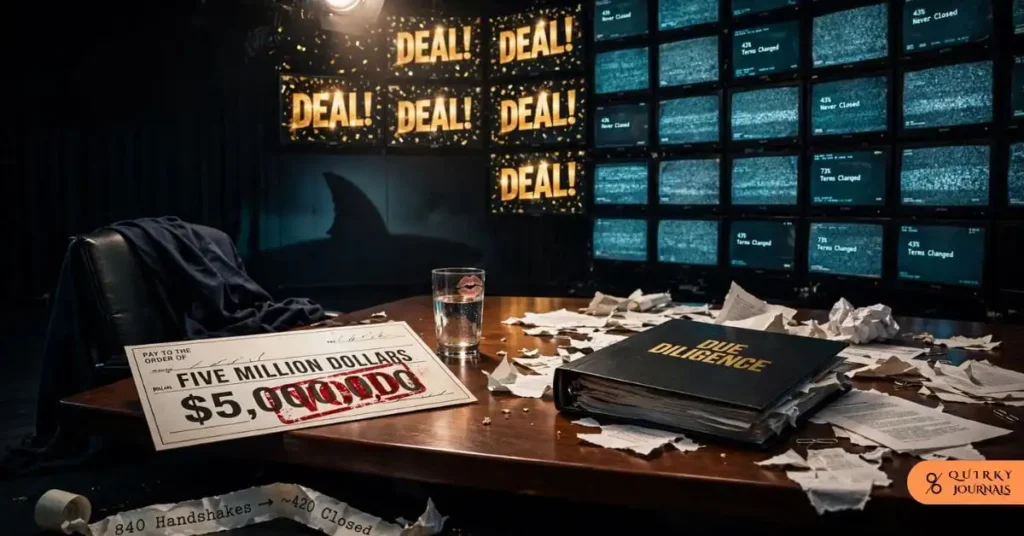
Only 45% of Shark Tank Deals Close: The Dirty TV Secret
You watch the handshake. The music swells. Kevin O’Leary nods like he just found the next unicorn, and the entrepreneur walks off the set with a number in their head and, supposedly, a deal in their pocket.
Except that deal might not exist. Not really. Not yet.
Roughly half of the agreements struck on camera during Shark Tank never survive the weeks and months that follow. They collapse quietly, off-screen, with no music and no applause. According to research compiled by startup analysts tracking 16 seasons of the show, only about 45 to 50 per cent of on-air handshake deals actually close after due diligence. That’s not a rumour. That’s the math.
So let’s pull back the curtain. This piece breaks down why deals fall apart, which Sharks actually follow through, which entrepreneurs got burned, and what any founder pitching money (on TV or off) needs to understand before they ever say yes to an offer.
The Handshake Isn’t the Deal
Here’s the part casual viewers miss constantly. What airs on television is a verbal agreement, not a signed contract. The actual legal and financial negotiation starts after the cameras stop rolling, according to a detailed breakdown of Shark Tank deal statistics. Both sides still have to review documents, confirm numbers, and decide if the relationship makes sense once the lights are off.
That distinction matters more than most people realise. It changes what a “yes” on Shark Tank actually means. It’s an invitation to negotiate seriously, not a closed transaction.
Investigative reporting backs this up in blunt terms. Forbes fact-checked seven full seasons of deals and found that 73 per cent of entrepreneurs who accepted an offer on air did not get the exact terms they shook hands on. Some got better terms. Most got worse ones, or no deal at all.
Roughly 43 per cent said their agreement never came to fruition. The Sharks pulled out, or the terms shifted into something the founder couldn’t accept. Another 30 per cent said the numbers changed, but they took the revised deal anyway because publicity still had value. We’ll come back to that publicity angle later, because it changes the entire calculus of whether “no deal” is actually a loss.
The Real Numbers Behind the Curtain
Let’s get specific. Across sixteen seasons, more than 840 deals have been struck on camera, based on aggregated data from Shark Tank’s full-season statistics. The Sharks have collectively pledged over $220 million. Sounds massive. It isn’t the full story.
| Metric | Figure |
|---|---|
| Total episodes aired (16 seasons) | 350+ |
| Entrepreneur pitches | 1,400+ |
| On-air handshake deals | 840+ |
| Estimated closure rate after due diligence | 45%–50% |
| Total pledged investment (on air) | $220M+ |
| Largest on-air offer (never closed) | $5M, Zero Pollution Motors |
| Largest deal that actually closed | $2.5M, Zipz Wine (Kevin O’Leary) |
Notice something in that table. The biggest number on the show wasn’t the biggest number in reality. That gap alone tells you everything about how television and finance handle risk differently.
Independent analysis from a company that spent weeks analysing thousands of Shark Tank businesses reached a similar conclusion using a different methodology: half of broadcast deals never close. Different researchers, same rough answer. When multiple independent studies converge on a number, that number tends to hold up.
Why Deals Fall Apart: Due Diligence, Explained
So what actually kills a deal between the handshake and the wire transfer? One word: diligence.
Due diligence is the investigation an investor runs to confirm that everything the entrepreneur said on camera is true. Investopedia describes the entrepreneurs pitching on the show as presenting a product or service and requesting an investment in exchange for equity. What that pitch doesn’t always include, deliberately or not, is the full financial picture.
According to a plain-language explainer on the concept, due diligence means exhaustively examining and verifying information before entering a legally binding contract. It’s standard practice in any acquisition or investment, not something unique to reality television. What makes Shark Tank different is the speed of the on-air pitch. Founders get a few minutes to sell a story. Investors then get weeks to check if the story holds.
The process typically covers financial records, legal structure, and market position, per a legal breakdown of what due diligence actually covers. It also increasingly includes what’s called soft diligence: culture, leadership quality, and whether the founder is someone an investor actually wants to be in business with for years.
Lori Greiner has spoken publicly about this timeline. Most deals get negotiated within 30 to 90 minutes during filming, but according to her own account of the process, finalising an agreement can take weeks or months. Some never close at all. The handshake, she’s said, is the beginning, not the finish line.
What Due Diligence Actually Looks Like, Shark by Shark
Every investor on the panel runs their own version of this process, and the differences are revealing. Interviews with the show’s Australian panel found that due diligence commonly involves lawyers, accountants, and auditors, and it isn’t cheap. One investor on that panel reported spending upward of $300,000 a year just verifying deals before he’d commit money.
On the American version, Mark Cuban has said publicly that his team confirms whether the pitch presented on stage lines up with what the business actually shows once you look under the hood. In an interview covered by a profile of the full cast’s due diligence habits, Cuban explained that he wants confirmation that the trends presented on air remain consistent once the cameras are off, with no material changes hiding underneath.
Meanwhile, Wikipedia’s entry on the show notes that Kevin O’Leary estimates roughly 20 per cent of handshake deals never get executed, largely due to the diligence process uncovering issues during product testing or financial review. Robert Herjavec has a different read: he believes 90 per cent of collapsed deals get killed by the entrepreneur, not the investor, sometimes because the founder only wanted the TV exposure in the first place.
That disagreement between two Sharks on the same panel is telling. Even the investors don’t fully agree on who’s walking away and why.
Who Actually Closes: The Shark-by-Shark Scorecard
Not every investor closes at the same rate. A Forbes investigation into which Sharks actually follow through tracked dozens of entrepreneurs after their episodes aired and found real variation.
| Shark | Reported Deal Closure Behaviour |
|---|---|
| Barbara Corcoran | Most likely to close, around 60% of tracked deals finalised |
| Daymond John | 56% closure rate, but also most likely to change terms afterwards |
| Mark Cuban | 54% closure rate on tracked deals, invests in more companies overall |
| Kevin O’Leary | Roughly 45% least likely to close among those tracked |
| Robert Herjavec | Around 30% closure rate in the same sample |
| Lori Greiner | Around 29% closure rate in the same sample |
One important caveat here. This sample wasn’t exhaustive. Reporters reached 74 per cent of contestants who received on-air offers, and the figures reflect what those specific founders reported, not a full audit of every deal ever made. Still, the pattern is consistent enough to matter. Some investors follow through more reliably than others, and founders chasing a deal should factor that into who they’re pitching to, not just how big the number is.
Cuban himself pushed back on this data slightly, telling Forbes he suspects his actual closure rate might be even lower than reported, since some entrepreneurs come on the show purely for the publicity and never intend to close regardless of the offer.
The Cautionary Tale: A $5 Million Deal That Vanished
If you want the single clearest example of the gap between television and reality, look at Zero Pollution Motors. Robert Herjavec offered the compressed-air-powered car company $5 million on air, the largest offer in the show’s history at the time, according to a full-season statistical review. It was a landmark moment. Cameras loved it.
Then diligence happened. The deal never closed. The largest number ever spoken aloud in that room turned out to be the largest number that never became real money.
The biggest headline on Shark Tank isn’t always the biggest outcome. Sometimes it’s the biggest cautionary tale.
Compare that to the largest deal that actually went through: Kevin O’Leary’s $2.5 million investment in Zipz Wine, a single-serve wine cup company, also in Season 6. Both deals happened in the same season, which explains why Season 6 posted the highest average investment size of any season on record.
The Founders Who Got Burned
Statistics are abstract. Real founders are not. Several small businesses walked away from their episode believing they had a deal, only to watch it dissolve.
Take Biem, a kitchen tool for spraying butter that appeared in Season 8. According to a detailed roundup of notable Shark Tank failures, founder Doug Foreman raised a $500,000 offer from Lori Greiner for 14 per cent equity on air. The deal fell through afterwards.
Or consider You Smell Soap, which struck what looked like a solid arrangement with Robert Herjavec in Season 3: $55,000 plus a $50,000 salary for 30 per cent equity. According to the same source, founder Megan Cummins spent six months trying to reach Herjavec after filming, without much luck. When he finally responded, his revised offer was far less favourable, and Cummins turned it down. The show never mentions any of that follow-up. Viewers only see the handshake.
Foot Fairy, a shoe-sizing app, got a similar runaround with Mark Cuban. The founders had no app development experience and outsourced the build. The resulting product was buggy and failed to properly track commissions, and the deal with Cuban never closed. The company shut down within six months of airing.
Then there’s Body Jac, a fitness device from Season 1. Barbara Corcoran famously told the founder he had to lose thirty pounds to prove the machine worked before she’d finalise the investment. He did it, and the deal went through. But the business never found traction afterwards, and Corcoran later called it one of the worst investments she ever made.
None of these stories is an outlier. They’re representative of what happens to a meaningful share of the businesses that walk into that room believing the handshake is the finish line.
Why Founders Sometimes Walk Away, Too
It’s easy to assume the Sharks are always the ones backing out. That’s not accurate. Herjavec’s estimate that 90 per cent of collapsed deals get killed by the entrepreneur deserves more attention than it usually gets.
Founders walk for a few common reasons. Sometimes the revised term sheet includes clauses they didn’t expect and don’t like. Sometimes a better offer shows up after the show airs, from an angel investor who saw the episode and moved faster than the Sharks’ legal team. And sometimes the founder simply used the platform for exposure and never planned to give up equity in the first place, which several Sharks have openly complained about in recent seasons.
This cuts both ways, and it’s worth remembering before you assume every collapsed deal is a story of investor betrayal. Sometimes it’s the founder doing the math and realising the terms don’t actually serve the business.
Understanding the Term Sheet: What’s Actually Being Negotiated
To understand why so many deals fall apart, you need to understand what a term sheet actually is. According to a fundraising guide from Carta, a term sheet establishes the financial terms of an investment: valuation, investment amount, and the rights each party holds afterwards.
Crucially, it’s usually non-binding on the big economic points. A breakdown of standard term sheet structure explains that while most provisions aren’t enforceable contracts, certain sections, like confidentiality and exclusivity, absolutely are. That distinction is exactly where a lot of Shark Tank deals quietly die. The handshake covers the exciting parts. It rarely covers the boring, binding parts that lawyers argue over for months.
According to an explainer on venture term sheets, common clauses include liquidation preferences, anti-dilution provisions, voting rights, and board composition. None of that gets discussed on camera. All of it gets negotiated afterwards, and any one of those clauses can blow up an otherwise friendly deal.
A more detailed guide from Wall Street Prep’s breakdown of the VC process lays out the standard sequence: pitch, investor decision, term sheet negotiation, documentation, and finally, fund release. Shark Tank compresses the first two steps into a televised event lasting a few minutes. Everything after that still has to happen the slow way, off-camera, with lawyers involved.
Why Informational Asymmetry Makes This Worse for Founders
Here’s an uncomfortable truth about any investment negotiation, television or otherwise. The investor almost always has more experience with the process than the founder does. A conversation with two corporate securities lawyers put it plainly: a fund sending a term sheet is often negotiating several others that same week, while a founder might go through this exact process once every few years, if that.
That asymmetry is baked into Shark Tank by design. The entrepreneur gets one shot, a few minutes, under bright lights, with a national audience watching. The Shark gets to say yes on camera and then spend weeks quietly reassessing with a full legal and financial team. It’s not exactly a fair fight, and understanding that imbalance explains a lot of why so many deals shift or die after the credits roll.
One venture fund’s own writing on the topic notes they’ve personally reviewed over 500 term sheets. Most founders will never approach that number in an entire career. The gap in repetition alone creates leverage that has nothing to do with who has the better business.
Red Flags That Predict a Deal Will Die in Diligence
Patterns emerge once you study enough of these collapsed deals. A few warning signs show up again and again:
- Vague or rounded financial figures presented on camera that don’t match detailed bookkeeping once requested.
- Inexperienced founders who outsourced core technical work without understanding what they were building, similar to what happened with Foot Fairy.
- Unresponsive communication after the show. Multiple Sharks have said slow replies during diligence are themselves a red flag about how the founder will run the business long term.
- Overly generous on-air terms that no rational investor would actually honour once real numbers surface, often a sign the Shark was excited by the pitch more than the fundamentals.
- Product claims that don’t survive testing are a common and quiet reason O’Leary has cited for walking away.
None of these is unique to television. They’re the same red flags any angel investor or venture fund looks for. Shark Tank just compresses the timeline and puts the entire mess on national television.
The Silver Lining: Deals That Fell Apart But Still Won
Not every collapsed deal is a tragedy. Some of the most famous business success stories connected to the show never actually closed at all.
The clearest example involves the Kang sisters and their app. Mark Cuban made the largest offer in the show’s history, $30 million to buy the entire company outright. According to Investopedia’s account of the pitch, the sisters turned it down and walked out with no deal. After the exposure from the episode, they went on to raise $23.2 million across four funding rounds independently, ultimately building an app with more than 10 million users.
Then there’s Chef Big Shake. The Sharks passed entirely, deciding the shrimp burger venture was too risky. According to the same reporting, angel investors saw the episode and offered $500,000 afterward. Annual sales grew from $30,000 to a projected $5 million within a year. Even Cuban later admitted regret over passing on that one.
And the biggest example of all: Ring, the smart doorbell company. Founder Jamie Siminoff left the tank with no deal whatsoever. According to statistical coverage of the show’s history, he generated $1 million in sales shortly after the episode aired anyway. Amazon eventually acquired Ring for over $1 billion. Rejection, in that case, turned out to be the best thing that ever happened to the business.
The Shark Tank Effect: Why “No Deal” Isn’t Always a Loss
This pattern has a name. Analysts call it the Shark Tank Effect, the surge in traffic, credibility, and sales a business experiences simply from appearing on national television, regardless of whether a deal closes.
Proper Good, a meal company, sold roughly three and a half months’ worth of product in a single week after its episode aired, according to a case study tracking the company’s growth. The exposure helped the business reach $2 million in revenue that year alone.
Boost Oxygen reported generating over $15 million in sales tied directly to its episode, according to the company’s own account of the aftermath. Tantos, a snack company that received no deal at all, still saw roughly 3,000 orders in the four days following its episode, according to trade press coverage of the launch. One co-founder said the show permanently raised their daily sales floor by three to four times.
Marketing agencies have built entire case studies around this phenomenon. A documented SEO analysis of one company’s episode tracked a measurable spike in backlinks and search visibility beginning 24 hours before the episode even aired, driven by media coverage stacking on top of the broadcast itself.
The takeaway isn’t subtle. Getting a deal is nice. Getting seen by millions of people is often worth more.
The Global Picture
This isn’t a uniquely American phenomenon, either. According to a global overview of the franchise’s various international versions, roughly 50 per cent of deals made on the US show proceed after due diligence, a figure that lines up closely with everything else covered here. Similar patterns show up on Dragon’s Den in the UK and Canada, and on Shark Tank Australia, where due diligence concerns and post-show growing pains derail deals just as often.
Success rates fluctuate by market readiness and how well the product actually scales once real demand hits. The format changes country to country. The underlying math on closed deals stays remarkably consistent.
What This Means If You’re Actually Pitching Investors
If you’re a founder, on Shark Tank or off it, a few practical lessons fall out of all this data.
First, treat any verbal agreement as a starting point, not a finish line. According to a founder-facing guide to venture negotiations, a well-negotiated term sheet protects founders from giving up excessive control before the real terms are even locked in. Don’t celebrate until the documents are signed.
Second, get ahead of your own diligence. Have your financials organised before anyone asks. A beginner’s guide to how investors evaluate opportunities notes that revenue trends, debt levels, and industry positioning are the first things scrutinised. If your numbers are messy, that’s exactly where a deal starts to wobble.
Third, understand what you’re actually negotiating. According to a comprehensive guide to term sheet structure, valuation determines not just how much money you get, but how much ownership and control you’re trading away permanently. Read every clause. Ask questions about the ones you don’t understand.
A Founder’s Pre-Pitch Checklist
- Financial statements reviewed and reconciled, not estimated from memory
- Legal structure and cap table are documented and accurate
- Product claims are independently verifiable, not just marketing copy
- Responsive communication plan ready for the weeks after any pitch
- A lawyer familiar with startup term sheet negotiation lined up before you need one, not after
None of this guarantees a closed deal. It does dramatically improve your odds of surviving diligence intact, and it puts you in a stronger negotiating position if terms do shift.
What This Means If You’re Raising Money Through Crowdfunding Instead
Not every founder gets a shot at national television. Many turn to equity crowdfunding instead, and the same due diligence principles apply, just with different regulatory guardrails.
According to an SEC investor bulletin on Regulation Crowdfunding, companies raising money this way must file detailed disclosures, and investors face limits on how much they can commit within twelve months. That’s a very different structure from a handshake on a soundstage, and it exists specifically because early-stage investing carries real risk.
The SEC’s own guidance for issuers requires companies to file a Form C before soliciting any investors, and to keep providing updates as long as the securities remain outstanding. Failing to disclose material information can trigger enforcement action, according to a legal explainer on crowdfunding compliance. Investors, meanwhile, are cautioned to treat these opportunities as high risk. A regulatory bulletin covering crowdfunding risk disclosures lists limited liquidity, valuation uncertainty, and fraud risk among the specific concerns regulators want investors to weigh before committing money.
The Bottom Line on What You’re Actually Watching
Shark Tank sells a story: pitch, handshake, victory lap. The real story is messier, slower, and far less telegenic. Roughly half of what you watch on screen either changes dramatically or never happens at all.
That’s not a scandal. It’s how serious investing actually works. Due diligence exists because verbal promises and financial reality don’t always match, and no investor with real money on the line skips that step just because cameras were rolling.
What should change is how you watch the show, and how you think about pitching your own business, whether that’s to a Shark, a venture fund, or a crowd of retail investors. The handshake was never the finish line. It never will be. Build your business, and your paperwork, like the real negotiation starts the moment the cameras turn off. Because it does.
Spend some time for your future.
To deepen your understanding of today’s evolving financial landscape, we recommend exploring the following articles:
Why SpaceX Stock Crashed 23% Days After Its Blockbuster IPO
Why Lottery Winners Go Broke: The Psychology of Sudden Wealth Nobody Prepares You For
Pump and Dump in the Age of Influencers: How Financial Fraud Moved to Instagram and Discord
Buy, Borrow, Die: How the Ultra-Wealthy Avoid Taxes Legally
Disclaimer
This article is provided for informational and educational purposes only and does not constitute financial, investment, or legal advice. Statistics referenced throughout this piece are drawn from third-party research, journalism, and publicly available statements from Shark Tank cast members and featured entrepreneurs, and individual figures may vary depending on the source, methodology, and season analysed. Investment outcomes involving early-stage businesses, including those featured on Shark Tank or raised through equity crowdfunding, carry substantial risk, including the potential loss of principal. Readers considering any investment decision should consult a licensed financial advisor, attorney, or accountant before proceeding. Shark Tank is a registered trademark of its respective rights holders, and this article is not affiliated with, endorsed by, or sponsored by ABC, Sony Pictures Television, or any Shark Tank cast member.
References
[1] Slidebean, “Is Shark Tank Real? How Many Shark Tank Deals Fail?” Available: https://slidebean.com/blog/is-shark-tank-real-how-many-shark-tank-deals-fail
[2] Failory, “Shark Tank Failures: 10 Massive Fails & 9 Huge Misses.” Available: https://www.failory.com/blog/shark-tank-failures
[3] E. Canal, “We Fact-Checked Seven Seasons Of Shark Tank Deals,” Forbes, 2016. Available: https://www.forbes.com/sites/emilycanal/2016/10/21/about-72-of-deals-that-happen-on-shark-tank-dont-turn-out-as-seen-on-tv/
[4] Investopedia, “Shark Tank Rejections That Turned Into Success Stories.” Available: https://www.investopedia.com/articles/personal-finance/101515/3-shark-tank-failures-made-millions.asp
[5] Startupbooted, “Shark Tank Statistics: Deals, Investments, Success Rates.” Available: https://www.startupbooted.com/shark-tank-statistics
[6] Failory, “Shark Tank Statistics: The Truth Behind the Show’s Deals.” Available: https://www.failory.com/blog/shark-tank-statistics
[7] Shark Tank Blog, “Lori Greiner Reveals How Long Shark Tank Deals Really Take.” Available: https://www.sharktankblog.com/lori-greiner-how-long-shark-tank-deals-take/
[8] SmartCompany, “How each Shark Tank investor does their due diligence.” Available: https://www.smartcompany.com.au/finance/how-each-shark-tank-investor-does-due-diligence-deals-sometimes-fall-through/
[9] J. McEvoy, “Inside The Secretive World Of Shark Tank Deals,” Forbes, 2023. Available: https://www.forbes.com/sites/jemimamcevoy/2023/01/10/inside-the-secretive-world-of-shark-tank-deals-who-the-real-winners-are/
[10] Shark Tank Blog, “Shark Tank Statistics: The Ultimate Breakdown.” Available: https://www.sharktankblog.com/shark-tank-statistics/
[11] B. D. Evans, “The Cast of Shark Tank on the Importance of Due Diligence,” Inc., 2017. Available: https://www.inc.com/brian-d-evans/the-entire-cast-of-shark-tank-weighs-in-on-what-matters-in-due-diligence.html
[12] Wikipedia, “Shark Tank.” Available: https://en.wikipedia.org/wiki/Shark_Tank
[13] Carta, “What is a Term Sheet? Common Terms & Examples for Startups.” Available: https://carta.com/learn/startups/fundraising/term-sheets/
[14] Silicon Valley Bank, “Understanding venture capital term sheets.” Available: https://www.svb.com/startup-insights/vc-relations/venture-capital-term-sheets/
[15] LTSE Insights / Gunderson Dettmer, “How to understand a startup term sheet for venture capital.” Available: https://ltse.com/insights/understanding-your-first-term-sheet
[16] Wall Street Prep, “Venture Capital Term Sheet: Format + PDF Template.” Available: https://www.wallstreetprep.com/knowledge/the-ultimate-guide-to-the-vc-term-sheet-term-sheet-template/
[17] Growth Equity Interview Guide, “Venture Capital Term Sheets: A Comprehensive Guide.” Available: https://growthequityinterviewguide.com/venture-capital/venture-capital-term-sheets
[18] Hustle Fund, “Venture Capital Term Sheet: What You Need to Know.” Available: https://www.hustlefund.vc/post/venture-capital-term-sheet
[19] Excedr, “Venture Capital Term Sheets.” Available: https://www.excedr.com/resources/venture-capital-term-sheets
[20] Rho, “What is a term sheet?” Available: https://www.rho.co/blog/term-sheet
[21] Silicon Valley Bank, “How to read a startup term sheet.” Available: https://www.svb.com/startup-insights/raising-capital/read-startup-term-sheet/
[22] Shark Tank Success, “Proper Good Update After Shark Tank.” Available: https://sharktanksuccess.com/proper-good-update-after-shark-tank/
[23] SEO.co, “The Shark Tank Effect: A Case Study on Sales, Traffic & SEO.” Available: https://seo.co/shark-tank-nightcap/
[24] Boost Oxygen, “Boost Oxygen on Shark Tank: How a Million-Dollar Deal Fueled Growth.” Available: https://www.boostoxygen.com/boost-oxygen-shark-tank/
[25] Food Business News, “Tantos experiences the ‘Shark Tank’ effect.” Available: https://www.foodbusinessnews.net/articles/29574-tantos-experiences-the-shark-tank-effect
[26] Salt ‘n Pepper Blog, “The Impact of Shark Tank on Startups: A Global Overview.” Available: https://saltnpepperblog.com/the-impact-of-shark-tank-on-startups-a-global-overview/
[27] The Motley Fool, “Due Diligence: What It Is, Types, Example.” Available: https://www.fool.com/terms/d/due-diligence/
[28] ByLawMe, “What Is Due Diligence? Meaning and Importance.” Available: https://www.bylawme.com/post/what-is-due-diligence-meaning-importance
[29] Crux Investor, “What Does ‘Due Diligence’ Mean? A Beginner’s Guide.” Available: https://www.cruxinvestor.com/posts/what-does-due-diligence-mean-a-beginners-guide
[30] U.S. Securities and Exchange Commission, “Updated Investor Bulletin: Regulation Crowdfunding for Investors.” Available: https://www.investor.gov/introduction-investing/general-resources/news-alerts/alerts-bulletins/investor-bulletins/updated-11
[31] U.S. Securities and Exchange Commission, “Regulation Crowdfunding: Guidance for Issuers.” Available: https://www.sec.gov/resources-small-businesses/regulation-crowdfunding-guidance-issuers
[32] JGCG Law, “Crowdfunding Legal Requirements & SEC Rules Explained.” Available: https://jgcg.com/crowdfunding-legal-requirements-and-sec-regulations/
[33] Investment Executive, “SEC bulletin educates investors on crowdfunding.” Available: https://www.investmentexecutive.com/news/regulation/sec-bulletin-educates-investors-on-crowdfunding/