

Investing

A dramatic financial-tech illustration showing a glowing AI model pipeline in the center, with the key-value cache highlighted as shrinking from large memory blocks into tiny compressed cubes labeled “3 bits.” On the left, a stock market chart for memory chip companies plunges sharply in red, while on the right, chip packages and RAM modules appear cracked or fading into the background. A subtle Google-style research lab silhouette and a headline overlay reading “TurboQuant” create a sense of shock and breakthrough. High-contrast, cinematic lighting, red and blue color palette, 16:9 aspect ratio, ideal as a blog header for an article about the Google TurboQuant memory market sell-off.

A $450 Billion Blow: RAM Markets Plummet 30% Following Google’s TurboQuant Reveal

Google’s TurboQuant sent shockwaves through memory markets by promising to cut the key-value cache needed for LLM inference to just 3 bits, triggering a brutal sell-off across chipmakers and wiping hundreds of billions from semiconductor valuations. This article explains what TurboQuant actually does, why investors panicked so fast, and whether the market reaction reflects a real long-term threat or just a cyclical overreaction. It also breaks down the key-value cache bottleneck, the role of HBM demand, and what this could mean for AI infrastructure spending going forward.

A $450 Billion Blow: RAM Markets Plummet 30% Following Google’s TurboQuant Reveal Read More »
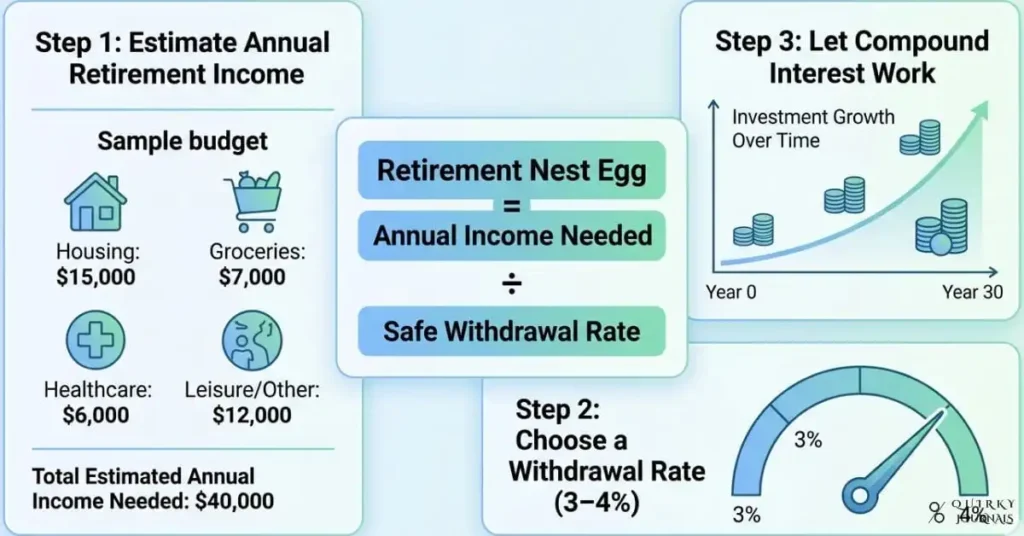
A clean, infographic-style illustration showing a central formula block labeled “Retirement Nest Egg = Annual Income Needed ÷ Safe Withdrawal Rate,” with three supporting panels around it: one labeled “Step 1: Estimate Annual Retirement Income” showing a sample budget; one labeled “Step 2: Choose a Withdrawal Rate (3–4%)” with a dial at 4%; and one labeled “Step 3: Let Compound Interest Work” with a rising curve over 30 years. Soft blues and greens, simple icons for a house, groceries, and healthcare, 16:9 aspect ratio, suitable as a header image for a retirement calculator guide.

Retirement Calculator Formula: How to Estimate Your Future Needs

Most people know they should “save for retirement,” but few can translate that into a clear number and monthly target. A simple retirement calculator formula changes that by turning fuzzy goals into concrete estimates based on income, spending needs, inflation, investment returns, and the famous 4% rule. This guide walks you through the core nest-egg formula, shows how to estimate your annual retirement income, and explains how compounding and inflation shape the amount you really need to retire with confidence.

Retirement Calculator Formula: How to Estimate Your Future Needs Read More »

A dramatic, high-resolution illustration of a financial trading floor and stock market screen suddenly “frozen”: large digital price boards show halted symbols and wide red bid‑ask spreads, with candlestick charts abruptly flatlined. In the foreground, an investor holds a smartphone showing a trading app where the “sell” button is greyed out or displaying “liquidity unavailable.” Background includes ghosted images of popular assets like ETFs, bonds, and stocks behind an icy, cracked glass effect to symbolize frozen markets. Color palette of deep blues and cold whites with sharp red accents for falling prices; realistic, cinematic style, 16:9 aspect ratio, ideal as a header image for an article about the illusion of market liquidity.

The Diversification Myth: Understanding Correlation Breakdown During Market Stress

Most investors assume their assets are always just a tap away from cash—until markets seize up and “sell” buttons stop working in practice. This guide explains why market liquidity is a fragile illusion, how it can vanish overnight even in blue‑chip assets, and what past crises like 2008, 1987, and March 2020 reveal about frozen markets. You will learn how to read bid‑ask spreads, market depth, and structural risks in products like ETFs, plus practical steps to protect your portfolio before liquidity disappears.

The Diversification Myth: Understanding Correlation Breakdown During Market Stress Read More »

Cinematic, data‑driven illustration of a Bitcoin coin sinking into a red ocean made of falling candlestick charts, while in the background the U.S. Capitol and a wall of oversized Treasury bonds loom over the scene. Digital tickers display “US DEFICIT,” “REAL YIELDS ↑,” and “BTC −50%,” with ETF flow numbers flipping from green to red. Color palette of dark blues and deep reds, moody lighting, 16:9 aspect ratio, suitable as a header image for an article on how the US budget crisis helped trigger the 2025–26 crypto crash.

Bitcoin’s 50% Drawdown: How the US Budget War Hit Crypto Liquidity

Between October 2025 and February 2026, Bitcoin fell from record highs above $125,000 to nearly $60,000, erasing around half its value and wiping out roughly $1.9 trillion from the wider crypto market cap. Far from being a purely “crypto-native” blow‑up, this crash was triggered and amplified by a brewing U.S. budget crisis, higher real yields, and shrinking liquidity as the government soaked up capital to fund record deficits. This article explains how Treasury issuance, ETF flows, and shifting macro narratives combined to crush digital assets—and what that link between fiscal stress and Bitcoin means for the next phase of the cycle.

Bitcoin’s 50% Drawdown: How the US Budget War Hit Crypto Liquidity Read More »

a cinematic portrait that captures the complex financial reality and "doom spending" habits of this Gen Z young adult. This scene places him in a modest rental apartment, lit by the contrasting neon glow of a laptop displaying a volatile crypto trading app and a tablet showing a luxury home listing with a high "unaffordable" price point. The surrounding clutter—including travel photos, a new designer bag, and Buy Now, Pay Later (BNPL) receipts—illustrates the coping mechanism of prioritizing smaller, immediate luxuries over unattainable long-term goals.

Doom Spending and Financial Nihilism: Inside Gen Z’s Money Mindset

Gen Z is not blowing money because they do not understand compound interest—they are spending because the math of traditional wealth-building no longer adds up. With record debt loads, bleak housing affordability, and youth unemployment stuck in double digits, many young adults have concluded that homeownership and conventional retirement are fantasies, not goals. This article unpacks how that despair fuels doom spending, pushes Gen Z toward high‑risk bets like crypto and meme stocks, and reshapes the future of saving, lending, and investing.

Doom Spending and Financial Nihilism: Inside Gen Z’s Money Mindset Read More »

Startup Legal 101: Everything Founders Need to Know About Equity Splits, Vesting Schedules, and Incorporation

Startup Legal 101: Equity, Vesting and Incorporation

Legal structure is the scaffolding your startup grows on. Incorporation turns your project into a separate legal “person” that can own assets, sign contracts, issue shares, and shield your personal finances from company liabilities. Thoughtful equity splits ensure co‑founders are rewarded in proportion to their contribution and risk, while vesting schedules prevent someone who leaves early from walking away with a huge, unearned stake. This guide breaks down incorporation choices, how to approach founder equity conversations, and the mechanics of vesting so you can build on a solid legal foundation instead of trying to fix it under pressure right before your first serious funding round.

Startup Legal 101: Equity, Vesting and Incorporation Read More »

A 16:9 cinematic illustration of a sprawling Bitcoin mining farm at night: long rows of glowing ASIC rigs inside an industrial warehouse, with thick power cables leading out to a nearby fossil-fuel power plant whose smokestacks emit visible plumes on one side, and a contrasting field of wind turbines and solar panels on the other. Above the scene, a faint semi-transparent Bitcoin symbol hangs in the hazy sky like a moon, subtly tinted in gold. The colour palette should contrast warm, polluted oranges and greys near the plant with cooler blues and greens around the renewables, visually encoding the tension between Bitcoin’s heavy energy use and the push toward cleaner power. No text, numbers, or logos anywhere in the image.

Bitcoin Climate Impact 2026: Carbon Emissions, Water Use & Mining Footprint Explained

Is Bitcoin Killing the Climate? The Staggering Carbon and Water Cost of Mining in 2026 Bitcoin is often called digital gold. However, unlike physical gold, its environmental toll is something most investors prefer not to discuss. Behind every transaction, every mined block, and every price surge lies an enormous and growing consumption of energy, water,

Bitcoin Climate Impact 2026: Carbon Emissions, Water Use & Mining Footprint Explained Read More »

A 16:9 semi-realistic illustration of a modest, comfortable suburban home interior in the evening: a person in simple, casual clothes sits at a plain wooden table reviewing a calm investment dashboard on a laptop that shows diversified charts and growing bars (no numbers or text), while an older but well-kept economy car is faintly visible through the window outside. The scene feels intentionally ordinary—no luxury branding—yet the charts and neatly organised papers hint at substantial, hidden wealth being carefully managed. Warm, subdued lighting with neutral and earthy tones should convey privacy, intention, and quiet prosperity.

Stealth Wealth: 13 Quiet Strategies to Build Wealth Like the Top 1%

Stealth wealth flips the usual script on money. Instead of using cash to signal success—cars, clothes, restaurants—it channels every surplus dollar into assets that quietly compound in the background: broad index funds, income-producing real estate, profitable private businesses, and cash buffers that make every setback survivable. The people who practise it live well below their means, automate investing so they never “forget” to build wealth, keep their financial life boring on the surface, and design their lifestyle so almost no one can tell how much they’re actually worth. This guide unpacks 13 of those habits and systems so you can borrow the playbook of the genuinely wealthy without changing who you are or trying to impress anyone.

Stealth Wealth: 13 Quiet Strategies to Build Wealth Like the Top 1% Read More »

A 16:9 semi‑realistic illustration of a relaxed client and a budget counsellor sitting across from each other at a small round table in a bright office. The counsellor is turning a tablet toward the client, showing a simple, colour‑blocked monthly budget flow (income arrows leading to bills, debt, and savings icons) with no words or numbers. On the table are a few neatly stacked papers and a pen, and in the background a large window with daylight and a couple of green plants creates a calm, hopeful atmosphere. Colours are soft blues and greens to convey clarity, support, and reduced stress, with no text or logos anywhere in the scene.

What Is Budget Counselling? Costs, Benefits & Step-by-Step Process

Budget counselling is like having a coach for your day‑to‑day money decisions. Instead of guessing where your cash goes each month, you sit down with a certified counsellor who reviews your income, bills, debts, and habits, then helps you build a spending plan you can actually live with. Together, you identify leaks, prioritise essentials, and map out a clear path for paying down debt and rebuilding savings—often with ongoing check‑ins that keep you accountable. For anyone who feels stuck, overwhelmed, or one crisis away from falling behind, budget counselling offers structure, support, and a workable roadmap back to stability.

What Is Budget Counselling? Costs, Benefits & Step-by-Step Process Read More »

Why 63% of Investors Still Avoid Crypto: The Real Reasons Behind the Hesitation

Crypto Hesitation: The Real Reasons Investors Opt Out

Despite headline-grabbing rallies and institutional adoption, nearly two-thirds of Americans still have little or no confidence in crypto as a safe, reliable way to invest, trade, or pay. For many, the hesitation is rational: crypto’s price swings dwarf those of stocks, bonds, and even gold; the regulatory landscape is fragmented and constantly shifting; high‑profile hacks, bankruptcies, and frauds have eroded trust; and the learning curve around wallets, keys, and taxes is steep. This article unpacks those concerns one by one—extreme volatility, unclear rules, counterparty and custody risk, scams, environmental worries, and simple emotional stress—then contrasts them with what proponents claim and offers a cautious framework for anyone who still wants limited, deliberate exposure rather than an all‑or‑nothing bet.

Crypto Hesitation: The Real Reasons Investors Opt Out Read More »