
Must Read

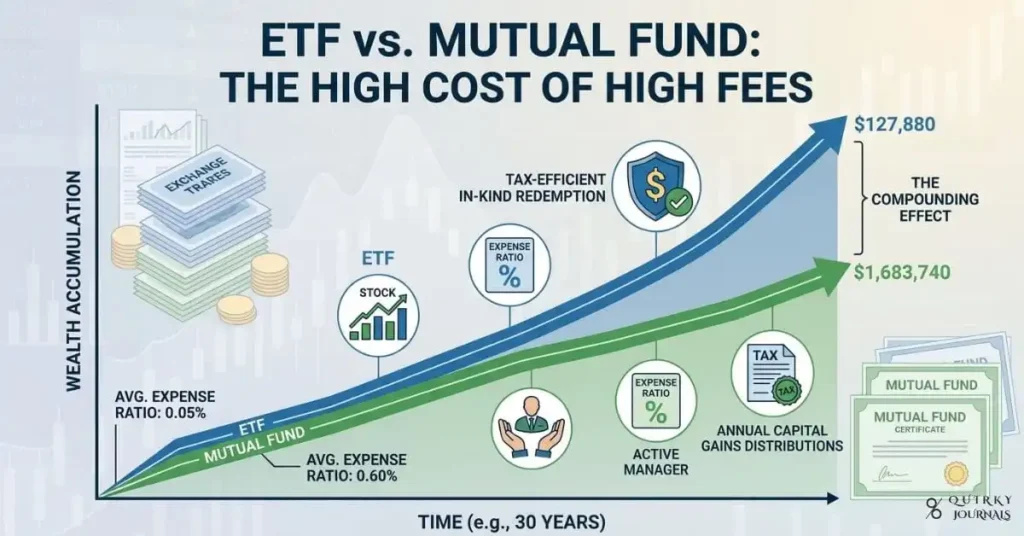
A clean, data‑driven illustration showing two parallel paths rising over time, labeled “ETF” and “Mutual Fund,” with small fee percentages (e.g., 0.05% vs 0.60%) at the base and the final wealth values at the end of the line significantly diverging, emphasizing compounding. Overlay icons for stock indices, expense‑ratio percentages, and subtle tax‑efficiency symbols, with a muted background of market charts and fund shares. Professional, modern design with blue and green tones, 16:9 aspect ratio, ideal as a blog header for an article on ETF vs. mutual fund expense ratios and long‑term growth.

ETF vs. Mutual Fund: Minimising Fees for Maximum Growth

ETFs and mutual funds can both track the same index, but the ETF vs. mutual fund duel turns into a long‑term wealth fight where the quieter winner is usually the one with the lower expense ratio. This guide compares the fee structures, tax efficiency, and compounding effects of ETFs and mutual funds so you can see how small differences in costs add up to tens or even hundreds of thousands of dollars over decades.

ETF vs. Mutual Fund: Minimising Fees for Maximum Growth Read More »

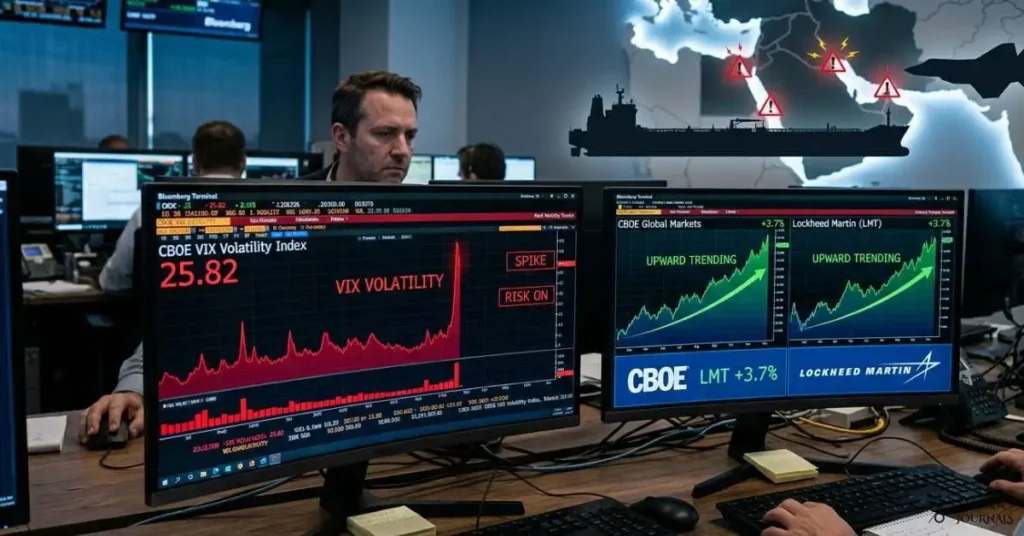
A realistic, editorial-style scene of a trading desk with two large monitors: one showing the VIX spiking above 25 with red volatility charts, the other displaying stock charts and logos for CBOE and Lockheed Martin trending upward. In the background, a world map highlights the Middle East with warning icons over key shipping lanes, and an oil tanker silhouette next to a fighter jet suggests energy and defense risk. Cool, tense color palette (deep blues and reds), high contrast, 16:9 aspect ratio, suitable as a feature image for an article on using CBOE and LMT as volatility hedges amid geopolitical escalation.

How CBOE and Lockheed Martin Became Geopolitical Hedges

With war risk rising and energy routes under threat, investors in 2026 are not just buying gold or Treasuries—they are hedging volatility itself and the companies that profit from it. CBOE, which earns more as index options and VIX trading surge, and Lockheed Martin, a prime beneficiary of expanding defense budgets, have both outperformed as geopolitical tensions escalate and the VIX pushes into a sustained high‑vol regime above 25. This article explains why these two tickers have become go‑to portfolio shock absorbers, how they behave when fear spikes, and what risks still come with treating them as volatility hedges.

How CBOE and Lockheed Martin Became Geopolitical Hedges Read More »

A bold, modern marketing scene showing a Gen Z audience scrolling on smartphones while a series of stale, overly polished ads fade into the background. In the foreground, one ad “wins attention” with fast-cut visuals, bold typography, meme-style energy, and authentic creator-style presentation. Include social app UI elements, a short-form video frame, and a subtle analytics dashboard showing higher engagement. Bright, high-contrast colors with neon accents, 16:9 aspect ratio, suitable as a blog header for an article about Gen Z ads and modern marketing.

Attracting Gen Z Clicks: What Works in Advertising to Gen Z Clients

Most brands are still advertising to Gen Z like it is 2015, and that is why the ads are getting ignored. This guide breaks down what actually works with Gen Z today—short hooks, authentic creative, platform-native content, and trust-first messaging—so you can stop being skipped and start getting attention that converts.

Attracting Gen Z Clicks: What Works in Advertising to Gen Z Clients Read More »

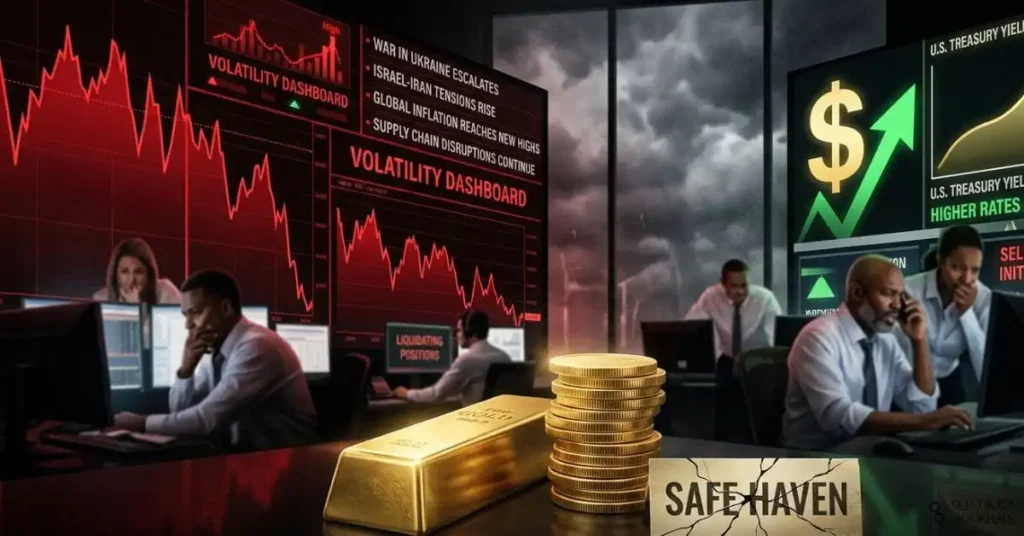
A cinematic financial illustration of a gold bar and gold coin stack sitting in the foreground while red market charts and a volatility dashboard flash behind it. In the background, a stormy geopolitical scene with headlines about war and inflation contrasts with a rising U.S. dollar symbol and Treasury yield curve, suggesting that gold is falling despite panic. Include subtle sell-off cues like traders liquidating positions and a cracked “safe haven” label. Dramatic, high-contrast lighting with gold, black, and deep red tones, 16:9 aspect ratio, suitable as a blog header for an article about why gold prices are falling in 2026.

Why Gold Prices Are Falling in 2026

Gold’s 2026 drop is confusing only if you assume “risk-off” always means “gold up.” In March, rising Treasury yields, a stronger U.S. dollar, profit-taking after a crowded bull run, and forced liquidity selling overwhelmed safe-haven demand even as geopolitics worsened. This guide explains why gold can fall during market volatility, what the March 2026 sell-off says about investor positioning, and how to think about gold’s role in a macro environment where inflation, rates, and cash needs can matter more than fear alone.

Why Gold Prices Are Falling in 2026 Read More »

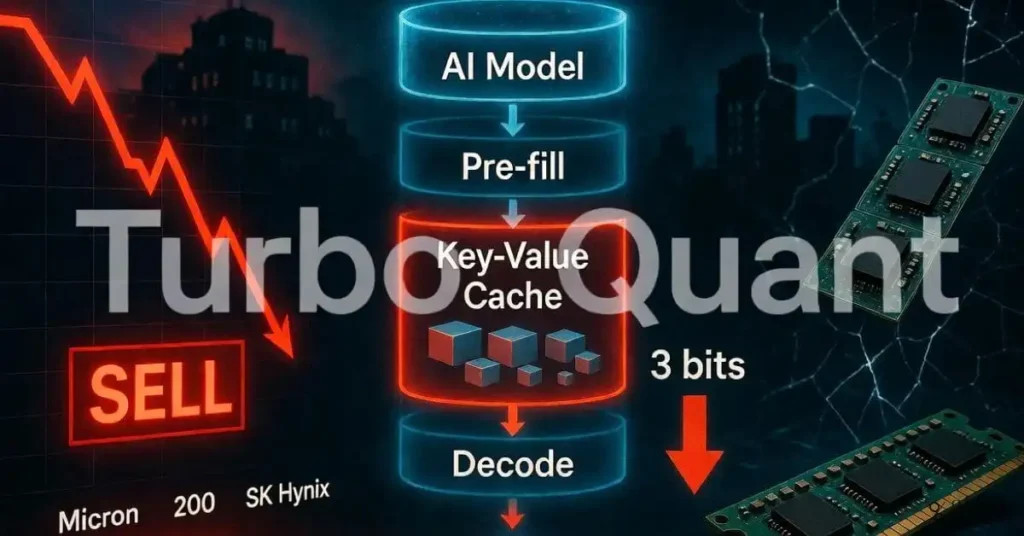
A dramatic financial-tech illustration showing a glowing AI model pipeline in the center, with the key-value cache highlighted as shrinking from large memory blocks into tiny compressed cubes labeled “3 bits.” On the left, a stock market chart for memory chip companies plunges sharply in red, while on the right, chip packages and RAM modules appear cracked or fading into the background. A subtle Google-style research lab silhouette and a headline overlay reading “TurboQuant” create a sense of shock and breakthrough. High-contrast, cinematic lighting, red and blue color palette, 16:9 aspect ratio, ideal as a blog header for an article about the Google TurboQuant memory market sell-off.

A $450 Billion Blow: RAM Markets Plummet 30% Following Google’s TurboQuant Reveal

Google’s TurboQuant sent shockwaves through memory markets by promising to cut the key-value cache needed for LLM inference to just 3 bits, triggering a brutal sell-off across chipmakers and wiping hundreds of billions from semiconductor valuations. This article explains what TurboQuant actually does, why investors panicked so fast, and whether the market reaction reflects a real long-term threat or just a cyclical overreaction. It also breaks down the key-value cache bottleneck, the role of HBM demand, and what this could mean for AI infrastructure spending going forward.

A $450 Billion Blow: RAM Markets Plummet 30% Following Google’s TurboQuant Reveal Read More »

Startup Legal 101: Everything Founders Need to Know About Equity Splits, Vesting Schedules, and Incorporation

Startup Legal 101: Equity, Vesting and Incorporation

Legal structure is the scaffolding your startup grows on. Incorporation turns your project into a separate legal “person” that can own assets, sign contracts, issue shares, and shield your personal finances from company liabilities. Thoughtful equity splits ensure co‑founders are rewarded in proportion to their contribution and risk, while vesting schedules prevent someone who leaves early from walking away with a huge, unearned stake. This guide breaks down incorporation choices, how to approach founder equity conversations, and the mechanics of vesting so you can build on a solid legal foundation instead of trying to fix it under pressure right before your first serious funding round.

Startup Legal 101: Equity, Vesting and Incorporation Read More »

A 16:9 image of a person at a tidy kitchen table with a phone to their ear, a calm, focused expression, and neatly stacked credit card statements and a simple budget sheet in front of them. A laptop shows a minimal chart trending downward (symbolising shrinking debt). Warm natural light from a nearby window, soft blues and neutrals for a hopeful, in-control mood. No text or logos.

Negotiate Credit Card Debt: Lower Rates and Balances

Negotiating credit card debt works because lenders would rather recover something than risk getting nothing through default or bankruptcy. Before you ever call, the key moves are to list every balance, APR, and minimum payment, build a bare‑bones budget, and decide exactly what you can afford—either as a lower monthly payment or a lump‑sum settlement. When you speak to the issuer’s hardship or retention team, you are not begging; you are proposing a deal: reduced rate, structured repayment plan, or partial payoff in exchange for closing the account. With preparation, calm persistence, and written confirmation of any agreement, many borrowers turn overwhelming revolving debt into a manageable path to zero.

Negotiate Credit Card Debt: Lower Rates and Balances Read More »

A 16:9 cinematic illustration of a sprawling Bitcoin mining farm at night: long rows of glowing ASIC rigs inside an industrial warehouse, with thick power cables leading out to a nearby fossil-fuel power plant whose smokestacks emit visible plumes on one side, and a contrasting field of wind turbines and solar panels on the other. Above the scene, a faint semi-transparent Bitcoin symbol hangs in the hazy sky like a moon, subtly tinted in gold. The colour palette should contrast warm, polluted oranges and greys near the plant with cooler blues and greens around the renewables, visually encoding the tension between Bitcoin’s heavy energy use and the push toward cleaner power. No text, numbers, or logos anywhere in the image.

Bitcoin Climate Impact 2026: Carbon Emissions, Water Use & Mining Footprint Explained

Is Bitcoin Killing the Climate? The Staggering Carbon and Water Cost of Mining in 2026 Bitcoin is often called digital gold. However, unlike physical gold, its environmental toll is something most investors prefer not to discuss. Behind every transaction, every mined block, and every price surge lies an enormous and growing consumption of energy, water,

Bitcoin Climate Impact 2026: Carbon Emissions, Water Use & Mining Footprint Explained Read More »

A 16:9 semi-realistic illustration of a person sitting comfortably on a sofa in a softly lit living room, laptop and a simple notepad with numbers open on a coffee table, a cup of tea beside them. Their posture is relaxed and relieved, with a faint upward-trending line and calm wave shapes subtly integrated into the background wall art to symbolise progress and calm. Warm, soothing colours (soft blues, greens, and warm beige), no text or logos.

Stop Worrying About Money: 9 Stress‑Cutting Tips

Financial stress thrives in vagueness—when you are guessing at balances, avoiding statements, and hoping each month “somehow works out.” The way out is not willpower; it is structure. By facing your numbers honestly, giving every dollar a job in a written budget, automating minimum protections like bill payments and emergency savings, and adding a few nervous system calmers (walks, journaling, breathing) around money tasks, you turn finances from a constant background threat into a series of specific, solvable problems. Over time, that mix of emotional tools and practical systems shrinks money worries out of your head and back into their proper place: one important part of life, not the thing that runs it.

Stop Worrying About Money: 9 Stress‑Cutting Tips Read More »