
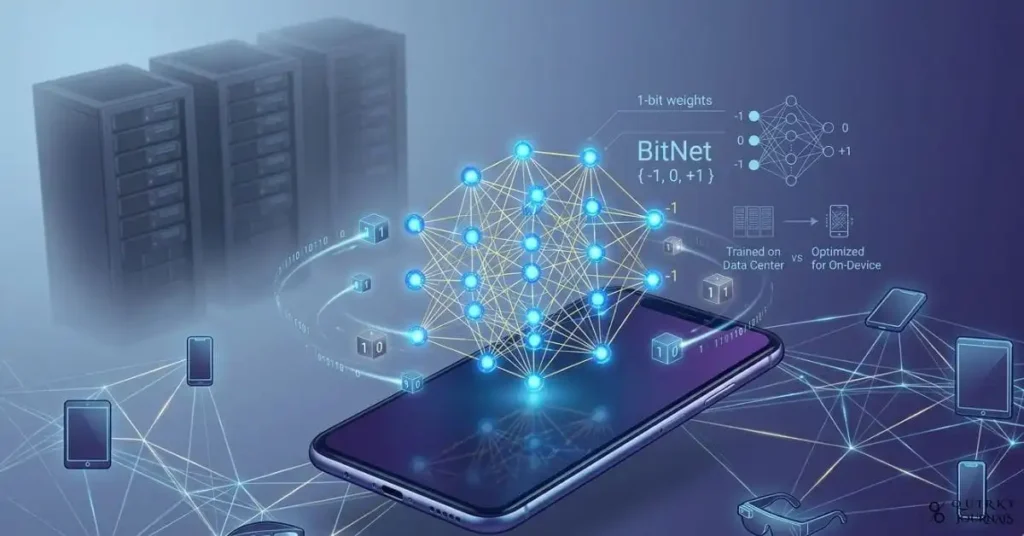
Phones and BitNet: How 1-Bit LLMs Are Bringing AI Training to Your Smartphone
Artificial intelligence has always demanded enormous computing power. Until recently, running a sophisticated language model meant paying for cloud servers, powerful GPUs, and expensive API calls. For most people, genuine on-device AI remained a distant dream. That picture, however, is changing fast thanks to a quiet revolution in how AI models are built.
The technology driving this shift is called a 1-bit large language model (LLM) architecture, and its most prominent implementation is Microsoft’s BitNet. Rather than storing model weights as 16-bit or 32-bit floating-point numbers, BitNet compresses every parameter down to just one or two bits. The result is a model that is dramatically smaller, faster, and cheaper to run. Crucially, it can run on the device already sitting in your pocket.
This post explores what 1-bit LLMs are, how BitNet works, and why this technology could fundamentally change who gets to use AI. Furthermore, it examines the performance trade-offs, the hardware implications, and the real-world use cases that are becoming possible on smartphones and edge devices. Whether you are a developer, a business leader, or simply curious about the future of mobile AI, this guide has you covered.
What Is a 1-Bit LLM and Why Does It Matter?
To understand why 1-bit LLMs are significant, it helps to know how traditional models work. A standard large language model, such as GPT-4 or LLaMA, stores its weights as 16-bit floating-point numbers, commonly written as FP16. Each weight requires 16 bits of memory. A model with billions of parameters, therefore, needs tens of gigabytes just to load into memory.
A 1-bit LLM, by contrast, stores each weight as a single bit. That means each parameter is either a 1 or a 0. This sounds overly simple, yet recent research shows that carefully designed 1-bit architectures can match the performance of much larger full-precision models on many tasks. According to Forbes, ‘vanilla LLMs are in 16-bit floating values, and the bulk of any LLMs is matrix multiplication,’ making the shift to 1-bit a massive computational saving.
The implications are profound. Smaller models load faster, use less battery, and require far less memory. For developers building apps, this means lower cloud costs and faster response times. For end users, it means AI features that work offline, without any internet connection. Additionally, for billions of people in regions with unreliable connectivity, it means AI that is finally accessible to them.
BitNet b1.58: Microsoft’s Ternary Weight Breakthrough
Microsoft’s latest implementation, known as BitNet b1.58, takes the 1-bit concept one step further. Rather than using just two possible weight values (1 and 0), it uses three: negative one, zero, and positive one. In binary terms, this requires 1.58 bits per weight, which is where the unusual name comes from.
The addition of zero as a possible weight value is more important than it might seem. As the Forbes analysis explains, including zero ‘enables explicit support for feature filtering, which can significantly improve the performance of 1-bit LLMs.’ Essentially, a zero weight means a neuron connection is entirely turned off. This makes the model more expressive without dramatically increasing memory usage.
Microsoft trained BitNet b1.58 2B4T, its two-billion-parameter model, from scratch on a four trillion token dataset. Importantly, this was not a post-training compression of a larger model. According to InfoQ, the goal was ‘to avoid the precision loss typically caused by quantising a model originally trained in full precision, while retaining the benefits of smaller weights.’ Training from scratch in 1-bit format is a fundamentally different and more principled approach.
How BitLinear Layers Replace Standard Neural Network Weights
The technical heart of BitNet is the BitLinear layer. In a standard neural network, linear layers use torch.nn.Linear operations with full-precision floating-point weights. BitNet replaces these with custom BitLinear layers that encode weights as ternary values during the forward pass.
The quantisation scheme used is called absolute mean quantisation, or absmean. This method maps all weights to one of three values: negative one, zero, or positive one. The process is mathematically clean and, crucially, it is designed to minimise the information lost during compression. Two additional techniques, activation quantisation and layer normalisation, further reduce the model’s memory footprint and improve training stability.
The result of these architectural choices is striking. Because the weights are limited to ternary values, the matrix multiplications at the core of transformer inference no longer require floating-point arithmetic. Instead, they can be performed using simple addition and subtraction operations. This is many times faster on standard CPUs and requires a fraction of the energy of traditional GPU-based inference.
BitNet b1.58 vs. Standard LLMs: Key Technical Differences
| Feature | Standard LLM (FP16) | BitNet b1.58 | Improvement Factor |
| Weight Precision | 16-bit floating point | 1.58-bit ternary (-1, 0, +1) | ~10x reduction in bits |
| Memory Footprint | Very large (tens of GB for large models) | Dramatically smaller | Up to 7.2x at 70B scale |
| Inference Speed (70B) | Baseline | 4.1x faster | 4.1x |
| Throughput (70B) | Baseline | 8.9x higher | 8.9x |
| Training Approach | Full-precision then quantise | Native 1-bit from scratch | No precision loss |
| CPU Suitability | Poor (needs GPU) | Strong (optimised kernels) | Major improvement |
| Edge Deployment | Not practical | Feasible on smartphones | Game-changing |
The bitnet.cpp Inference Library: Running Models on CPU
One of the most practical developments in Microsoft’s BitNet project is the release of bitnet.cpp, an open-source inference framework specifically designed for 1-bit LLMs. Standard inference libraries such as llama.C++, cannot handle the unique quantisation scheme used by BitNet b1.58. Therefore, Microsoft built a dedicated solution.
According to the official GitHub repository, bitnet.cpp ‘offers a suite of optimised kernels that support fast and lossless inference of 1.58-bit models on CPU, with NPU and GPU support coming next.’ The library is built on top of llama.cpp, which is already a popular choice for running quantised models on consumer hardware. This foundation means developers already familiar with that ecosystem can adapt quickly.
The significance of CPU-optimised inference cannot be overstated. Almost every computing device in the world, from laptops to smartphones to Raspberry Pi boards, has a CPU. Very few have dedicated GPUs capable of running standard LLMs. By shifting inference to the CPU, bitnet.cpp unlocks AI inference on an enormous range of devices that were previously out of reach. Furthermore, upcoming NPU and GPU support will push performance even higher on devices equipped with those components.
Performance Numbers: How Fast Is BitNet Really?
Raw performance figures are compelling. Research highlighted by CodingScapee shows that at 70 billion parameters, a BitNet b1.58 model is 4.1 times faster and uses 7.2 times less memory than an equivalent LLaMA model. Throughput, meaning the number of tokens generated per second, improves by 8.9 times. These are not marginal gains. They represent a fundamentally different performance envelope.
Equally important is the quality of output. As Forbes reports, BitNet b1.58 ‘can match the full precision (i.e., FP16) baselines in terms of both perplexity and end-task performance, starting from a 3B size, when using the same configuration.’ Perplexity is a standard measure of how well a language model predicts text. Matching full-precision perplexity with 10 times fewer bits per weight is a remarkable achievement.
The performance advantage also scales with model size. Larger BitNet models gain disproportionately more from the 1-bit architecture compared to smaller ones. According to CodingScape, ‘BitNet b1.58’s latency and memory advantages increase with model scale.’ This scaling behaviour suggests that as models grow, 1-bit architecture becomes even more attractive relative to traditional approaches.
Why Smartphone AI Has Been So Difficult Until Now
To appreciate what BitNet changes, it is worth understanding the barriers that have kept serious AI off smartphones. A modern flagship smartphone typically has between 8 and 16 gigabytes of RAM. A standard 7-billion-parameter LLM in FP16 format requires roughly 14 gigabytes of memory just to load. That leaves no room for the operating system, apps, or the inference process itself.
Battery life presents another major constraint. Running a full-precision model on a smartphone’s CPU or GPU draws significant power. A few minutes of AI inference could noticeably drain the battery of even a high-end device. For real-world use cases, this makes sustained on-device AI inference impractical.
Connectivity is a third barrier. As Forbes observes, ‘the only realistic means you have to use those large-scale LLMs is by connecting online to them.’ This dependence on internet connectivity limits AI access for users in areas with poor or expensive data connections. Furthermore, it raises significant privacy concerns, since user queries must be sent to remote servers for processing.
How 1-Bit LLMs Solve the Smartphone Problem
BitNet addresses each of these barriers directly. A 2-billion-parameter BitNet b1.58 model requires only a fraction of the memory of a comparable FP16 model. This fits comfortably within the memory available on a modern smartphone without competing with other apps for resources. Consequently, loading and running the model becomes a realistic proposition for everyday use.
Energy efficiency improves dramatically as well. Because BitNet inference replaces floating-point multiplications with simple addition operations, the computational workload shrinks enormously. As Pureinsights puts it, ‘imagine running an LLM on a mobile device without draining the battery.’ That vision is now technically achievable with 1-bit architecture.
Privacy is an additional benefit that often goes unmentioned. When AI inference happens entirely on the device, user data never leaves the phone. Sensitive queries about health, finances, or personal relationships stay local. This on-device privacy model is increasingly important to users and regulators alike. Moreover, it enables AI functionality in scenarios where sending data to the cloud is prohibited, such as in healthcare or legal contexts.
On-Device AI Before and After 1-Bit LLMs
| Challenge | Before 1-Bit LLMs | After 1-Bit LLMs (BitNet) |
| Memory Requirements | 14+ GB for 7B model (FP16) | Under 2 GB for comparable quality |
| Internet Dependency | Required for all LLM inference | Fully offline capable |
| Battery Impact | Heavy drain, impractical | Lightweight, sustained use possible |
| Privacy | Data sent to cloud servers | All processing stays on the device |
| Latency | Network round-trip adds delay | Instant local inference |
| Cost to User | API calls billed by token | Free after model download |
| Availability | Requires a data connection | Works anywhere, any time |
The New Scaling Law: What BitNet Changes About AI Economics
BitNet’s authors argue that 1-bit models define a scaling law for large language models anew. Traditional scaling laws describe how model performance improves as you add more parameters and training data, always assuming full-precision weights. BitNet introduces a different curve, one where efficiency and performance scale together rather than trading off against each other.
For businesses, this shift has major financial consequences. Codingscape notes that ‘the reduced memory footprint and faster inference times of 1-bit LLMs would allow businesses to run these models on less expensive hardware or cloud instances, reducing the overall infrastructure costs associated with AI deployments.’ Smaller hardware bills mean AI becomes accessible to startups and small businesses that previously could not afford it.
Scalability also improves substantially. When models require fewer resources per inference, a given server can handle many more simultaneous requests. As Codingscape explains, ‘with lower resource requirements, businesses could scale their AI applications more easily, serving more users or processing more data without hitting hardware limitations as quickly.’ This scalability advantage compounds over time as usage grows.
Edge Computing and IoT: AI Everywhere
The impact of 1-bit LLMs extends well beyond smartphones. Edge computing describes the practice of running computation close to where data is generated, rather than sending it to distant cloud servers. Factories, hospitals, vehicles, and smart home devices all generate data that could benefit from real-time AI analysis.
Until now, edge devices have been too resource-constrained to run meaningful AI inference. BitNet changes this equation. As Pureinsights highlights, ‘1-bit LLMs could be deployed on edge devices for tasks like anomaly detection and local data processing, reducing reliance on centralised cloud resources.’ This enables faster responses, reduced bandwidth costs, and greater resilience when connectivity is unavailable.
The Internet of Things is another area ripe for transformation. Imagine smart devices with built-in language models capable of real-time data analysis and decision-making. A home thermostat could understand natural language commands without connecting to a cloud. An industrial sensor could diagnose equipment faults and explain them in plain English. These applications are now within technical reach thanks to 1-bit architectures.
Voice Assistants: The Next Generation
Current voice assistants such as Apple Siri, Google Assistant, and Amazon Alexa rely heavily on cloud processing. Your voice travels to a remote server, gets processed, and returns a response. The round trip takes time, requires a data connection, and exposes your speech data to third-party servers.
With 1-bit LLMs, the entire interaction could happen on the device. Pureinsights envisions ‘1-bit LLMs powering next-generation voice assistants that are faster, more responsive, and usable on low-power devices.’ A locally running voice assistant would respond in milliseconds rather than seconds. Furthermore, it would work in aeroplanes, underground car parks, and remote areas without any signal.
The privacy benefits are especially significant for voice data. Many users are uncomfortable knowing that voice recordings are stored on remote servers. On-device processing eliminates this concern. Additionally, organisations with strict data governance requirements could finally deploy intelligent voice interfaces without violating compliance rules around data residency and privacy.
What Models Are Currently Available?
Several 1-bit and low-bit models are already available for developers to experiment with. The official BitNet GitHub repository supports a range of models, including BitNet b1.58 in large and 3B sizes. Notably, it also supports aLlama3-8B model fine-tuned to 1.58-bit, trained on 100 billion tokens, and several Falcon3 models from TII UAE in sizes ranging from 1B to 10B parameters.
The inclusion of Falcon3 models at the 7B and 10B scales is significant. It shows that 1-bit quantisation is not limited to Microsoft’s own architecture. Third-party teams are already adapting their models to the BitNet format, suggesting that the ecosystem is growing quickly. Consequently, developers have real choices about which model best fits their application’s requirements.
For developers wanting to get started, the bitnet.The cpp setup script allows you to specify a model from HuggingFace, choose a quantisation type, and begin running inference with just a few commands. The barrier to entry is remarkably low given how technically sophisticated the underlying architecture is. This accessibility will play a key role in how quickly 1-bit LLMs gain adoption.
Available BitNet-Compatible Models (as of 2025)
| Model Name | Parameters | Bit Format | Notes |
| BitNet b1.58-large | ~1B | 1.58-bit | Original Microsoft BitNet model |
| BitNet b1.58-3B | 3B | 1.58-bit | Stronger reasoning, still compact |
| BitNet b1.58 2B4T | 2B | 1.58-bit | Trained on 4T tokens from scratch |
| Llama3-8B-1.58-100B | 8B | 1.58-bit | Llama3 adapted to 1.58-bit, 100B tokens |
| Falcon3-1B-Instruct | 1B | 1.58-bit | TII UAE instruction-tuned model |
| Falcon3-3B-Instruct | 3B | 1.58-bit | TII UAE instruction-tuned model |
| Falcon3-7B-Instruct | 7B | 1.58-bit | Strong multilingual performance |
| Falcon3-10B-Instruct | 10B | 1.58-bit | Largest available BitNet-compatible model |
How BitNet Handles the Quantisation Quality Problem
A common concern with quantised models is quality degradation. When you take a model trained in full precision and compress its weights to lower bit formats, you inevitably lose some information. This process is called post-training quantisation, and it typically results in a measurable drop in model quality, especially at lower bit depths.
BitNet sidesteps this problem by training natively in 1-bit format from the outset. There is no full-precision model to compress. Instead, the model learns its ternary weights directly through the training process, with the optimiser adapting to work within the 1-bit constraint. According to InfoQ, this approach aims ‘to avoid the precision loss typically caused by quantising a model originally trained in full precision.’
The results back this up. Researchers report that BitNet b1.58 matches FP16 baseline performance on both perplexity benchmarks and practical end-tasks at 3B parameters and above. For many applications, including text summarisation, question answering, and conversational AI, this level of quality is more than sufficient. Moreover, the performance gap narrows further as models are trained on more data, suggesting that continued scaling will bring parity on even harder tasks.
Hardware Implications: Designing Chips for 1-Bit Models
Today’s AI chips, including NVIDIA GPUs and GoogleTPUs, are optimised for floating-point matrix multiplication. They are extraordinarily powerful at this task, but they are also expensive, power-hungry, and large. A shift to 1-bit AI could eventually make these chips less central to AI inference.
New hardware optimised specifically for ternary or binary weight operations could be dramatically more efficient. BitNet’s authors explicitly call for ‘new hardware optimised for 1-bit LLMs,’ according to CodingScape. Such chips would perform addition-based inference natively, consuming a tiny fraction of the power of today’s GPU-based solutions. Consequently, they could enable AI inference in ultra-low-power devices such as hearing aids, smart glasses, and embedded sensors.
Several semiconductor companies have already begun exploring this direction. The potential market for dedicated 1-bit AI chips is enormous. As smartphones, laptops, and IoT devices increasingly demand on-device AI, manufacturers have strong financial incentives to develop purpose-built silicon. The trajectory here is reminiscent of how Apple’s Neural Engine transformed mobile AI performance when it first appeared in 2017.
Mixture of Experts and Long Sequence Handling
Beyond straightforward language model inference, BitNet’s authors highlight two additional technical areas where 1-bit architecture opens new doors. The first is Mixture of Experts (MoE), a technique where a model routes different inputs to specialised sub-networks rather than processing everything through the same weights. This approach can significantly increase model capacity without proportionally increasing inference cost.
In a 1-bit MoE model, the memory savings compound. Each expert sub-network is already tiny due to ternary weights. Therefore, it becomes feasible to load a very large number of experts into memory simultaneously, even on devices with limited RAM. This could enable smartphone models that are effectively much larger and more capable than their parameter count suggests.
Long sequence handling is the second area of interest. Standard transformers struggle with very long input contexts because memory requirements grow with the square of the sequence length. With 1-bit weights reducing the baseline memory footprint dramatically, models can handle longer inputs before hitting memory limits. This opens up applications like summarising long documents, analysing extended conversations, and processing detailed code files entirely on the device.
Real-World Applications on Your Smartphone
What does all this mean for everyday users? Several categories of smartphone applications stand to be transformed by on-device 1-bit LLMs. Understanding these use cases helps illustrate why this technology matters beyond the technical benchmarks.
Smart keyboards and text completion tools could operate with far greater sophistication. Today, on-device predictive text is limited to simple statistical models. With a 1-bit LLM, your phone could suggest contextually aware completions, rewrite messages in different tones, or draft full replies based on your communication history, all without ever contacting a server.
Translation apps would benefit enormously. Current offline translation tools are functional but limited. A BitNet-scale model could provide near cloud-quality translation entirely on the device, even in areas without connectivity. For travellers, emergency responders, and aid workers operating in remote regions, this capability could be genuinely transformative.
Health and accessibility applications represent another compelling use case. On-device AI could power real-time speech transcription, reading assistance for people with dyslexia, or symptom-checking tools that work without sharing sensitive health data with any external server. The privacy and reliability benefits make on-device processing particularly valuable in healthcare contexts.
Smartphone Use Cases Enabled by 1-Bit LLMs
| Application | What Changes | Key Benefit |
| Text Completion | Context-aware suggestions using LLM | Smarter, more natural writing |
| Offline Translation | Near cloud-quality translation locally | Works without internet |
| Voice Assistants | Fully on-device speech-to-text + reasoning | Faster, private, always available |
| Document Summarisation | Summarise long PDFs or emails on a device | Privacy and speed |
| Health Apps | Symptom checking without data leaving the phone | Strict privacy compliance |
| Accessibility Tools | Real-time transcription and reading aid | Independence for users with disabilities |
| Code Assistants | Lightweight coding helps in mobile IDEs | Productivity without cloud API costs |
| Personalised Tutoring | Adaptive education with no cloud dependency | Works in low-connectivity regions |
The Privacy Revolution: Keeping Data on Your Device
Privacy is one of the most under-discussed benefits of on-device AI. Every time you send a query to a cloud-based AI service, that query is transmitted to and processed on a remote server. Most major AI providers have privacy policies, but they also retain the right to use interaction data for model improvement. Furthermore, any data breach on those servers could expose sensitive user queries at scale.
On-device inference eliminates these risks. Your questions stay on your phone. Your documents are never uploaded. Your voice recordings are never transmitted. This local-first approach aligns with growing regulatory pressure around data privacy, including the GDPR in Europe and various US state-level privacy laws. Companies deploying AI in regulated industries will find on-device processing a compliance advantage.
For users in countries with strict data sovereignty requirements, on-device AI may be the only compliant option for many applications. Governments and enterprise customers increasingly require that sensitive data never leave their jurisdiction. A 1-bit LLM running on a local device inherently satisfies this requirement without any additional architecture. Therefore, the compliance case for on-device AI is as strong as the technical one.
Limitations and Open Challenges
Despite the excitement surrounding BitNet, it is important to acknowledge what the technology cannot yet do. Performance parity with full-precision models is demonstrated at the 3B parameter scale and above. Below that threshold, quality gaps remain in harder reasoning and knowledge-intensive tasks. For applications requiring complex multi-step reasoning or broad factual knowledge, larger cloud-hosted models still have an advantage.
The specialised inference requirements also present a short-term barrier. Standard deep learning tools do not support BitNet’s quantisation scheme. Developers must use the dedicated bitnet.cpp framework, which, though well-designed, requires learning a new tool. As the ecosystem matures and support is added to mainstream libraries, this friction will reduce. However, for now, it adds complexity to the deployment process.
Training 1-bit models from scratch also requires significant expertise and resources. Most organisations cannot afford to train a 2B parameter model on four trillion tokens. Consequently, many will depend on pre-trained BitNet models released by Microsoft and other research organisations. The range of available pre-trained models is growing, but fine-tuning and adapting them for specific domains remains an active area of research with fewer established best practices than standard LLM fine-tuning.
How Developers Can Get Started with BitNet
For developers eager to explore 1-bit LLM inference, the entry point is straightforward. The BitNet GitHub repository provides clear setup instructions. The setup script downloads a chosen model from HuggingFace, configures the quantisation type, and prepares the environment for inference. Supported operating systems include Linux and macOS, with Windows support in development.
Once installed, running inference requires only a few lines of command-line instruction. The library supports multiple quantisation types, including i2_s and tl1 formats, allowing developers to trade off between speed and accuracy depending on their hardware. Pre-tuned kernel parameters are available for popular hardware configurations, making optimisation accessible even without deep systems programming expertise.
For mobile developers, integrating BitNet into a smartphone application will require additional work to wrap the C++ inference library in platform-appropriate bindings, such as JNI for Android or a Swift wrapper for iOS. Several open-source projects are already working on this layer. As on-device AI frameworks mature, expect this integration path to become significantly smoother over the coming months.
The Competitive Landscape: Who Else Is Working on Efficient LLMs?
Microsoft is not alone in pursuing efficient, small-footprint AI models. Apple’s on-device models, which power features in iOS 18 and later, demonstrate Apple’s commitment to local inference. Apple has its own approach to model compression and hardware acceleration through the Neural Engine, though it has not publicly adopted BitNet’s specific architecture.
Google has been pushing Gemini Nano as its on-device model for Android, designed to run on Pixel smartphones and other Android devices. Meta LLaMA 3 models, particularly the smaller variants, are also being adapted for on-device use by the community. Additionally, companies like Qualcomm are optimising their Snapdragon chips specifically for running AI models locally.
What distinguishes BitNet from these alternatives is the radical nature of the architectural change. Other solutions typically take existing full-precision models and apply post-training compression. BitNet trains in 1-bit format from the very beginning. This native approach, combined with the open-source availability of both models and inference code, positions BitNet as a uniquely accessible entry point into on-device AI for developers worldwide.
Environmental Impact: Less Energy, Lower Carbon
The environmental cost of AI is a growing concern. Training and running large language models consume enormous quantities of electricity. Data centres dedicated to AI inference generate significant carbon emissions, and demand for AI compute is growing exponentially. On-device AI powered by 1-bit models offers a partial solution to this problem.
When inference moves from centralised cloud servers to individual devices, the energy consumption per query drops dramatically. A BitNet model running on a smartphone uses far less total energy than a cloud API call that routes through data centres. Multiplied across billions of daily queries, this shift could have a meaningful impact on the tech sector’s total energy footprint.
Furthermore, reduced hardware requirements mean fewer servers need to be manufactured and cooled. The embodied carbon in AI server infrastructure is substantial. Shifting workloads to devices that users already own eliminates the need for this additional hardware. For technology companies with ambitious sustainability commitments, on-device AI enabled by BitNet is therefore a strategically attractive option.
Looking Ahead: What Comes After BitNet?
The trajectory of research in this space suggests that 1-bit models are just the beginning. Researchers are exploring sub-1-bit representations, novel training algorithms, and hybrid architectures that combine ternary weights with other efficiency techniques. Each advance pushes the frontier of what is possible on constrained hardware.
The integration of 1-bit LLMs with other emerging technologies is also exciting. Pairing a BitNet model with a retrieval-augmented generation (RAG) system could give a small on-device model access to a large, up-to-date knowledge base stored locally. This combination would allow a smartphone to answer complex factual questions accurately without any cloud dependency.
Longer term, the convergence of 1-bit LLMs with dedicated AI chips, improved training data, and maturing tooling will likely produce on-device models that are qualitatively indistinguishable from today’s best cloud models for most everyday tasks. When that threshold is crossed, the dominance of centralised AI infrastructure will be genuinely challenged. The smartphone in your pocket may eventually become the primary interface for personalised, private, and powerful AI.
Conclusion: A Smarter Future Fits in Your Pocket
BitNet and 1-bit LLMs represent one of the most significant architectural shifts in AI since the transformer model was introduced. By compressing model weights to ternary values and training natively in that format, Microsoft and its collaborators have unlocked a path to AI that is fast, efficient, private, and accessible on the hardware billions of people already own.
The numbers speak clearly. A 70-billion-parameter BitNet model is 4.1 times faster, uses 7.2 times less memory, and delivers 8.9 times the throughput of an equivalent full-precision model. At smaller scales, quality matches full-precision baselines. Combined with the open-source Bitnet.cpp inference library, these models are already running on CPUs without any GPU required.
For developers, businesses, and end users, the practical implications are enormous. Apps that previously needed constant cloud connectivity can now run AI features offline. Privacy-sensitive applications can keep all data on the device. Organisations in low-connectivity or regulated environments can finally deploy intelligent tools without compromise.
We are at an early stage of this transition, but the direction is clear. As 1-bit models improve, hardware catches up, and tooling matures, the gap between cloud AI and on-device AI will continue to narrow. Eventually, the most capable AI you use may not live in a distant data centre. It may live right in your phone.
Spend some time on your future.
To deepen your understanding of today’s evolving financial landscape, we recommend exploring the following articles:
The Rise of the Machines: What Algorithmic Trading Really Does
The 11 Money Ratios That Reveal Your True Financial Health
Bounced Check Consequences: What Happens and How to Fix It Fast
What is a Sinking Fund? The Beginner’s Guide to Smarter Saving
Explore these articles to get a grasp on the new changes in the financial world.
Disclaimer
This article is provided for informational and educational purposes only. It does not constitute professional, financial, or technical advice. Information about third-party products, frameworks, and research reflects publicly available sources at the time of writing. The author and publisher accept no liability for decisions made based on this content. Readers should verify all technical specifications with official documentation before making implementation decisions.
References
[1] InfoQ. (2025). Microsoft Native 1-Bit LLM Could Bring Efficient genAI to Edge Devices. InfoQ.com.
[2] Microsoft. (2025). BitNet: Official Inference Framework for 1-Bit LLMs. GitHub.com.
[3] Codingscape. (2024). The Era of 1-Bit LLMs: Lower Compute and Costs. Codingscape.com.
[4] Forbes / Eliot, L. (2024). Small Bits, Big Ideas: The Amazing Rise of 1-Bit LLMs. Forbes.com.
[5] Pureinsights. (2024). 1-Bit LLMs: The Future of Efficient AI? Pureinsights.com.
[6] Ma, S. et al. (2024). The Era of 1-bit LLMs: All Large Language Models are in 1.58 Bits. arXiv:2402.17764. arXiv.org.
[7] Vaswani, A. et al. (2017). Attention Is All You Need. arXiv:1706.03762. arXiv.org.
[8] Kaplan, J. et al. (2020). Scaling Laws for Neural Language Models. arXiv:2001.08361. arXiv.org.
[9] Shazeer, N. et al. (2017). Outrageously Large Neural Networks: The Sparsely-Gated Mixture-of-Experts Layer. arXiv:1701.06538. arXiv.org.
[10] Lewis, P. et al. (2020). Retrieval-Augmented Generation for Knowledge-Intensive NLP Tasks. arXiv:2005.11401. arXiv.org.
[11] Google DeepMind. (2024). Gemini Nano. DeepMind. Google.
[12] Apple Machine Learning Research. (2024). On-Device Models. Apple.com.
[13] HuggingFace. (2024). Quantisation Overview. HuggingFace.co.
[14] Strubell, E., Ganesh, A. and McCallum, A. (2019). Energy and Policy Considerations for Deep Learning in NLP. arXiv:1906.02629. arXiv.org.