
How Kenya Built the World’s Most Successful Fintech
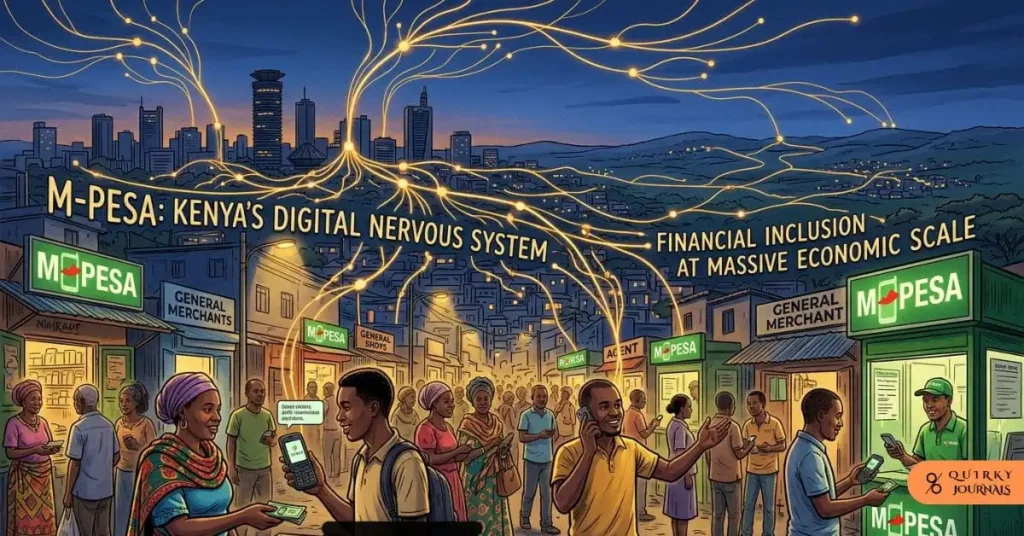
Here is a number that should stop you cold: 59% of Kenya’s entire GDP flows through a single mobile money app. Not a bank. Not a government system. A telecom company’s SMS-based payment tool was built for a country where most people had never held a credit card. That app is M-Pesa, and it has been quietly rewriting the rules of financial inclusion since 2007.
Meanwhile, the richest economies on earth, armed with far greater capital, infrastructure, and technical talent, tried to copy it. Most failed. Some didn’t even try. That failure is not a coincidence. It’s a lesson.
This is the full investigation: why M-Pesa worked, why the world refused to replicate it honestly, and what the financial inclusion fintech revolution actually needs to look like from here.
What Was M-Pesa Actually Solving?
Let’s go back to 2006. Over 74% of Kenya’s adult population had no bank account. Sending money from Nairobi to a relative in the rural Rift Valley meant stuffing cash in an envelope and praying it arrived. Bus drivers acted as informal couriers. Western Union charged fees that ate into remittances. Post offices were slow. Banks were for the wealthy.
The pain was obvious, daily, and severe. But it wasn’t just an inconvenience. It was systemic exclusion. Without a financial account, you couldn’t save safely, receive wages digitally, access credit, or participate in the formal economy.
Nick Hughes, then working at Vodafone, spotted this gap at the 2003 World Summit for Sustainable Development. His idea was brutally simple: use the SMS infrastructure that millions of Kenyans already had in their pockets. No smartphone required. No bank branch needed. Just a SIM card, a four-digit PIN, and a network of local agents acting as human ATMs.
Vodafone partnered with Safaricom, Kenya’s dominant telecoms operator. They launched in March 2007. The uptake was immediate and almost violent in speed.
The Numbers Tell a Story Nobody Expected
Within two years of launch, M-Pesa became Kenya’s leading money transfer method. By 2009, over 50% of the population was sending money through it. The same people who had previously relied on bus drivers and post offices had moved almost entirely to M-Pesa. Western Union’s share? Barely relevant.
Today, the scale is staggering:
- 34 million subscribers in Kenya alone as of late 2024, with 82 million registered accounts
- 381,000 agents nationwide, creating a physical footprint no bank could match
- 21 billion transactions processed in FY2023, valued at KSh 35.9 trillion
- 4,000 transactions per second processed daily, according to Safaricom CEO Peter Ndegwa
- 633,000 merchants accepting M-Pesa payments via Lipa Na M-Pesa
That last metric is worth pausing on. M-Pesa is not merely a remittance app anymore. It is the operating system of Kenya’s economy. You pay your rent, your electricity bill, your school fees, your hospital invoice, and your street food vendor using the same interface. It was, as one Nairobi fintech entrepreneur aptly noted, “the original super app before the term existed.”
The Three Structural Conditions That Made It Possible
People who study M-Pesa often describe its success as a perfect storm. That framing undersells it. Perfect storms are accidents. M-Pesa succeeded because three specific structural conditions aligned simultaneously, and those conditions were not replicated elsewhere.
Condition 1: A Void, Not a Market
This is the factor most often missed by Western analysts. M-Pesa was not competing against existing financial services. It was filling a genuine vacuum. When you launch into a market where the alternatives are bus drivers and prayer, your adoption curve looks nothing like a market where 70% of people already have checking accounts.
Compare that to South Africa, where Vodacom attempted an M-Pesa launch and hit a wall. Why? South Africa’s major retail banks, Absa, FNB, and Standard Bank, had already expanded successfully into low-income markets. The painful problem that M-Pesa solved in Kenya simply did not exist in the same form in Johannesburg. M-Pesa shut down in South Africa in 2016, having reached just one million subscribers.
India was similar. When Vodafone launched M-Pesa in 2013, the market already had UPI’s predecessor ecosystem building momentum and a wave of digital wallet startups like Paytm capturing early adopters. The specific pain M-Pesa healed in Kenya did not exist in the same magnitude in urban India. By mid-2019, Vodafone was quietly planning to exit the Indian mobile money space entirely.
Condition 2: A Regulator That Moved Like a Partner, Not a Gatekeeper
This one is uncomfortable for anyone who believes regulators should always have a clear rulebook before allowing innovation. The Central Bank of Kenya issued M-Pesa a “letter of no objection” in February 2007. Not a license. Not a comprehensive framework. A letter that essentially said: We don’t see a legal problem here, go ahead.
That single document unlocked one of the most consequential financial innovations of the 21st century. The CBK adopted what scholars now recognise as a “test and learn” approach, allowing M-Pesa to operate under an innovative trust account model rather than forcing it into the straitjacket of banking regulations designed for a different era.
When a coalition of Kenyan banks lobbied the finance minister in December 2008 to audit M-Pesa and slow its growth, the audit actually vindicated the platform. The service was found to be robust. And because existing banking law didn’t even cover non-bank products like M-Pesa, there was no legal basis to shut it down.
That regulatory posture is almost impossible to replicate in markets with deeply entrenched banking lobbies. In the United States, any fintech attempting to build a parallel payment infrastructure would face a gauntlet of FDIC regulations, state money transmitter licenses across fifty jurisdictions, and well-funded opposition from incumbents.
Condition 3: Safaricom’s Near-Monopoly and Its Agent Network
At launch, Safaricom controlled roughly 80% of Kenya’s mobile market. That dominance was not incidental to M-Pesa’s success. It was foundational. When you have a near-total market share, you can build a network that reaches everywhere. Every rural shopkeeper, every corner kiosk, every petrol station became a potential M-Pesa agent.
This agent network solved the “cash-in/cash-out” problem that kills every mobile payment platform born in a cash-heavy economy. People need a physical touchpoint to convert between digital money and physical currency. Safaricom built that touchpoint at scale first. By the time competitors arrived, Safaricom had already trained the market, established habits, and made switching costs prohibitive.
In markets with genuine carrier competition, no single operator has this leverage. Nobody in the United States, for example, can convince all four major carriers to build a unified agent network. The incentives simply don’t align.
The Poverty Impact: What the Data Actually Shows
The question of M-Pesa’s poverty impact is more contested than its breathless boosters usually admit. But the headline findings are still genuinely remarkable.
A landmark study by economists at MIT and Georgetown University found that M-Pesa lifted approximately 194,000 Kenyan households out of extreme poverty, primarily through increased financial resilience and women’s economic empowerment. A separate MIT study quantified this at roughly a 2% reduction in poverty headcount, or around 250,000 people.
The gender dimension is particularly striking. In patriarchal households, M-Pesa gave women a private financial channel that bypassed male control of household income. Female-headed households showed greater consumption growth and a more pronounced shift away from subsistence agriculture than male-headed ones.
Financial access in Kenya moved from 26.7% of adults in 2006 to 83.7% by 2021. That is a transformation achieved in fifteen years that most countries have failed to achieve in generations.
| Metric | Kenya 2006 | Kenya 2024 | Change |
|---|---|---|---|
| Adults with financial access | 26.7% | ~90% | +63.3 percentage points |
| GDP flowing through mobile money | ~0% | 59% | Effectively infinite growth |
| M-Pesa transaction value (annual) | Negligible | KSh 35.9 trillion | Category creation |
| M-Pesa agents | 0 | 381,000 | +381,000 |
| Formal bank deposit accounts (2015-2019) | Baseline | +71% increase | Competition spurred banking growth |
But let’s be honest about the critiques, too. Economist Milford Bateman and colleagues have argued that M-Pesa’s expansion, while improving individual financial access, may have crowded out competitors and extracted value through transaction fees that, in a cash economy, would have been zero. Large portions of Safaricom’s profits flow to foreign shareholders. That’s a real tension worth naming.
Why Did the Rest of the World Refuse to Copy This?
Here is where the story gets genuinely frustrating. Policymakers, development economists, and fintech operators around the world watched Kenya’s experiment in real time. The data was published. The mechanism was understood. The results were not in dispute.
And yet, fifteen years after M-Pesa launched, 1.3 billion adults globally remain unbanked according to the World Bank’s Global Findex 2025 Report. That figure has improved from the 1.7 billion reported in earlier cycles, but the pace of progress is far slower than M-Pesa’s example suggested was possible.
Why? The honest answer is that copying M-Pesa required dismantling three deeply embedded systems: incumbent banking power, over-cautious regulation, and the assumption that financial infrastructure must be built from the top down.
The Banking Lobby Problem
In Kenya, the banking sector was not powerful enough in 2007 to stop M-Pesa before it achieved scale. That is not a coincidence or luck. It reflects Kenya’s financial development stage at the time. Traditional banks had limited reach into rural and low-income populations, so M-Pesa was not immediately perceived as a competitive threat.
By the time banks understood what was happening, M-Pesa had already trained 20 million users and was processing transactions that dwarfed traditional banking volumes. The banks that lobbied against it in 2008 lost the argument, and then adapted by partnering with the platform.
In the United States, the European Union, and other mature financial markets, incumbents perceive any telecom-led payment system as an existential threat from day one. The lobbying happens before launch. The regulatory capture is preemptive. In the US, even Apple’s and Google’s payment tools, launched by trillion-dollar companies with army-sized legal teams, have struggled to achieve the kind of systemic penetration M-Pesa achieved in Kenya.
According to Forbes analysis, PayPal’s total payment volume in the US represents less than 5% of GDP, even under generous assumptions. M-Pesa processes 59% of Kenya’s GDP. The comparison is not flattering for Western incumbents.
The Regulatory Architecture Mismatch
Western financial regulation was built to protect consumers and prevent systemic risk in complex, interconnected markets. Those are legitimate goals. But those regulations create an architecture that is fundamentally incompatible with the “test and learn” posture that made M-Pesa possible.
Consider the contrast. Kenya’s CBK used informal “no objection” letters to create space for innovation. The US Federal Reserve, the OCC, and state-level money transmitter regulators operate in a system where legal clarity must precede launch. The cost of regulatory compliance in the US makes it nearly impossible for a small telecom operator to build a payment product without massive upfront capital and a team of lawyers.
This is not purely a Western problem. In India, tight regulation and a large number of competing intermediaries held back mobile money growth for years. In Nigeria, only 3% of adults used mobile money even as late as 2012. In Uganda and Tanzania, a smaller number of agents and insufficient innovation in solving the cash float problem restricted growth, even where demand existed.
Latin America is a particularly instructive case. The CGAP study on M-Pesa’s replication limits in Latin America concluded that M-Pesa’s core innovations, proximity and simplicity, had already been introduced by other players in most LAC markets before M-Pesa arrived. The window had closed.
The “Already Solved” Assumption
This is perhaps the most pernicious barrier. Policymakers in high-income countries looked at Kenya’s banking desert and said: That’s a developing country problem. We’ve solved this already. Our poor have debit cards.
This assumption is dangerously wrong. According to the FDIC, in 2021, 5.9 million US households remained unbanked. Millions more are “underbanked,” meaning they have accounts but rely on expensive check-cashing services, payday lenders, and money orders for core financial activities. The cost of being financially excluded in America is enormous. It’s just less visible because it happens quietly in low-income neighbourhoods, not in the streets of Nairobi.
The M-Pesa model, adapted for context, could have addressed this. Instead, the US went in the direction of fintech apps with complex fee structures and CFPB investigations, while millions of people kept paying $10 to cash a paycheck.
A Framework for Why Mobile Money Succeeds or Fails
Research from Harvard Business School, the Consultative Group to Assist the Poor, and multiple central banks has now distilled the conditions for mobile money success into a reasonably clear framework. Here it is, presented without the usual academic hedging:
| Factor | Kenya (M-Pesa) | South Africa (Failed) | India (Failed) |
|---|---|---|---|
| Existing banking penetration | Low (26% in 2006) | High (urban-dominant) | Medium, rapidly growing |
| Regulatory posture | Permissive, “test and learn” | Restrictive (FICA compliance) | Complex, multi-regulator |
| Operator market dominance | High (~80% Safaricom share) | Low (competitive market) | Low (fragmented) |
| Agent network density | Very high (381,000+) | Very low | Low at launch |
| Unmet demand intensity | Extreme (bus courier system) | Low (bank’s functional) | Medium (crime concern) |
| First-mover advantage | Yes (no alternatives) | No (alternatives existed) | No (Paytm won the market) |
| Outcome | 59% of GDP, 90% adult adoption | 1M users, platform shut down | Exit by 2019 |
The pattern is consistent. Mobile money succeeds where it solves an acute, unmet pain, where the operator has enough market concentration to fund a dense agent network, and where regulators give it room to breathe before forcing it into a compliance framework designed for institutions three times its size.
The Uncomfortable Critique: Has M-Pesa Overpromised?
No honest analysis of M-Pesa can skip this part. The platform that started as a development initiative has evolved into something more complicated.
Fuliza, M-Pesa’s overdraft product, disbursed KSh 638 billion in 2023 alone. The convenience is real. The ease of access through a few phone taps is genuinely valuable to people managing tight household budgets. But the effective annual interest rate, if the facility were extended over a full year, would equate to approximately 132%. Traditional banks in Kenya are not permitted to charge anywhere near that figure.
The Kenyan government’s 2024 Finance Act imposed a 3% excise duty on M-Pesa transactions, generating an estimated $320 million annually for the treasury. That revenue is real. But it comes primarily from the people with the fewest financial alternatives: the low-income users whom M-Pesa was designed to serve. Every transaction they make now carries a cost that didn’t exist when the platform launched.
Economist Milford Bateman called M-Pesa an “extractive activity,” by which large profits are created from taxing small-scale payments that would have been free in cash. The profits flow disproportionately to Safaricom’s foreign shareholders. Local spending power is reduced. The critique is not definitive, but it’s not trivial either.
There is also the monopoly problem. M-Pesa’s market share sits at 91%, though it has been slipping incrementally. Airtel Money grew from 7.6% to 8.9%. That’s healthy competitive pressure, but it’s far from a balanced market. When one platform controls 91% of mobile money, the word “inclusion” starts to feel like the wrong frame. The question becomes: included on whose terms?
What the World Actually Learned (and Is Building Now)
The good news is that M-Pesa’s influence has been real, even if direct replication failed. The ideas it demonstrated, that financial infrastructure could be built on mobile rails, that regulators could enable innovation with light-touch frameworks, that agent networks could replace branch banking, have embedded themselves into global fintech policy thinking.
Brazil’s PIX: The Government-Run Alternative
Brazil launched PIX, its instant payment system, in 2020. The model is fundamentally different from M-Pesa. It’s government-built, bank-integrated, and designed with zero transaction costs for individuals. By 2023, PIX processed $1.3 trillion in transactions. Financial account ownership in Brazil rose from 70% in 2017 to 84% in 2021. That’s a meaningful jump driven by a system that chose inclusivity as a design principle, not a marketing tagline.
The PIX model avoids M-Pesa’s extractive critique precisely because it doesn’t generate private profit from every transaction. But it also required Brazil’s central bank to build and mandate it, which requires a level of political will and state capacity that most emerging economies don’t have.
India’s UPI: The Platform Play
India’s Unified Payments Interface, built by the National Payments Corporation of India, solved the multi-player problem by creating interoperability as infrastructure. Rather than allowing one operator to own the rails, UPI made the rails public and invited all players to build on top. Today, UPI has over 300 million active monthly users. Google Pay, PhonePe, Paytm, and dozens of other players compete for customers, while the underlying protocol remains neutral.
The competition this enabled drove innovation and kept fees low. India’s 90% adult account ownership rate in 2024 is partly a product of this architecture. The lesson: sometimes you don’t need one dominant player. Sometimes you need neutral infrastructure and fierce competition above it.
The OMFIF 2023 Findings: Central Banks Are Watching
An OMFIF survey from 2023 found that 82% of central bank respondents intend to work with commercial banks and payment service providers on digital currencies. The language of partnership has replaced the language of gatekeeping. That shift is an M-Pesa legacy, even if policymakers won’t always credit it as such.
Former Central Bank of Kenya Deputy Governor Sheila M’Mbijjewe put it precisely: “Being scared of having your business model interrupted is not the way to go. We have to keep developing. If we had kept everything within the existing banking structure, banks might have hesitated to innovate, and might have kept prices high.”
The Financial Inclusion Fintech Opportunity That Still Exists
Here is the current picture, drawn from the World Bank’s Global Findex 2025 Report:
- 79% of adults globally now have an account, up from 74% in 2021. Progress is real.
- But 1.3 billion adults remain unbanked, with women constituting 55% of that population.
- 52% of the unbanked are from the poorest 40% of households globally.
- Of those without accounts, 900 million own a mobile phone. More than 530 million people have smartphones.
- In Sub-Saharan Africa, financial account ownership rose from 34% in 2014 to 58% in 2024, but the gender gap and rural-urban divide remain severe.
That 900 million figure is the key. These are people who have the device required to access mobile money. They lack the on-ramp. The infrastructure question is largely solved. The remaining gap is regulatory, cultural, and product design.
Where the Real Opportunity Lives in 2025
The GSMA Mobile Money Report consistently identifies three regions where the gap between mobile phone penetration and financial inclusion is largest: Sub-Saharan Africa outside Kenya, South and Southeast Asia, and parts of Latin America.
These are not markets without potential. They are markets where regulatory frameworks haven’t caught up, where no single operator has the market concentration to fund an agent network at scale, or where cultural trust in digital money has not been established through a credible early win.
The M-Pesa lesson for fintech builders operating in these spaces comes down to three principles:
Principle 1: Solve a Painful Real Problem First
M-Pesa did not launch as a “financial inclusion platform.” It launched as a tool to send money home safely. The financial inclusion was an outcome of solving a visceral, daily pain point. This sounds obvious. But most fintech startups in emerging markets launch with the financial inclusion pitch first and the product second. That’s backwards. Find the bus-driver-carrying-cash problem in your market. Build for that. Inclusion follows.
Principle 2: Build the Physical-Digital Bridge First
The agent network is not a nice-to-have. It is the entire product in a cash-heavy economy. Without cash-in/cash-out points, digital money has no entry and no exit for people whose income arrives in physical notes. The agent problem is expensive and unglamorous. It requires incentive alignment, training, and float management. Most startups avoid it. That avoidance is exactly why most startups in this space fail.
Wave Mobile Money in Senegal and Côte d’Ivoire has shown that this lesson can still be executed fresh. Wave built an agent network, charged zero fees, and achieved extraordinary adoption rates by making the economic proposition undeniable for both agents and users.
Principle 3: Engage Regulators as Partners, Not Obstacles
The CBK’s regulatory sandbox approach has now been studied and partially replicated in over 25 African countries. As of October 2024, 25 national regulatory sandboxes exist across 15 African nations. That’s real momentum. The question is whether founders are engaging these sandbox frameworks early and creatively, or simply waiting for full regulatory clarity that may never come.
Kenya itself has evolved. The Business Laws (Amendment) Act of 2024 expanded CBK oversight to cover digital credit providers comprehensively. By October 2024, only 85 of over 400 digital lenders had secured licenses. That shakeout is painful for individual companies. But it is probably healthy for a market that had developed predatory lending patterns on digital rails.
The Bigger Question: Can Financial Inclusion Be Profitable and Equitable Simultaneously?
This is the tension that will define the next decade of financial inclusion fintech. M-Pesa answered the first part: yes, serving the unbanked can be wildly profitable. It demonstrated that scale at the base of the pyramid generates real revenue.
The second part, equitable, is harder. When a platform becomes the only option for 91% of a population’s mobile financial transactions, and then starts layering on high-interest credit products and faces government taxation on every transaction, the mission drift is visible. The people with no alternatives pay for the platform’s success.
Brazil’s PIX model offers a structural counter-argument: government-built, publicly mandated interoperability can achieve financial inclusion without private extraction. But it requires a competent, committed state. India’s UPI model offers a middle path: publicly built rails, private competition above them. Both have achieved remarkable results. Neither has the spontaneous energy that made M-Pesa’s early years so extraordinary.
The honest answer is probably that no single model works everywhere. The variables, banking penetration, operator concentration, regulatory capacity, cash-dependence, and cultural trust, are too different across markets. What M-Pesa proved is that the problem is solvable. What its critics proved is that the solution requires ongoing vigilance about who benefits and who pays.
What Founders, Policy Makers, and Investors Should Take From This
The M-Pesa story is now old enough to read honestly, without the hype of novelty and without the cynicism of hindsight. Here is what actually survives that reading:
For Fintech Founders
- The market that looks too poor or too rural to serve is often the market where demand is most acute, and competition is thinnest.
- Agent networks are your moat. Building them is hard. That hardness is the point.
- Don’t launch a “financial inclusion app.” Launch something that solves a specific, painful transaction problem. The inclusion narrative will write itself once scale is achieved.
- Study Wave and models like it as carefully as you study M-Pesa. The second generation is learning from the first generation’s mistakes.
For Policy Makers
- A letter of no objection is sometimes more valuable than three years of rulemaking. Permissive frameworks with strong consumer protection backstops outperform rigid pre-approval regimes for early-stage financial innovation.
- Bank lobbies will always oppose mobile money. That opposition is a sign of competitive threat, not consumer risk.
- Interoperability should be a design requirement, not an afterthought. Kenya’s Fast Payment System, still in development, represents an attempt to mandate interoperability after one player achieved dominance. It would have been far easier to build it in from the start.
For Investors
- The 900 million unbanked people who own mobile phones represent a genuine market, not a charity project. The GSMA estimates that global mobile money revenue surpassed $3 billion annually.
- The companies worth backing in financial inclusion fintech are the ones building the unglamorous physical infrastructure, agent networks, cash management systems, trust architecture, not just the consumer-facing app.
- Watch the regulatory evolution in Southeast Asia and francophone West Africa closely. Both regions have the unmet demand and increasing regulatory sophistication that Kenya had in 2005.
The Leapfrog Principle and What Comes Next
The concept of technological leapfrogging describes how developing economies sometimes skip intermediate technology stages and adopt advanced solutions directly. Kenya leapfrogged ATMs, credit cards, and branch banking entirely. The mobile phone became the bank.
This leapfrog is now being extended in new directions. M-Shwari brought savings and credit into the same interface. The M-Pesa Super App now hosts 61 mini-apps covering insurance, e-commerce, and microfinance. Kenya’s fintech ecosystem has grown to over 100 companies, accounting for 15% of fintech startups across all of Africa.
The next leapfrog is likely in AI-powered credit scoring for people with no traditional credit history. M-Pesa’s transaction data creates exactly the kind of behavioural financial record that alternative credit models can use. This is already happening. Branch International and Tala use mobile phone data to underwrite loans for people invisible to traditional bureaus.
The risk is that this algorithmic credit expansion creates a new form of exclusion: those whose phone usage patterns don’t fit the model. But the potential is enormous. If M-Pesa phase one was about payment access, and phase two was about savings and basic credit, phase three is about building a complete financial life on digital rails for people who were previously unreachable by any formal institution.
The Honest Verdict
M-Pesa is simultaneously the most successful financial inclusion story of the last fifty years and a cautionary tale about what happens when a platform outgrows its original mission. Both things are true. The poverty reduction data is real. The mission drift is real. The 194,000 households lifted from extreme poverty are real. The 132% effective annual interest rate on Fuliza is real.
The world’s reluctance to copy it honestly is also real, and it reflects something uncomfortable about how financial systems are actually governed. Incumbents protect incumbents. Regulators protect stability over access. The political economy of banking in mature markets is not designed to produce the kind of permissive, vacuum-filling innovation that M-Pesa required.
That doesn’t make replication impossible. It makes it deliberate. Brazil built PIX by political will. India built UPI by institutional design. Kenya built M-Pesa by accident, opportunity, and one central bank official willing to issue a letter instead of a regulation.
The 900 million unbanked people who already own mobile phones are waiting for whichever version of that story fits their context. The question is not whether financial inclusion fintech can work. M-Pesa proved that in 2007. The question is whether the people building the next wave are willing to do the hard, physical, regulatory, and patient work that the Kenyan model actually required, stripped of the mythology and faced honestly.
The tools exist. The demand is unambiguous. The only remaining question is execution.
Spend some time for your future.
To deepen your understanding of today’s evolving financial landscape, we recommend exploring the following articles:
China’s “Lying Flat” Generation: What Happens When Young People Opt Out of Capitalism Entirely
The Portugal Golden Visa Collapse: What Happens When a Country Sells Residency to the Rich
I Didn’t Notice the Leak — Until My Bank Statement Told Me
Inside the Secret World of Family Offices: How the Ultra-Wealthy Manage Money You’ll Never See
Explore these articles to get a grasp on the new changes in the financial world.
Disclaimer
The content presented in this article is intended for informational and educational purposes only. Nothing in this article constitutes financial, investment, legal, or regulatory advice. The data, statistics, and case studies cited reflect publicly available research and reporting at the time of writing and may not reflect current market conditions or regulatory landscapes. Readers should conduct their own independent research and consult qualified professionals before making any financial, business, or policy decisions. The author and publisher accept no liability for actions taken in reliance on the information presented herein. Regulatory environments vary by jurisdiction, and references to specific regulatory approaches in Kenya, Brazil, India, or other countries should not be interpreted as endorsements of those approaches in other legal contexts.
References
- Wikipedia Contributors. “M-Pesa.” Wikipedia, The Free Encyclopedia. [Online]. Available: https://en.wikipedia.org/wiki/M-Pesa [Accessed: June 2025].
- C. Stadler, “M-PESA: Why The World’s First Large Mobile Payment Platform Keeps On Winning,” Forbes, Jun. 2024. [Online]. Available: https://www.forbes.com/sites/christianstadler/2024/06/11/m-pesa-why-the-worlds-first-large-mobile-payment-platform-keeps-on-winning [Accessed: June 2025].
- Safaricom PLC. “M-PESA Annual Report FY2023.” Safaricom Annual Report. [Online]. Available: https://www.safaricom.co.ke/annualreport_2023/m-pesa.html [Accessed: June 2025].
- T. Suri and W. Jack, “The long-run poverty and gender impacts of mobile money,” Science, vol. 354, no. 6317, pp. 1288-1292, Dec. 2016.
- L. Hove and A. Dubus, “M-PESA and Financial Inclusion in Kenya: Of Paying Comes Saving?” Sustainability, vol. 11, no. 3, p. 568, Jan. 2019. [Online]. Available: https://www.mdpi.com/2071-1050/11/3/568 [Accessed: June 2025].
- World Bank Group. “Global Findex Database 2025.” World Bank Publications. [Online]. Available: https://www.worldbank.org/en/publication/globalfindex [Accessed: June 2025].
- Harvard Business School Digital Initiative. “Replicating MPESA: Lessons from Vodafone(Safaricom) on why Mobile Money fails to gain traction in other markets.” Technology and Operations Management, HBS. [Online]. Available: https://d3.harvard.edu/platform-rctom/submission/replicating-mpesa-lessons-from-vodafonesafaricom-on-why-mobile-money-fails-to-gain-traction-in-other-markets [Accessed: June 2025].
- N. Hughes and S. Lonie, “M-PESA: Mobile Money for the ‘Unbanked,'” Innovations, vol. 4, no. 2, pp. 63-81, Spring 2009.
- CGAP. “The Replication Limits of M-Pesa in Latin America.” CGAP Blog, Jul. 2016. [Online]. Available: https://www.cgap.org/blog/replication-limits-of-m-pesa-in-latin-america [Accessed: June 2025].
- OMFIF. “M-Pesa success shows importance of competition in payments.” OMFIF Digital Monetary Institute, Mar. 2024. [Online]. Available: https://www.omfif.org/2024/03/m-pesa-success-shows-importance-of-competition-in-payments/ [Accessed: June 2025].
- Fintech Association of Kenya. “At 18, M-PESA Faces Its Adult Future.” Fintech Association of Kenya Blog, 2025. [Online]. Available: https://fintechassociation.africa/blog/at-18-m-pesa-faces-its-adult-future-kenyas-mobile-money-giant-at-a-crossroads [Accessed: June 2025].
- N. Ndung’u, “A Digital Financial Services Revolution in Kenya: The M-Pesa Case Study.” African Economic Research Consortium, 2021. [Online]. Available: https://www.researchgate.net/publication/349548752_A_Digital_Financial_Services_Revolution_in_Kenya_The_M-Pesa_Case_Study [Accessed: June 2025].
- R. G. Jack and T. Suri, “Mobile Banking: The Impact of M-Pesa in Kenya.” NBER Working Paper No. 17129, National Bureau of Economic Research, 2011. [Online]. Available: https://www.nber.org/papers/w17129 [Accessed: June 2025].
- Chambers and Partners. “Fintech 2025 – Kenya.” Global Practice Guides, 2025. [Online]. Available: https://practiceguides.chambers.com/practice-guides/fintech-2025/kenya [Accessed: June 2025].
- Quartz Africa. “Why South Africa’s largest mobile network, Vodacom, failed to grow M-Pesa.” Quartz Africa, 2022. [Online]. Available: https://qz.com/africa/467887/why-south-africas-largest-mobile-network-vodacom-failed-to-grow-mpesa [Accessed: June 2025].
- FinDev Gateway. “Financial Inclusion: A Global Overview.” CGAP FinDev Gateway, 2025. [Online]. Available: https://www.findevgateway.org/region/financial-inclusion-global-overview [Accessed: June 2025].