
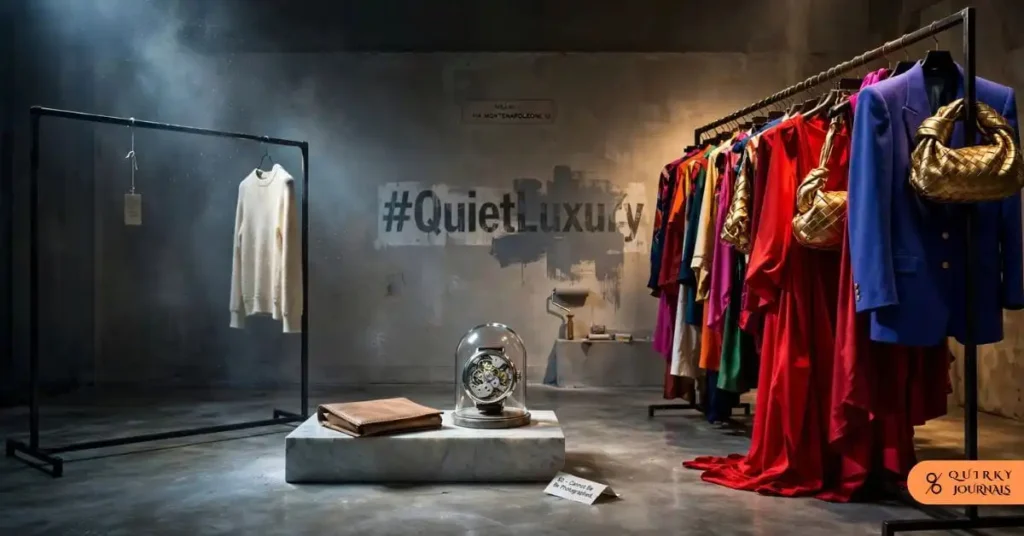
What Killed Quiet Luxury: Commodification, Fatigue, and Status
A woman walks into a Milan showroom wearing a head-to-toe design. Nobody looks up. Six months ago, that outfit would have signalled taste, restraint, and money quietly handled. Now it just signals that she hasn’t checked the memo. The runways have moved on. So with the money.
Quiet luxury isn’t dead because people got bored with neutral cashmere. It’s dead because the wealthy figured out something faster than the rest of us usually do: once a philosophy becomes a hashtag, it stops being a philosophy. It has become a custom that anyone can rent for $40 at a fast-fashion chain. Nothing kills status faster than accbehavioursy.
So what’s rein placing it? Not one thing. A cluster of behaviours, all pointing in the same direction. Some are loud. Most are quiet in a totally different way, the kind of quiet that costs six figures and can’t be photographed. This piece walks through what the data, the private bankers, and the people actually spending the money are obsessing over right now.
The Slow Death of Beige
For years, the wealthy dressed like they were trying not to be noticed. Neutral palettes. Unbranded totes. Cream knits that cost more than a used car but looked like they came from a thrift store. That was the point. Fashion editors called it quiet luxury. Everyone else called it “Why does that plain sweater cost $900?”
The colour shifted. Runways this season leaned into saturated colour. Valentino red. Bottega gold. Sculptural shoulders borrowed straight from the 1980s. Editors declared the trend dead in headline after headline, and for once, the street data backed them up. Search volume for maximalist fashion climbed steadily through early 2026.
But here’s the twist almost nobody’s writing about. The people who actually originated quiet luxury, not the ones copying it, never really left. What died wasn’t the philosophy. What died was the costume version of it, performed for Pinterest boards and TikTok “old money aesthetic” videos. Real quiet luxury just got harder to spot, which was always the intention.
What Actually Killed the Trend
Three things killed quiet luxury as a mass aesthetic, and none of them had anything to do with fashion at all.
First, commodification. Once brands with no history of craftsmanship started slapping “quiet luxury” on beige polyester, the term lost meaning. The original point was never the colour. It was the conviction behind the choice, and conviction doesn’t scale.
Second, fatigue. A wardrobe built entirely around not being noticed eventually reads as fear rather than confidence. Editors started describing the aesthetic as caution dressed up as elegance. Brutal, but not wrong.
Third, and this is the big one, the wealthy simply moved their attention elsewhere. Clothing stopped being where status lived. Status moved into the body, the calendar, and the bloodstream. We’ll get there.
Loud Luxury Isn’t the Full Story
Plenty of coverage this year framed the shift as quiet luxury versus loud luxury, beige versus gold, restraint versus maximalism. That framing sells headlines. Its jewellery is incomplete.
Yes, some of the wealthy went loud. Statement jewellery came back. Layered gold replaced the single delicate chain. Bags in cherry red and emerald green started showing up next to the neutral totes rather than replacing them entirely. That’s real, and it’s documented across fashion week coverage from New York to Milan.
But most of the actual money didn’t go loud. It went somewhere less photogenic. According to Julius Baer’s Global Wealth and Lifestyle Report, luxury goods prices actually fell in 2026, the first decline the index has recorded since it began tracking. Meanwhile, spending on travel, wellness, and experience climbed sharply.
Found Luxury: Collecting Over Curating
Inside interior design circles, a different successor emerged: found luxury. Where quiet luxury meant a perfectly curated, almost sterile neutral home, found luxury means rooms built slowly, over years, out of objects with actual history.
Designers describe it as a shift from prescribed to personal. Think inherited furniture next to a piece sourced on a trip to Marrakech, layered with textiles that don’t perfectly match. It photographs less cleanly than a beige living room, and that’s exactly why it reads as credible. Nothing about it can be bought in one afternoon.
This reveals the underlying mechanism driving every 2026 luxury trend. The wealthy are chasing anything that can’t be instantly replicated by someone with a credit card and a Pinterest board. Time became the new scarcity. You can buy a beige sweater in an hour. You cannot buy twenty years of curated inheritance.
The Craft Revival Behind Found Luxury
Found luxury also revived an entire economy that quiet minimalism had quietly starved: craftspeople. Bespoke furniture makers, restorers, and small-batch textile studios are reporting waitlists that stretch into next year.
That waitlist itself has become part of the appeal. Waiting six months for a hand-restored armoire signals patience and access at once, something a same-day online order never could. It’s the interior design version of a members-only club.
The irony is hard to miss. A movement built on rejecting mass production has become, in its own way, a new kind of status marker for people who can afford to wait. Scarcity, once again, does the heavy lifting that a logo used to do.
The Longevity Economy Just Hit $6.8 Trillion.
Here’s where the real story lives. The global wellness economy reached roughly $6.8 trillion in 2026, nearly double its size a decade ago. Within that number, luxury wellness tourism alone is valued at more than $1.2 trillion and growing at more than 13 per cent annually.
Compare that to traditional luxury goods, where growth has gone flat or negative, depending on the category. The money didn’t disappear. It relocated. Health became the asset class everyone with means is quietly building a position in.
Simone Gibertoni, CEO of the longevity clinic Clinique La Prairie, put it plainly: ” Health is becoming the new wealth. The longevity-focused segment of that wellness economy is forecast to reach around $610 billion by the end of this year, an industry the size of a mid-sized country’s GDP.
Why the Ultra-Wealthy Stopped Buying Watches
Trophy assets used to define old money. Limited-edition watches. Rare whiskies. A garage of classic cars nobody drove. That entire category has cooled.
The 2025 Knight Frank Wealth Report found luxury collectables like art, wine, watches, and classic cars dropped over 18 per cent in value. At the same time, prime real estate and income-generating investments attracted renewed interest, alongside first- and business-class airfare, which rose by as much as 39 per cent in some cities.
Read that again. The wealthy paid more to fly and less for the watch they’d wear on the flight. Owning things quietly lost its shine. Doing things, especially things that are hard to replicate or fake, took its place.
Inside the Longevity Clinic Obsession
Longevity clinics used to be a fringe indulgence for biohackers and Silicon Valley founders. In 2026, they’re closer to mainstream infrastructure for anyone with disposable income above a certain threshold.
According to surveys of high-net-worth individuals, every respondent in the Asia Pacific reported actively pursuing longevity strategies, from personalised diagnostics to preventive therapies. In North America, 87 per cent said the same. This isn’t a spa day. It’s genome sequencing, full-body imaging, stem cell therapy, and peptide treatments, priced accordingly.
What’s driving it isn’t only vanity. It’s generational anxiety about time running out faster than the bank account. As one McKinsey report on healthy ageing notes, more than half of consumers across markets now rank healthy ageing as a top priority. The wealthy just have the means to act on that anxiety immediately.
The Rise of the Private Health Concierge
Alongside the clinics, a quieter industry has emerged: the private health concierge. These are physicians on retainer, available by text, who coordinate everything from bloodwork to specialist referrals without a single waiting room in sight.
Membership at top-tier concierge practices in cities like New York and London can run into the tens of thousands annually. What clients are really buying is time, since traditional healthcare systems are notoriously slow, and speed itself has become a luxury good.
The model has spread to family offices as well, many of which now employ a dedicated health strategist alongside the usual roster of accountants and estate lawyers. Health, quite literally, sits on the balance sheet now.
Wellness Tourism Is the New Trophy Asset
Travel used to be about the destination. Now, for the affluent traveller, it’s about what the trip does to your biomarkers.
Wellness tourism is projected to surpass $1.4 trillion by 2027. Eighty-one per cent of affluent travellers now prioritise wellness-focused outcomes from a trip. More strikingly, 81 per cent of high-net-worth individuals say they would rather fund a transformative luxury trip than a lavish wedding. Experience has not simply joined status signalling. It has replaced it.
Resorts have responded accordingly. Guests at properties like Clinique La Prairie’s international outposts are treating skin as a biological system rather than a cosmetic project, blending AI-powered sleep tracking with old-fashioned silence.
Sleep as a Status Symbol
Nothing captures the new luxury mindset better than sleep. A decade ago, bragging about how little you slept was a founder’s badge of honour. In 2026, the opposite is true. Optimised, tracked, protected sleep has become the flex.
Devices like the Oura Ring and Whoop are now standard accessories in boardrooms, not just gyms. Six Senses properties have opened dedicated biohacking lounges where guests review their sleep data with actual practitioners rather than an app notification.
The subtext is unmistakable. If you can afford to protect eight uninterrupted hours a night, you’re signalling control over your own calendar in a way no watch ever could. Sleep debt used to be a status symbol of its own kind. Now it just looks like poor management.
The Access Economy: Jets, Clubs, and Time
Ownership is quietly losing its appeal among the newly wealthy. According to Knight Frank’s Family Office Survey, 47 per cent of first-time private jet flyers in early 2026 were under 45. A growing share of them prefer paying a premium for last-minute charters over the hassle of owning and maintaining a jet outright.
The same logic applies to private members clubs, which have expanded rapidly from their London and New York roots into Miami, Milan, and Singapore. These clubs now bundle wellness facilities that used to require a separate high-end clinic membership.
Even the superyacht has been reframed. Andrew Hay, former Global Head of Residential at Knight Frank, describes today’s superyacht less as a status object and more as a mobile hotel with the infrastructure to run a business from international waters. Sales value jumped 70 per cent in 2025 alone.
The New Real Estate Playbook: Multi-City Living
Prime real estate hasn’t disappeared from the wealthy wish list. It’s just being deployed differently. Rather than a single trophy mansion, the emerging pattern is a portfolio of smaller footholds across several cities and time zones.
A pied-a-terre in London, a ski chalet in the Alps, a warm-weather base in the Gulf. Each property serves a specific purpose rather than a singular flex. Liam Bailey, Knight Frank’s Global Head of Research, calls this the extraordinary mobility of wealth, driven partly by tax strategy and partly by lifestyle preference.
There are now over 713,000 ultra-high-net-worth individuals worldwide, and roughly 89 people crossed the $30 million threshold every day over the past five years. The market isn’t shrinking. It’s just spreading itself thinner and more deliberately, across the map.
Old Status Signals vs New Status Signals
The table below breaks down the shift plainly. Nothing here is subtle once you see it laid out side by side.
| Old Status Signal (2015 to 2023) | New Status Signal (2026) |
|---|---|
| Logo-covered handbags | Genome sequencing and full-body imaging |
| Limited-edition watches | Longevity clinic membership |
| Owning a private jet | On-demand charter access without the overhead |
| Beige, unbranded minimalism | Inherited, collected, personally meaningful interiors |
| Rare whisky collections | Wellness retreats with measurable biomarker outcomes |
| Trophy real estate in one city | A mobile lifestyle spanning several homes and time zones |
| Bragging about no sleep | Bragging about optimised, tracked sleep |
The Male Wellness Boom Nobody Saw Coming
For most of the last decade, luxury wellness marketing skewed heavily female. That’s flipped, fast. Men are now 36 per cent more likely to prioritise wellness spending, with increases of 8 per cent or more expected across 2026.
The growth is concentrated in what the industry politely calls longevity aesthetics. Injectables. Recovery therapies. Preventative skin health. Clinics at resort brands like Six Senses are reporting strong demand for quarterly treatment protocols priced between $1,000 and $5,000 per cycle.
This isn’t the spa-day version of male self-care from a decade ago. It’s tech-informed skin analysis paired with hormone panels, marketed less like pampering and more like performance engineering. Whether that framing is honest or just clever repackaging is a separate question. Either way, the money is following it.
Food as a Longevity Strategy
Even grocery lists have gone status-conscious. Dietary focus among the wellness-obsessed has shifted heavily toward polyphenol-rich foods: wild berries, leafy greens, high-phenolic olive oil, and deeply pigmented vegetables.
Short-term stimulants are out. Durable cellular energy is the new goal. Creatine and high-grade adaptogens, once confined to gym bags, are now mainstream staples in kitchens that also happen to have a private chef on call.
Even humble vegetables like cabbage are getting a longevity rebrand for their gut health benefits. The underlying message hasn’t changed much from a decade of wellness culture. What’s changed is the price tag attached to executing it properly, and the seriousness with which the wealthy now treat a grocery run as a health intervention.
Radical Stillness and the Rise of Silence
Here’s the part that sounds almost contradictory until you sit with it. In an era of constant digital noise, the rarest luxury available to the wealthy in 2026 is silence.
Destinations built around doing essentially nothing, agrarian retreats, dark sky stargazing at zero-light-pollution sites, communal saunas without a phone in sight, have become some of the hardest bookings to secure. Even David Beckham’s much-covered pivot toward beekeeping and vegetable growing in the Cotswolds fits the pattern, signalling not really about vegetables. It’s an expensive way of signalling that someone finally has enough time to grow their own food.
Brands chasing this audience have had to adjust their entire media approach. Instead of hyper-frequent digital ads, the smartest ones are investing in slow, deep-immersion formats: long-form podcasts, prinnot tonals, and invite-only experiences. In 2026, a brand’s ability not to interrupt someone has quietly become a marker of prestige in itself.
Cultural Immersion Over Ticking Boxes
Travel advisors are seeing a related pattern play out on the ground. Rather than racing through a checklist of famous sites, wealthy travellers increasingly want depth over breadth. Longer port stays. Smaller safari camps. Unhurried mornings instead of packed itineraries.
According to Virtuoso’s 2026 Luxe Report, cultural immersion climbed four per cent to become a top-five travel trend this year, with roughly 85 per cent of luxury travellers now wanting to deeply explore local culture rather than simply pass through it.
Destinations rewarding that patience are seeing outsized interest. Iceland, Antarctica, and Norway topped the list of rising destinations, alongside a jump for Vietnam and a strong showing for Kyoto, joining Tokyo among the top cities to visit this year.
The Data Point Nobody Expected: Falling Tech Prices
One statistic buried in the Julius Baer report deserves more attention than it got. Prices for luxury tech dropped sharply through 2025. A flagship MacBook Pro costs 21 per cent more than the year before. Samsung’s top-tier phone fell 22 per cent.
That’s not just a pricing quirk. It reflects cooling demand for flashy personal electronics among the exact demographic that used to queue for the newest device on release day. The gadget stopped being the flex.
Put simply, the wealthy grew indifferent to status-driven consumption of anything that ages quickly. A phone is obsolete in a year. A longevity protocol, in theory, pays dividends for decades. That math, more than any single fashion trend, explains where the spending actually went.
Intergenerational Wealth and Changing Values
Roughly $83.5 trillion in global wealth is projected to change hands over the coming decades, according to the Capgemini World Wealth Report. That handover isn’t purely financial. It’s philosophical.
Younger heirs are, on average, more inclined toward well-being, purpose-led investing, sustainable finance, and general well-being than the generation handing them the money. They’re also more digitally fluent and considerably more likely to question inherited assumptions about what wealth is supposed to look like.
Private banks have noticed. Portfolio performance alone no longer satisfies this incoming client base. They increasingly want portfolios that reflect personal values and expected lifespan, not just risk tolerance. That single shift is quietly reshaping how private wealth management firms pitch new clients.
Gen Z’s Different Relationship With Status
If millennials popularised quiet luxury, Gen Z is arguably the generation abandoning it fastest, and for reasons that go beyond aesthetics. Gen Z luxury consumers are 84 per cent more likely to increase wellness spending in 2026, specifically, with mental health topping their list of priorities.
That’s driving two related trends: cognitive resilience and personalised hormone-aligned routines. High-end coaches now offer personalised mental fitness programs through premium apps, with monthly pricing running from $500 to $3,000 depending on intensity.
The New Definition of Old Money
Old money used to mean a certain look: inherited tweed, a family crest, a house that never changed. In 2026, the definition is drifting toward something less visual and more behavioural.
The common thread across everything in this piece, the interiors, the clinics, the travel, the falling tech prices, is a rejection of anything that can be bought quickly and displayed loudly. New old money looks like patience, privacy, and a body that works well into its eighties.
It’s a quieter kind of loud, if that makes sense. Nobody’s posting their genome sequencing results on social media. But everyone in that world already knows exactly who’s doing it, and who isn’t.
When Advertising Validated the Trend
Culture caught up publicly this year. The 2026 Super Bowl earned an unofficial nickname among advertising insiders: the Wellness Bowl. At least five healthcare and wellness brands bought airtime, a historic shift for a broadcast usually dominated by beer and soda.
One spot leaned into the idea directly. It argued, bluntly, that rich people live longer. Another normalised preventive cancer screening with humour. A third positioned long-term weight management as a lifestyle strategy rather than a quick fix.
None of this created the longevity trend. It simply validated it in front of 128 million viewers at once. That kind of mainstream validation raises the bar for every wellness brand that follows. It’s no longer optional to show up in this conversation. It’s the price of staying relevant.
What This Means If You’re Not Ultra-Rich
None of this requires a family office to act on. The underlying signalling transfers cleanly to anyone paying attention: stop signalling through objects that anyone can buy in an afternoon, and start investing in things that compound over time.
That doesn’t mean everyone needs a $5,000 longevity protocol. It means the instinct behind it, treating your health span as seriously as your bank balance, scales down perfectly well. A consistent sleep schedule, resistance training, and real social benefits cost close to nothing and deliver most of the same benefits the wealthy are paying six figures to chase.
The interiors lesson scales too. A room built slowly out of things with actual meaning will always beat one bought in a single big-box run, regardless of budget. Found luxury was never really about money. It was about patience, which happens to be the one resource that’s genuinely hard to buy.
The Risk of Turning Longevity Into a New Costume
Worth saying plainly: this trend can absolutely go the same way quiet luxury did. The moment longevity becomes a hashtag rather than a genuine health practice, it risks the exact commodification that killed beige minimalism.
Signs of that are already visible. Supplement brands slap the word longevity on products with zero clinical backing. Wellness retreats charge premium rates for what amounts to a nice hotel with a juice bar. The line between science-backed intervention and expensive placebo is getting blurrier, not clearer, as more money floods in.
The people actually getting results tend to be the ones treating this as unglamorous, boring work: consistent sleep, real diagnostics, and doctors who don’t post on social media. Everyone else is buying a very expensive version of hope, dressed up in clinical language. That’s a hard truth, but it’s worth sitting with before writing a check.
Where This Goes Next
Trends built on scarcity eventually get commodified. That’s the whole cycle we just watched play out with quiet luxury, and it’s the cycle longevity culture is already entering. Give it three to five years, and biohacking will probably read the way quiet luxury reads right now: a philosophy that got copied into meaninglessness.
What won’t get commodified, at least not easily, is time itself. The people building genuinely interesting lives in 2026 aren’t chasing whatever the current label is. They’re buying back hours, protecting attention, and investing in bodies and homes that can’t be assembled overnight. That’s a harder story to package into a hashtag, which is probably exactly why it’s the one worth paying attention to.
Spend some time for your future.
To deepen your understanding of today’s evolving financial landscape, we recommend exploring the following articles:
Why Europe Wants a Digital Euro: Visa, Mastercard, and Dollar Risk
Job Hopping Makes You Richer. Here’s the Data Companies Don’t Want You to See
Shark Tank Deals That Never Actually Closed: The Dirty Secret Behind TV’s Biggest Investment Show
Why SpaceX Stock Crashed 23% Days After Its Blockbuster IPO
Explore these articles to get a grasp on the new changes in the financial world.
Disclaimer
This article is provided for general informational and editorial purposes only. It does not constitute financial, medical, legal, or investment advice. References to specific brands, clinics, products, or reports are included for illustrative and journalistic purposes and do not imply endorsement. Readers should consult a qualified professional before making decisions related to health, wellness protocols, or significant financial purchases. Statistics and figures cited reflect publicly available reporting at the time of writing and are subject to change.
References
[1] Luxury Communications Council, “Longevity is the New Luxury,” 2026. [Online]. Available: https://www.luxurycommunicationscouncil.com
[2] Julius Baer, “The Global Boom in Longevity Wellness,” 2026. [Online]. Available: https://www.juliusbaer.com
[3] Knight Frank, “The Wealth Report 2026,” 2026. [Online]. Available: https://www.knightfrank.com
[4] Forbes, “How the Ultra-Wealthy Are Spending Their Money in 2026,” 2026. [Online]. Available: https://www.forbes.com
[5] Homes and Gardens, “The Found Luxury Trend Is Replacing Quiet Luxury,” 2026. [Online]. Available: https://www.homesandgardens.com
[6] Healing Holidays, “Top 2026 Wellness Trends,” 2026. [Online]. Available: https://www.healingholidays.com
[7] Luxury Lifestyle Magazine, “7 Luxury Wellness Trends That’ll Dominate 2026,” 2026. [Online]. Available: https://www.luxurylifestylemag.co.uk
[8] McKinsey and Company, “Healthy Ageing Consumer Research,” 2026. [Online]. Available: https://www.mckinsey.com
[9] Global Wellness Institute, “Global Wellness Economy Monitor,” 2026. [Online]. Available: https://www.globalwellnessinstitute.org
[10] Virtuoso, “2026 Virtuoso Luxe Report,” 2026. [Online]. Available: https://www.virtuoso.com
[11] Business of Fashion, “State of Fashion 2026,” 2026. [Online]. Available: https://www.businessoffashion.com