
The Roth IRA vs. 401(k) Strategy: A Tiered Approach to Tax Minimisation
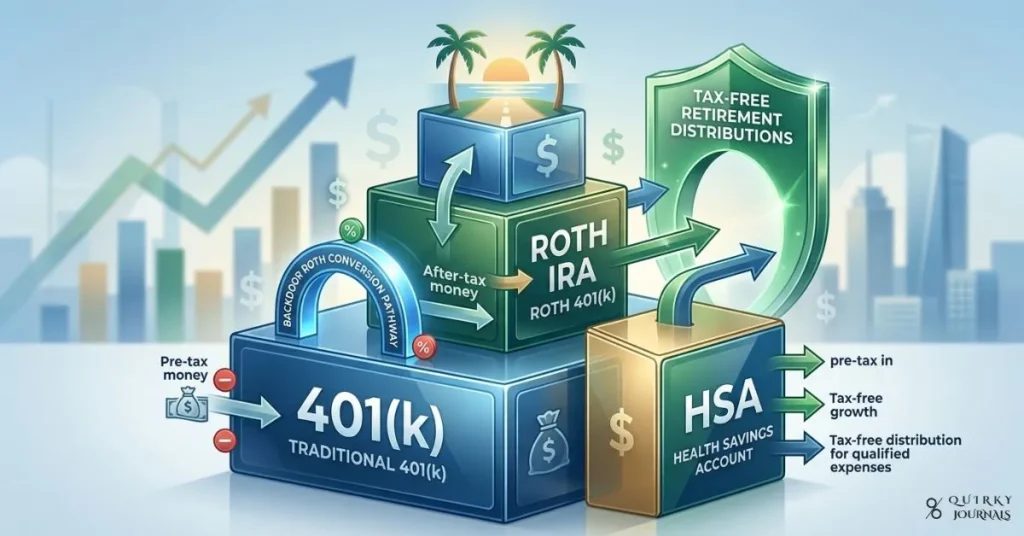
Most people think about retirement accounts as a simple binary: traditional or Roth, pre-tax or after-tax. In reality, the smartest retirement savers think in layers. They stack multiple tax-advantaged accounts in a specific sequence, turning what looks like a complicated array of rules and limits into a coherent, powerful system for keeping as much of their money as possible out of the government’s hands, both today and in retirement.
This post lays out that system. We will cover the foundational differences between a 401(k) and a Roth IRA, walk through the 2025 and 2026 contribution limits and income thresholds, and then build a tiered framework that shows you exactly where to put each dollar in what order. We will also cover the Health Savings Account (HSA) as a hidden retirement weapon, the backdoor Roth for high earners who are blocked out of direct contributions, and the mega backdoor Roth for those who want to go even further.
By the end, you will have a clear picture of not just what each account does, but how to deploy them together to minimise taxes across your entire lifetime, not just in any single year.
The Core Difference: Pre-Tax vs. After-Tax Money
Everything in retirement account strategy flows from one fundamental concept: the timing of the tax. Every dollar you earn will be taxed at some point. The question is whether you pay that tax before you invest or when you withdraw in retirement.
A traditional 401(k) and a traditional IRA use pre-tax money. You contribute dollars before income tax is applied, which reduces your taxable income today. The money then grows tax-deferred inside the account. When you withdraw in retirement, you pay ordinary income tax on every dollar you take out, including all the growth. The benefit is the upfront tax deduction. The cost is that you owe taxes on everything you withdraw later.
A Roth IRA and Roth 401(k) work the opposite way. You contribute after-tax money, receiving no deduction today. The money grows inside the account completely tax-free. Qualified withdrawals in retirement are also tax-free, meaning the government never touches your investment growth again. The cost is paying tax upfront. The benefit is permanent tax-free growth and tax-free income in retirement.
Why the Choice Between Pre-Tax and Roth Comes Down to Tax Rates
The financial mathematics of pre-tax versus Roth boils down to a single question: Will your tax rate be higher now or when you withdraw? As the White Coat Investor explains clearly, if you take money out of a Roth account at the same marginal tax rate you put it in at, the outcome is mathematically identical. If you withdraw at a higher rate, the Roth wins. If you withdraw at a lower rate, the pre-tax account wins.
For most people in their peak earning years who expect a significant drop in income in retirement, the traditional pre-tax account tends to win on pure math. For younger earners in low tax brackets, or anyone who expects their retirement income to be high, Roth almost always wins. For the rest, a thoughtful combination of both is often the correct answer, which is why the tiered approach matters so much.
There is also a secondary benefit to Roth accounts that the simple tax-rate comparison misses: flexibility and estate planning. Roth IRAs have no required minimum distributions (RMDs) during the owner’s lifetime. That means you can let the money compound indefinitely without being forced to withdraw and pay taxes simply because you have reached a certain age. Traditional accounts force RMDs beginning at age 73 under current law, which can push retirees into higher tax brackets even when they do not need the cash.
2025 and 2026 Contribution Limits: The Numbers You Need to Know
Before building a tiered strategy, you need to know the current contribution limits and income thresholds. These numbers are updated annually by the IRS to account for inflation, and they changed meaningfully between 2025 and 2026.
For the 2025 tax year, the 401(k) employee contribution limit is $23,500, according to Britannica Money. Workers aged 50 to 59 and 64 and older can make an additional catch-up contribution of $7,500, bringing their total to $31,000. Under the SECURE 2.0 Act provisions, workers aged 60 to 63 get a special enhanced catch-up of $11,250 instead, bringing their total to $34,750. The total contribution limit, including employer contributions for 2025, is $70,000.
For 2026, the IRS raised the employee contribution limit to $24,500, with an $8,000 catch-up for those aged 50 to 59 and 64 and older. The total annual additions limit increases to $72,000 for 2026, according to the IRS announcement. Roth IRA and traditional IRA contribution limits stay at $7,000 for 2025, with a $1,000 catch-up for those 50 and older. For 2026, the IRA limit rises to $7,500, with an $8,600 total for those 50 and older.
Roth IRA Income Limits: Who Can Contribute Directly
Unlike 401(k) plans, which have no income restrictions for contributions, Roth IRAs phase out eligibility for direct contributions above certain income thresholds. For the 2025 tax year, single filers with a modified adjusted gross income (MAGI) above $165,000 cannot make direct Roth IRA contributions at all. The phase-out begins at $150,000. For married couples filing jointly, the phase-out begins at $236,000, and the hard cutoff is $246,000.
For 2026, these thresholds increase slightly. According to the IRS, the Roth IRA phase-out range for single filers rises to $153,000 to $168,000, and for married joint filers to $242,000 to $252,000. High earners who exceed these limits are not necessarily locked out of Roth benefits entirely. They have access to the backdoor Roth IRA strategy, which we will cover later in this post.
Importantly, Roth 401(k) plans have no income limits at all. As Fidelity explains, a Roth 401(k) allows after-tax contributions up to the full 401(k) limit regardless of income. This is one of the most underused strategies for high earners who are blocked from direct Roth IRA contributions: simply designate your 401(k) contributions as Roth rather than pre-tax, subject to the same contribution limits but with no income ceiling.
The Employer Match: The Highest-Return Investment You Will Ever Make
Any tiered contribution strategy must begin with one non-negotiable step: capturing the full employer match. An employer match is, quite literally, a 100% instant return on your investment. No index fund, no bond, no other asset class delivers guaranteed, immediate doubling of your money. Failing to capture the full match is leaving part of your compensation on the table.
As New York Life emphasises, if your employer offers a match, you should absolutely take full advantage of it before exploring any other options. A common match structure is 100% of the first 3% of salary, then 50% of the next 2%. A worker earning $80,000 per year who contributes at least 5% to their 401(k) would receive $3,200 per year in free employer contributions. Over a 30-year career compounding at 7%, that $3,200 per year grows to over $300,000 in additional retirement wealth, at zero additional cost to the employee.
The tax treatment of the match itself matters less than capturing it entirely. Even if you prefer Roth contributions for your own dollars, employer match contributions almost always go into the pre-tax portion of your account. That is fine. The free money still outweighs any tax considerations. Step one of the tiered strategy is always: contribute enough to your 401(k) to get every dollar of the employer match.
The Health Savings Account: The Overlooked Triple-Tax Weapon
Before moving up the contribution ladder, there is an account that belongs in the strategy that most retirement guides either skip or mention only briefly: the Health Savings Account (HSA). Among all tax-advantaged accounts available to American workers, the HSA is uniquely powerful because it offers what no other account provides: a triple tax advantage.
According to Safe Landing Financial, contributions to an HSA are tax-deductible, the money grows tax-deferred inside the account, and qualified withdrawals for medical expenses are completely tax-free. No other commonly available savings vehicle offers all three of these benefits simultaneously. A traditional 401(k) gives you the deduction and tax-deferred growth, but taxes withdrawals. A Roth IRA gives you tax-free growth and tax-free withdrawals, but no deduction. Only the HSA delivers all three.
The 2025 HSA contribution limits are $4,300 for individual coverage and $8,550 for family coverage, with a $1,000 catch-up contribution for those aged 55 and older. The critical strategy for investors with adequate cash flow is to pay medical expenses out of pocket rather than drawing on HSA funds, keeping all receipts, and letting the HSA grow invested for decades. Then, in retirement, you can reimburse yourself for any of those past out-of-pocket expenses tax-free, with no time limit on the reimbursement. After age 65, you can withdraw for any reason without penalty, though non-medical withdrawals are taxed as ordinary income, just like a traditional IRA.
Building the Tiered Strategy: A Step-by-Step Priority Order
With the foundational concepts established, here is the tiered contribution framework that maximises tax efficiency across accounts. This order applies to most working adults with access to a 401(k) and an HSA. Individual circumstances will vary, and consulting a qualified financial advisor or tax professional is always advisable before making major changes.
| Tier | Account | Action | Why |
|---|---|---|---|
| 1 | 401(k) | Contribute enough to capture the full employer match | 100% instant return on investment |
| 2 | HSA (if eligible) | Max out HSA contribution | Triple tax advantage, best tax efficiency of any account |
| 3 | Roth IRA | Max out Roth IRA (or backdoor Roth if over income limits) | Tax-free growth, no RMDs, maximum flexibility |
| 4 | 401(k) | Max out remaining 401(k) room (pre-tax or Roth) | Higher limits than IRA, continued tax-advantaged growth |
| 5 | Mega Backdoor Roth | After-tax 401(k) contributions converted to Roth (if plan allows) | Access up to $70,000-$72,000 total 401(k) annual additions limit |
| 6 | Taxable Brokerage | Invest remaining savings in low-cost index ETFs | No tax advantages, but no restrictions or penalties either |
This order is not arbitrary. It reflects a deliberate prioritisation of the highest guaranteed return (employer match), then the most powerful tax structure (HSA), then the most flexible tax-free vehicle (Roth IRA), then additional tax-advantaged space (full 401(k)), then advanced strategies for those with extra savings capacity.
Why the Roth IRA Comes Before Filling the 401(k): The Flexibility Argument
Many investors are surprised that the tiered strategy places a full Roth IRA contribution above completing the 401(k) max. After all, the 401(k) limit ($23,500) is more than three times the Roth IRA limit ($7,000). Why not just put everything into the 401(k) first?
The answer lies in flexibility. A Roth IRA allows you to withdraw your contributions (not earnings) at any time, for any reason, without taxes or penalties. This is not the case with a 401(k), which typically imposes a 10% penalty on early withdrawals plus ordinary income tax. The Roth IRA’s contribution withdrawal flexibility means it can serve as a backup emergency fund of last resort. It also gives investors far more control over their investment choices, since IRA accounts can hold virtually any publicly traded security, while 401(k) plans typically offer only 30 to 50 fund options selected by the employer.
Additionally, Roth IRAs have no required minimum distributions during the owner’s lifetime. The 401(k) forces RMDs beginning at age 73. By prioritising the Roth IRA, you are building a pool of tax-free money that you can access in retirement to manage your tax bracket strategically, drawing from the Roth IRA in years when your pre-tax withdrawals would otherwise push you into a higher bracket.
The Backdoor Roth IRA: Bypassing the Income Limits
For high earners who exceed the Roth IRA income limits, the direct contribution path is closed. However, there is a legal and widely used workaround known as the backdoor Roth IRA. The strategy is elegant in its simplicity.
First, you make a nondeductible contribution to a traditional IRA. Since you are above the income limit for a Roth IRA, you also cannot deduct a traditional IRA contribution if you have a workplace retirement plan. So you contribute after-tax dollars to the traditional IRA, receiving no tax benefit upfront. Second, you convert that traditional IRA to a Roth IRA. The IRS allows anyone to convert a traditional IRA to a Roth, regardless of income level. Since you already paid tax on the contributed dollars, the conversion is typically tax-free. As Vanguard explains, this strategy works because while there are income limits for direct Roth contributions, there are no income limits on conversions.
One important caveat is the pro-rata rule. If you have other pre-tax traditional IRA assets, the IRS treats all your IRAs as one pool when calculating how much of a conversion is taxable. This can make the backdoor Roth more complicated and partially taxable if you have significant existing pre-tax IRA balances. A tax professional can help you navigate this calculation and determine whether the strategy makes sense in your specific situation.
Pre-Tax vs. Roth 401(k): Which Should You Choose?
Once you have captured the employer match, maxed the HSA, and maxed the Roth IRA, the next tier is filling the remainder of your 401(k) limit. Here, you face the choice between pre-tax and Roth contributions within the 401(k) itself. Many employers now offer both options.
The decision framework mirrors the broader Roth-versus-traditional debate. If you are in a high tax bracket now and expect a lower tax rate in retirement, the pre-tax 401(k) contribution makes sense. You save taxes at your current high rate and pay them later at a lower rate. If you are in a moderate or low tax bracket, or if you expect significant retirement income, the Roth 401(k) option allows you to lock in your current tax rate and never pay taxes on that money again.
As the Kitces financial planning blog notes, most high-income individuals who feel the pressure of top tax brackets tend to prefer Roth-style accounts to eliminate the tax bite on growth going forward. The Roth 401(k) is particularly attractive for high earners who are blocked from direct Roth IRA contributions but still want Roth exposure at the higher 401(k) contribution limits, since the Roth 401(k) has no income restrictions whatsoever.
The Mega Backdoor Roth: Advanced Strategy for High Savers
For workers who have already maxed their 401(k) employee contributions, maxed their IRA, and maxed their HSA, and still have money to invest, the mega backdoor Roth offers a path to additional Roth-style savings that far exceeds normal contribution limits.
The strategy exploits the gap between the employee contribution limit and the total annual additions limit. For 2025, the employee deferral limit is $23,500, but the total additions limit, including employer contributions and after-tax contributions, is $70,000. After accounting for your own deferrals and any employer match, the remaining room under that $70,000 ceiling can be filled with after-tax 401(k) contributions, which are distinct from both pre-tax and Roth 401(k) contributions. According to Fidelity, those after-tax contributions can then be converted either to a Roth 401(k) through an in-plan Roth conversion or rolled out to a Roth IRA as an in-service distribution.
The result is extraordinary. A worker under 50 contributing $23,500 in employee deferrals, receiving a $6,000 employer match, could potentially contribute an additional $40,500 in after-tax contributions and convert them all to Roth, for a total of $70,000 in tax-advantaged retirement savings in a single year. For 2026, that ceiling rises to $72,000. Tech industry giants like Google, Microsoft, and Meta commonly offer plans that support this strategy, according to Consilio Wealth Advisors.
Important Requirements for the Mega Backdoor Roth
The mega backdoor Roth is not available to every worker. It requires specific plan features that not all employers offer. According to District Capital Management, the strategy requires two conditions to be met simultaneously. First, your 401(k) plan must allow after-tax contributions beyond the normal employee deferral limit. Second, your plan must allow either in-plan Roth conversions or in-service distributions to a Roth IRA. If your plan permits only one of these but not the other, the strategy does not work cleanly.
The best way to find out if your plan qualifies is to ask your HR department or plan administrator directly. The specific questions to ask are whether the plan allows after-tax contributions (not Roth 401(k) contributions, which are different), and whether it allows in-plan Roth conversions or in-service withdrawals. If the answer to both is yes, you have access to one of the most powerful tax-advantaged retirement savings tools available to American workers.
One additional risk to manage is the timing of the conversion. After-tax contributions that sit in the account and earn investment returns before being converted will have taxable earnings attached to them. To minimise this, convert as promptly as possible after contributing. This reduces the earnings component and keeps the conversion nearly tax-free.
Roth Conversions as a Long-Term Tax Management Tool
Beyond annual contributions, strategic Roth conversions represent a powerful tool for managing your lifetime tax bill. A Roth conversion involves moving money from a pre-tax account, either a traditional IRA or 401(k), into a Roth account, paying ordinary income tax on the converted amount in the year of conversion, but permanently eliminating future taxes on that money and its growth.
The ideal time to execute Roth conversions is during years when your taxable income is temporarily lower than usual. These windows commonly occur in early retirement, before Social Security begins, or before RMDs force distributions from pre-tax accounts. By converting strategically during these low-income years, you can fill up lower tax brackets with Roth conversions, paying taxes at relatively modest rates rather than at the potentially higher rates that RMDs might impose later.
As the Guideline retirement platform notes, if you anticipate being in a higher tax bracket when you retire, funding Roth accounts now and converting strategically is a particularly wise approach. The combination of tax-free growth, no RMDs, and the ability to control when you pay taxes makes the Roth conversion one of the most versatile long-term tax planning tools available.
The Pro-Rata Rule and the Pro-Rata Problem
Anyone implementing a backdoor Roth or Roth conversion strategy needs to understand the pro-rata rule. This IRS rule treats all of your traditional IRA assets as a single pool when determining how much of any conversion is taxable. If you have $100,000 in a traditional IRA that was funded entirely with deductible (pre-tax) contributions, and you then make a $7,000 nondeductible backdoor Roth contribution, you now have a total IRA balance of $107,000, of which $7,000 is after-tax, and $100,000 is pre-tax. When you convert the $7,000, the IRS does not let you convert only the after-tax portion. Instead, 6.5% of the conversion ($7,000 / $107,000) is after-tax and tax-free, while the remaining 93.5% is pre-tax and taxable.
This rule can significantly complicate or even undermine the backdoor Roth strategy for investors who have large existing pre-tax IRA balances. One common solution is to roll existing traditional IRA balances into your current employer’s 401(k) plan, which removes them from the pro-rata calculation. However, not all 401(k) plans accept IRA rollovers. Again, this is an area where a qualified tax advisor can prevent costly mistakes and help you structure the strategy correctly from the start.
Required Minimum Distributions and Why Roth Accounts Help
Required minimum distributions represent one of the most significant tax risks in retirement that many investors fail to plan for. Beginning at age 73 under the current law, all traditional 401(k) and traditional IRA accounts are subject to RMDs. The IRS requires you to withdraw a minimum amount annually, calculated based on your account balance and your life expectancy. These withdrawals are taxed as ordinary income, regardless of whether you need the money.
For retirees with large pre-tax accounts, RMDs can be substantial. A 73-year-old with $2 million in traditional IRA assets would face an RMD of roughly $75,000 in the first year, all of it added to their taxable income. If they also receive Social Security and pension income, this could push them into a high tax bracket, potentially triggering the Medicare surcharge known as the Income-Related Monthly Adjustment Amount (IRMAA) and increasing the taxable percentage of their Social Security benefits.
Roth IRAs are completely exempt from RMDs during the owner’s lifetime. As Fidelity explains, there are no required minimum distributions from a Roth IRA. This makes Roth accounts invaluable not just as a tax-free growth vehicle but as a tax management tool in retirement. By building a significant Roth balance over your working years, you give yourself the flexibility to choose how much pre-tax income you withdraw annually, keeping your taxable income at a level that minimises both income taxes and Medicare premiums.
Comparing the Accounts Side by Side: 2025 and 2026 Data
The table below summarises the key features and current limits for the main tax-advantaged retirement accounts available to most American workers.
| Feature | Traditional 401(k) | Roth 401(k) | Roth IRA | HSA |
|---|---|---|---|---|
| 2025 Contribution Limit | $23,500 (employee) | $23,500 (shared with traditional) | $7,000 | $4,300 individual / $8,550 family |
| 2026 Contribution Limit | $24,500 (employee) | $24,500 (shared with traditional) | $7,500 | Must have a qualifying HDHP |
| Income limits | None | None | Single: phase-out $150k-$165k (2025); Married: $236k-$246k (2025) | None during the owner’s lifetime |
| Tax on contributions | Pre-tax (deductible) | After-tax (no deduction) | After-tax (no deduction) | Pre-tax (deductible) |
| Tax on growth | Tax-deferred | Tax-free | Tax-free | Tax-free |
| Tax on qualified withdrawals | Ordinary income tax | Tax-free | Tax-free | Tax-free (medical); income tax (non-medical, age 65+) |
| Required minimum distributions | Yes, from age 73 | Yes (unless rolled to Roth IRA) | Typically goes into the pre-tax portion | None |
| Employer contributions | Yes | Contributions are withdrawable anytime, penalty-free | No | Sometimes (counts toward limit) |
| Early withdrawal flexibility | 10% penalty plus taxes before age 59.5 | 10% penalty on earnings before 59.5 | Contributions withdrawable anytime, penalty-free | Penalty-free for qualified medical expenses at any age |
Tax Diversification: The Strategic Case for Holding Both Account Types
Just as portfolio diversification across asset classes reduces investment risk, tax diversification across account types reduces tax risk in retirement. An investor who has all their retirement savings in a traditional 401(k) has concentrated all their tax exposure in the future. Whatever tax rates prevail when they retire, those rates determine what percentage of their lifetime savings the government takes. An investor with a mix of pre-tax, Roth, and taxable accounts has options.
In any given retirement year, they can draw from the pre-tax account up to the top of a lower tax bracket, then supplement with Roth withdrawals that add no taxable income, and hold the taxable account for capital gains that may qualify for the preferential 0% long-term rate if their income is low enough. This kind of bracket management across multiple account types can reduce the effective tax rate on retirement withdrawals far below what any single account type could achieve alone.
The Kitces hierarchy of tax-preferenced savings vehicles makes the point elegantly: the goal is not to optimise a single account but to build a system that minimises taxes across your entire financial life. This requires holding multiple account types with different tax treatments, so that you always have options to draw income from the most tax-efficient source given your circumstances in any particular year.
Special Situations: Self-Employed, Freelancers, and Small Business Owners
The tiered strategy described above assumes access to an employer 401(k) plan. Self-employed workers, freelancers, and small business owners have a different but potentially more powerful set of options. A Solo 401(k), also called an individual 401(k), allows self-employed individuals to make contributions both as the employee and as the employer, dramatically increasing the total amount that can be sheltered from taxes.
In 2025, a self-employed person can contribute up to $23,500 as the employee deferral component of a Solo 401(k), plus an additional employer contribution of up to 25% of net self-employment income, subject to the overall $70,000 total additions limit. Solo 401(k) plans can also be set up to allow Roth contributions and, in some cases, after-tax contributions that enable the mega backdoor Roth strategy. A SEP-IRA is another option for the self-employed, allowing employer-only contributions of up to 25% of compensation, capped at $70,000 for 2025, though SEP-IRAs do not allow Roth contributions.
For small business owners with employees, a SIMPLE IRA provides another tax-advantaged option with lower administrative complexity than a full 401(k) plan. The SIMPLE IRA contribution limit for 2025 is $16,500, with the employer required to match contributions up to certain percentages. Choosing among these options requires careful analysis of income level, business structure, and long-term tax planning goals.
The Five-Year Rule: A Critical Roth IRA Timing Detail
One often-misunderstood element of Roth IRA rules is the five-year rule, which governs when earnings in a Roth IRA can be withdrawn tax-free. To receive a fully qualified tax-free withdrawal of both contributions and earnings, two conditions must be met: you must be at least 59 and a half years old, and your Roth IRA must have been open for at least five years.
The five-year clock starts on January 1 of the first tax year for which you made a Roth IRA contribution. It does not restart each time you make a new contribution. If you opened your first Roth IRA in 2020, your five-year period ended on January 1, 2025, regardless of when in 2020 you actually contributed. This means there is genuine value in opening a Roth IRA as early as possible, even with a small initial contribution, to start the five-year clock running.
For Roth conversions, the five-year rule works differently. According to Vanguard, if you are under 59 and a half and you have a Roth IRA that holds proceeds from multiple conversions, you are required to track the five-year holding period for each conversion separately. This distinction is particularly important for investors who implement backdoor Roth conversions in their 40s and intend to access the converted funds before age 59 and a half.
Choosing Between Roth and Pre-Tax at Each Income Level
A common question is whether there is a clear income level below which Roth is always better or above which pre-tax is always better. The answer is nuanced, but some general guidelines hold across most situations.
At lower income levels, specifically when your marginal federal income tax rate is 22% or below, Roth contributions and conversions are generally attractive. You are paying a relatively modest tax rate now, and you eliminate future uncertainty about what that rate might be decades later. In the 24% bracket, the decision becomes more balanced and depends heavily on projected retirement income and tax rates. At the 32% bracket and above, the pre-tax advantage becomes stronger for current-year contributions, though strategic Roth conversions during lower-income years remain valuable. At any income level, the HSA is almost always the correct choice before either Roth or pre-tax options, given its unique triple-tax structure.
The right answer ultimately depends on your complete financial picture: expected retirement income, Social Security timing, projected RMDs, state taxes, estate planning goals, and potential changes in federal tax law. None of these variables is known with certainty, which is precisely why tax diversification across multiple account types remains the most resilient strategy for most investors. Rather than betting entirely on one tax treatment, building balances in both pre-tax and Roth accounts gives you the flexibility to adapt to whatever tax environment prevails in your retirement years.
Spend some time for your future.
To deepen your understanding of today’s evolving financial landscape, we recommend exploring the following articles:
How to Calculate Inflation and Protect Your Money
Your Brain is Wired to Overspend: Here’s How to Outsmart It
War Economy Chapter 20: Why Savings Are Destroyed First
Cash Value vs Cheap Coverage: Reassessing Whole Life Insurance
Explore these articles to get a grasp on the new changes in the financial world.
Disclaimer
This article is provided for informational and educational purposes only. Nothing in this post constitutes tax, legal, financial, or investment advice. Tax laws, contribution limits, and income thresholds change annually and may have been updated since this article was written. The strategies described here may not be appropriate for every individual situation. Always consult a qualified financial advisor, tax professional, or retirement planning specialist before making decisions about contributions, conversions, or withdrawals from retirement accounts. The author and publisher accept no liability for any financial outcomes arising from reliance on this content.
References
- [1] Fidelity, “Roth IRA vs. 401(k): What’s the Difference?” [Online]. Available: https://www.fidelity.com/learning-center/smart-money/roth-ira-vs-401k
- [2] White Coat Investor, “Should I Do Roth or Traditional 401(k)?” [Online]. Available: https://www.whitecoatinvestor.com/should-you-make-roth-or-traditional-401k-contributions/
- [3] New York Life, “Roth IRA vs 401(k): Which Is Right for You?” [Online]. Available: https://www.newyorklife.com/articles/roth-ira-vs-401k
- [4] Guideline, “401(k) vs Roth IRA: A Retirement Savings Guide.” [Online]. Available: https://www.guideline.com/education/articles/401k-vs-roth-ira
- [5] Michael Kitces, “The Hierarchy of Tax-Preferenced Savings Vehicles.” [Online]. Available: https://www.kitces.com/blog/hierarchy-tax-preference-savings-vehicle-roth-high-income/
- [6] Britannica Money, “2025 Contribution Limits: 401(k), Traditional, and Roth IRA.” [Online]. Available: https://www.britannica.com/money/2025-contribution-limits-401k-ira
- [7] IRS, “401(k) Limit Increases to $24,500 for 2026, IRA Limit Increases to $7,500.” [Online]. Available: https://www.irs.gov/newsroom/401k-limit-increases-to-24500-for-2026-ira-limit-increases-to-7500
- [8] Fidelity, “Roth 401(k): Pros and Cons.” [Online]. Available: https://www.fidelity.com/learning-center/personal-finance/roth-401k
- [9] Fidelity, “Mega Backdoor Roth: What It Is and How It Works.” [Online]. Available: https://www.fidelity.com/learning-center/personal-finance/mega-backdoor-roth
- [10] Vanguard, “Backdoor Roth IRA: What It Is and How to Set It Up.” [Online]. Available: https://investor.vanguard.com/investor-resources-education/article/how-to-set-up-backdoor-ira
- [11] Empower, “Mega Backdoor Roth: How It Works and Its Benefits.” [Online]. Available: https://www.empower.com/the-currency/money/mega-backdoor-roth
- [12] District Capital Management, “Mega Backdoor Roth (2025 and 2026): Limits, Steps, and Big Benefits.” [Online]. Available: https://districtcapitalmanagement.com/mega-backdoor-roth/
- [13] Safe Landing Financial, “HSA Triple-Tax Advantage Guide (2025 Update).” [Online]. Available: https://safelandingfinancial.com/hsa/
- [14] Fidelity, “Can You Have a Roth IRA and a 401(k)?” [Online]. Available: https://www.fidelity.com/learning-center/smart-money/can-you-have-a-roth-ira-and-a-401k
- [15] CNBC Select, “The 401(k) and IRA Contribution Limits for 2025.” [Online]. Available: https://www.cnbc.com/select/401k-contribution-limit-2025/
- [16] Consilio Wealth Advisors, “How to Maximise Retirement Savings with a Mega Backdoor Roth 401(k).” [Online]. Available: https://www.consiliowealth.com/insights/mega-backdoor-roth-401k-ira