
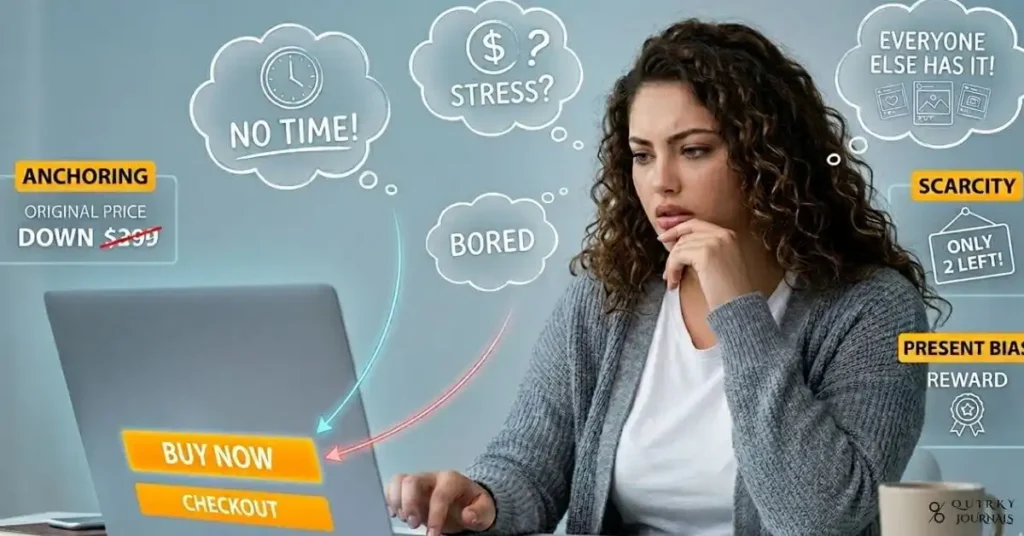
Emotional Spending Audits: Using Behavioural Finance to Stop Impulse Buys
Most people know, on some level, that they spend money impulsively. They buy things they did not plan to buy, regret them shortly after, and then repeat the same cycle. The problem is rarely a lack of awareness. It is a gap between knowing what you should do and actually doing it when a tempting product appears in front of you.
That gap is exactly what behavioural finance was built to close. Unlike traditional financial theory, which assumes people make rational economic decisions, behavioural finance accepts a more honest premise: human beings are predictably irrational. Our spending decisions are shaped by emotions, cognitive shortcuts, social pressures, and environmental triggers that operate largely beneath conscious awareness.
An emotional spending audit takes that insight and turns it into a practical tool. Rather than simply telling yourself to “spend less,” an audit helps you identify the specific emotional states, situations, and mental patterns that drive your unplanned purchases. Armed with that information, you can use behavioural finance strategies to interrupt those patterns before they reach your wallet.
This guide walks through the science behind impulse buying, the most relevant behavioural finance concepts for personal spending, and a structured process for auditing and reshaping your own emotional spending habits.
What Behavioural Finance Actually Means for Everyday Spending
Behavioural finance is a field that blends psychology and economics to explain why people make the financial decisions they do. It challenges the classical economic assumption that individuals always act rationally in pursuit of their best financial interests. Instead, it documents the systematic ways in which human psychology leads to predictable and often costly financial mistakes.
According to Investopedia’s overview of behavioural economics, even when people set clear intentions, such as eating healthily or saving money, their actual behaviour is subject to cognitive bias, emotions, and social influences. The gap between intention and action is not a character flaw. It is a structural feature of how the human brain processes decisions under real-world conditions.
For everyday spending, this matters enormously. Retailers, e-commerce platforms, and advertisers invest billions of dollars studying and exploiting the psychological vulnerabilities that behavioural finance identifies. They design checkout flows, pricing structures, and promotional messages specifically to trigger the cognitive biases that lead to unplanned purchases. Understanding those tactics from the other side gives you a meaningful advantage.
The practical applications of behavioural finance for personal spending fall into two broad categories. The first involves understanding the psychological mechanisms that drive impulse buying. The second involves applying specific tools, such as nudges, commitment devices, and reframing techniques, to counteract those mechanisms. Both categories are covered in depth throughout this guide.
The Psychology of Impulse Buying: Why Your Brain Works Against You
Before you can audit your emotional spending, you need a clear picture of what is happening in your brain when an impulse buy occurs. The process is faster and more automatic than most people realise, and it involves several overlapping psychological mechanisms.
The most fundamental mechanism is present bias. Your brain naturally assigns more value to rewards that are available immediately than to rewards that are available in the future. A product you can have right now feels disproportionately attractive compared to the future financial security that saving the same money would provide. Present bias is not a weakness specific to certain people. It is a universal feature of human cognition that evolutionary psychologists trace back to environments where immediate rewards genuinely mattered more than future ones.
Emotional state is another powerful driver. Research consistently shows that moods like stress, boredom, sadness, and anxiety increase the likelihood of impulse purchases. As noted in a peer-reviewed study on nudge-based interventions for online impulse buying, impulse buying is sudden, emotionally driven, and unplanned. The emotional component is not incidental. It is central to the mechanism. Shopping provides a brief neurological reward that temporarily relieves negative emotions, which is precisely why the pattern tends to repeat.
Social influence adds another layer. Seeing others make purchases, receiving social validation for consumption, and feeling pressure to conform to perceived group norms all accelerate impulse buying. Online shopping platforms that show how many people are viewing an item, or how many units remain in stock, exploit social influence deliberately to increase urgency.
Common Cognitive Biases That Fuel Unplanned Purchases
Behavioural finance has catalogued dozens of cognitive biases that affect financial decision-making. Several are particularly relevant to impulse buying and worth understanding in detail before conducting your personal spending audit.
The anchoring bias causes you to rely too heavily on the first piece of information you encounter. When a product is shown with a “was $120, now $60” price tag, the $120 anchors your perception of value, making the $60 feel like a bargain regardless of whether the item is worth $60 to you. This is one of the most widely used retail pricing tactics precisely because anchoring works so reliably on human cognition.
The scarcity effect makes items feel more desirable simply because they appear limited. “Only 3 left in stock” or “sale ends tonight” messages activate a fear of missing out that bypasses deliberate reasoning. Because scarcity historically signalled genuine value in human evolutionary history, the brain still responds to artificial scarcity with genuine urgency.
Retail therapy bias, sometimes called the “mood repair” function of shopping, leads people to use purchases as emotional self-medication. When you are stressed or overwhelmed, the brain seeks dopamine, and shopping delivers a small but reliable spike. The problem is that the relief is temporary while the financial cost is permanent.
The savings illusion, described well by EconomistZone in their overview of behavioural economics applications, causes people to justify unnecessary purchases as “savings.” Buying something you did not need at a discount is not saving money. It is spending money more cheaply. But the brain often codes it as a win rather than a cost, which is exactly the framing retailers encourage.
What an Emotional Spending Audit Is and Why It Works
An emotional spending audit is a structured self-examination process that maps your spending behaviour against your emotional states, environmental triggers, and cognitive patterns. It is not a budget review, though it can complement budgeting. The focus is not on the numbers themselves but on the conditions that produce unplanned spending.
The audit works because it interrupts the automaticity of impulse buying. Most impulsive purchases happen so quickly that the buyer has no conscious awareness of the emotional state or mental shortcut driving the decision. By retrospectively examining purchases and the circumstances surrounding them, you start to see patterns that were previously invisible. Over time, pattern recognition makes it possible to catch impulse triggers before they reach a purchase decision.
Behavioural finance research supports this approach. According to Investopedia, behavioural economics seeks to explain why people make irrational financial decisions and, by extension, how awareness of those patterns can be used to counteract them. Awareness alone is not sufficient, but it is the necessary starting point for any durable behavioural change.
The audit process also aligns with what psychologists call “metacognition,” which means thinking about your own thinking. Research on habit change consistently shows that people who develop the ability to observe their own mental processes are significantly better at modifying automatic behaviours than those who try to change behaviour through willpower alone. Willpower is a finite resource. Structural insight is not.
Step One: Track Every Purchase for 30 Days Without Judgment
The first step in an emotional spending audit is straightforward but requires consistency: track every purchase you make for 30 days, along with a brief note about your emotional state at the time of the purchase. Do not skip small purchases. The pattern often lives in the small ones.
For each purchase, record three things: what you bought, how much it cost, and one word or phrase that describes how you were feeling immediately before you bought it. Common emotional states to look for include stressed, bored, excited, anxious, tired, lonely, celebratory, or rewarding myself. Over 30 days, these brief notes accumulate into a dataset that reveals your personal emotional spending triggers with surprising clarity.
Several apps make this process easier. Tools like YNAB (You Need a Budget), Mint, and Copilot allow you to tag and categorise transactions, add notes, and review spending patterns over time. Alternatively, a simple spreadsheet or even a notes app on your phone works perfectly well for this purpose. The tool matters far less than the consistency of the practice.
It is important to approach this step without self-criticism. The purpose is data collection, not self-punishment. Judgment during the tracking phase tends to produce defensiveness, which causes people to stop tracking or to rationalise purchases in ways that obscure the honest pattern. Suspend evaluation entirely for the first 30 days and simply observe.
Step Two: Categorise Your Triggers Into Patterns
After 30 days of tracking, the next step is to review your data and look for recurring patterns. Most people find that their impulse purchases cluster around a small number of specific emotional states, times of day, situations, or environments. Identifying those clusters is the core analytical work of the audit.
Start by grouping your tracked purchases by the emotional state you noted at the time. How many purchases occurred when you were stressed? How many times were you bored? How many during a specific time of day, such as late at night or during a lunch break? How many happened after checking social media or browsing a specific website?
According to Global Credit Union’s research on impulse buying prevention, many online impulse purchases are made late at night by people on their phones in bed. That specific pattern, late-night mobile shopping, is one of the most common trigger clusters that audit reviews reveal. Knowing that this is your pattern is immediately actionable in a way that a general instruction to “spend less” is not.
Look also for product category clusters. Are your impulse purchases concentrated in clothing, food delivery, technology accessories, home goods, or digital subscriptions? Product category patterns often reflect specific emotional needs: clothing impulse buying often correlates with identity or mood-related emotions, while food delivery impulse buying often tracks with tiredness or stress. Understanding the category pattern helps you trace it back to the underlying emotional driver more precisely.
Step Three: Rate Each Purchase With a Satisfaction Score
One of the most illuminating exercises in an emotional spending audit is assigning a satisfaction score to each purchase you tracked, rated from one to ten. This score reflects how you felt about the purchase roughly 48 hours after making it, once the initial dopamine response had faded.
This retrospective rating exercise, sometimes called a “purchase regret audit,” generates powerful data. Most people find that their planned purchases score consistently higher in retrospective satisfaction than their impulse purchases. The items they agonised over, researched, and decided on deliberately tend to deliver lasting satisfaction. The items grabbed impulsively during a moment of emotional vulnerability tend to score poorly once the emotional trigger has passed.
Capturing this pattern in your own data, rather than as an abstract concept, creates what behavioural scientists call “affective forecasting correction.” You are essentially teaching your future self, through evidence, that the anticipated satisfaction from an impulse buy is consistently inflated relative to actual satisfaction. Over time, this correction weakens the emotional pull of impulse buying because your brain starts to anticipate the regret rather than only the reward.
Resources like Psychology Today’s decision-making research hub document the science behind affective forecasting in detail and provide useful frameworks for understanding why anticipated emotional responses to purchases so consistently exceed actual ones.
The Role of Environmental Design in Impulse Control
Once you understand your personal trigger patterns, the next step is to redesign your environment to reduce exposure to those triggers. Environmental design is one of the most powerful and underused tools in behavioural finance because it works without requiring willpower. If the trigger is not present, the impulse cannot fire.
This principle is sometimes called “choice architecture,” a term developed by behavioural economists Richard Thaler and Cass Sunstein in their influential work on nudge theory. The core idea is that the way choices are structured and presented powerfully shapes which option people select. By restructuring your personal choice environment, you can make the desired behaviour, in this case not buying impulsively, the path of least resistance rather than the one that requires active effort.
Practical environmental design changes for impulse buying might include: removing saved credit card information from e-commerce websites, deleting shopping apps from your phone’s home screen, unsubscribing from promotional email lists, and setting your browser to not auto-fill payment details. As Global Credit Union notes, even the small amount of extra effort required to log in and enter payment details manually is often enough to interrupt an impulse purchase. That friction matters.
Similarly, removing yourself from environments that trigger your spending can be highly effective. If you know that browsing a particular website or mall tends to produce unplanned purchases, reducing your exposure to that environment removes the trigger entirely rather than requiring you to resist it repeatedly.
Nudges: The Behavioural Finance Tool That Does the Work for You
A nudge, in behavioural finance terms, is a small change to the choice environment that predictably shifts behaviour in a desired direction without restricting options or requiring significant effort. Nudges work by aligning the path of least resistance with the desired outcome.
As EconomistZone highlights, nudge-based approaches for spending include setting up automatic savings transfers and using apps that prompt you to pause before buying. These are not restrictions. They are structural adjustments that make the better financial choice easier to take than the impulsive one.
One of the most effective nudges for impulse buying is the “shopping cart pause.” This involves a self-imposed rule that any item added to an online shopping cart must remain there for 24 to 48 hours before it can be purchased. The rule removes the immediacy of the impulse while preserving full freedom to complete the purchase. In practice, a large proportion of cart items are abandoned during the waiting period as the emotional urgency naturally dissipates.
Another powerful nudge is reframing purchases in terms of time rather than money. Known as the “hours worked” reframe, this involves calculating how many hours of work a purchase represents before deciding to buy. A $120 impulse buy does not feel as abstract or easy to justify when you recognise it as six hours of your working time. This reframe is particularly effective for discretionary purchases that feel small in dollar terms but accumulate significantly over time.
Commitment Devices: Using Your Future Self as an Accountability Partner
A commitment device is a behavioural finance tool in which you make a binding agreement with yourself about your future behaviour, often by creating a cost or obstacle that makes the undesired behaviour more difficult to execute. Commitment devices are remarkably effective precisely because they acknowledge a truth that pure willpower strategies ignore: your future self in a moment of temptation may not share the values and priorities of your present self in a calm, reflective moment.
The classic example from behavioural economics is Ulysses binding himself to the mast to resist the Sirens. He knew that his future self would be unable to resist the temptation, so he constrained his options in advance while he still had the clarity to do so. The same logic applies to spending.
Practical commitment devices for impulse buying include: giving a trusted friend or partner oversight of discretionary spending above a certain threshold, using a prepaid debit card with a fixed monthly allowance for discretionary purchases, freezing credit cards in blocks of ice at home (literally, not figuratively), and using apps like Self Control or browser extensions like StayFocusd to block access to retail websites during high-risk hours identified in your audit.
Financial commitment tools like stickK and Beeminder allow you to put real money on the line as a commitment device. You pledge a sum to a cause you care about, or even to an “anti-charity” you oppose, that is forfeited if you fail to meet your spending goal. The loss aversion built into human psychology, the fact that losses feel roughly twice as painful as equivalent gains feel good, makes this kind of commitment device particularly potent.
Loss Aversion: The Bias You Can Use in Your Favour
Loss aversion is one of the most robustly documented findings in behavioural finance. Research by psychologists Daniel Kahneman and Amos Tversky established that people feel the pain of a loss approximately twice as intensely as they feel the pleasure of an equivalent gain. This asymmetry drives many irrational financial decisions, including impulse buying triggered by “fear of missing out” on a deal.
However, loss aversion can also be harnessed in your favour once you understand the mechanism. Instead of using loss aversion against yourself by focusing on what you might miss by not buying something, reframe the purchase decision to activate loss aversion on the side of your financial goals.
One effective technique is to calculate the opportunity cost of each impulse purchase in terms of a specific financial goal. If you are saving toward a vacation, a home deposit, or an emergency fund, express each impulse purchase as a percentage of that goal. Spending $80 on an unplanned clothing item does not feel like losing $80. But spending $80 that represents 2% of your emergency fund goal, or four days’ worth of progress toward your holiday, activates a different emotional response entirely. The loss framing shifts the psychological weight from “missing a deal” to “losing progress on something that genuinely matters.”
Research from the Behavioural Economics Group supports this reframing approach, demonstrating that connecting financial decisions to personally meaningful goals significantly strengthens the motivation to resist impulse spending relative to abstract rules like “stay within budget.”
The “24-Hour Rule” and Why It Works Neurologically
The 24-hour rule is one of the simplest and most effective behavioural finance tools for impulse buying. The rule is straightforward: before making any unplanned purchase above a set threshold, you must wait at least 24 hours. During that waiting period, you are not allowed to research the item, add it to a cart, or discuss it with others in ways that build excitement about it.
The rule works because of how the brain processes emotional urgency over time. The limbic system, which drives emotional responses including the desire to acquire, responds intensely to immediate stimuli. However, that response is not sustained. When the physical or digital item is no longer in front of you and time has passed, the emotional intensity naturally diminishes. The prefrontal cortex, which handles deliberate reasoning and long-term planning, then has an opportunity to engage with the decision more rationally.
Neurologically, waiting 24 hours allows cortisol and dopamine levels triggered by the shopping stimulus to return to baseline. What felt urgent and exciting in the store or on the screen often feels much less compelling the following day in the clear light of your regular mental state. As Global Credit Union recommends, even vowing to leave items in the cart until morning helps people cool their purchasing impulse significantly.
Set your 24-hour rule threshold at a level that makes sense for your income and spending patterns. For some people, it might apply to any purchase over $30. For others, $100 or $200 might be the right threshold. The key is choosing a number that captures your typical impulse purchase range without being so restrictive that you abandon the rule quickly.
Emotional Triggers: Mapping the Specific Feelings That Cost You Money
Going deeper into the audit process requires mapping your emotional triggers in detail. General awareness that “emotions drive spending” is not specific enough to produce lasting change. What you need is a precise map of which emotions, in which contexts, produce which categories of unplanned spending for you specifically.
As the Life Skills Advocate notes, boredom, stress, and social pressure raise the likelihood of an impulse buy. Additionally, online shopping removes the natural pauses that brick-and-mortar shopping creates, and saved cards or one-click checkout can turn a fleeting want into an immediate purchase. Each of these factors is a specific lever that, when identified in your own audit data, becomes a targeted intervention point.
To map your triggers precisely, review your 30-day tracking data and answer the following questions: Which emotional state appears most frequently before my impulse purchases? What typically causes that emotional state for me? What time of day does it tend to occur? What platform or environment am I typically in when the purchase happens? Is there a connection between the emotional trigger and the product category I tend to buy?
Once you have answered these questions for your own data, you have a personalised trigger map. This map is the foundation for designing targeted interventions that address your actual patterns rather than generic spending advice that may not fit your life at all.
Stress Spending: Understanding the Most Common Emotional Trigger
Stress is the single most commonly identified emotional trigger for impulse buying across multiple behavioural finance studies. When you are under stress, the brain seeks relief, and shopping provides a rapid, accessible form of reward that temporarily reduces cortisol levels. The problem is that the relief is brief and the financial consequence is lasting, which often adds a second layer of stress on top of the original one.
If your audit reveals that stress is your primary trigger, the most effective intervention is not to focus on the spending behaviour directly. Instead, focus on addressing the stress through alternative channels that do not carry financial cost. Physical exercise, mindfulness practices, social connection, and creative activities all provide neurological relief from stress without depleting your bank account.
This approach aligns with what behavioural scientists call “competing response” training, in which an undesired behaviour is displaced by an incompatible desired behaviour rather than simply suppressed. Suppression alone, telling yourself “do not buy that,” tends to fail because it does not address the underlying emotional need the behaviour is serving. Competing responses address the need without the problematic behaviour.
Practical competing responses for stress spending might include keeping a list of free or low-cost stress-relief activities in your phone, right next to your banking app, so that the alternative is immediately accessible when the urge to shop arises. Some people find it helpful to create a dedicated “stress response kit,” a set of activities, playlists, snacks, or contacts that reliably shift their mood without triggering spending.
Boredom Spending: The Scrolling-to-Shopping Pipeline
Boredom is the second most commonly identified emotional trigger for impulse buying, and it has become significantly more prevalent in the smartphone era. The pipeline from boredom to spending is now remarkably short: you feel bored, you pick up your phone, you open a shopping app or social media feed full of product advertisements, and within minutes, you are adding items to a cart.
The design of modern e-commerce platforms explicitly targets this pipeline. Infinite scroll, personalised product recommendations, push notifications about sales, and one-click purchasing are all features engineered to capture bored attention and convert it into spending. Understanding that this pipeline is deliberately designed to exploit boredom is the first step toward disrupting it.
If boredom is a significant trigger in your audit, the most effective interventions involve restructuring the boredom-to-phone-to-shopping pipeline at its earliest stages. As Global Credit Union recommends, deleting shopping apps from your phone means that visiting a store’s website requires deliberate effort. That small additional step creates a friction point that disrupts the automatic pipeline. Replacing shopping apps with alternatives that address boredom, such as reading apps, games, podcasts, or social messaging, provides a competing response that satisfies the same need.
It can also help to proactively schedule engaging activities during the times your audit identifies as high-risk for boredom spending. If late evenings are your vulnerability, having a book, a series to watch, or a creative project to return to removes the situational boredom that feeds the pipeline.
Social Spending: When Other People’s Choices Drive Your Purchases
Social influence is a powerful and often underestimated driver of impulse buying. Seeing friends make purchases, encountering aspirational consumption on social media, and feeling social pressure to match the spending patterns of your peer group all contribute to unplanned purchases that have more to do with social signalling than genuine desire for the item.
Behavioural finance research on social influence in spending identifies several specific mechanisms. Social proof, the tendency to use others’ choices as a guide for your own, is exploited by platforms that display product popularity metrics. Social comparison, the tendency to evaluate your situation relative to others, is activated by curated social media feeds that prominently feature others’ acquisitions, experiences, and lifestyles.
If your audit reveals a strong social influence component to your impulse buying, consider conducting a targeted social media audit alongside your spending audit. Identify which accounts, platforms, or content types most consistently trigger feelings of inadequacy, desire, or social pressure. Unfollowing or muting those sources directly reduces the stimulation that leads to socially driven spending.
It is also worth examining whether any of your social relationships involve implicit or explicit pressure to spend to participate. Social situations that regularly involve high-cost activities, whether dining at expensive restaurants, attending expensive events, or exchanging expensive gifts, may benefit from honest conversation with the relevant people about spending boundaries. Many people find that those conversations, though initially uncomfortable, are far less awkward than the financial stress of spending beyond their means to maintain a social image.
The “One In, One Out” Rule: A Structural Spending Constraint That Works
One of the most practically effective structural rules for reducing impulse buying is the “one in, one out” policy. The rule requires that before any new item is purchased in a given category, one existing item from the same category must be donated, sold, or discarded.
The rule works through several behavioural mechanisms simultaneously. First, it introduces a delay because the act of identifying and removing the outgoing item takes time, which creates natural friction that interrupts impulse momentum. Second, it forces a concrete comparison between the new item and an existing item, which often reveals that the existing item is sufficient and the new purchase is redundant. Third, it creates a physical limit on accumulation, which prevents the gradual lifestyle inflation that makes impulse buying so financially damaging over time.
As Global Credit Union notes, requiring yourself to give something away before buying something new delays the purchase and makes you consider how much you really want the item. That deliberation is the key. Most impulse buying happens precisely because there is no deliberation at all.
The one-in-one-out rule is also psychologically gentle in a way that strict budgets often are not. It does not tell you that you cannot buy something. It simply requires a small act of reciprocity before you do. That framing tends to produce less psychological resistance than hard spending limits, which some people experience as restrictive and ultimately rebel against.
Budgeting for Impulses: The “Fun Money” Framework
One of the most common mistakes in addressing impulse buying is trying to eliminate it. This approach tends to fail because it ignores the legitimate role that small indulgences play in emotional regulation and quality of life. A budget that has no room for any unplanned spending is a budget most people will abandon within weeks, often with a spending binge that undoes months of progress.
A more sustainable and behaviorally sound approach is to explicitly budget for impulse spending. Some financial planners call this a “fun money” allocation. The idea is to set aside a fixed monthly amount, appropriate to your income and financial goals, that can be spent on anything without guilt or justification. Once that allocation is spent, the month’s discretionary impulse fund is exhausted.
This framework works because it removes the psychological tension between spending and self-denial. By making room in the budget for some impulsive spending, you eliminate the forbidden fruit effect that causes people to fixate on what they cannot have. The result is often less overall impulse spending because the urgency and emotional charge around discretionary purchases diminish when they are pre-approved rather than guilt-laden.
According to Global Credit Union, it is okay to leave room in your budget for impulse purchases, but unplanned impulse purchases, even when they feel small at the time, can add up and derail your long-term financial goals. Adding a line item for fun money and sticking to the limit gives you freedom within a structure that keeps your broader financial goals protected.
Reframing Costs: The Time-Value Mental Model
One of the most effective cognitive reframes in behavioural finance for impulse spending is translating prices into time. Rather than seeing a price tag as a number, you see it as a quantity of your life that you are exchanging for the item. This reframe shifts the comparison from an abstract dollar amount to something far more viscerally meaningful: your finite time and energy.
The calculation is simple. Divide the price of the item by your effective hourly take-home rate, after tax and commute. A $90 sweater that you could buy equally well for $40 at a different store represents two additional hours of your working time. Framed that way, the premium suddenly carries a very different emotional weight than it does as a price tag.
As EconomistZone highlights, reframing costs in terms of hours worked to make frivolous spending less appealing is a well-supported behavioural finance technique precisely because it makes the true cost of spending tangible in human terms rather than abstract financial ones. The brain responds to time in a much more emotionally immediate way than it responds to money, which is why this reframe reliably shifts purchase decisions when applied consistently.
You can also reframe purchases in terms of savings goals. If every $50 of impulse spending delays your emergency fund completion by three weeks, or your vacation fund by a specific number of days, express that cost explicitly every time you make a purchase decision. Connecting spending to goal timelines activates the loss aversion mechanism discussed earlier and makes the true cost of impulse buying concrete rather than vague.
Digital Tools That Apply Behavioural Finance Principles Automatically
Several digital tools have been designed specifically to apply behavioural finance principles to personal spending, making the desired behaviours easier to maintain by building them into your financial infrastructure.
Automatic savings tools like Acorns, which rounds up purchases to the nearest dollar and invests the difference, and Qapital, which allows you to set rule-based savings triggers, make saving happen without requiring active decision-making at the moment of spending. This approach directly exploits the default bias in behavioural economics: people tend to stick with whatever option requires no action, so making saving the automatic default rather than an active choice dramatically increases savings rates.
Spending tracking and insight tools like YNAB and Empower (formerly Personal Capital) provide visual representations of spending patterns that make previously invisible habits suddenly visible. The act of seeing your spending categorised and charted creates what behavioural economists call a “spotlight effect” on financial behaviour, where increased visibility consistently reduces undesired spending.
Browser extensions like Honey and Capital One Shopping insert a pause into the checkout process by automatically searching for coupon codes. While the primary function is to save money on purchases you are making anyway, the secondary behavioural effect is that the pause introduced by the coupon search creates a natural moment of reflection that can interrupt impulse momentum.
Building a Personal Spending Policy: Rules That Reflect Your Values
Beyond individual tools and tactics, the most durable defence against impulse buying is a personal spending policy, a clear set of self-defined rules that reflect your actual values and financial goals rather than generic advice about frugality.
A personal spending policy is different from a budget. A budget tells you how much you can spend in each category. A spending policy tells you the conditions under which you will spend and the criteria a purchase must meet to be approved. The policy is proactive and values-based rather than reactive and numbers-based.
For example, your policy might include rules like: “I only buy clothing items that I have wanted for at least two weeks,” or “I do not make any purchases above $50 when I am feeling stressed,” or “I review my financial goals before making any discretionary purchase above $100.” These rules are personal, flexible, and tied to specific triggers identified in your audit rather than to abstract financial principles.
As EconomistZone notes, applying behavioural tools like commitment devices and default options to daily routines can make a significant difference. The key insight is that these tools work best when they are customised to your specific patterns rather than applied generically. Your spending policy is the document that captures that customisation.
Running the Audit Quarterly: Treating Your Spending Like a Business Expense Review
An emotional spending audit is not a one-time exercise. Spending patterns change as your life circumstances, income, stress levels, and emotional landscape evolve. Committing to a quarterly audit review ensures that your behavioural finance tools remain aligned with your current patterns rather than the patterns you had when you first ran the audit.
Each quarterly review should cover: changes in your trigger patterns, the effectiveness of the tools and rules you implemented after the previous audit, any new environmental factors that have introduced new spending triggers, and an update to your personal spending policy based on what you have learned.
Treating the spending audit as a recurring business process rather than a one-time event also changes the psychological relationship you have with it. Business expense reviews are not about shame or failure. They are about data, efficiency, and continuous improvement. Bringing that mindset to personal finance makes the process feel constructive rather than punitive, which is essential for sustaining the habit long-term.
Consider scheduling your quarterly audit at the same time as another existing financial review, such as checking your investment account performance or reviewing your insurance policies. Anchoring the audit to an existing habit makes it easier to maintain and signals to yourself that it is part of a coherent, intentional approach to your financial life rather than an isolated corrective exercise.
What Progress Actually Looks Like: Realistic Expectations for Change
One of the most important things to understand when beginning an emotional spending audit is what realistic progress looks like. Behavioural change in financial habits is rarely linear, and the behavioural finance literature is consistent on this point: expecting immediate and complete elimination of impulse buying is a setup for discouragement and abandonment of the process.
Realistic progress looks like a gradual shift in the ratio of planned to unplanned purchases, a reduction in the average cost of impulse buys, and an increase in the frequency with which you catch yourself at the trigger stage rather than the checkout stage. These are meaningful changes even if they do not feel dramatic. Over a year, they add up to substantial financial improvement and a genuinely different relationship with spending.
It also looks like occasional backsliding, particularly during periods of elevated stress, major life change, or disrupted routine. Rather than treating a relapse into impulse spending as evidence that the audit process failed, use it as a data point: what happened to my stress or emotional state in the period preceding this relapse? What trigger fired that I had not anticipated? What adjustment to my environment or policy would make this less likely in the future?
The goal is not perfection. According to Global Credit Union, giving yourself the freedom to make a few frivolous purchases along the way is not financial failure. Managing your debt and keeping yourself on track financially will help you feel even better in the long run. The audit process is a tool for building a sustainable, self-aware relationship with money, not a mechanism for enforcing perfect financial austerity.
Practical Summary: Your Emotional Spending Audit Checklist
To bring together everything covered in this guide, the following checklist provides a step-by-step framework for conducting your own emotional spending audit and implementing behavioural finance tools to reduce impulse buying.
- Track every purchase for 30 days, noting emotional state, time, platform, and product category for each transaction.
- Review your 30-day data and identify your top two or three emotional trigger states (stress, boredom, social pressure, tiredness, etc.).
- Assign a retrospective satisfaction score to each purchase to identify the ratio of regretted impulse buys to satisfying planned purchases.
- Map your environmental triggers: which times of day, platforms, or situations most frequently precede your impulse purchases?
- Implement at least two environmental design changes: remove saved payment details, delete high-risk shopping apps, or unsubscribe from promotional emails.
- Choose one nudge to apply immediately: the 24-hour rule, the hours-worked reframe, or the shopping cart pause.
- Set up one commitment device appropriate to your trigger patterns: a prepaid spending card, a spending accountability partner, or a behavioural economics app.
- Build a “fun money” line item into your monthly budget so that some impulse spending is pre-approved and guilt-free.
- Write a personal spending policy of three to five rules that reflect your specific trigger patterns and financial values.
- Schedule a quarterly audit review to update your trigger map, assess the effectiveness of your tools, and refine your spending policy.
Conclusion: Spending With Awareness Is Spending With Power
Impulse buying is not a personal failure or a character defect. It is a predictable response to a combination of psychological mechanisms and environmental designs that are deliberately engineered to produce it. Recognising that truth is the first step toward changing the outcome.
Behavioural finance gives you the conceptual tools to understand why your spending decisions diverge from your intentions. An emotional spending audit gives you the personal data to make those concepts specific and actionable. Together, they shift you from someone who knows they should spend more intentionally to someone who has a concrete map of their own patterns and a personalised toolkit for addressing them.
The process takes time and requires honest self-observation. However, the returns compound in ways that extend well beyond the financial. Developing a clearer understanding of the relationship between your emotional states and your spending decisions is, at its core, a form of self-knowledge that benefits every dimension of your life, not just your bank balance.
For further reading on behavioural finance and personal spending, explore resources from the Behavioural Economics Group, ideas42, and Richard Thaler’s research hub. Consumer financial tools like YNAB, Qapital, and Beeminder each embody specific behavioural finance principles that complement the audit process described in this guide.
Spend some time for your future.
To deepen your understanding of today’s evolving financial landscape, we recommend exploring the following articles:
War Economy Chapter 20: Why Savings Are Destroyed First
Cash Value vs Cheap Coverage: Reassessing Whole Life Insurance
From Startup Growth to Scaling: A Practical Guide for Businesses
How Algos “See” the Market: Signal Hunting Explained
Explore these articles to get a grasp on the new changes in the financial world.
Disclaimer
The content in this article is for general informational and educational purposes only. It does not constitute financial, psychological, or professional advice. Individual financial circumstances vary widely. Always consult a qualified financial advisor or mental health professional before making significant changes to your financial behaviour or strategies. The author and publisher accept no liability for actions taken based on the content of this article.
References
- EconomistZone. “7 Ways to Apply Behavioural Economics to Improve Decision-Making.” https://economistzone.com/qa/7-ways-to-apply-behavioral-economics-to-improve-decision-making/
- Mandolfo, M. “Rein it in: Nudge-Based Interventions to Cope with Online Impulse Buying Among Young Adults.” Journal of Behavioural Economics for Policy, Vol. 6, Special Issue 1, 2022. https://sabeconomics.org/wordpress/wp-content/uploads/JBEP-6-S1-5.pdf
- Global Credit Union. “8 Ways to Prevent Impulse Buying.” https://www.globalcu.org/learn/smart-spending/prevent-impulse-buying/
- Life Skills Advocate. “How to Stop Impulsive Spending With ADHD: 17 Practical Strategies.” https://lifeskillsadvocate.com/blog/impulsive-spending-with-adhd/
- Investopedia. “Understanding Behavioural Economics: Theories, Goals, and Real Examples.” https://www.investopedia.com/terms/b/behavioraleconomics.asp
- Kahneman, D., and Tversky, A. “Prospect Theory: An Analysis of Decision under Risk.” Econometrica, 47(2), 1979. https://www.jstor.org/stable/1914185
- Thaler, R. H., and Sunstein, C. R. Nudge: Improving Decisions About Health, Wealth, and Happiness. Yale University Press, 2008. https://yalebooks.yale.edu/book/9780300122237/nudge/