
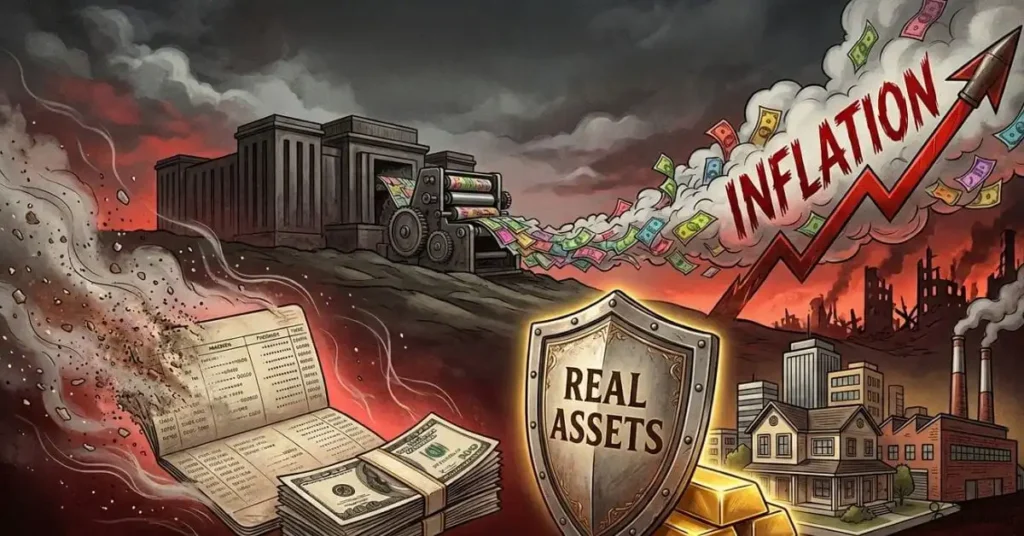
War Economy Chapter 20: Why Savings Get Destroyed Faster Than Assets
Most people assume that war is primarily a physical crisis. Buildings fall. Infrastructure burns. Bridges collapse. Yet one of the most devastating and least discussed consequences of armed conflict is what happens to ordinary people’s money. Savings accounts, cash reserves, government bonds, and pension funds can be wiped out far more swiftly and completely than physical property. Understanding why this happens is not just a matter of historical curiosity. It is a practical financial lesson that every investor and saver needs to understand before a crisis arrives.
Throughout history, from the hyperinflation that gutted German savings after World War I to the currency collapses that followed conflicts in Zimbabwe, Yugoslavia, and Venezuela, the pattern repeats itself with remarkable consistency. Governments at war face enormous spending demands. They cannot always raise taxes fast enough or borrow cheaply enough to meet those demands. So they print. They expand the money supply. They debase the currency. And when they do, cash savings are the first casualty.
Physical assets, by contrast, tend to hold value in ways that paper wealth cannot. Land remains land. Gold remains gold. A well-run business generating essential goods continues generating revenue even as the currency around it loses purchasing power. This divergence between savings and assets is not accidental. It is structural, and understanding its mechanics is one of the most important financial lessons that history can offer.
This post explores why savings erode so rapidly during wartime, how governments finance military spending in ways that destroy purchasing power, and what the historical record tells us about protecting wealth when geopolitical stability breaks down. It draws on economic history, academic research, and current financial analysis to build a comprehensive picture of the war economy and its consequences for ordinary savers.
How Governments Finance War: The Three-Channel Model
When a country goes to war, it faces an immediate and often overwhelming surge in spending requirements. Weapons, logistics, personnel, and support infrastructure all demand funding that rarely exists within the normal budget. Governments historically respond through three primary channels: taxation, borrowing, and money creation. Each has different consequences for savers, and understanding the mix matters enormously for predicting what happens to purchasing power.
Taxation is the most straightforward mechanism. Governments raise income taxes, introduce new levies on goods and services, and sometimes implement one-off wealth taxes on savings or assets. During World War II, for example, the United States expanded its income tax base dramatically, bringing millions of Americans into the tax system for the first time through payroll deductions. While painful, taxation at least extracts wealth transparently and proportionally. Savers lose money but through a visible mechanism they can plan around.
Borrowing is the second channel. Governments issue war bonds, treasury bills, and sovereign debt to finance spending. This approach has the short-term advantage of spreading cost over time, but it introduces a structural problem: debt that eventually requires repayment or restructuring. According to Economics Help’s analysis of wartime economics, countries emerging from major conflicts often carry debt burdens that constrain economic policy for decades. When that debt becomes unmanageable, governments frequently choose inflation as the exit strategy, repaying lenders in devalued currency and thereby transferring wealth from creditors to debtors.
The third and most destructive channel for savers is monetary expansion. When governments direct their central banks to purchase sovereign debt or simply create new money to cover spending gaps, the money supply expands without a corresponding increase in goods and services. The result is inflation. More money chases the same number of things, and each unit of currency buys less. For savers holding cash or cash-equivalent instruments, this is a slow-motion confiscation of purchasing power that requires no legislation, no consent, and no transparency.
The Inflation Mechanism: Why Cash Is the Most Vulnerable Asset
To understand why savings are destroyed faster than assets during wartime, it helps to understand precisely how inflation operates as a wealth transfer mechanism. When inflation rises, the real value of any fixed nominal claim falls. A savings account holding 10,000 dollars that yields 2% annual interest loses purchasing power if inflation runs at 8%. The nominal balance appears stable. The real purchasing power, however, shrinks by roughly 6% every year.
For savers in normal economic conditions, this might be a modest and manageable drag. During wartime, however, inflation can accelerate dramatically and unpredictably. The German hyperinflation of 1921 to 1923 is the most extreme example in modern history. The Weimar Republic financed World War I partly through monetary expansion, and the consequences played out catastrophically in the years that followed. At its peak in November 1923, prices in Germany were doubling every few days. A loaf of bread that cost 160 marks in 1922 cost 200 billion marks a year later. Savings accumulated over lifetimes were rendered worthless within months.
This was not an isolated anomaly. Following World War II, the International Monetary Fund has documented that a significant number of European countries experienced inflation rates well above 20% in the years immediately following the conflict. In Hungary, the most extreme post-war hyperinflation in recorded history occurred between 1945 and 1946, with prices doubling every fifteen hours at its peak. People who held cash or government bonds were devastated. Those who held land, gold, or productive businesses retained far more of their pre-war wealth.
The mechanism is straightforward and consistent. Governments create money to pay for war. Prices rise as that money enters circulation. Fixed nominal savings lose real value proportionally. Physical assets, by contrast, reprice upward to reflect the new nominal environment. The asset holder is not made wealthier in real terms. However, they are protected against the inflation tax that decimates the saver’s purchasing power.
Government Bonds: The Illusion of Safety During Conflict
One of the most common instincts during geopolitical uncertainty is to move money into government bonds. The logic seems sound: sovereign debt backed by a stable government should be safe, especially in wartime when the government has every incentive to maintain creditor confidence. This reasoning, while intuitive, has historically proven to be dangerously incomplete.
The core problem with government bonds during wartime is that they represent a fixed nominal claim on a government whose finances are deteriorating rapidly. If that government chooses, or is forced, to inflate its way out of its debt burden, the bondholder bears the full cost. A 30-year government bond purchased in 1914 paying 3% annual interest delivered a deeply negative real return to its holder if the government issuing it ran high inflation throughout the 1920s and 1930s. The nominal coupon payments continued. The purchasing power those payments represented, however, declined steadily with each passing year.
According to National Bureau of Economic Research analysis of sovereign debt during wartime, governments under military and fiscal stress have a long history of defaulting on or restructuring their debt obligations. Whether through outright default, forced conversion of short-term bonds into long-term instruments, or inflation-driven real-value erosion, bondholders have frequently absorbed significant losses when governments face the impossible arithmetic of wartime finance.
Furthermore, wartime capital controls can trap bond investors in deteriorating positions. During periods of national emergency, governments sometimes restrict the movement of capital across borders, prevent the sale of certain financial instruments, or freeze financial accounts. In these situations, the ability to exit a position in deteriorating government bonds is removed precisely when it matters most. Bank for International Settlements research on capital controls shows that such measures have been implemented in every major conflict of the twentieth century, typically within weeks of hostilities beginning.
Currency Debasement Throughout History: A Recurring Pattern
The destruction of savings through currency debasement is not a modern phenomenon. It predates central banking, paper money, and electronic finance by centuries. Roman emperors systematically reduced the silver content of the denarius coin to fund military campaigns. Medieval European monarchs clipped coins and reissued debased currency to finance wars. The pattern has repeated across cultures, centuries, and political systems because the underlying logic is always the same: war costs more than normal revenue can cover, and the easiest way to bridge the gap is to make each unit of currency worth less.
The American Civil War provides an instructive example from the nineteenth century. The Union government introduced the greenback, an inconvertible paper currency, to finance the war effort. Between 1862 and 1864, the greenback lost approximately 60% of its gold value at peak. People holding gold or productive farmland retained their wealth. Those holding greenbacks or fixed-income instruments denominated in greenbacks saw their purchasing power cut dramatically.
World War I accelerated the breakdown of the gold standard across Europe, removing the last formal constraint on money creation. Britain suspended gold convertibility in 1914. France and Germany followed. Once governments were freed from the discipline of maintaining gold reserves to back their currencies, the door was open to monetary financing of wartime expenditure on an unprecedented scale. The inflationary consequences played out through the 1920s in ways that reshaped European societies and contributed to the political instability that preceded the next global conflict.
More recently, the IMF has documented that countries engaged in extended military conflicts in the twenty-first century, including conflicts in the Middle East, North Africa, and Eastern Europe, have consistently seen elevated inflation rates compared to non-conflict neighbours. The mechanism may be more sophisticated in the modern era, operating through quantitative easing and central bank asset purchases rather than the printing press. However, the effect on savers is identical: purchasing power is silently redistributed away from those holding cash and toward governments with the ability to create it.
Physical Assets vs. Paper Wealth: Why the Divergence Occurs
The central insight of wartime financial history is that physical assets and paper wealth behave very differently when governments come under fiscal and monetary stress. Understanding why this divergence occurs is essential for anyone seeking to protect their financial position during periods of geopolitical instability.
Physical assets have intrinsic utility. Land produces food, provides shelter, and generates income regardless of what a government does with its currency. A factory making essential goods continues to have economic value even if the nominal currency in which it operates is inflating rapidly. Gold has served as a store of value across thousands of years and dozens of collapsed currencies because its supply cannot be expanded by government decree. These assets reprice upward in nominal terms when inflation accelerates, not because they have become more valuable in real terms, but because the unit of measurement (the currency) has become worth less.
Paper wealth, by contrast, is a promise. A bank deposit is a promise by the bank to return your money. A government bond is a promise by the government to repay principal and interest. Cash is a promise by the central bank that this token has value. During wartime, when the institutions behind those promises are under maximum stress, the reliability of those promises deteriorates. Governments inflate. Banks face runs and sometimes failures. The value of the promise depends entirely on the health and honesty of the institution making it, and wartime strains both heavily.
According to Ray Dalio’s research on debt crises and geopolitical cycles, periods of major conflict consistently show the same asset class hierarchy in terms of wealth preservation. Hard assets like gold, commodities, productive land, and real estate tend to preserve purchasing power best. Equity in businesses producing essential goods comes next, followed by foreign currency holdings in neutral countries. Government bonds and domestic cash consistently sit at the bottom of the preservation hierarchy during inflationary wartime episodes.
This pattern is not coincidental. It reflects the fundamental structural difference between an asset whose value derives from physical reality and one whose value derives from institutional trust. When institutional trust is under the maximum strain that war creates, paper claims on those institutions suffer accordingly.
The Role of Sanctions and Frozen Assets in Modern War Economies
Modern warfare has introduced a new dimension to the destruction of paper wealth: financial sanctions and the freezing of assets held in foreign jurisdictions. This mechanism affects not just the citizens of countries at war but also investors, businesses, and individuals with financial connections to sanctioned nations.
When Russia invaded Ukraine in February 2022, the international response included the freezing of approximately 300 billion dollars in Russian central bank reserves held in Western financial institutions. Brookings Institution analysis of this action described it as one of the largest single deployments of financial sanctions in history, demonstrating that even sovereign-level paper wealth, the foreign exchange reserves of a major economy, could be rendered inaccessible almost overnight.
For ordinary citizens in sanctioned or conflict-affected countries, the consequences are often more immediate. Exchange rate collapses following sanctions or conflict can destroy the purchasing power of domestic savings within days. Reuters documented that the Russian rouble lost approximately 40% of its value against the US dollar in the weeks following the invasion of Ukraine and the announcement of Western sanctions. Russians holding roubles in domestic savings accounts lost a significant fraction of their international purchasing power almost immediately, while those holding physical assets, foreign currencies, or gold were substantially better protected.
This modern dynamic reinforces the historical lesson. Paper wealth is only as secure as the institutional and geopolitical framework that supports it. When that framework is disrupted by conflict, the most vulnerable financial positions are those that depend most heavily on institutional reliability: bank deposits, domestic bonds, and cash in the local currency.
Wartime Taxation: The Visible Confiscation
While inflation is the most insidious destroyer of savings during wartime, direct taxation also plays an important role in the wealth redistribution that armed conflict generates. Governments at war typically increase tax burdens significantly, and the structure of those increases often hits liquid savings and income more heavily than physical assets.
Income taxes rise dramatically during wartime because they are the most immediately productive revenue source. Inheritance taxes and windfall profit levies frequently appear as governments seek additional revenue from accumulated wealth. Capital gains taxes may be temporarily suspended or altered in ways that benefit the government’s revenue position rather than investors. Each of these measures extracts value from financial positions more readily than from physical assets, which are harder to value, harder to tax, and harder to force-sell.
The Tax Policy Center’s analysis of World War II taxation shows that in the United States, the top marginal income tax rate rose from 81% before the war to 94% by 1944. These rates, while extraordinary by modern standards, were politically achievable in a wartime context where shared sacrifice was both expected and demanded. The effect was to dramatically reduce the after-tax return on earning and saving relative to holding appreciating physical assets, creating a structural incentive that has appeared in every major conflict-driven tax regime.
Wealth taxes, while less common in peacetime, also appear during extended conflicts. France implemented forced loans and special levies during both World Wars. Britain introduced excess profits duties. The United States levied an excess profits tax that captured a significant portion of business earnings above a normal return. In each case, the liquid, easily measurable components of wealth, including cash, bonds, and financial savings, bore a disproportionate share of the burden compared to physical assets that were harder to value and more politically difficult to tax.
Supply Chain Disruption and the Real Economy Impact on Savings
Beyond the financial mechanisms of inflation and taxation, war also destroys the real economic foundation that savings are meant to represent. When supply chains break down, when trade routes are disrupted, and when production facilities are destroyed or repurposed for military use, the goods and services that money is supposed to purchase become scarce or unavailable. This scarcity effect compounds the inflation produced by monetary expansion, creating a particularly severe squeeze on the purchasing power of savings.
During World War II, rationing systems in the United Kingdom, the United States, and across occupied Europe meant that even people with intact savings could not freely spend them on goods that were either unavailable or restricted. British wartime rationing records document that by 1942, clothing, food, fuel, and a wide range of consumer goods were all subject to government allocation. The nominal value of savings was meaningless in the context of goods that could not be purchased regardless of how much money one held.
Furthermore, businesses and services that savers depend upon can be destroyed, nationalised, or fundamentally disrupted by conflict. Banks may fail or impose withdrawal restrictions. Insurance companies may void policies for war-related events. Pension funds invested in government bonds or domestic equities may see their asset bases severely impaired. These institutional disruptions can freeze access to savings even when the nominal value appears intact, a situation that amounts to functional destruction of wealth even if the account statement still shows a positive balance.
Supply chain disruptions also create asymmetric opportunities that favour asset holders over savers. When essential goods become scarce, those who own productive capacity, farmland, manufacturing facilities, or commodity stockpiles benefit from rising prices. Investopedia’s analysis of wartime investment patterns consistently shows that commodity producers, defence contractors, and agricultural landowners outperform broader markets during extended conflicts, while cash-heavy positions and fixed-income holdings lag significantly.
Modern Conflict and Digital Financial Vulnerability
The twenty-first century has introduced new dimensions of financial vulnerability that previous generations did not face. Digital financial systems, while enormously convenient in peacetime, carry risks that become acute during conflict. Cyberattacks on banking infrastructure, disruptions to payment processing networks, and the potential for targeted attacks on financial data systems all represent modern threats to paper wealth that have no analogue for physical assets.
The conflict in Ukraine has provided real-world evidence of these risks. The Cybersecurity and Infrastructure Security Agency (CISA) documented numerous cyberattacks on Ukrainian financial infrastructure both before and during the Russian invasion. Several Ukrainian banks experienced temporary disruptions to online banking and payment systems, interrupting access to savings for ordinary citizens at the worst possible time.
More broadly, the increasing digitalisation of financial systems means that paper wealth is now entirely dependent on functioning digital infrastructure. A person holding a million dollars in a bank account that they cannot access because the network is down, the bank is under cyberattack, or the government has imposed emergency restrictions effectively has no wealth in that moment. By contrast, physical assets, gold coins stored in a home safe, land that produces food, or a business with physical inventory, retain their utility regardless of whether digital networks are functioning.
This modern vulnerability adds a new dimension to the ancient lesson. Paper wealth has always been dependent on institutional trust. In the digital age, it is also dependent on technological infrastructure, and wartime is precisely when that infrastructure faces its greatest stress. Recognising this dynamic is important for anyone building a financial strategy that needs to be robust across a range of geopolitical scenarios.
Historical Case Studies: Savings Destruction in Practice
Examining specific historical episodes helps to move the analysis from abstract principle to concrete financial reality. Several case studies from the twentieth century illustrate the mechanisms of savings destruction in particularly clear ways.
The most dramatic example remains Weimar Germany. Following World War I, Germany’s obligation to pay war reparations under the Treaty of Versailles, combined with the collapse of its industrial output and the monetary financing of government deficits, produced hyperinflation of a severity that had no modern precedent. Historians at History.com have documented that middle-class Germans who had done everything right by conventional financial wisdom, saving diligently, purchasing government war bonds, keeping money in banks, were completely wiped out. Meanwhile, those who owned farms, physical businesses, foreign currency, or commodities retained meaningful wealth throughout the episode.
Post-World War II Japan offers another instructive case. Bank of Japan historical records show that Japan experienced consumer price inflation of over 300% in the years immediately following the war’s end. The government introduced a capital levy, a one-time tax on wealth, in 1946 that targeted financial assets. Simultaneously, inflation eroded the real value of savings held in cash or bank deposits. Japanese savers holding financial wealth faced a double blow: the capital levy extracted a portion directly while inflation eroded the remainder. Physical assets, despite the physical destruction of the war itself, recovered their value far more quickly and completely.
The former Yugoslavia provides a more recent example. As the country disintegrated through civil war in the 1990s, hyperinflation in the Federal Republic of Yugoslavia reached extraordinary levels. Cato Institute research on Yugoslavia’s hyperinflation estimated peak monthly inflation of approximately 313 million percent in January 1994. Citizens who had held Yugoslav dinars in savings accounts were devastated. Those who had converted savings into Deutsche Marks, physical gold, or durable goods months earlier preserved their wealth through the crisis.
What History Tells Us About Protecting Wealth During Wartime
The consistent lesson across centuries of wartime finance is that wealth preservation requires holding assets whose value is not dependent on governmental or institutional promises. While this principle does not guarantee outcomes in any specific conflict, it provides a framework for thinking about financial resilience under extreme conditions.
Gold has historically been the most reliable store of value during wartime precisely because it is no one’s liability. Its value does not depend on any government’s fiscal discipline, any central bank’s monetary restraint, or any institution’s continued solvency. The World Gold Council’s research on gold as a strategic asset shows that during periods of geopolitical stress and elevated inflation, gold consistently outperforms both cash and government bonds in preserving purchasing power. This pattern has held across the major conflicts of the twentieth century and into the twenty-first.
Real estate and productive land offer similar protection through a different mechanism. Land cannot be inflated away. A farm producing food retains its utility regardless of the nominal currency in which its output is priced. An apartment building collecting rent generates income that adjusts, at least partially, with inflation over time. UBS Wealth Management’s analysis of inflation hedges consistently ranks real assets, including real estate and commodities, among the most effective preservers of purchasing power during inflationary periods.
Equities in companies producing essential goods, energy, and defence-related products also tend to preserve real value better than cash or bonds during wartime, though with considerably more volatility. SmartAsset’s research on wartime investing identifies consumer staples, energy producers, and defence contractors as sectors that have historically demonstrated resilience during military conflicts, reflecting their essential role in wartime economies.
Diversification across currencies and jurisdictions provides another layer of protection. During any specific conflict, the currency and financial system of neutral or uninvolved countries remain outside the direct blast radius of wartime fiscal and monetary policies. Swiss francs, for example, have repeatedly served as a refuge for wealth during European conflicts precisely because Switzerland’s political neutrality protected its monetary system from the distortions that war inflicts on belligerent nations.
The Psychological Dimension: Why People Get Caught Holding Cash
If the historical lesson is so clear, why do so many people end up holding cash and savings accounts precisely when those instruments are most vulnerable? The answer lies partly in psychology and partly in the speed with which wartime financial conditions deteriorate.
In normal times, cash and bank deposits are genuinely good instruments for short-term savings. They are liquid, low-cost, and risk-free in the narrow sense that the nominal balance does not decline. Years of peacetime financial experience create strong habits around these instruments, and those habits are hard to override when the circumstances change. By the time inflation has accelerated enough to make the problem undeniable, a significant portion of purchasing power may already have been lost.
Furthermore, moving out of cash and into physical assets requires taking actions that feel psychologically risky during uncertain times. Buying gold when everyone is frightened, purchasing real estate in a country that may be affected by conflict, or converting domestic currency into foreign exchange when restrictions may be imminent all feel like drastic steps. The same uncertainty that makes those steps necessary also makes them psychologically difficult to take. Behavioural economics research on loss aversion consistently shows that people weigh potential losses more heavily than equivalent gains, making proactive defensive financial moves much harder than the rational analysis would suggest they should be.
There is also the challenge of timing. Acting too early on geopolitical concerns means giving up yield, convenience, and the psychological comfort of conventional financial behaviour for risks that may not materialise. Acting too late means the window for protecting wealth has already partially closed. This dilemma has no clean solution, which is why diversification across asset types in normal times, rather than reactive repositioning in crisis, is consistently the more effective strategy.
Current Geopolitical Context: Lessons for Today’s Savers
The lessons of wartime financial history are not merely academic in the current geopolitical environment. As of 2026, elevated military spending, ongoing conflicts in Eastern Europe and the Middle East, rising great-power competition, and increased sanctions activity have all created conditions that bear meaningful similarities to earlier periods of geopolitical stress.
According to Stockholm International Peace Research Institute (SIPRI) data, global military expenditure reached record levels in 2023, with major economies significantly increasing their defence budgets. This spending must be financed somehow, and the three-channel model outlined earlier, taxation, borrowing, and monetary expansion, remains as relevant as ever. The distributional consequences of how that financing occurs will be felt most acutely by those whose wealth is concentrated in the most vulnerable instruments.
At the same time, as CNBC financial advisors noted in March 2026, the appropriate response for most savers is not panic or extreme repositioning. Diversification across asset classes, jurisdictions, and time horizons remains the foundation of sound financial planning. Keeping six to twelve months of expenses in readily accessible cash is prudent. Ensuring that longer-term savings are not overly concentrated in instruments that depend entirely on a single government’s fiscal discipline is equally sensible. These are not dramatic measures. They are the basic principles of financial resilience that the historical record consistently validates.
For those with more substantial assets to protect, the Financial Times has reported that institutional investors increasingly incorporate geopolitical risk into their portfolio construction, explicitly allocating to hard assets, inflation-linked securities, and geographically diversified holdings as buffers against the kind of fiscal and monetary deterioration that conflict can accelerate. Adopting similar principles at the individual level, scaled appropriately to personal circumstances, is a reasonable response to the elevated geopolitical risks of the current era.
Practical Principles for Financial Resilience in Uncertain Times
Drawing together the historical evidence and current financial analysis, several practical principles emerge for anyone seeking to protect their financial position against wartime or geopolitical risks. These are not speculative trading strategies. They are structural approaches to portfolio construction that reduce vulnerability to the specific mechanisms through which savings get destroyed during conflict.
The first principle is to hold some allocation to hard assets. Gold, silver, and other precious metals provide a store of value that is independent of any government’s fiscal decisions. Real estate in politically stable jurisdictions provides both inflation protection and utility. Commodity exposure through exchange-traded funds or direct holdings provides a hedge against supply chain disruption.
The second principle is currency diversification. Holding some portion of savings in currencies issued by governments with strong fiscal positions and low conflict risk reduces dependence on any single monetary system. Currency diversification strategies are well-documented in financial literature and accessible to retail investors through foreign currency accounts, international ETFs, and currency-hedged investment funds.
The third principle is duration awareness in fixed-income holdings. Long-term government bonds carry the greatest exposure to inflation risk because their fixed payments become less valuable over a longer period of rising prices. Shorter-duration instruments, including treasury bills, short-term bond funds, and money market accounts, provide more flexibility to reinvest at higher yields if inflation rises, reducing but not eliminating the vulnerability of cash-equivalent positions.
The fourth principle is geographic diversification. Concentrating all savings in the financial system of a single country creates exposure to that country’s specific political, fiscal, and monetary risks. Spreading holdings across multiple stable jurisdictions reduces the risk that any single geopolitical event can impair the majority of your financial position.
Finally, the fifth principle is liquidity management. Holding enough genuinely liquid assets to cover short-term needs, without holding so much cash that inflation erodes purchasing power over the medium term, requires ongoing attention. The right balance depends on individual circumstances, but the general principle of maintaining meaningful liquidity without over-concentration in depreciating cash instruments is one of the most consistently validated lessons in wartime financial history.
Comparing Asset Classes Under Wartime Conditions
The table below summarises how major asset classes have historically performed during periods of significant military conflict and the inflationary pressures they typically generate. These are broad generalisations drawn from historical patterns rather than guarantees of future performance, but the patterns are consistent enough across multiple episodes to be instructive.
| Asset Class | Inflation Protection | Liquidity During Crisis | Institutional Risk | Historical Wartime Performance |
|---|---|---|---|---|
| Cash / Savings Accounts | Very Low | High (unless frozen) | High | Poor to Devastating |
| Government Bonds | Low | Medium | High | Poor to Negative Real Returns |
| Physical Gold | High | Medium | Very Low | Strong Preservation |
| Real Estate | Medium to High | Low | Low | Generally Preserving |
| Equities (Essential Sectors) | Medium | Medium to High | Medium | Mixed, Sector Dependent |
| Foreign Currency (Neutral Nations) | Medium to High | High | Low to Medium | Strong if Accessible |
| Commodities | High | Medium | Low | Generally Strong |
The Moral Dimension: War as a Wealth Transfer Mechanism
Beyond the purely financial analysis, it is worth acknowledging the moral dimension of how war redistributes wealth. The destruction of savings through inflation and taxation during wartime is not random. It follows patterns that consistently redistribute wealth from those who hold it in the most accessible, taxable, and inflatable forms toward those who hold physical assets, operate essential businesses, or have the knowledge and resources to protect themselves through diversification.
This dynamic means that wartime financial policies often widen inequality in ways that persist long after the conflict ends. Oxfam’s research on inequality and conflict shows that post-conflict societies frequently exhibit sharply polarised wealth distributions, with small groups of asset holders having preserved or even increased their real wealth while large portions of the population have seen savings and income wiped out. Understanding this dynamic does not change the practical financial advice, but it provides important context for why the choices made before and during a conflict have consequences that extend far beyond the individual portfolio.
Furthermore, the fact that monetary expansion is the most politically painless of the three war-financing mechanisms, because its costs are diffuse, gradual, and non-transparent, means that governments systematically choose it over more visible alternatives. Savers who do not understand this mechanism are at a systematic disadvantage to those who do. Financial education about the relationship between wartime fiscal policy and purchasing power is, therefore, not just an academic matter. It is a practical tool for protecting ordinary people from a wealth transfer that they may not even recognise is happening.
Spend some time for your future.
To deepen your understanding of today’s evolving financial landscape, we recommend exploring the following articles:
Cash Value vs Cheap Coverage: Reassessing Whole Life Insurance
From Startup Growth to Scaling: A Practical Guide for Businesses
How Algos “See” the Market: Signal Hunting Explained
Why Physical Gold and Paper Gold Are Not the Same Investment
Explore these articles to get a grasp on the new changes in the financial world.
Disclaimer
This article is intended for general informational and educational purposes only. It does not constitute financial, investment, or legal advice. The historical examples and analysis provided are for illustrative purposes and do not guarantee future outcomes. All investment decisions should be made in consultation with a qualified financial professional who understands your individual circumstances. The author and publisher accept no liability for financial decisions made based on this content.
References
- Internal Revenue Service. (2023). Tax History Project. [Online]. Available: https://www.irs.gov/newsroom/tax-history-project
- Economics Help. (2023). Economics of War. [Online]. Available: https://www.economicshelp.org/blog/14527/economics/economics-of-war/
- Deutsche Bundesbank. (2023). Weimar Republic Hyperinflation. [Online]. Available: https://www.bundesbank.de/en/bundesbank/history/weimar-republic-hyperinflation
- International Monetary Fund. (2016). A History of Inflation Targeting. [Online]. Available: https://www.imf.org/en/Publications/WP/Issues/2016/12/31/A-History-of-Inflation-Targeting-42779
- National Bureau of Economic Research. (2007). Sovereign Debt During Wartime. [Online]. Available: https://www.nber.org/papers/w13471
- Bank for International Settlements. (2017). Capital Controls Research. [Online]. Available: https://www.bis.org/publ/work711.htm
- Federal Reserve History. (2023). Civil War Era Monetary Policy. [Online]. Available: https://www.federalreservehistory.org/essays/civil-war-era-monetary-policy
- Brookings Institution. (2023). Russia’s Frozen Assets. [Online]. Available: https://www.brookings.edu/articles/russias-frozen-assets-and-what-to-do-with-them/
- Reuters. (2022). Russian Rouble Exchange Rate History. [Online]. Available: https://www.reuters.com/markets/currencies/russia-rouble-exchange-rate-history-2022-02-28/
- Tax Policy Center. (2023). How Did World War II Affect Federal Tax Policy. [Online]. Available: https://www.taxpolicycenter.org/briefing-book/how-did-world-war-ii-affect-federal-tax-policy
- Investopedia. (2023). War and Its Impact on Investments. [Online]. Available: https://www.investopedia.com/articles/investing/103015/war-and-its-impact-on-investments.asp
- CISA. (2022). Destructive Malware Targeting Ukrainian Organizations. [Online]. Available: https://www.cisa.gov/news-events/cybersecurity-advisories/aa22-011a
- World Gold Council. (2023). Relevance of Gold as a Strategic Asset. [Online]. Available: https://www.gold.org/goldhub/research/relevance-of-gold-as-a-strategic-asset
- Cato Institute. (2012). Yugoslavia’s Hyperinflation. [Online]. Available: https://www.cato.org/sites/cato.org/files/pubs/pdf/working-paper-8.pdf
- SIPRI. (2024). World Military Expenditure Reaches New Record High. [Online]. Available: https://www.sipri.org/media/press-release/2024/world-military-expenditure-reaches-new-record-high
- SmartAsset. (2023). How to Protect Your Money During War. [Online]. Available: https://smartasset.com/investing/what-to-invest-in-during-war
- CNBC. (2026). Where Investors Can Look for Stability as Iran War Rattles Markets. [Online]. Available: https://www.cnbc.com/2026/03/05/iran-war-investors-stability.html
- Oxfam. (2023). Inequality and Conflict Research. [Online]. Available: https://www.oxfam.org/en/research/inequality-and-conflict