
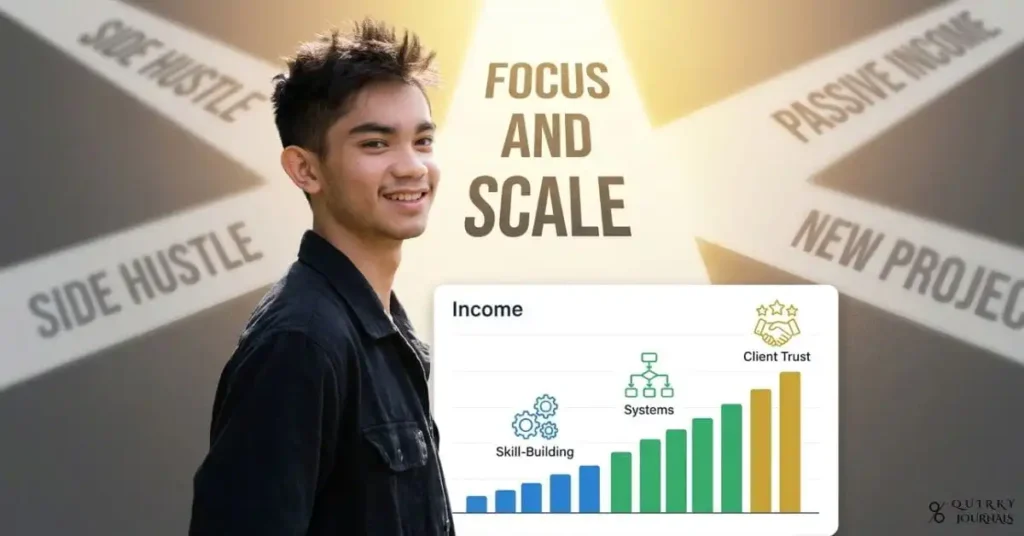
Stop Diversifying, Start Mastering: The 4-Step Framework for Sustainable Income Growth.
Diversification is one of the most repeated pieces of financial advice in existence. Multiple income streams. Side hustles. Passive income from five different directions at once. Social media makes it look effortless.
In reality, diversifying too early is one of the fastest ways to stay stuck. When you spread your focus across too many income sources before any single one is working properly, you end up with several half-built things instead of one thing that actually generates money. You are busy but not productive. You are active but not growing.
The framework in this guide flips that conventional wisdom on its head. Instead of diversifying first and hoping something sticks, you focus and master one income stream, stabilise it, optimise it, and only then expand. The sequence matters enormously. Get it right and income grows in a compounding, sustainable way. Get it wrong, and you spin in circles for years.
This is not a guide about getting rich fast. It is a guide about building income that lasts. Each of the four steps, Focus and Scale, Stabilise, Optimise, and Diversify, builds directly on the one before it. Skip a step, and the whole structure weakens. Follow them in order, and the results compound.
Why Diversifying Too Early Keeps You Broke
The appeal of multiple income streams is real. No single source of income means no single point of failure. If one dries up, you have others. That logic is sound in theory. However, it only holds when each stream is already established and generating consistent returns.
Most people who chase multiple income streams at once never reach that point with any of them. Each new project dilutes the time, energy, and focus available for every other project. Results stay mediocre across the board. Motivation fades. The whole portfolio collapses under its own complexity.
According to Lunch Money’s 4-step wealth framework, you cannot build lasting wealth without first getting clear on where you stand and building consistent habits around a single focused plan. That principle applies just as directly to income building as it does to debt payoff. Clarity before complexity. Always.
Furthermore, spreading effort too thin creates a dangerous illusion of progress. You are always doing something. Your calendar is full. Yet income does not grow. The solution is not to add more projects. It is to go deeper into the one that already shows promise.
The Cost of Context Switching
Every time you shift focus from one income project to another, there is a switching cost. Your brain requires time to reload the context of the new project: where you left off, what the next step is, and what problems are still unresolved. Research consistently shows that this switching overhead destroys productivity.
For income-generating projects, the cost is even higher. Relationships with clients or customers require consistent attention. Skills require regular practice to deepen. Operational knowledge accumulates slowly and degrades quickly when neglected. Jumping between projects means none of them benefits from the compound effect of sustained focus.
Mastery, by contrast, requires repetition. Each iteration of a task you have done many times before is faster and better than the last. Systems solidify. Mistakes stop repeating. Income per unit of effort rises steadily. That trajectory is only possible when focus is sustained.
Table 1: Spreading Effort vs. Focused Mastery: Expected Outcomes
| Dimension | Diversify Early Approach | Focus and Master Approach |
| Skill depth | Shallow across many areas | Deep in one high-value area |
| Income trajectory | Flat or declining | Compounding over time |
| Daily productivity | Fragmented, context-switching | Focused and efficient |
| Client or market trust | Weak across multiple areas | Strong in a specific niche |
| Burnout risk | High (too many fronts) | Lower (clear priorities) |
| Time to first real result | Slow (effort diluted) | Faster (effort concentrated) |
Step 1: Focus and Scale – Build Skills, Discipline, and Maximum Efficiency in One Area
The first step is the hardest. It requires choosing one income stream and committing to it fully, often when other opportunities seem equally or more attractive. That tension is precisely the point. The ability to say no to distractions while saying a deep yes to a single direction is the defining skill of every high-earning individual who has built income sustainably.
Focus and Scale means selecting the income-generating activity that aligns with your existing skills, available time, and market demand. Then it means going as deep and as fast as possible within that single lane. Not dabbling. Not testing. Committing.
According to Vistra’s analysis of sustainable growth drivers, effective financial processes are pivotal to a firm’s development. The same principle applies to an individual income stream. Robust mechanisms that regulate how you work, how you price your services, and how you deliver value are the foundation of growth. None of those mechanisms develops under scattered attention.
Choosing the Right Area to Focus On
Choosing where to focus is not a permanent life decision. It is a strategic bet you make for the next twelve to twenty-four months. The criteria are practical rather than romantic. Which income source already has some traction? Which one do you have genuine skill or knowledge in? Which one has demonstrated market demand?
Traction matters more than passion. An income source with modest momentum beats one you are excited about, but that has generated nothing yet. Momentum is evidence. Passion without results is just a plan.
Additionally, consider the income ceiling of your chosen area. Some income streams have low ceilings: they can generate a modest income but scale poorly. Others have high ceilings but require more upfront investment of time or capital. Choosing a high-ceiling area, even if initial results are slower, typically pays off significantly over a two to three-year horizon.
Building Skills Deliberately
Focused skill building is not the same as staying busy in your chosen area. Deliberate practice means identifying your weakest points and targeting them specifically. It means seeking feedback from people already earning at the level you want to reach. It means studying the best work in your field systematically rather than consuming content at random.
According to the BCG framework for sustainable business model innovation, the goal in the early stage is to bypass current constraints, break tradeoffs, and deploy advances in your specific area. For an individual income builder, that means finding the leverage points in your skill set that produce disproportionate returns when improved.
Discipline during this phase looks simple from the outside, but is demanding in practice. Every day you show up and work on the same thing compounds your advantage. Every day you switch to something else resets part of that compound effect. Consistency over weeks becomes proficiency. Proficiency over months becomes mastery. Mastery is what commands premium income.
Table 2: Focus and Scale Phase Checklist
| Action Item | Why It Matters |
| Identify one income stream with existing traction | Momentum is evidence of viability |
| Assess the income ceiling of your chosen area | Determines long-term return on investment |
| Map your current skill gaps vs. top earners | Focuses development on the highest-leverage gaps |
| Set a daily or weekly non-negotiable work block | Consistency builds compound skill advantage |
| Say no to new income opportunities for 90 days | Protects focus during the critical build phase |
| Seek feedback from people earning at your target level | Accelerates improvement and avoids wasted effort |
Step 2: Stabilise – Create Consistency in Operations or Income Generation
Focused effort in Step 1 starts to produce results. Clients arrive. Sales happen. Revenue begins flowing. This is an exciting phase, but it is also a dangerous one. Many people mistake early traction for a stable system. They add complexity too soon, take on more work than their operations can handle, or start chasing new opportunities again.
Step 2 is about turning irregular results into predictable ones. Stabilisation means creating the systems, routines, and processes that make income generation consistent rather than random. Without this step, even a genuinely strong income source will remain fragile.
According to Lunch Money’s financial framework, establishing consistent habits that support your goals is a critical bridge between awareness and real wealth building. Those habits include regular check-ins, systematic tracking, and repeatable processes. The same logic applies directly to income generation. A process you repeat reliably beats a brilliant idea you execute once.
What Stability Actually Looks Like
Stability in an income stream has several markers. You know where your next client or customer is coming from. You have a repeatable process for delivering your product or service. Revenue does not spike and crash with your motivation level. Your income over any given month is broadly predictable based on your activity level in the prior month.
Reaching that state requires systematising everything that currently lives only in your head. Onboarding new clients. Delivering your service. Following up on proposals. Collecting payments. Handling common questions. Each of these should have a documented process or template that produces consistent results without requiring you to reinvent the wheel every time.
Furthermore, Vistra emphasises that robust budgetary mechanisms help regulate costs and underpin efficiency. For an individual income builder, the equivalent is tracking income and expenses meticulously. Knowing your cost per client acquired, your average revenue per engagement, and your time per deliverable gives you the data you need to make smart decisions about what to keep, cut, or double down on.
Building Your Reliability Reputation
Stabilisation is also where your reputation begins to compound. When clients or customers experience consistent quality and reliable delivery from you, they return. They refer others. They become case studies that attract new business. A reputation built on reliability is one of the most durable competitive advantages available to any income earner.
Conversely, inconsistency destroys reputation faster than almost anything else. Delivering brilliantly one month and disappearing the next creates uncertainty in clients’ minds. Uncertainty kills referrals. Reliability generates them. During the stabilisation phase, reliability is more important than innovation.
Additionally, stabilisation is when you should begin building a basic financial buffer. Lunch Money recommends starting with an emergency fund as a buffer against unexpected expenses. For self-employed income builders, this buffer should be larger: two to three months of operating expenses held in liquid savings. Irregular income without a buffer creates constant cash flow anxiety that undermines decision-making and performance.
Table 3: Signals That Your Income Stream Has Stabilised
| Stability Signal | What It Indicates |
| Revenue is predictable month over month | The system is producing consistent results |
| You have a documented delivery process | Operations do not depend solely on your memory |
| Clients refer others without being asked | Reliability reputation is compounding |
| You have 2-3 months of expenses in reserve | Financial buffer protects against downturns |
| You know your cost and time per unit of output | You have data for optimisation decisions |
| Demand slightly exceeds your current capacity | You are ready to optimise, not just fill gaps |
Step 3: Optimise – Increase Efficiency to Maximise Profitability
With a stable and consistent income stream in place, you now have something genuinely valuable to optimise. This is where the real leverage is unlocked. Optimisation means extracting more value from the same or less effort. It means making your income stream more profitable per hour invested, per client served, or per unit sold.
Optimisation can take many forms. Raising prices is often the fastest and most underutilised lever. If demand consistently exceeds your capacity, the market is telling you that you are priced too low. Raising prices does not just increase revenue: it often improves client quality and reduces the administrative burden of dealing with underpaying, high-maintenance clients.
According to BCG’s framework for sustainable business model innovation, the optimisation phase is where you seek to break trade-offs and deploy advances to integrate and reinforce both business advantage and value delivery. For an individual income builder, this translates directly to finding the combination of price, product, and process that maximises return without sacrificing the quality that built your reputation in Step 2.
Automation and Systems as Optimisation Tools
Technology is one of the most powerful optimisation tools available. Administrative tasks that consume hours of your week, including scheduling, invoicing, follow-up emails, and reporting, can often be partially or fully automated with relatively simple tools. Time recaptured from administration is time available for income-generating activity or for deeper skill development.
As the LinkedIn insight from Jeffery Boyle on niche market mastery captures, the top digital performers build systems that work while they sleep. The objective is not to work harder but to build a structure that scales effort efficiently. Automation is the tool. Systematisation is the mindset. Both are available to individual income builders, not just large companies.
Process documentation from Step 2 now becomes a template for delegation. If your processes are written down and tested, training someone else to handle parts of your workflow becomes feasible. Delegation, whether to a virtual assistant, a contractor, or software, is a form of optimisation. It frees your highest-value hours for the activities only you can do.
Pricing Strategy During Optimisation
Most self-employed income builders undercharge for extended periods. They set initial prices low to attract early clients and never revise them upward as their skills and reputation improve. Optimisation is the right moment to correct this.
Review your pricing against what the market pays for comparable quality at your current skill level. Talk to peers and clients. Research what your most successful competitors charge. If your prices are significantly below market rate, a meaningful increase is almost certainly justified. Even a 20% price increase on a stable client base represents a substantial lift in income with no additional hours worked.
Additionally, consider whether your income stream can be structured to generate recurring revenue. One-off transactions require constant new client acquisition to maintain income levels. Retainer arrangements, subscription models, or ongoing service contracts generate predictable monthly income from existing relationships. Recurring revenue dramatically reduces the marketing burden and stabilises cash flow simultaneously.
Table 4: Key Optimisation Levers for Income Stream Profitability
| Optimization Lever | Method | Expected Impact | Complexity |
| Price increase | Revise rates upward 10-30% | High (immediate revenue lift) | Low |
| Task automation | Software for admin, billing, and scheduling | Medium (time saved) | Low to medium |
| Process delegation | Hire a contractor or VA for lower-value tasks | High (frees the highest-value hours) | Medium |
| Recurring revenue model | Shift to retainers or subscriptions | High (predictable cash flow) | Medium |
| Client quality filtering | Raise the minimum engagement value | Medium (better margin, less admin) | Low |
| Productization | Package services into fixed offerings | High (reduces custom scope creep) | Medium |
Knowing When Optimisation Is Complete
Optimisation is never fully complete, but there is a point of diminishing returns. When incremental improvements to your current income stream require increasing amounts of effort for decreasing results, you have likely extracted most of the available leverage from optimisation in its current form.
The signal that you are ready for Step 4 is straightforward. Your primary income stream is generating reliable, optimised returns. Your operations run smoothly with minimal daily firefighting. You have both the financial capacity and the bandwidth to invest attention in something new without jeopardising what you have built.
That readiness is the critical prerequisite for diversification. It is not a timeline. It is a state. Reaching it in twelve months is possible. Reaching it in three years is also fine. The point is that diversification should follow optimisation, not precede it.
Step 4: Diversify – Expand Only Once the Initial Stream Is Established
This is where diversification finally earns its place. Notice that it is the fourth step, not the first. By the time you reach this stage, you have a working income stream that generates consistent, optimised revenue. You have financial reserves. You have proven systems. You have operational confidence.
Diversifying from that position is completely different from diversifying from scratch. You are not hoping that one of several experiments works. You are investing surplus capacity and capital, generated by your established stream, into carefully selected new opportunities. The risk profile is fundamentally different. The probability of success is significantly higher.
According to BCG, full potential value is achieved only when a new business model is brought to scale by engaging people and expanding impact. The same applies here. Diversification at Step 4 means bringing your existing skills, systems, and reputation to bear in a new direction. You are not starting over. You are extending what already works.
Which Diversification Paths Make Sense
Not all diversification is equally smart. The best new income streams share characteristics with your established ones. They leverage skills you have already developed. They serve a similar or adjacent market. They benefit from the reputation you have built. These adjacencies reduce the learning curve and allow you to move faster toward stability in the new stream than you did in your first one.
Avoid diversifying into areas that require entirely new skill sets, entirely new markets, and entirely new operational systems simultaneously. That is not diversification. It is starting over from scratch while trying to maintain your existing income. The cognitive and operational load is enormous and usually unsustainable.
As the NICHE framework highlighted in the Jeffery Boyle LinkedIn piece on niche mastery demonstrates, there are riches in niches when you commit fully to your strength. When diversifying, look for adjacent niches where your core strength transfers cleanly rather than entirely new territories that require rebuilding from zero.
Running the FSOD Cycle Again
Here is the elegant truth about this framework. When you add a new income stream in Step 4, you do not just add it and walk away. You apply the same four-step process to the new stream. Focus on it deliberately. Stabilise its operations. Optimise its profitability. Only then consider adding a third stream.
This recursive application of the framework is what prevents the chaos that kills most multi-income strategies. Each stream goes through its own maturation cycle. No stream is expected to perform at full capacity from day one. Instead, each receives the focused attention it needs at each stage before you move to the next.
Over time, the result is a portfolio of income streams, each stable and optimised, each built on the foundation of the one before it. That is genuinely sustainable income diversification. It is built for permanence rather than for the illusion of variety.
Table 5: Diversification Readiness Assessment
| Criteria | Ready to Diversify | Not Ready Yet |
| Primary income stream | Stable and optimised | Still irregular or fragile |
| Financial reserves | 3+ months of expenses saved | Living paycheck to paycheck |
| Available bandwidth | Genuine surplus time and energy | The primary stream still needs full attention |
| New stream alignment | Adjacent to existing skills and the market | Completely new domain from scratch |
| Motivation source | Strategic expansion from strength | Anxiety about current income only |
| Risk capacity | Can absorb a new stream underperforming | Cannot afford a new stream to fail |
The Complete FSOD Framework at a Glance
The four steps form a clear and sequential system. Each builds on the one before it. None can be skipped without weakening the foundation for everything that follows.
Step 1, Focus and Scale, is where you choose one income source and go deep. You build skills, establish discipline, and develop efficiency within a single lane. The goal is to generate your first consistent results and begin demonstrating market value.
Step 2, Stabilise, is where you systematise those early results. You create repeatable processes, build financial reserves, and develop the reliable reputation that drives referrals and retention. Income becomes predictable rather than random.
Step 3, Optimise, is where you extract maximum profitability from your stable system. You raise prices to market rate, automate or delegate lower-value tasks, and shift toward recurring revenue structures wherever possible. Income per hour worked rises steadily.
Step 4, Diversify, is where you expand intelligently from a position of strength. You apply your existing skills, systems, and reputation to adjacent opportunities. Each new stream goes through its own FSOD cycle before another is added.
Table 6: The FSOD Framework Summary
| Step | Name | Core Goal | Key Actions | Success Signal |
| 1 | Focus and Scale | Build skill and momentum | Choose one area, go deep daily | First consistent income from one source |
| 2 | Stabilize | Create predictability | Document processes, build reserves | Revenue predictable month over month |
| 3 | Optimize | Maximize profitability | Raise prices, automate, delegate | Higher income per hour worked |
| 4 | Diversify | Expand from strength | Add adjacent income streams | Multiple stable, optimised streams |
Common Objections to the FSOD Framework
Most people resist this framework at first. The objections are predictable, and each one reveals a mindset pattern worth examining.
‘What If My First Income Stream Fails?’
This is the most common fear. The answer is that a stream which fails quickly during Step 1 is actually providing valuable information at the lowest possible cost. You learn what does not work before investing years into it. The framework asks you to commit for a defined period, gather real data, and make an evidence-based decision. That is not the same as betting everything on one horse forever.
Furthermore, the financial clarity approach recommended by Lunch Money involves reviewing where you stand and building from reality, not from hope. If honest assessment reveals that your chosen stream has no real traction after focused effort, switching to a better-aligned option is a rational and recommended response. The framework is a discipline, not a trap.
‘I Need Multiple Streams Now for Security’
The paradox of this objection is that the security you are seeking through multiple streams is undermined by the dilution that prevents any single stream from becoming truly secure. One well-established stream generating reliable income is far more secure than three fragile streams generating unpredictable income.
Security comes from depth, not from breadth. A deep well provides reliable water. A dozen shallow holes provide none. The FSOD framework is specifically designed to build the deep well first before digging additional ones from a position of proven capability and financial resilience.
‘This Will Take Too Long’
Moving through all four steps does take time. For most people, reaching Step 4 readiness takes one to three years of focused effort. That timeline is longer than most social media promises suggest. However, it is dramatically shorter than the five to ten years many people spend bouncing between multiple income experiments that never fully succeed.
Moreover, the income trajectory of the FSOD approach is compounding. Early results are modest. Results in years two and three, once optimisation is working, tend to accelerate sharply. The conventional approach of spreading effort across multiple streams produces a flat or slowly rising income trajectory that feels like progress but rarely crosses meaningful thresholds.
How to Start Applying the FSOD Framework Today
Theory without action produces nothing. The following steps move you from reading about this framework to actively implementing it. Each step is concrete and executable within the current week.
First, conduct an honest audit of your current income activities. List every income source you are currently pursuing, including side projects, freelance work, investments, and part-time activities. For each one, estimate how many hours per week it consumes and what it generates in monthly income. This exercise alone is frequently revealing.
According to Lunch Money’s framework, reviewing the past three to six months of financial activity is eye-opening but essential. It shows where income actually comes from versus where you believe it comes from. These two things are often different.
Second, identify which of your current income activities has the highest hourly return and the clearest growth potential. That is your primary candidate for Step 1. If none of your current activities qualifies, that information is equally useful. It tells you to begin the search for a viable primary stream before worrying about anything else.
Third, commit to a 90-day focus window on your chosen stream. During those 90 days, you do not start new income projects. You do not chase new opportunities. You work on deepening your skill, improving your delivery, and building momentum in the single chosen area. Ninety days of genuine focused effort produce more meaningful data about a stream’s potential than three years of scattered attention.
Tracking Your Progress Through the Framework
Define concrete metrics for each step before you begin. In Step 1, track weekly hours of focused work and any early income signals. In Step 2, track monthly revenue consistency and the number of processes you have documented. In Step 3, track revenue per hour worked and how frequently you raise your prices or rates. In Step 4, track how long each new stream takes to reach stability compared to your first.
These metrics transform a qualitative sense of progress into an objective record. They also make it clear when you are genuinely ready to move to the next step, rather than moving out of impatience. The data decides. Not your anxiety about missing out.
Final Thoughts: Mastery Before Multiplication
The advice to diversify your income is not wrong. It is simply incomplete. The missing piece is the word ‘when.’ Diversify when you have something worth diversifying from. Build that something first.
The FSOD framework, Focus and Scale, Stabilise, Optimise, and Diversify, gives you a clear sequence for building sustainable income growth. Each step prepares the conditions for the next. Together, they create an income engine that compounds rather than stagnates.
Most people will resist Step 1 the longest. Choosing one thing and sticking to it when everything around you suggests you should be doing more feels counterintuitive. It is, however, the decision that separates people who build real income from those who stay perpetually busy without getting there.
Master one thing fully. Stabilise it completely. Optimise it thoroughly. Then, and only then, multiply it strategically. That sequence is not a limitation. It is the fastest route to the outcome most people claim to want: income that is sustainable, scalable, and genuinely freeing.
Spend some time for your future.
To deepen your understanding of today’s evolving financial landscape, we recommend exploring the following articles:
5 Stablecoin Risks the GENIUS Act Left Open
How 1‑Bit LLMs Bring Real AI to Your Phone
The Rise of the Machines: What Algorithmic Trading Really Does
The 11 Money Ratios That Reveal Your True Financial Health
Explore these articles to get a grasp on the new changes in the financial world.
Disclaimer
This article is for informational and educational purposes only. It does not constitute financial, investment, business, or professional advice. Individual results vary based on skill, effort, market conditions, and other factors. Always consult qualified professionals before making significant financial or business decisions.
References
[1] Lunch Money, ‘How to Use This Simple 4-Step Framework to Pay Off Debt and Build Wealth,’ [Online]. Available: https://lunchmoney.app/blog/how-to-use-this-simple-4-step-framework-to-pay-off-debt-and-build-wealth. [Accessed: Mar. 2025].
[2] Vistra, ‘The Four Key Drivers of Sustainable Growth,’ [Online]. Available: https://www.vistra.com/insights/four-key-drivers-sustainable-growth. [Accessed: Mar. 2025].
[3] BCG, ‘Four Steps to Sustainable Business Model Innovation,’ [Online]. Available: https://www.bcg.com/publications/2021/four-strategies-for-sustainable-business-model-innovation. [Accessed: Mar. 2025].
[4] J. Boyle, ‘NICHE Framework for Market Domination,’ LinkedIn, [Online]. Available: https://www.linkedin.com/posts/jefferyboyle_idaho-nichemarkets-datadriven-activity-7393698556802605057-hWmn. [Accessed: Mar. 2025].